Orchid Intimidation

Fear Not

I used to find orchids intimidating to grow. Their dust-sized seeds are fairly unique in not having any food reserves so — in the wild, at least — need the help of a fungus partner to get growing. And some orchids (epiphytes) spend their lives nestled in trees so need a special potting mix when grown in a pot. Orchids have above-ground structures called pseudobulbs. And many, especially those that call humid, tropical forests their homes, demand exacting environmental conditions that are very different from that found in most homes. Whew!

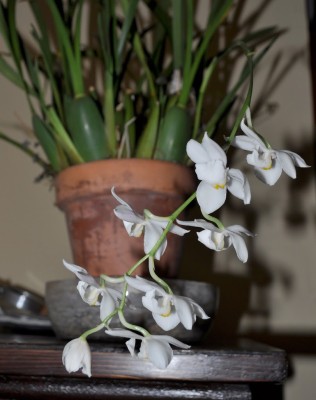
So I steered clear of growing any orchid for many years — until a local orchid enthusiast gave me a plant. After a couple of years, that plant, around this time of year, sent up a slender stalk which was soon punctuated with eight waxy, white flowers, each an inch across. For two months, those flowers greeted me each morning with their beauty and their delicious fragrance. Every year since, that plant has greeted me for weeks in midwinter.

Odontogl . . . a Mouthful

My orchid has no common name so needs to be referred to by its botanical mouthful, Odontoglossum pulchellum. (Even orchid names are intimidating, especially so because different genera have often been hybridized, and the resulting hybrid combines the generic names of the parents. So a hybrid with Brassavola, Laelia, and Cattleya in its parentage would have the name Brassolaeliocattleya. Now that’s a mouthful!)

Name notwithstanding, my Odontoglossum pulchellum has been easy to grow and get to flower. Odontoglossum pulchellum orchidThe plant spends summers outdoors in semi-shade near the north wall of my house, and winters indoors on a sunny windowsill. I water it perhaps twice a week, unless I forget.
Sounds like your run-of-the-mill houseplant, doesn’t it? So much for orchids being difficult.

The only special treatment my plant gets is a special potting mix. Odontoglossum pulchellum is an epiphytic orchard. Commercial potting mixes are available for epiphytic orchards but I make my own by mixing equal parts of my standard (home made) potting mix with equal parts wood chips. Nothing special about the chips; I just scoop them up from the pile that I use mostly for mulch that an arborist kindly dumps next to my woodshed every year.

Every spring I divide my orchid plant into 2 or 3 new plants, potting each new plant into its own pot with fresh potting mix.

More Orchids?

Odontoglossum pulchellum is an orchid that tolerates being treated like your average houseplant. And this is one of the most important points in growing orchids in a house: choose a sort that thrives in such an environment. Other orchids that will grow in the average home include phalaenopsis, paphiopedilums, and mini-catts, which are dwarf hybrids involving Cattleya (the corsage orchid).

Ideally, for flowering at least, certain conditions must be met. Most orchids enjoy bright light, which means setting the plant at an east, west, or south windowsill. From spring through autumn, light from a south window is too intense and may scorch foliage, so plants need to be protected with a thin gauze curtain, or moved to other windows or semi-shade outdoors.

Most orchids — again, for flowering — enjoy a ten to fifteen degree temperature difference from day to night, which is no problem in winter if you heat with a wood stove or already turn the thermostat down at night to conserve fuel. In the summer, the plant needs to be outdoors or else in a room that is not air-conditioned.

Even those orchids adapted to a home environment benefit from increased humidity. I raise the humidity around my plants by perching the flowerpot above a water-filled tray. Clustering plants together is another way to raise the humidity near plants, and also creates a visual lushness.

Once correctly sited, many orchids do not require inordinate amounts of care. Water requirements vary, but species with thickened pseudobulbs (bulbous stems), such as my Odontoglossum, get by with the least frequent watering. Orchid roots are susceptible to fertilizer burn, so the rule in feeding is to do it frequently and lightly. As with other houseplants, some orchid species take an annual rest, and at such times watering and feeding should commensurately diminish.

Since “mastering” the growing of one orchid, I have acquired another kind.Pink rock orchid This orchid is Dendrobium kingianum, which does go under the more user-friendly common name of pink rock orchid. I have also gotten this one to flower — but not every year.
The Best Winter Herbs

Mini-Trees for Flavor

Second best to fresh-picked vegetables in winter, which are not within most gardener’s grasp with temperatures in the single digits, are fresh-picked herbs. Fresh-picked herbs — indoors — in winter are within the grasp of most gardeners, even non-gardeners.

Flowering and fruiting demand lots of light energy, but it is the leaves of most herbs that provide us with flavoring, so most herbs do fine in any reasonably bright window. The same goes for normal household temperatures and humidity.

So make space near your windows for herb plants!

Let’s look below ground now. Any potting mix suitable for houseplants will also be to the liking of herb plants. The mix should hold some moisture between waterings while at the same time drain well so that roots, which need to breathe, don’t suffocate. My own mix, made  from equal parts compost, perlite, peat moss, and soil, provides air and moisture as well as nutrients and beneficial microorganisms that keep plants healthy. Soil dug from the garden and used straight up is never suitable; in the confines of a flowerpot, it holds too much moisture.

Now for the plants. Many people, perhaps most, choose basil as their number one herb to grow. Nix on that, indoors. Think of a Mediterranean summer with bright sunlight beaming down on warm soil. That’s what basil needs and what you can’t provide in winter except with supplemental light and, depending on your thermostat setting, supplemental heat. Not in my house.

I’d also suggest against parsley or chives. The problem is that neither grows fast enough to keep up with periodic clipping of the amounts normally harvested.

The best herbs for indoor growing are perennial, woody, subtropical plants. Before you bemoan my nixing of basil, chives, and parsley, consider these perennials: bay, rosemary, sage, and thyme. 

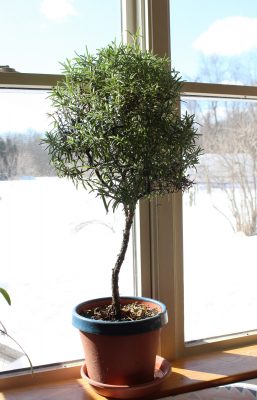
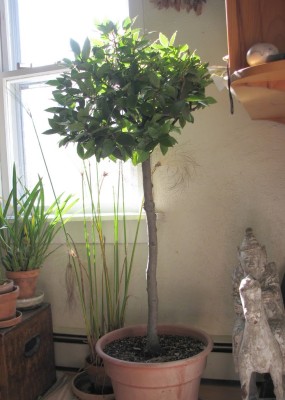
Small, indoor rosemary "tree"

Small, indoor rosemary “tree”

Bay, rosemary, sage, and thyme are also good choices for indoor growing because they do double duty: They’re pretty as well as flavorful, can stand repeated harvest, and live for years and years. My bay tree started life here as a small plant carried back in my backpack from California over 25 years ago. Fresh bay tastes quite different from the dried leaf, and much, much better. My rosemary plants are each a few years old and show no signs of decline.

Both bay and rosemary are happy to be trained as bushes, as topiaries, or as miniature trees. Mine are miniature trees, each plant with a short length of trunk capped by a mop head of leaves (and flowers, now, in the case of rosemary). Their training began early, when I selected a single vigorous shoot for each plant, staked it upright, and removed all other shoots. Once shoots achieved head-height (the height of THEIR proposed head, an artistic rather than horticultural decision), I pinched out their growing tips to induce side shoots to grow. I pinched the tips of side shoots to induce them, in turn, also to branch. All this pinching induced a dense mop head of stems and leaves atop each trunk. Small, lollipop trees.

Maintenance of the bay and rosemary is easy. Both are as large as I’d like them to be so every year or two, they get tipped out of their pots and and inch or two shaved off the outside of their root balls. After returning to their pots, potting soil gets packed into the space beyond the periphery of the root balls, giving new roots access to fresh soil and nutrients.

Their heads also get trimmed periodically to maintain their neat shape. The annual trimming provides a bumper harvest, but a few leaves or stems can be clipped for seasoning any time of year.

Bay laurel tree

Bay laurel

I’m not enough of a fan of sage or thyme to grow them through winter indoors. But sage could be grown as a small, decorative shrub, especially varieties such as Tricolor, with white-edged leaves, Purpurascens, with purplish leaves, or Aurea, with some gold in its leaves. Thyme, which comes in various colors and flavors (lemon or caraway, for example), is a subshrub, or ground cover. How about a thyme ground cover carpeting the ground at the feet of a potted miniature bay tree?

Ongoing care for any of these herbs is watering, which can spell the difference between success or failure. Neither rosemary, bay, sage, nor thyme readily show their thirst with wilting leaves. Years ago, as I brushed past the little rosemary tree I was growing at the time, all the leaves dropped off. The plant was dead.

The potting soil for any of these plants needs to be kept just moist. Scheduled watering won’t do because watering needs changes through the season with growing conditions. A $10 “moisture meter” is an easy way to tell whether a plant is thirsty, as is, with practice, lifting a pot to feel how heavy it is.

Carrying the Sky on Their Backs

I saw two bluebirds a few days ago, but am not ascribing any significance to the sighting. They’re just pretty.

An Early Spring

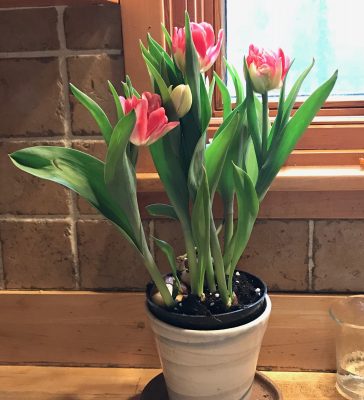
It could be spring. Now. Indoors, with the sweet fragrance from a flowerpot of pastel colored hyacinths and other spring-flowering bulbs. All it takes is a little bit of trickery. The bulbs don’t have to wait till spring.Forced tulip bulbs

Knowing what a bulb is helps understand the trickery. But first: All that we commonly call a “bulb” is not, in fact, a bulb botanically speaking. To conjure up an image of a true bulb, picture a stem that’s been telescoped down from a couple of feet or more long to a fraction of an inch. All the leaves on that bulb also move down and closer together. The leaves, except the innermost ones, are thick and juicy, the better to store both moisture and food reserves. Near the center of the bulb is a sleeping flower bud.

Hyacinths, daffodils, and tulips are true bulbs.

Though often called a bulb, crocus is an example of a “corm.” A corm is also a short stem, in this case a short fat stem which provides storage for food reserves for winter and to fuel early spring growth.

Forcing a bulb, real or not, to flower early, indoors is, in many ways, just like forcing a cut branch of dogwood or plum to flower early, indoors. Daffodil, hyacinth, tulip, crocus, dogwood, and plum stems all enter winter with flower buds sleeping within.

All these stems of cold-climate plants are savvy enough not to start growing in the dead of winter, even after a freak warm spell. They do this by marking time, counting hours and days when temperatures are between about 30 and 45 degrees Fahrenheit, that is, cool but not frigid. Once sufficient hours have accumulated, their chilling “bank” has been filled, warmth can awaken a stem, whether its a dogwood branch or a daffodil bulb.

The first step in forcing a bulb is to get it to grow roots by planting it in a pot of soil or stones, or to suspend the bulb above water with only its base in the drink. A bulb’s roots, like the roots of other plants, grow whenever soil temperatures are above 40°F., so they can be in place and ready to support leaves and flowers when spring comes. 

In time, typically 6 to 8 weeks, which varies with the type and variety of bulb, roots will grow and the the winter chilling requirement will be satisfied. Once the chilling “bank” has been filled, growth can begin. A well-grown, spring-flowering bulb comes packed with a flowerbud-in-waiting  . . . waiting, that is, for a chilling period to break its dormancy and then sufficient warmth to allow growth. The larger the bulb, the more flowers-in-waiting.

Keeping a potted bulb cool at this point is useful for staggering flowering for multiple pots of bulbs or delaying flowering for a specific date, such as someone’s birthday. 

When ready to enjoy the flowers, don’t just bring the pot into a hot room. They would blast open and collapse. The plants, at this point, need gradually increasing warmth, and enough light to draw out a sturdy flower stalk. Forcing bulbs to blossom out of season demands a certain amount of artistry in addition to science. 

If you want flowers and want them now, and haven’t prepared bulbs ahead of time, you still have some options. Purchasing pre-chilled bulbs is one option.

The other option is to bypass the whole chilling rigamarole and force Paperwhite narcissi. These bulbs hail from perennially warm climes and will bloom without any prior chilling. All that’s needed is to pot them up and wait as long as it takes for the fragrant, white blossoms to unfold. To stagger their blooms, pot them up sequentially; lack of water keeps them dormant.

When the flower on a forced bulb has wilted and the show is over, the usual next home for the bulb is the compost pile. If the plant has been planted in soil, and if the emerging leaves can be kept growing in very bright light for many weeks, sufficient energy can be garnered keep the bulb alive through the following dormant season. Then plant the bulb outdoors this autumn and it should flower again — in a few springs hence, once it garners enough energy to also make flower buds.

The Green Faerie

In a Smoke-Filled Café . . . 

What you are about to read might have been improved upon if I had been writing with la fée verde (the green fairy) looking over my shoulder. Or better yet, if I also was writing from a smoke-filled cafe in Paris.

The Green Faerie, Viktor Oliva

The Green Faerie, Viktor Oliva

Or even better, from a smoke filled cafe at the turn of the 19th century, hanging out with the likes of Ernest Hemingway, Oscar Wilde, James Joyce, and Lord Byron.

There’s a certain mystique with drinking absinthe, la fée verde, a distilled spirit concocted from various herbs which might include tansy, fennel, green anise, and bee balm. The most important ingredient is, of course, Artemisia absinthe, absinthe, the plant. Absinthe is one of many plants in the genus Artemisia, commonly referred to as mugwarts or wormwoods.

Full disclosure: I generally am not fond of this genus because it’s one of my worst weeds. My artemisiac nemesis is not absinthe, though, but common wormwood (Artimesia vulgaris). This ugly, perennial weed perennially keeps poking up through the leafy mulch beneath a clump of delphiniums in one corner fo the garden.

Whence the Green Faerie?

But back to absinthe, the drink. It’s been accused of being an addictive, psychoactive drug and hallucinogen, which led to its being banned in the early 1900s almost everywhere except the United Kingdom.

Artemisias all contain potent chemicals, and the chemical of potency of absinthe is thujone. Not that absinthe has cornered the market on thujone; it’s also found in some junipers, tansy, some mints, and arborvitae, whose generic name is Thuja.

As it turns out, the concentration of thujone in absinthe is too low to invite visits from the green fairy.

The Absinthe Drinker, Picasso

The Absinthe Drinker, Picasso

That invite comes from alcohol, 45-74%, that’s responsible — duh — for absinthe’s bringing on hallucinations and other psychological changes. And its addictiveness.

Still, thujone can be toxic, which is perhaps why absinthe sold in the U.S. must contain less than 10 ppm thujone. Which has led to some rumors that American absinthe isn’t “real” absinthe. Not true because, first of all, absinthe is not a well defined alcoholic drink. And secondly, less thujone does not mean less absinthe, the plant, in the bottle. Particular absinthe plants vary in their thujone concentration. And thirdly, thujone concentration in the absinthe poured out of the bottle will vary also with length and method of storage; it decomposes over time.

Most artemisias are very bitter, so enjoying absinthe, the drink, is an acquired taste. (I’ve never tasted absinthe, nor, with my aversion to bitter flavors, do I intend to.) And even then, absinthe is not a liquid anyone would drink straight up.

The Absinthe Drinker, Degas

The Absinthe Drinker, Degas

All of the various methods of imbibing it involve sweetening it with sugar and diluting it with some iced water. Well, perhaps not all methods in this era of craft cocktails.

Absinthe, the plant, is not hard to grow. It’s a perennial that’s native to Europe but has naturalized in the U.S. and Canada. (Uh oh.) It enjoys a dry, fertile soil, especially one rich in nitrogen. Artemisias generally have relatively inconspicuous flowers but sometimes attractive, hoary leaves; absinthe’s leaves are gray-green on their upper sides and white on their undersides. Dusty Miller is the showiest of the artemisias, with powdery, white leaves.

My experience with common wormwood makes the ease of propagating absinthe somewhat frightening. Cuttings root readily and the plant self-seeds generously.

One Artemesia I Do Like

Now that I think of it, there is one artemesia that I do especially like, despite its potential weedy nature. Sweet Annie (A. annua) is a self-seeding annual whose tiny seeds sprout every spring to grow into 2 to 5 foot tall sweetly fragrant plants. Sweet AnnieThe sweet, resiny aroma is retained in air-dried plants for years. I keep a clump hanging upside down near my front door so that the aroma can waft into the air when the door is opened or someone brushes past.
When l’heure verte (the green hour, as 5 pm was called among absinthe enthusiasts (or addicts) in late 19th century France arrives, you won’t see me sitting at a table peering down into my glass of absinthe. The only artemesia that I might imbibe would be Sweet Annie, not because it tastes good. If I ever contract malaria, Sweet Annie is the ticket. It’s a traditional Chinese treatment and has in recent decades been incorporated into modern treatments also. So that’s another reason to like Sweet Annie, but not absinthe.

Fruit in Winter!


Snow Mulching

Only four inches of snow fell a a couple of weeks ago but I decided anyway to go outside and mulch. And shovel snow. And shovel snow and mulch.

What I was trying to do, besides clear snow from the driveway, the paths, and the doorway to the greenhouse, was to create a microclimate. A microclimate is a small area where the climate is slightly different from the general climate.

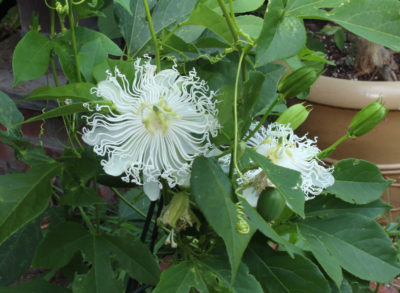
One group of plants in need of this special treatment are my maypops, Passiflora incarnata. Yes, Passiflora genus is that of passionflower, and maypop is a hardy species of passionflower, native to eastern U.S.. It bears the same breathtaking flowers, whose intricate arrangement of flower parts was used by Christian missionaries to teach native Americans about the “passion” of Christ, as the tropical species. White maypop flowerAnd, like the tropical species, flowers are followed by egg-shaped fruits filled with air and seeds around which clings a delectable gelatinous coating. You know the flavor if you’ve ever tasted Hawaiian punch.
Maypop parts ways with tropical passionflowers, which are woody vines, in being an herbaceous vine. The roots live year ‘round but the above ground portions of the plant die back each winter.

Besides creating a microclimate for the maypops, I also chose to plant them in an existing microclimate to their liking. That is on the south side of my woodshed, where the sun bears down to provide extra warmth in summer. (Another goal was to let the vines each summer cover a trellis that would give the woodshed some shade to prevent the firewood from drying out to much.) These plants of southeastern U.S. like their summers hot.

Soil moderates temperatures so never get as cold in winter as the air — or, in summer, as hot as the air. Five feet down, soils remain at a balmy 50°F year ‘round. Shallower depths are commensurately colder in winter and warmer in summer than deeper down.

Maypop is borderline hardy this far north. Insulating the ground around the plants will keep temperatures around the roots from dropping too low. Hence the snowy mulch.

As maypop grows through the summer, new flowers and then fruits appear. The longer the growing season, the more fruits the plants bear. Although I want to keep the ground from getting too cold in the depths of winter, I’d like it to warm up quickly in spring to get the plants going.

Wood chips, straw, snow, or any other mulch is going to put the brakes on soil warming, so, ideally, the mulch should be removed after the coldest part of winter is past. Except if that mulch is snow, which will melt.

Ugly but Delicious

Wandering through the snow to the other side of the farmden, I come upon another fruit, this one ready to pick and eat right now! Medlar. (Medlar and maypop each warranted a whole chapter in my book Uncommon Fruits for Every Garden.)

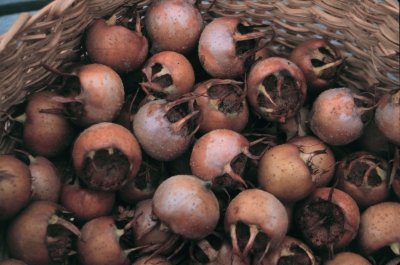
Medlar fruits resemble small, russeted apples (a relative), tinged dull yellow or red, with their calyx ends (across from the stems) flared open. Medlar, fruit in basketIt’s peak of popularity was in the Middle Ages. And though popular, it was made fun of for it’s appearance; Chaucer called it the “open-arse” fruit.
That old-fashioned look extends to the tree itself, which even this time of year is attractive with the elbowed contortions of its branches. In spring, the blossoms, which resemble wild roses, are borne singly at the ends of branches and, opening late so that each is cradled in already opened whorl of leaves.

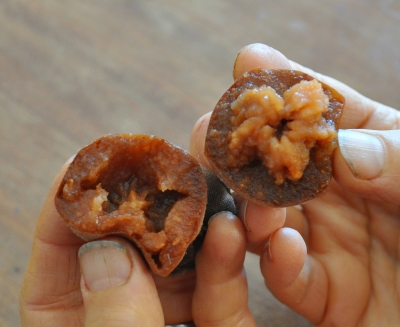
But back to the fruit; its got another quirk, besides its appearance. It’s inedible when first harvested. But after the fruit has sat for a couple of weeks or more indoors, a process called bletting, the once-hard, white flesh turns to brown mush.

Medlar, after bletting

Medlar, after bletting

Yechhhh! The flavor, though, has a refreshing briskness with winy overtones, like old-fashioned applesauce laced with cinnamon.

Fruits left on the tree also blet, and my trees are loaded with fruits.

Uh oh. Although medlar is generally pest-free, I see that many of the fruits have what looks like some sort of pest damage. Instead of the smooth, brown mush, flesh of damaged fruits is drier, almost powdery. What is it?

(Almost?) Hardy Orange

More snow more recently fell, and with it came bitter cold, which made me fear for the survival of my hardy orange, Citrus trifoliata. This orange is allegedly hardy to zone 5, but still . . .

The plant is only about four feet tall and there was plenty of snow so I just started piling snow on top of it. The ends of some branches remained exposed, which is okay because they can tell me whether the plant is really hardy.

Hardy orange bears flowers and fruits very similar to sweet oranges except that hardy orange fruits are bitter and very seedy. They could be used — in moderation — for flavoring, though. Citrus, Flying DragonHardy orange fruitMostly I grow it for the novelty of an outdoor orange tree, for the sweetly fragrant blossoms, and for the decorative, green, swirling, recurved spiny stems.
Come spring, I;’ll know if just how hardy the hardy orange really is. Temperature the night after covering it dropped to minus 18° Fahrenheit.

Life Goes On


The dark green wreath was tied with red ribbons and gliding towards me, in its progress stirring up snowflakes gently floating out of the grey sky. No, the wreath was not hanging from a horse-drawn sled, but was plowing through the frigid air affixed to the chrome grille of a gleaming white Cadillac! Here we are in the twenty-first century, still infusing a breath of life into our winters with cut evergreen boughs, just as did the ancient Egyptians, Persians, Jews, Christians, and Druids.

Whether for Christmas, for the ancient winter festival of Saturnalia, or for any other tradition, a wreath celebrates the continuity of life through winter. Evergreens are favorite wreath materials because their year long green flaunts winters’ apparently lifeless cold.

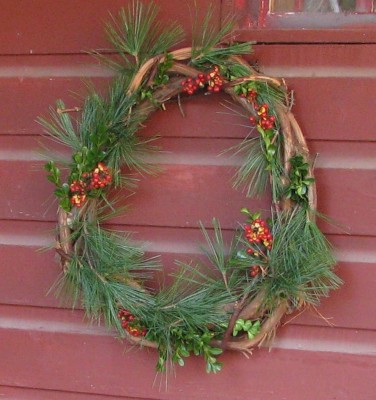
A few evergreen boughs tied together make a doorway more inviting or a room more cozy in winter, but a bona fide wreath creates something special. And the actual making of a wreath can be an end in itself this time of year.Wreath

Plenty of native and cultivated plants, many probably growing right in your backyard, could supply evergreen leaves for wreaths. Depending on the weather and the variety, needles of some junipers might still look bright green, although many turn purplish in the cold. Norway spruce always looks rich green, as do, with a softer look, the long, slender needles of white pine. With flattened sprays of scale-like leaves, arborvitae is another good choice, surely one of the best choices for a winter wreath when you translate its name to “tree of life.”

Don’t forget broadleaf evergreens also. Mahonia, holly, leucothoe, rhododendron, boxwood, and English ivy are suitable broad-leaf evergreens for a wreath. Indoors, none of the broadleaf evergreens will hold their leaves in a wreath as long as the needle-leaved evergreens.

To get a little wilder — more in keeping with the raucous Saturnalia celebrated in ancient Rome — use some evergreens with splotches or borders of yellow on them. No evergreen has all yellow leaves, but Gold Star and Kuriwao Sunburst junipers, for example, have yellow-tipped leaves. Midas Touch and Variegata are broadleaved evergreens, varieties of Japanese holly, with spots or splotches of yellow on their otherwise green leaves.

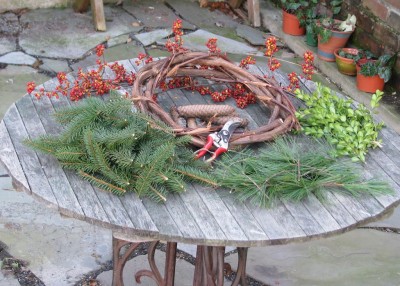
Okay, let’s calm down and get to some practical matters. Any wreath needs a support on which to mount the branches. That support could be a purchased styrofoam “doughnut” or one you make yourself from coat hangars. For an “organic” frame, readily available from the wild or backyard pruning, grape vines come to mind. Vines of bittersweet or virginia creeper would also work. Before grabbing at any wild vine, make sure you can identify and avoid poison ivy — it can cause rashes even this time of year.

Wrap any of these vines into a doughnut shape, weaving it into itself and weaving in new lengths as you go around and around. Wreath materialsA few loops of string or thin wire can unobtrusively firm everything in place.
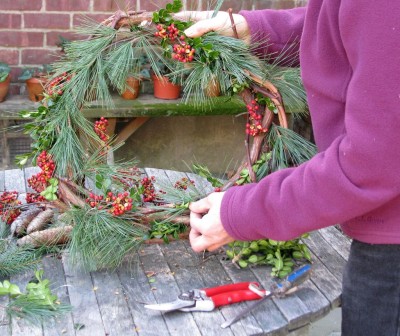
Next, wire, glue or tuck small bunches of evergreens onto the base, with all the bunches facing the same direction. Be generous so as to create a harmonious backdrop for the colorful stuff that comes next.

A walk in the woods or around your yard should turn up some colorful fruits, even this time of year. Still abundant are wild rose hips, bittersweet, winterberry, and barberry. Other seed pods are also good as ornaments. Wreath, almost finishedBesides the obvious — pine cones — also consider the flattened silvery pods of silver dollar plant, the wiry ones of love-in-a-mist, and the shaggy manes of clematis. If yet more ornamentation is wanted, there’s always chains of cranberries or popcorn strung together.
When hints of spring are in the air and you tire of your wreath, just compost it or throw it in the woods (if made from all organic materials). For now, though, deck the halls.

Note: The “comments” part of these blog posts has been erratically functional. It’s fixed! So fire away. Or just send a comment to test that it’s now working. Thanks.

Red and Green for Winter

A Mexican Native Adapts to Pot

A recent snowfall draped the landscape in magic. The white blanket settled softly on every horizontal surface to create a harmony in white.

Still, I miss green. Even better than seeing some green plants would be to liven up that green with, from the opposite side of the color wheel, red. And even better still would be to have this red-and-greenery close at hand — indoors.

Three plants fill this bill well, and are easy-care houseplants.

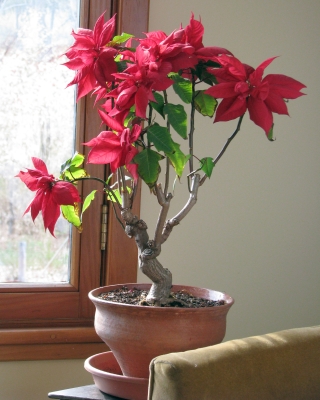
The most obvious and common member of this clan is poinsettia. Poinsettia plantBreeding, manipulation of their greenhouse environment, and plant growth regulators have transformed this sporadically blooming native of Mexico into a compact plant bursting into large blossoms for Christmas in foil wrapped pots.
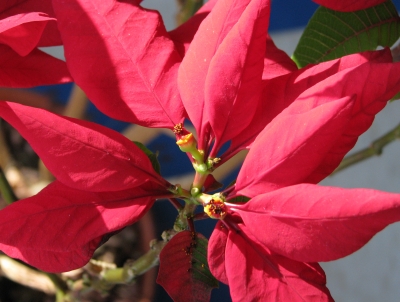
(Actually, the “blossoms” are not blossoms, but colored bracts, which are modified leaves. Peer into the whorl of bracts and you’ll see small, round, yellow cups, called cyanthiums in which inconspicuously reside the true blossoms.)

Poinsettia need not be a throwaway plant when the holiday season ends. The plant is easy to grow and, with just slightly more trouble, can be brought into bloom again this time next year. The plant is photoperiodic, meaning it blossoms after a period of exposure to short days. For poinsettia, that’s about a month of 12 hour, or less, days. That photoperiod begins about mid-September around here, so the plants could be left outdoors for the period as long as they’re not exposed to freezing temperatures. Or a plant could be moved in and out of a closet.

Although the photoperiod is spoken of in terms of length of day, length of darkness is what really matters. So each day’s dark period must be uninterrupted; no car headlights, table lamps, or even a flashlight.

If all this seems like too much trouble, just treat a poinsettia like any other houseplant. Photoperiod doesn’t stand alone in prompting flowers. Given good growing conditions, a poinsettia will still blossom — just not at Christmas.

Worth Having Even If It Does Come Late, or Early

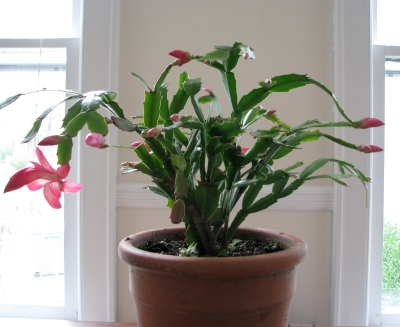
Christmas cactus also offers red-and-greenery in winter, and is also photoperiodic. But not always. In a cool room, below 60°F., the plant will flower no matter how long each day’s light stretches. Even if it’s exposed, artificially of course, to continuous light!

Christmas cactusAbove 60°F, temperature steps in to play a role. At room temperatures, or thereabouts, a Christmas cactus needs about the same day length as does poinsettia, except that it might not need the weeks and weeks of short days before it decides to bloom. Then again, it might wait a few weeks, to throw in another wrinkle, depending on the variety of Christmas cactus.

My tack has been to give my plant reasonably good growing conditions, with bright light in winter and a little shade in summer and a well-drained potting mix rich in peat or other organic material,  and let it blossom according to its whim. In which case “holiday cactus” might be a better name for these plants than “Christmas cactus” because blossoms might unfold during Thanksgiving, Christmas, Easter, or anytime in between.

“Butterflies” in Winter

The last plant of this triad is my favorite: cyclamen. In bloom, it looks like delicate, red (or pink or white) butterflies fluttering above the mottled green, heart-shaped leaves.

Cyclamen’s native habitat — the Mediterranean, with its cool, wet winters and hot, dry summers — offers hints of the plant’s ongoing care and flowering needs. Potted cyclamen plantThis time of year, late fall going into winter, is when the plant is flowering and wants to be kept cool (preferably no higher than about 65°F.), moist (but not waterlogged), and in indirect light (which casts no more than a fuzzy shadow). Under these conditions, those butterflies can hover over the plant for weeks and weeks.
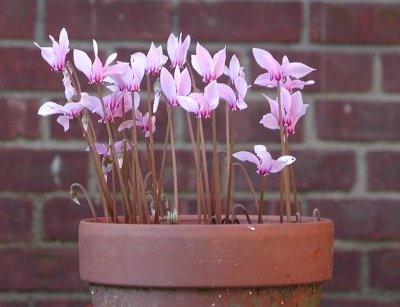
As spring comes — that is, “spring” indoors — leaves start to yellow and flowers fade. The plant is going dormant. At this point, the plant needs less water, the amount commensurate with the vibrancy of its leaves. Come fall, leafstalks start to appear again atop the bulb (botanically a corm, which is a short, swollen underground plant stem that is a storage organ), and the cycle begins again.

My favorite cyclamen species is Cyclamen hederifolium (ivy-leaved cyclamen).Hardy cyclamen in pot

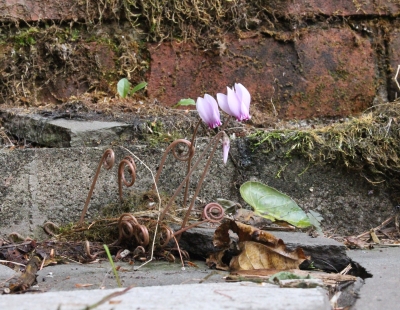
Cyclamen flower in a crannied wall

Cyclamen flower in a crannied wall

It’s a very much scaled down version of the potted cyclamen you see for sale this time of year. It’s cute. Besides that, it’s also cold-hardy outdoors here. Some self-seeded “volunteers” even have established themselves to brighten up cracks between the flagstones of my terrace, blossoming each year in early fall.

End of Year Punch List


Winterizing

My carpenter friends, near the end of their projects, have their “punch lists” to serve as reminders what odds and ends still need to be done. I similarly have a punch list for my gardens, a punch list that marks the end of the growing season, a list of what (I hope) will get done before I drop the first seeds in the ground next spring.

(No need for an entry on the punch list to have the ground ready for that seed. Beds have been mulched with compost and are ready for planting.)

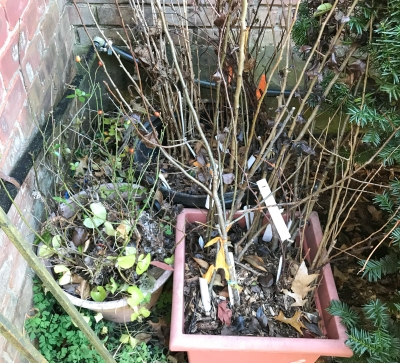
Hardy, potted plants, including some roses, pear trees, and Nanking cherries, can’t have their roots exposed to the full brunt of winter cold.plants, almost ready for winter I’ve huddled all these pots together against the north wall of my house but soon have to mound leaves or wood chips up to their rims to provide further cold protection.
I’ll save some leaves to protect strawberry plants. Their insulating blanket won’t go down until weather turns colder, with the soil frozen an inch deep, or else their evergreen leaves will rot beneath the leaves.

I’ll be digging out or cutting down a number of woody plants, some even 10 or 20 years old, in the next few days or weeks to make way for better ones. (Ruthless!) Anna hardy kiwifruit, short for Annanasnaya, grows very well but ripens a bit late and doesn’t have quite as good flavor as my other varieties: Geneva, MSU, and Dumbarton. So out it goes. The same goes for Mars, Concord, and Cayuga White grapes; their flavor isn’t up to snuff. And Halle’s Giant, Lewis, and Clark filberts, except that their shortcoming is their susceptibility to the disease filbert blight.

A 5 gallon bucket filled with equal parts sifted compost and soil will be ingredients for any potting soils I’ll need for seedlings from midwinter on. For the finished potting soil, I’ll mix in another 5 gallon bucket with equal parts peat moss and perlite.

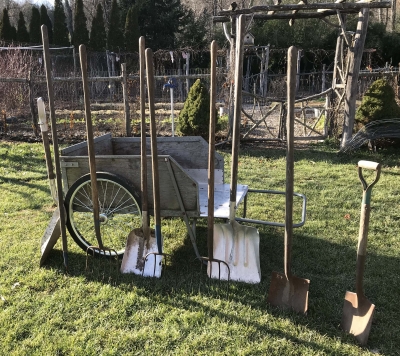
One sunny day soon I’ll lean pitchforks, rakes, and shovels against the garden carts and brush them with linseed oil diluted with equal parts paint thinner. Tool handles, readiedAfter the handles have been wiped down, 10 minutes later, they’ll be in good condition for at least another year.
Pruning hardly needs to be added to my punch list. I’m reminded about this annual job every time I look out the window or walk out the back door.

Deer at Bay

Protecting some of my trees and shrubs from animals doesn’t make it to the punch list either — because it needs to be done by now! Young pears (Concorde, Abbe Fetal, and Lady Petre) and apples (Liberty, Macon, Hudson’s Golden Gem, Ashmeads Kernel, and Pitmaston Pineapple) already have their hardware cloth and/or plastic collars protecting their bottom couple of feet of growth.

What about branches higher up, the ones the deer would find tasty. Thanks to fencing at both the north and south ends of my property, a couple of Deerchaser battery-powered repellants, two outdoor dogs, and vibes from me, deer rarely venture on site. But, as I discovered this past summer, just one deer on just one night can do a lot of damage to a young tree.

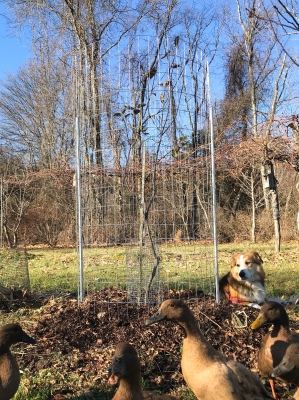
So this year I’m putting 5 foot high by 3 foot diameter cages of 2×4 welded wire fencing around my young apple trees. Deer protection, high fenceThe pear trees, close to the house, don’t get bothered. The problem with such cages is that it’s a hassle to weed or prune within the cage — both very important for young trees. Two metal stakes, each a 5 feet length of EMT electrical conduit, woven into part of fencing on opposite sides allows me to slide the fence up and down to get inside a cage to work. These trees, which are replacing my very dwarf apple trees, are semi-dwarfs which can fend for themselves once they get above 5 feet. Then I’ll remove the cages.
Memorables, for Vegetables

And now, some notes for next season’s vegetable garden . . .

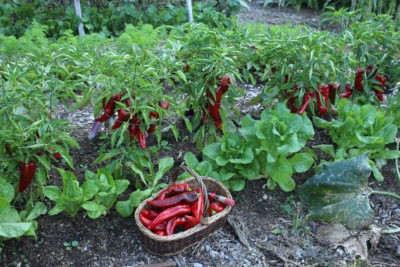
Reduce the number of pepper varieties to those that perform and taste best here: Sweet Italia,

Italian Sweet peppers

Italian Sweet peppers

Carmen, and Escamillo. And stake them right from the get go.

Plant a greater proportion of tight-necked onions, such as Patterson, New York Early, and Copra, to avoid bacterial diseases.

Plant less bok choy; no need to be inundated by them just because the space is available.

Keep an eye out for whiteflies and caterpillars on cabbage family plants; act sooner rather than later to keep them in check.

Plant more Shirofumi edemame; 30 feet of bed should be about right, they need a long, hot season.

Try King of the Garden Limas again, but plant even earlier indoors. 

Get Out!

Okay, time to get outside to work on my punch list before any snowfall limits the possibilities.

Autumn’s Leaves

Wherefrom the Colors?

Autumn is a season when New York’s Hudson Valley, and much of the Northeast, unfolds in all its glory. Not this autumn, though. What’s going on in the leaves this year? Is there anything I can do about it?.

Chlorophyll is what makes leaves green, but hidden behind that green, all season long, are some of autumn’s colors. Chlorophyll must be continually synthesized for a leaf to stay green. The shorter days and lowering sun of waning summer are what trigger leaves to stop producing chlorophyll and let some of the other colors come to the fore.

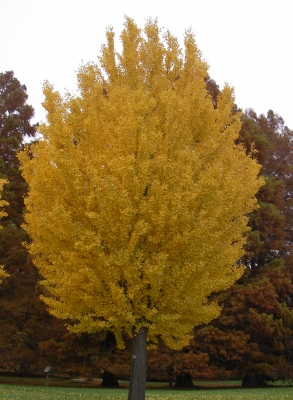
Yellows and oranges, no longer masked by chlorophyll green, come from carotenoids, which help chlorophyll do its job of harvesting sunlight to convert into plant energy. Thank carotenoids for the warm, yellow glow they give to gingko, aspen, hickory, and birch leaves.

Gingko in fall

Gingko

Tannins are another pigment, actually metabolic wastes, that all summer are hidden by chlorophyll. Their contribution to the fall palette are the season’s subdued browns, notable in some oaks and enriching the yellow of beeches.

Because leaves harbor carotenoids and tannins all summer long, nothing particular about autumn weather should either intensify or subdue their autumn showing. I’m blaming this autumn’s poor show on the season’s extended warm weather. It was slow to arrest chlorophyll production and induce leaf drop. A couple of hard freezes brought the whole works to a screeching halt, so instead of showy yellow leaves, my witchhazel’s stems are now “adorned” with wrinkled, green leaves frozen in place. Other trees and shrubs suffered a similar fate, and their frozen, green leaves are dropping without any fanfare.

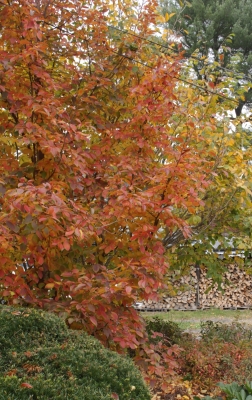
Autumn color also spills out reds and purples, most evident in red maples and some sugar maples, scarlet oak, sourwood, blueberry, and winged euonymus. Those reds and purples come from anthocyanins, yet another pigment. Except for trees like Purple Fountain beech and Royal Purple smokebush, whose leaves unfold dusky red right from the get go in spring and remain so all season long, in most leaves anthocyanins do not begin to develop until autumn.

Sugar maple in fall

Sugar maple

Anthocyanin formation requires sugars, which accumulate best with a combination of warm, sunny days to maximize photosynthesis, and cool, but not frigid, nights to minimize nighttime burning up of accumulated sugars. A cloudy, rainy autumn means less red because less anthocyanin is formed, and any that does form is diluted. Warm nights, such as characterized much of autumn, reduce anthocyanins by burning up much of each day’s sugar production. The result: Less reds and purples, as evidenced by the blah color of this year’s blueberries in my garden and maples in the forests. 

Can We Make the Color Better?

Is there anything we can do about the autumn show?

Here in the garden, my role in the autumn show is to plant trees genetically programmed for good autumn color. Colorful trees and shrubs include goldenrain tree, hickory, ironwood, and black tupelo. Certain varieties within each species might pack a bigger wow than the others. Hence the spicebush variety Rubra, brick red in fall, or Wright Brothers sugar maple, whose leaves become a mottling of gold, pink, orange, and scarlet. Other especially colorful varieties include Autumn Flame and October Glory red maple, Commemoration and Legacy sugar maple, Autumn Gold and President gingko, and September Beauty Chinese sumac.

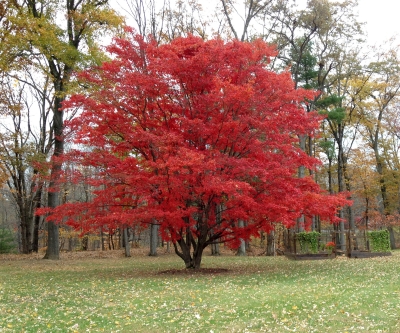
Japanese maple in fall

Japanese maple

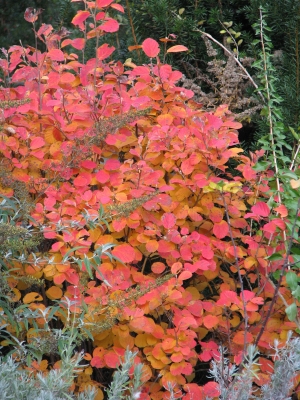
Despite this autumn’s weather, fothergilla and Japanese stewartia both managed to look as flamboyant this year as in others. If you believe that, going forward, autumn weather is going to bring on less spectacular color, choose varieties that originated from more southerly latitudes.

fothergilla, fall color

Fothergilla

Stewartia in fall

Stewartia

And if warmer autumns are going to be one effect of global warming, we can help the autumn show beyond our gardens, in the forests, by traveling less or more efficiently, using less plastic and other petrochemicals, eating more locally grown food and less farmed meat, investing in energy-efficient appliances and renewable energy, etc. (For more, see https://www.conserve-energy-future.com/stopglobalwarming.php.)

Back in the garden, my other role in ratcheting up the reds and purples is to make sure that leaves bask in light. I plant a tree where light is adequate (for that species) and, as necessary, prune so that branches don’t shade each other. Street lights don’t count as light, and actually have a negative effect, disrupting the signal that days are getting shorter and it’s time to slow chlorophyll production.

Lee’s New Book!!

Knowing something about how plants work can make gardening more interesting as well as make the landscape prettier and vegetable gardens more productive. And that’s the thrust of my upcoming book, The Ever Curious Gardener: Using a Little Natural Science for a Much Better Garden, to be published in early spring of 2018 but available for pre-order through Amazon or, signed, from me.The Ever Curious Gardener

Some Fruits and a Ornamental Veggie

Happy Blueberries, Happy Me

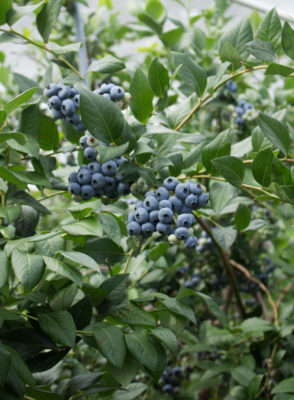
My sixteen blueberry plants make me happy, so I make them happy. (They made me happy this year to the tune of 190 quarts of berries, half of which are in the freezer.) I don’t know how much work bearing all those berries was for them, but I just finished my annual fall ritual of lugging bag upon bag of leaves over to the berry patch to spread beneath the whole 750 square foot planted area.Blueberry fruit cluster

I don’t begin this ritual spreading until the blueberries’ leaves drop. Then, old leaves and dried up, old fruits are on the ground and get buried beneath the mulch, preventing any disease spores lurking in these fallen leaves or fruits from lofting back up into the plants next spring. Rainy, overcast summers or hot, dry summers or any weather in between — my bushes have never had any disease problems.

In past years, I did do two things before spreading that mulch. First, I spread some nitrogen fertilizer: my universal pabulum, soybean meal, at the rate of 2 pounds per hundred square feet. And second, I spread some sulfur, at about the same rate, to keep the soil acidic. After many years of mulching, the soil has built up an ample reserve of organic nitrogen — evidenced by the plants’ 2 to 4 feet of new stem growth each year. So I no longer add extra nitrogen.

With all those years of mulching, levels of decomposed and decomposing soil organic matter have greatly increased the soil’s buffering capacity for acidity. That means that I no longer have to pay such close attention to acidity, so I rarely add sulfur anymore.

Sammy also likes the mulch

Sammy also likes the mulch


Besides all these other benefit, the mulch has created a soft root run that retains moisture, just what blueberries’ thin roots really like. Fruit is borne on shoots that grew the previous season, so each year’s vigorous new growth translates into a good crop in the offing for the next year.

New York Bananas

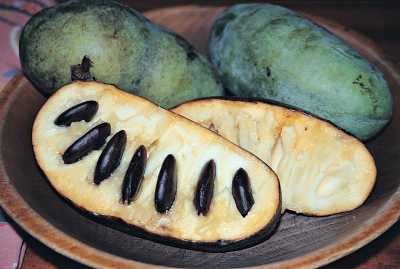
Although the crop seemed paltry at first this year, by the time autumn came around, pawpaws were in abundance. This uncommon fruit is the northernmost member of the tropical custard apple family, and the fruit does indeed taste very tropical — a flavor mix of banana, mango, avocado, and vanilla custard — even though it’s easy to grow and native throughout much of the eastern U.S..Pawpaw, like crème brûlée

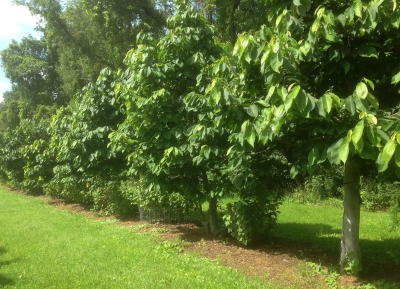
Two trees would be adequate for most households; I have about 20, just so I can learn more about them and their individual differences. That makes for a lot of pawpaws! (I test market most of them.)Row of pawpaw & black currant

Pawpaw fruits are very variable in both size and flavor even among the branches of a single tree. One year, I tried thinning the fruits to see if that would increase size of remaining fruits, as it does with apples and peaches. Pawpaw has a multiple ovary so each blossom can give rise to as many as 9 fruits. The small fruits are hard to see because they match so closely the green color of the leaves, so I didn’t thin as many as I had hoped. That said, at season’s end, fruits on thinned clusters seemed no larger than fruits on unthinned clusters.

Beginning around the middle of September, I began harvesting the first fruits. I picked some up from the ground and picked some softening ones from the trees, all of which continued through October. By putting them immediately in a cooler at 40°F, I still had good fruit into the middle of November.

Scarlet Runners

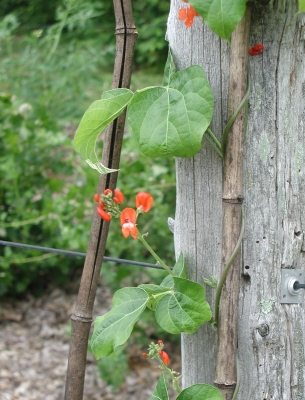
Every year I fear that at season’s end I’ll remember something I forgot to plant. This year it was scarlet runner beans.Scarlet runner bean flower

Despite the “bean” in the name, I’ve grown this vining bean, as do most people, primarily as an ornamental, for its scarlet blossoms. I occasionally eat the fat, hairy, yet delectable green beans.

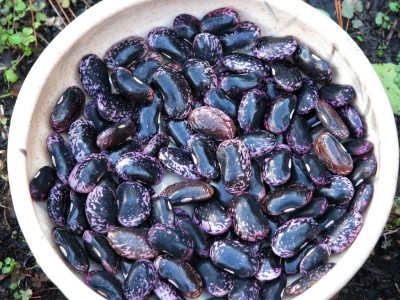
Every year I collect some of the matured black and pale purple, calico seeds for replanting the following year. One year, I decided to cook up some of these seeds and taste them. Scarlet runner bean seeds are quite tasty (and, I learned prior to eating, nonpoisonous). Scarlet runner beans
 
Next year I’ll remember the scarlet runners. My yard will be aflame in scarlet flowers and, because the plant is pest-free  —  even to Mexican bean beetles — I expect to reap a bumper crop of beans.