A Podcast and a Workshop

I was recently on Joe Lamp’l’s gardening podcast talking about “uncommon fruit.” They’re worth growing because they’re easy, they’re ornaments, and, with few or no pest problems, they’re easy. And they have excellent and unique flavors. Listen to the podcast here.

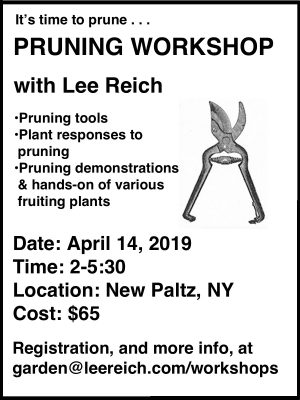
Also, I’m hosting a pruning workshop at my New Paltz, NY farmden:Pruning workshop announcement

The Season Begins

One More Thing? Ha!

I have one more important task to do before planting any vegetables this spring, and that is the annual mapping out of the garden, something I generally put off as long as possible.

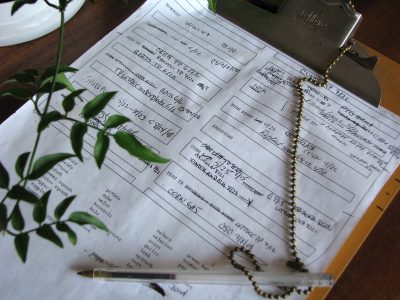
In theory, mapping out my garden should be easy. I “rotate” what I plant in each bed so that no vegetable, or any of its relatives, grows in a given bed more frequently than every 3 years. Garden planning on paperIn practice, I mostly pay attention to rotation of plants most susceptible to diseases, which are cabbage and its kin (all in the Brassicaceae), cucumber and its kin (Cucurbitaceae), tomato and its kin (Solanaceae), beans and peas (Fabaceae), and corn (sweet or pop, in the Gramineae).

Crop rotation prevents buildup of disease pests that overwinter in the ground; removing host plants eventually starves them out. (Insect pest are more mobile, so crop rotation has less impact except in very large plantings.) So one year a bed might be home to cucumbers, melons or squashes. The next year that bed might host cabbage, broccoli, kale, Brussels sprouts, or cauliflower. Then tomatoes, peppers, potatoes, or eggplants. And finally, the fourth year, back to cucumbers. Simple enough.

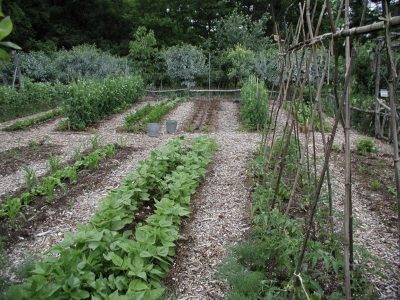
It would also be nice to rotate carrots and other root vegetables with leafy vegetables, such as lettuce, and fruiting vegetables, such as tomatoes. My garden's bedsRoot, leafy, and fruiting vegetables have somewhat different nutrient needs, so in the ideal garden these crops are rotated to make best use of soil nutrients.

And I do like to get the most out of my garden and confuse potential insect pests by grouping different kinds of plants within a bed.

Are you beginning to understand why I put off committing my garden plan to paper each spring?

Pea Problem(s)

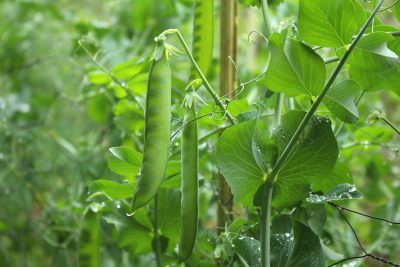
Peas present one more wrinkle in my vegetable garden planning. A few years ago they stopped bearing well, collapsing with yellowing foliage not long after they bore their first pods.

Further investigation has narrowed the problem to – probably – one of two diseases: fusarium or aphanomyces. Both, unfortunately, are long-lived in the soil so that a 3 year rotation does nothing to keep them in check.

Fortunately, I have two vegetable gardens. So, for the past few years I have banned peas from my north garden, planting them only in my south garden, in which they do get rotated. After a few more years, I’ll move the pea show to my north garden and leave my south garden pea-less. I’ve also been planting the varieties Green Arrow and Little Marvel, both of which are resistant to fusarium, at least.

Unfortunately, the problem is more likely aphanomyces, for which resistant varieties do not exist. Aphanomyces is a water mold, so thrives under wet conditions. So my tack will also be to keep any peas planted in my vegetable garden on the dry side, not even turning on the drip irrigation in those beds.

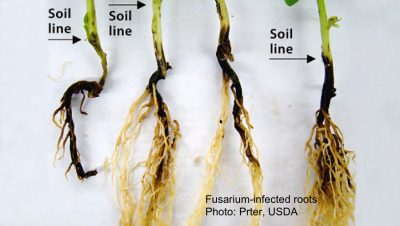
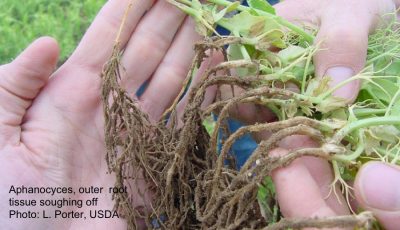
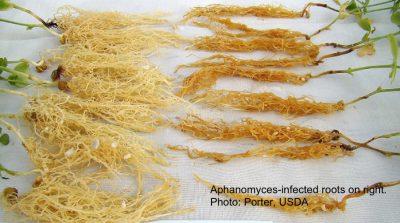
I’ll also be checking the plants more closely for symptoms. Plants infected by fusarium have a red discoloration to their roots. Fusarium-infected pea rootsPlants infected by aphanomyces have fewer branch roots and what roots there are lack the plump, white appearance of healthy roots.Pea roots with aphanomycesPea roots with aphanomyces

Pea Solution?

I’m also testing out root drenches with compost tea for my peas.

Yes, yes, I know I have dissed compost tea in the past. Mostly, its benefits, if any, have been overstated. But compost microbes have more chance of surviving in the dark, moist, nutrient-rich environment of the soil than on a leaf, where the stuff is often sprayed. I’m drenching the soil with the tea, not just giving the surface a spray, as usually recommended, so a lot more bacteria, fungi and friends are finding their way down there.

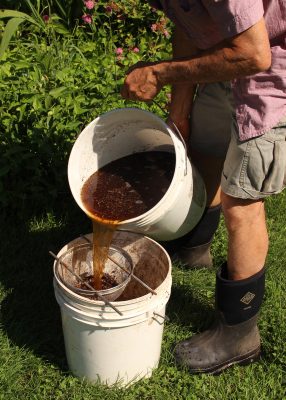
I see no reason (and research does not support) of going to the trouble of making the usual compost tea, which is aerated and might be fortified with such things as molasses. Compost tea, quick mixMy tea is nothing more than the liquid strained from compost soaked in water, then applied with a watering can at the base of the pea plants.

I’ve done this for a couple of seasons but have nothing definite to report yet. The hard part is sacrificing a bed as a control. Perhaps this year.

Increasing My Hyacinthal Holdings

Hyacinth City

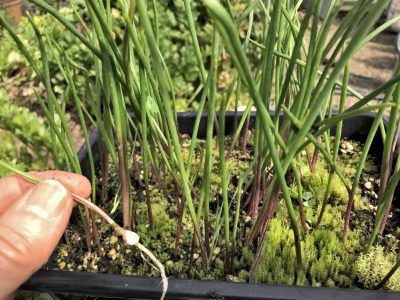
I’ve admitted this before; here’s more evidence of my addiction — to propagating plants. I currently have a seed flat that’s only 4 by 6 inches in size and is home to about 50 hyacinth plants. Obviously, the plants are small. But small and sturdy.

The genesis of all these plants goes back a couple of years when I needed photos for my book The Ever Curious Gardener: Using a Little Natural Science for a Much Better Garden. For the chapter on some aspects of the science of plant propagation and the practical application of that science, I made photos of some methods of multiplying hyacinth bulbs. Here’s an excerpt of that section:
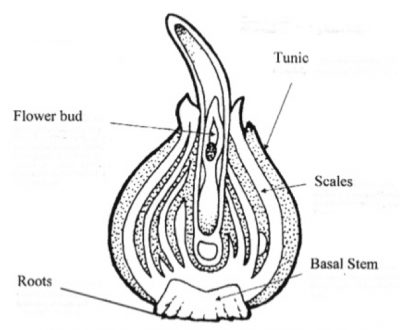
Hyacinth growing bulblets“Knowing what a bulb really is makes it easier to understand how they can multiply so prolifically that their flowering suffers, and how to get them to multiply for our benefit. Dig up a tulip or daffodil and slice it through the middle from the tip to the base. What you see is a series of fleshy scales, which are modified leaves, attached at their bases to a basal plate, off of which grow roots—just like an onion (but, in the case of daffodil, poisonous!). The scales store food for the bulb while it is dormant.

That bottom plate is the actual stem of the plant, a stem that has been telescoped down so that it’s only about a half-inch long. Those fleshy scales are what store food for the bulb, and, depending on the kind of bulb, are nothing more than modified leaves or the thickened bases of leaves.
Bulb cross-section diagramLook at where the leaves meet the stems of a tomato vine, a maple tree—any plant, in fact—and you will notice that a bud develops just above that meeting point. Buds likewise develop in a bulb where each fleshy scale meets the stem, which is that bottom plate. On a tomato vine, buds can grow to become shoots; on a bulb, buds can grow to become small bulbs, called bulblets. In time, a bulblet graduates to become a full-fledged bulb that is large enough to flower.”

Natural Increase

“Let’s see just how the big three flowering bulbs—tulips, daffodils, and hyacinths—grow. With tulips, the main bulb, the one that flowers, disintegrates right after flowering and is replaced by a cluster of new bulblets or bulbs. The mother bulb of a daffodil continues to grow after flowering, at the same time producing offsets of bulbs or bulblets which may remain attached to the mother bulb. Hyacinths grow the same way as daffodils, except for being much more reluctant to make babies.

All those bulblets and bulbs can, in time, crowd each other for light, food, and water, so flowering suffers. When my daffodils, tulips, or hyacinths seem to be making too many leaves and too few flowers, I know it’s time to dig them up and separate all the bulbs and bulblets. The best time for this operation is just as the foliage is dying back in spring or early summer because after that plants are out of sight until the following spring. Replanting can be done immediately or delayed until autumn.”

The Scoop on Propagating Bulbs

“Knowing something about bulb structure also gives me inside information on how to multiply my holdings faster, perhaps to make enough plants for a whole field or a giant flower bed. Merely digging up and planting offsets is one way of doing this. Also, knowing that the bottom plate is a stem and that the offsets come from side buds lets me coax those side buds to grow just as can be done with any other stem.

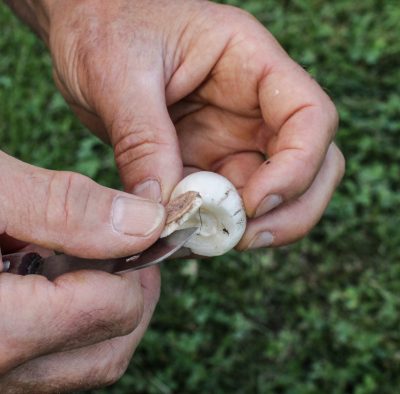
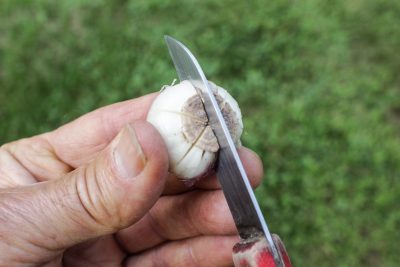
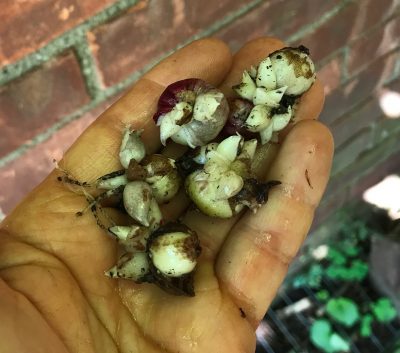
Pinching out the growing tip of any stem makes side buds grow. One way you get rid of, or ‘pinch out,’ the growing tip of a bulb is to turn the bulb upside down, then scoop out the center of the bottom plate with a spoon or knife. Bulb scoopingAnother way is to score the bottom plate with a knife into 6 pie shaped wedges, making each score cut deep enough to hit that growing point. Bulb scoringAfter scoring or scooping, set the bulb in a warm place in dry sand or soil for planting outdoors in a nursery bed in autumn.Hyacinth dormant bulbletsAfter a year, as many as 60 bulblets might be sprouting from the base of each scooped or scored bulb. Each bulblet does take 4 or 5 years to reach flowering size, but no matter. To quote an old Chinese saying: ‘The longest journey begins with the first step.’”

My little hyacinth bulblets are now in their second season of growth. I’ll keep them growing strongly until their leaves yellow as they go naturally dormant, probably late this spring. Come fall, I’ll dig them all out, separate them, and then plant them out in a nursery bed or else in their permanent homes. I expect aromatic bliss in a couple of years.

And, On Another Note

I was recently a guest on Susan Poizner’s radio show/podcast where we talked about growing uncommon fruits, here at my farmden and in general. Hear it at https://orchardpeople.com/growing-uncommon-fruits/

A Farmdener, That’s Me

A New Word is Introduced

I’d like to introduce the words farmden and farmdener into the English language. I wonder if there are any other farmdeners out there.

What is a farmden? It’s more than a garden, less than a farm. That’s my definition, but it also could be described as a site with more plants and/or land than one person can care for sanely. A gardener and garden gone wild, out of control.Farmden, aerial view
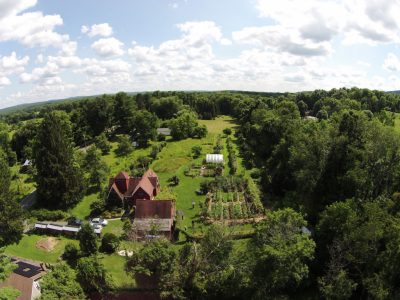
You might sense that I speak from personal experience. I am. My garden started innocently enough: A 30 by 40 foot patch of vegetables, a few apple trees, some flowers, and lawn. That was decades years ago, and in the intervening period, the lawn has grown smaller, the vegetable garden has doubled in size, and the fruit plantings have gone over the top.

Originally, I had less than acreage – 72 hundredths of an acre to be exact. But over the course of 15 years, I did manage to put my fingers onto almost every square foot of that non-acre. Squeezed into that area were 40 varieties of gooseberries, a dozen varieties of apples, a half dozen varieties of grapes, red currants, white currants, black currants, raspberries, mulberries: you get the picture. All that, in addition to my vegetables, flowers, and some shrubbery. But I was still not a farmdener, and my property was not a farmden.

Evolution of My Farmden

The transition from garden to farmden occurred with the purchase of a fertile acre-and-a-half field bordering the south boundary of my property.

With that purchase, I expanded my plantings, rationalizing that because I write about gardening (for magazines, for Associated Press, and for this blog) and host workshops here, I should test and grow a lot of what I write and talk about. So instead of 2 hardy kiwifruit vines such as any normal gardener might grow, I planted 20 vines of a few species and varieties. Instead of 2 pawpaw trees, à la normal gardener, I planted 20 pawpaw trees of  few varieties.
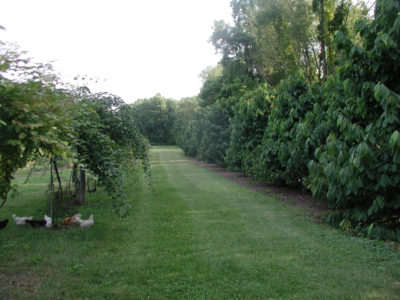
Pawpaws, blackcurrants, and hardy kiwis

Pawpaws, blackcurrants, and hardy kiwis

And how about another dozen apple trees? And chestnuts, filberts, pine nuts (Pinus koreansis is hardy here in New York’s Hudson Valley). Again, you get the picture.

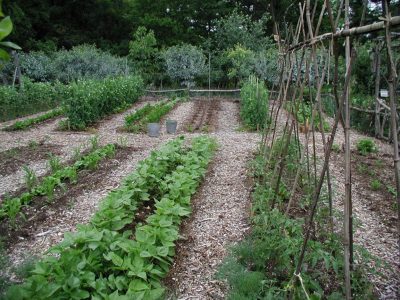
But no, I wasn’t finished. There was always one more plant needing a home, one more piece of ground hungry for a plant. Why not create another vegetable garden; after all, I had just gotten married, and that made another mouth to feed. Why buy vegetables when you have enough land to grow them?Vegetable garden And what about winter? A greenhouse full of salad and cooking greens solved that problem, in addition to providing figs in summer and early and late season cucumbers.
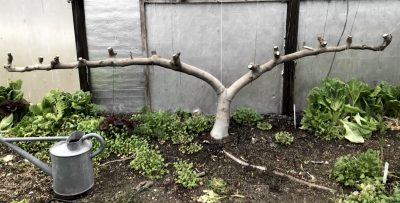
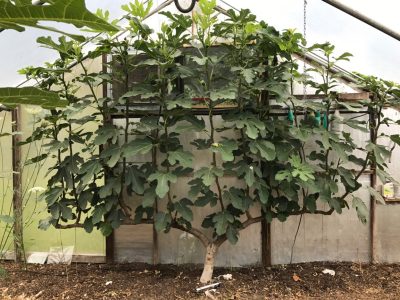
Greenhouse fig

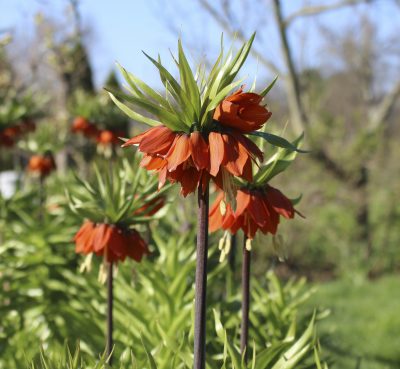
I like crown imperial (Fritillaria imperialis) flowers and learned the quirks of propagating them – pack pieces of bulb scales in moist potting soil and subject them to a few months of warm temperatures, then a few weeks of cool temperatures, pot up, plant out. Soon I had not a crown imperial or two such as you might find in most gardens, but dozens of them, and more still coming on.Crown imperial
You might imagine that, despite my plantings, my lawn still grew bigger with that increased acreage. Not so. Most of the acre and a half, except what was devoted to new plantings, became a hayfield that I mowed and helped feed my compost pile. A bit of rationality prompted me to graduate from scything to a small farm tractor for brush hogging that field. (Tennis elbow, the result of excessive scything, also helped with that decision. But I still use the scythe, a high quality Austrian style scythe, to mow parts of the field.)

Present and Future

What I now had – and have – is a farmden. And I am a farmdener. A farmden is not something from which you can earn a living, although I have sold some excess pawpaws, American persimmons, and hardy kiwifruits, mostly for test marketing in my efforts to see whether these fruits are worth promoting for small farms. (They are; flavor sells.)

And my farmden is a great venue for workshops, as long as I point out that participants should pay attention to my plants, not the number of them, because my property is obviously the handiwork of a crazed gardener (or a sane farmdener?). “Don’t try this at home,” I tell participants right off the bat.Farmden view
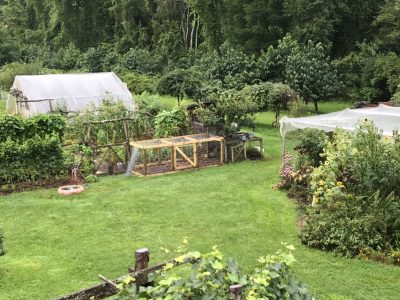
I do occasionally still garden. Right next to my terrace is a bed with tree peonies, potentiillas, clove currants, and Signet marigolds, all well-contained by the bricks of the terrace on one side and a low, moss-covered hypertufa wall on the other side. The bed is close to the house and the bed is small. Yesterday I noticed weeds starting to overstep their limit in the bed. I crouched down, started at one side of the bed, and gave it a thorough weeding, literally getting my hands on every square inch of soil. It was fun and it was quick.

Most of my time, though, is spent farmdening. It’s very satisfying, even if it does get crazy sometimes, and it yields a cornucopia of very tasty and healthful fruits and vegetables, many of them planted with an eye to beauty as well as function.

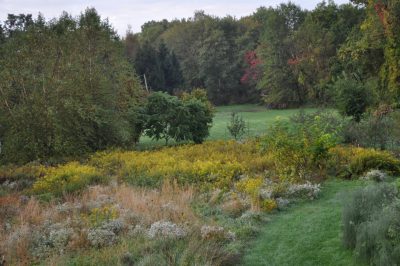
I have vowed not to plant anything more in the hayfield, in large part because it’s so pretty, the soft violet hue from midsummer’s monarda flowers grading over into a golden glow from late summer’s goldenrods. I also promised my daughter, when she was young and enthralled with Laura Ingalls Wilder, that we would leave most of the field as “prairie.” (Now over 30 years old, my daughter no longer yearns for prairies, but I’m keeping my promise.)South field
I have taken some of the edge off the transition from gardening to farmdening with some help here on the farmden from an occasional helper. Still, I am planning to keep the “den” in farmden.

Down in Dixie

Green, Green, Green, and Flowers!

After delivering a couple of lectures about gardening in North Carolina, I set off on a very short, whirlwind tour of the southeast, specifically North Carolina and Georgia, and ending with a stay in Charleston. How different from my spot here in New York’s Hudson Valley!

For all Charleston’s uniqueness, three characteristics jumped out. It being early March and my coming an achromatic landscape of snow, sleeping plant life, and cold, I was immediately struck by the abundance of greenery. Not the tired greenery of many evergreens here in the north, but vibrant, awake greenery in a variety of shapes, textures, and sizes.

Camellia blossoming in Charleston

Camellia blossoming in Charleston

Included in all that Charlestonian greenery were fronds of palm trees — saw palmetto and sabal palmetto — fanning out above jagged trunks. Those palms were a reminder that I was now in a subtropical rather than temperate climate. Not that the weather helped make the point; some days were in the high 40s and one night temperatures were predicted to dip near freezing.

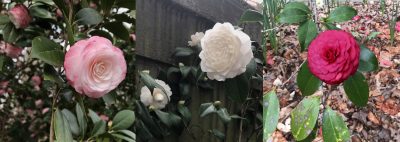
March notwithstanding, Charleston had no dearth of flowers. Camellia blossoms stared out from a backdrop of their verdant foliage. Camellia is one of my favorite plants. I tried to grow one of the hardier new varieties of camellia a few years ago, offering it some cold protection by planting it near my home; it died its first winter. I wonder if southerners become blasé about these blossoms; camellias were growing everywhere, and in bloom.

The white blossoms of sweet osmanthus belied their diminutive size with the strength with which they perfumed the air. The fragrance was fruity, apricot.

Very different was another fragrance, this one wafting from clusters of trumpet-shaped blossoms dangling from the bare stems of edgworthia, also known as paperbush. That’s another plant that won’t grow this far north but no matter. I wavered between enjoying and not enjoying its resinous aroma.

If only gardenias — another plant growing outdoors in the southeast but not hardy here in the North— had been in bloom, the olfactory part of my trip would have been complete. All I could do was marvel at what it would be like if I could have a dooryard shrub of gardenia. I might be on the verge of passing out as I hyperventilated through the bloom season.

Oranges? No. ‘Quats? Yes

Two interesting fruits turned up here and there.

One was loquat, an odd relative of apple and pear. The leaves are large, dark green, and evergreen with a matte finish, all of which makes an appearance that is subtropical, which the plant is. 

Most odd is loquat’s bearing habit. It flowers in autumn and ripens its fruit in spring or early summer. I once bought one at a fruit stand in Paris. Its flavor was unimpressive, but that’s true of many commercially marketed fruits. Loquats generally receive high praise for flavor. If I ever get to taste a good one, I might grow the plant in the loquat-perfect environment of my greenhouse.

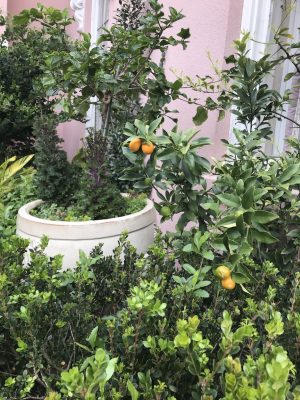
The other fruit was citrus, two fruits, actually, and also “-quats” but not at all related to kumquat. They were kumquat and citrangequate. It just didn’t seem like citrus could be hardy that far north (except for the super-cold-hardy but hardly edible trifoliate orange, which I have growing outdoors).Kumquats in Charleston But winter low temperatures in Charleston rarely dip even to freezing but kumquat trees are hardy into the ‘teens. A few citrangequats — trigeneric hybids of kumquat, trifoliate orange, and sweet orange — that I stole from a tree proved to be tasty with sweet, edible rind enclosing a pleasingly tart interior.
Southern Faves

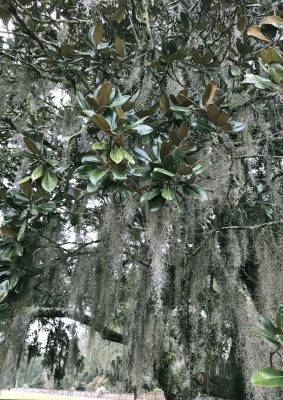
Three of my favorite plants that I cannot grow were present in abundance. I already mentioned camellia. Another is southern magnolia, a stately tree that differs from northern magnolia in having very large, leathery, evergreen leaves that look somewhat like the rubber trees that are common houseplants.

Southern magnolia decked with Spanish moss

Southern magnolia decked with Spanish moss

It was too early for the large, white, fragrant blossoms to appear but I would grow the tree for the leaves alone, if I could. It’s almost hardy here; I’ve seen trees in northern New Jersey.

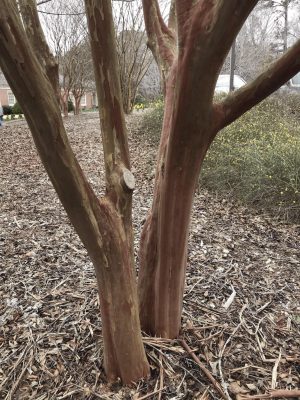
Another favorite is a deciduous plant also almost cold-hardy here: crape myrtle. The plants are decked with bright flowers in various shades of red all summer, but are bare of leaves or flowers in winter, even in South Carolina. No matter, crape myrtle has a mottled, shedding bark that puts on a good show when its flowers are offstage.Crape myrtle bark

And A Dark Cloud

A dark cloud that hangs over Charleston is its role in the slave trade. About 40% of all slaves entering America entered through Charleston. And it’s not just a statistic like this or a visit to the Slave Museum, site of one of Charleston’s many slave auctions, that recalls the horrors of human bondage. I couldn’t help, when visiting the plantations in and near Charleston, constantly reminding myself that they were only possible with the labor of enslaved humans. Reminders are everywhere; even the bricks of the buildings right in town were hand made by slaves.

Many of the slaves auctioned off in Charleston were separated from their families and transported to other sites throughout the colonies, making all the colonies and then states culpable. 


Volunteers and Clementine Boxes

Celery Volunteers for Me

I’m always on the lookout for volunteers in my garden, whether they’re people, fungi, plants, or any other organisms. The relationship is usually symbiotic. Human volunteers gain some knowledge and experience; I get some help in my ever-growing farmden. Fungal volunteers work with my plants, drinking in some of the sugars and other goodies plants produce. In return, the fungi protect plants agains certain pests and, in the case of mycorrhizal fungi, fungal threads ramifying through the soil act like extensions of plants’ roots so plants can absorb more nutrients.

  But what do plant volunteers get out of our arrangement? Plant volunteers usually arrive in droves so only some can stay. Those that stay get to enjoy especially good growing conditions.

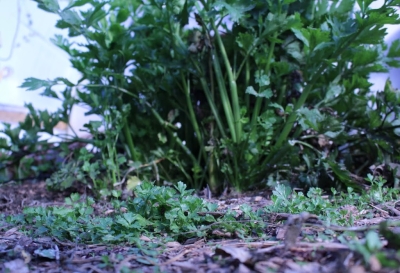
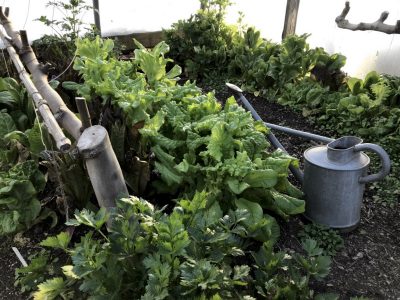
Which brings me to celery. Volunteer celery plantsFor the past few years, I’ve allowed celery in the greenhouse to go to seed each fall. The seeds drop and, within a few months, sprout to furnish plenty of seedlings for early summer celery in the greenhouse and later celery out in the garden. All of which is most welcome because celery seedlings are very slow to germinate and grow. Before celery volunteered around here, I had to sow seeds in early February in seed flats, keep the flats warm and moist until the seeds sprouted, transplant the sprouts into individual cells in another flat, and finally transplant the seedlings, after about 10 weeks of care, out into their permanent homes.
  Robust celery seedlings have sprouted and are now growing in a greenhouse bed and in the paths near near that bed, all without any help at all from me. I just lifted clumps of them, separated the seedlings carefully to minimize root disturbance, and “plugged” them back into the ground 8 inches apart. Pest problems are minimized because their new home is a greenhouse bed where celery hasn’t grown for the past two years.

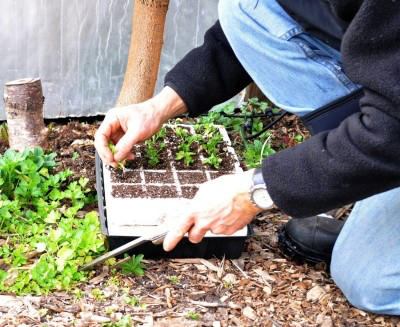
Seedlings from another clump when into individual cells of the APS Propagator; they’ll go outside into the garden in late April. I pulled a few leaves off all these transplanted seedlings so that they don’t lose too much moisture while waiting for their roots to settle into their new homes and get to work.Pricking out celery seedlings
  A lot of celery volunteers are still standing there in the paths and old celery bed. They are now weeds.

Ventura is the One for Me

Slow germination and growth, along with the need for a very rich and constantly moist soil, make celery more of a challenge to grow than most other vegetables. Which is one reason that I grow it!

  And there’s more. If seedlings are exposed to temperatures that are too cold for too long (55° or less for 10 days or more), the plants bolt, sending up seed stalks instead of growing thick, succulent leaves. Older books also talk about blanching celery, that is, piling soil up around the leaf stalks so they turn pale and tender from lack of sunlight. My celery rarely bolts, and I never blanche it.

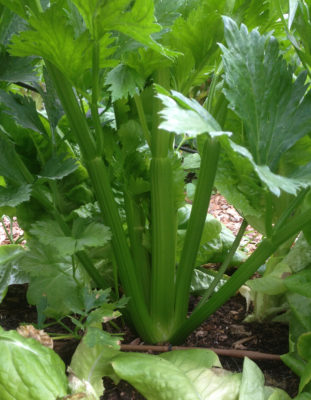
  One reason for my success with celery (besides, I hope, a greenish thumb) is the variety I grow: Ventura. This variety doesn’t need blanching and is grow thick crisp stalks with rich, but never harsh.Self-sown Ventura celery
  The best celeries I’ve grown were fairly large volunteers that I moved from the greenhouse path into a greenhouse bed one fall. I covered the plants for a few days to increase humidity while the roots were taking hold. All winter, those plants made the juiciest, longest, tastiest celery stalks ever.

Clementines are for More than Just Eating

Clementines are as tasty as the boxes they come in are useful. I can’t bear to throw those boxes out so have a stack of them waiting to be of use.

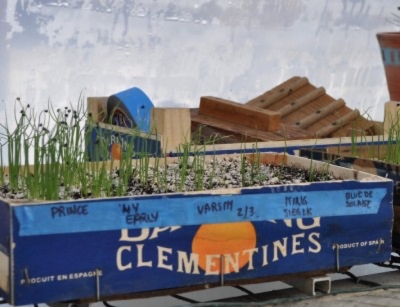
One box is home to my seed starting supplies: various dibbles and spatulas for lifting small seedlings to replant into larger flats; various sized pieces of plywood for firming soil in seed flats, some with dowels glued to their bottoms to lay out mini-furrows; tape and marking pens for labeling flats; popsicle sticks, also for labeling.Onion seedlings
  Two other boxes are now being used as seedling flats – for onions and leeks, sown in early February and now well on their way. Each box has 5 mini-furrows in which I sprinkled about 7 fresh onion or leek seeds per inch. The seedlings will grow in those boxes until transplant time, which is a couple of weeks before I’ll be planting out the Ventura celery.


Future Hopes

 Totipotentiality (Is This a Word?)

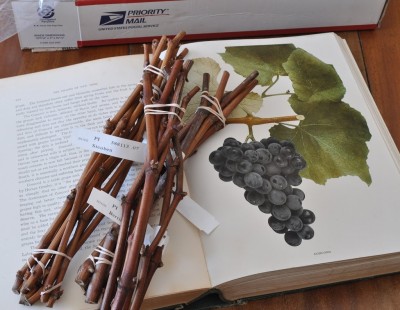
I was so excited one day a few years back to receive a box full of leafless sticks by mail. The exciting thing about those sticks was that each one of them could grow into a whole new plant from whose branches would eventually hang luscious apples and grapes.Grape cuttings

  And how did I know the fruits will be luscious? Because a year prior I was at an experimental orchard getting fruit photos for a book I was working on. Of course, I couldn’t help but also taste the fruits, and that’s why Chestnut Crab, Honeygold, Mollie’s Delicious, and King of the Pippins joined the two dozen or so other varieties of apples I already grew. Cayuga White, Bertille Seyve 2758, Steuben, Lakemont, Wapanuka, Himrod, Romulus, and Venus joined my grapes.

  It was “totipotence” – of the plants, not me – that allowed me to unlock potential treasures within those mailed sticks. Within a plant, every cell except for reproductive cells has the potential to become a root, a shoot, a flower, a thorn, a fruit, or any other part of a plant. For that matter, the same is true for humans and other animals. All that’s needed are the right conditions to get the various parts to grow – and there’s the rub.

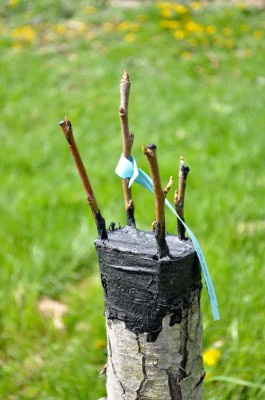
  A little art and science puts totipotence to work. In the case of the apples, I grafted those stems onto my existing trees or onto small rootstocks. Existing trees or rootstocks provide nothing more than roots to nourish shoots that will eventually sprout from the sticks. The plant beyond the graft remains genetically that of whatever variety is grafted upon the rootstock. Bark graftGrape sticks got plunged into the ground where they grew their own roots, shoots, and everything else. Apples aren’t so amenable to growing their own roots.
  I generally wait to graft or set cuttings until early spring. Warmth awakens those sticks. Until then, they’re kept cool and dormant.

  I planned on tasting the first fruits of my labors within about 3 years.

Out With the New, In With the Newer

None of those varieties I received as leafless sticks are still with me.

Because of pests, apples are especially problematic to grow here so I subsequently narrowed down my apple holdings to trees of my few very favorite varieties: Macoun, Liberty, Ashmeads Kernel, Pitmaston Pineapple, and Hudson’s Golden Gem.Cleft graft one year old

Except for Wapanuka, the grapes never tasted as good here as they did at that experimental orchard. Is it because of terroir? Was it the setting that influenced my tastebuds? Anyway, they’ve been replaced by other “sticks” — Somerset Seedless, Glenora, and Vanessa — that now bear fruit in the rows with my older, established vines..

Murphy’s Law, Amendments

Although I have gardened for decades, I still consider myself a relative newbie to greenhouse gardening. Sure, I’ve dabbled in various greenhouses over the years but I’ve only experienced the intimate vagaries of my own greenhouse for the last 18 years. It took time for it to finally dawn on me that Murphy’s Law – “Anything that can go wrong, will go wrong” – also applies in the greenhouse. In retrospect, why wouldn’t it?Greenhouse, March 1st

  I’ve had my brushes with the law. For instance, one winter evening a few years ago when I went to pick some lettuce for a salad; methinks, “Hmmm, quite nippy in here.” But then, except from when sunlight is beaming through the plastic covering, it’s always nippy in there in winter. Salad greens, kale, chard, and celery thrive in those cool temperatures, which dip into the mid-30s before the propane heater kicks on. (The in-ground figs stay dormant and leafless.)

  Still, temperatures felt nippier than normal so I checked the thermometer to confirm and, yes, it was getting down to the high 20s. I then checked the propane heater; it ignored me as I twisted the dial on the thermostat clockwise.

  Right then and there, I proposed an amendment to Murphy’s Law: “Anything that can go wrong, will go wrong — at the worst possible time!” Temperatures the night before had plummeted below zero. No wonder a water line had burst that morning. I had assumed that frigid temperatures had made only that corner of the greenhouse too cold. Fortunately, after a lot of nail biting, the gas man and I determined that the pilot light had blown out in the heater. Most plants survived the cold.

  One event does not a Law make. Thinking back to another Murphy event, I remember an even more serious freeze in the greenhouse. One day everything looked verdant; the next day mush. (The gas company had forgotten to re-fill the propane tank.) After that event, I rigged up a backup electric heater, just in case temperatures dropped below freezing.

  Perhaps yet another Murphy’s Law Amendment is needed. On the night of a more recent freeze, the electric heater was, of course, hooked up. Except it wasn’t poised for warmth. The thermostat was directing it to wake up, but I had forgotten to flip the heater’s “on-off” switch to “on.” My bad.

  Live and learn: The sun is now setting, the mercury is now plummeting, but no fear of high winds blowing out the pilot light again. I subsequently upgraded the heater for a pilot light-less one. But when I go out to pick some lettuce, celery, and parsley, I will: Check propane heater, check electric heater, check that the water line is off. And remember to latch the door closed on my way out — really!

Late Winter Sap, Pruning, and Planting

The Sap is Flowing

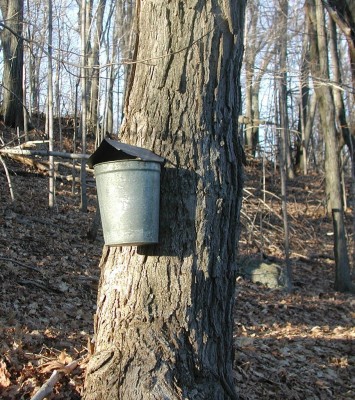
In past years, now is when we would always hope to make enough maple syrup to last until the following year at about this time. Maple syrup consumption has dropped dramatically, leaving me with quite a backlog of the stuff. So trees haven’t been tapped for the past few years.Tapping a maple tree

Not that we ever made that much maple syrup. Four tapped trees always produced sufficient sap for a year’s worth of syrup. It had to, because that’s how many spiles (taps) and buckets we own.

Our operation was nothing like what I came upon a couple of weeks ago cross-country skiing in the woods of northern Vermont. All of a sudden tubes had appeared in the pristine, white wilderness. Tubes everywhere! Baby blue plastic tubes, black plastic tubes, interlocking connectors, everything neatly wired into position at chest height and thoughtfully out of the way of any skiers enjoying the woods.

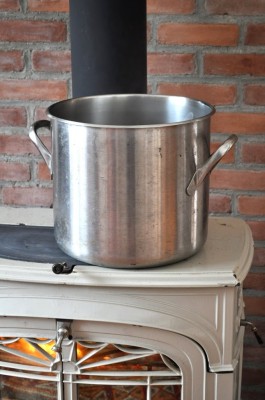
Processing the sap here at home is done quite differently from those commercial operations. Our low-tech approach was to merely add each day’s “catch” from the four buckets to a big stock pot sitting on the woodstove. The woodstove is stoked pretty much continuously this time of year, so the sap was always evaporating, with the added bonus of humidifying the house.Boiling maple sap

I see a few eyebrows going up. Sticky walls and ceiling are what comes to some minds upon the mention of cooking down maple sap indoors. Well, that’s usually myth. Sticky walls and ceiling only result when the sap is in an active boil and bubbles bursting on the surface of the liquid sent little droplets of sugar water into the air and onto walls and ceilings. But until the final stage of our sap-making, the sap was just slowly evaporating. The vapor given off by slowly evaporating, simmering, or boiling a solution of any sugar and water is nothing more than water vapor. That’s why the maple sugar becomes concentrated in the remaining liquid.

In those final stages of concentration, with much reduced liquid volume, the liquid can indeed reach an active boil. The pot of liquid announces that it’s nearing that stage by starting to gurgle like a baby, at which point it needs to be watched closely, mostly so that the syrup doesn’t get too concentrated or burn. The finish point is when the temperature of the liquid reaches about 219 degrees F.

Another Maple, Not So Good

Someone contacted me to say that, “The squirrels were chewing on Norway maple tree last week and sap was seen dripping down,” then went on to ask if that meant it was too late to prune. Perhaps the squirrels were enjoying some of the sweet sap. Yes, you can tap and boil into syrup the sap of all kinds of maples; I’ve tapped and made syrup from silver maple, red maple, boxelder, and, of course, sugar maple.

Getting back the pruning… It’s not at all too late. It’s fine to “dormant” prune any plants up until the time when they unfurl their leaves in spring.

Another good question might be: Why not just cut the Norway maple down to the ground? The trees are invasive and displacing our sugar maples, they have poor fall color, and they create lugubrious shade beneath which grass and much else can’t grow. Mostly, people keep these trees because they are already in place and full grown.

Pea Planting, Almost

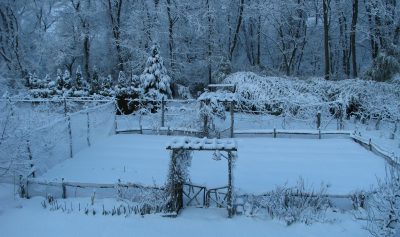
Despite snow covering the ground on the ground, I’m still planning to scratch open a furrow and plant peas – the first outdoor planting of the season – on April 1st.

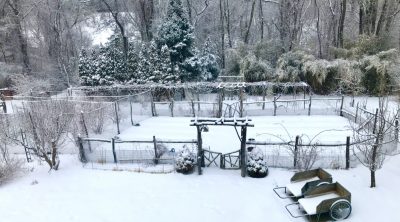
Given the white blanket, which may not be around by the time you read these words, some people might think me crazed for planting peas so soon. Then again, those people who insist on getting their peas in the ground before St. Patrick’s Day might think I’m dragging my heals.Winter scene, N garden

Here are the facts: Peas grow best at cool temperatures, making early sowing a must. The seeds will sprout whenever the soil temperature is above 40 degrees F. But St. Patrick’s Day can’t be the universally best time to sow peas because different places experience different climates on that date. It’s probably too late in Florida, too early in Maine, and just right in Ireland.

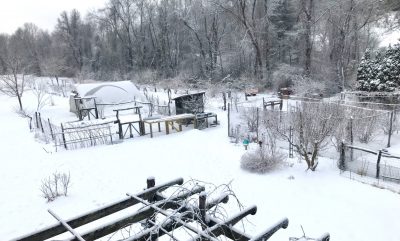
So call me a fool if you like, but I’m still planning on an April Fools Day planting for my peas. I’ll wait a few more days if the ground is frozen or covered with snow. Just a few days though, because things move quickly this time of year.Winter scene, looking south

Inside and Outside

Houseplant Envy

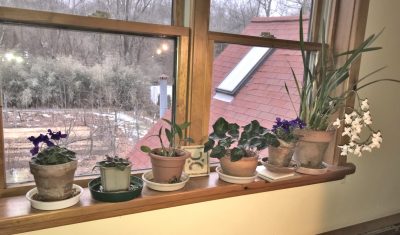
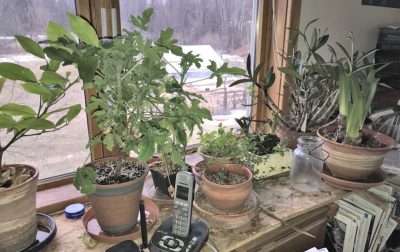
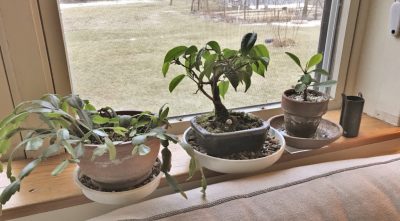
I wonder why my houseplants look so unattractive, at least compared to some other people’s houseplants. I was recently awed by the lushness and beauty of a friend’s orchid cactii, begonias, and ferns. I also grow orchid cactii and ferns, so what’s with mine?Houseplants at bedroom window

Perhaps the difference is that other’s houseplants have a cozy, overgrown look. Mine don’t. Most of my houseplants get repotted and pruned, as needed, for best growth. Every year, every two years at most, they get tipped out of their pots, their roots hacked back, then put back into their pots with new potting soil packed around their roots. In anticipation of lush growth, stems also get pruned to keep the plants from growing topheavy.

Rather than being scattered willy-nilly throughout the house or clustered cozily in corners, as in friends’ homes, my houseplants get carefully sited. For best growth, plants, especially flowering and fruiting plants, need abundant light, something that’s at a premium this time of year. So my houseplants huddle near south-facing windows like baby chicks near a heat lamp. And then in summer, when light, even indoors, becomes more adequate and the plants could move a bit back from the windows, I move them all outside so that summer sunlight, rain, and breezes can really get them growing.

What can I say? I’m too focussed on good growth, and that’s not necessarily what makes for the prettiest houseplant. It’s the difference between a lush plant packed into and overflowing its pot, along with elbow to elbow neighbors, versus one that’s had its soil refreshed frequently, its stems thinned out and pruned back, always with younger stems raring to grow. I can’t help myself.Houseplants, office window

Choice of houseplants also comes into play. Houseplants that are prettiest for the longest period of time — and need less light — are those valued for the shapes and colors of their leaves. I gravitate to houseplants with fragrant flowers or fruits, or — even better — fragrant flowers and fruits. Pumping out lots of flowers and, especially, fruits demands much more energy from a plant than just growing leaves. And that energy comes from sunlight and young leaves that are efficient at working with that light. Hence the repotting and clustering near sunny windows of my houseplants.Houseplants at living room window

Perhaps it’s also a matter of the “grass is greener,” to me, in someone else’s house. I’ll start looking at my houseplants more with the eye of an appreciative visitor.

Winter Cold: The Good and the Bad

The temperature was 9° and we were on our way to go cross-country skiing when a friend asked if there was any benefit to the cold weather. Plantwise, that is. We knew the weather was good for skiing. Interesting question, and the answer is “yes.”Vegetable garden in winter

The first benefit that comes to mind is the effect of cold on diseases, certain diseases, at least. The cold kills them. Peach leaf curl, for instance, is a disease that overwinters in peach buds, resulting in leaves that unfold thickened and twisted and eventually yellow and fall so fruiting and growth suffer. Except in cold winters. My winters are usually cold enough so this disease is rarely a problem.

A number of summers ago late blight disease of tomato went on the rampage here and throughout the Northeast. That disease can’t spend the winter this far north because it’s too cold. In that past summer and some other summers, the disease hitchhikes north on infected plants brought here or, when winds and humidity are just right, hopscotches along north from one infected field to the next.

Insect pests that overwinter in the soil are more damaged the colder the soil gets, and bare soil gets colder than mulched soil, all of which highlights the balancing acts necessary in gardening.

Pests notwithstanding, bare ground isn’t good for plants and soil. Plant roots are more likely to be damaged by the increased exposure and, especially evergreens, are more apt to dry out because more water will evaporate from bare ground and because roots have a hard time drinking in water from frozen ground. Bare ground is also subject to erosion and nitrogen loss.

On the other side of the coin, bare soil goes through more cycles of freezing and thawing, which breaks up and moves around soil particles, in effect tilling the soil. Back to the previous side of the coin, that freezing and thawing can move soil around enough to heave plants, especially small or newly rooted plants, up and out of the ground.

So, I like cold weather for my plants. But I mulch heavily. And I especially like it, as do the plants — and, admittedly, some pests — when there’s an additional blanket of snow over the ground. It also makes for good skiing.South field, winter view

Snowy Skies & Winter Colors

Snow Outside but Color Inside

A day like this, a gray sky and six inches of fluffy, fresh snow laid gently atop the white already resting on the ground, hardly turns my mind to gardening or plants. Even the greenhouse, usually a cheery horticultural retreat in winter, is dark and cold. Snow on the roof blocks what little light peeks through the gray sky, and the heater doesn’t come alive until the temperature drops to about 37° F.

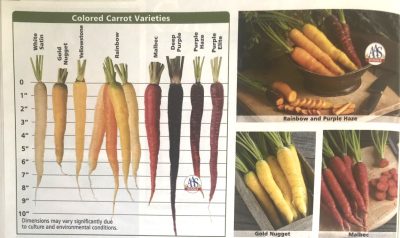
Carrots from jonnyseeds.com

And then I reach into my mailbox, and out comes summer! Seed and nursery catalogs oozing with photos of fresh carrots, heads of lettuce, juicy peaches, and sunny sunflowers. I’ve already ordered all my seeds, or so I thought until I started thumbing through more catalogs. Offerings in vegetable seeds, in particular, seem to get more interesting each year.

Take carrots, for example. Carrots have long been available in all sort of shapes and sizes. Nowadays, I can also buy seeds for white carrots (White Satin variety), carrots deep purple through and through (Deep Purple variety), and purple carrots with orange centers (Purple Haze variety).

Caulifower is also getting colorful. Its curds no longer need to be only white. The variety Cheddar is the color of orange cheddar cheese. Graffiti is a purple variety, unique among purple cauliflowers for retaining its color after being cooked. Years ago, I used to grow Violet Queen cauliflower, which turns green after being cooked and tastes very good.

I’m not saying that any of these interesting varieties taste better than less flamboyant varieties. Just sayin’ . . . they’re interesting.

Which Hazel?

Besides perusing summer-y seed and nursery catalogs, another antidote for a gray winter day is to get outside and enjoy it. I’m hoping to do that today, to glide through wooded paths on cross-country skiis.

No doubt I will come across plants flaunting winter weather and showing signs of life —even on this gray day. Native witchhazels, the so-called “common witchhazel” (Hamamelis virginiana), ocacionally still are showing off some of their strappy yellow flower petals. Witchhazel in bloomThe flowers don’t exactly jump out at you so you have to get up pretty close to even notice them. Still, they are a sign of plant life in the depths of winter.

Common witchhazel typically begins blooming in September and finishes by December. How seemingly foolish! It’s been hypothesized that they bloom when they do so as not to compete with another species, vernal witchhazel (H. vernalis), where both are native. (This seems an unusual explanation because plant evolution is generally encouraged by cross breeding. That’s why an apple tree, for instance, can’t pollinate itself even though each of its flowers have both male and female parts; it has to cross with pollinate with a genetically different tree to make seeds and fruit.) Vernal witchhazel, at home in the midwest and south, begins blooming in January and might continue until spring.

Even without that competition, not much reproduction is going on with common witchhazel. It has a motley crew of pollinators: tiny wasps, fungus gnats, bees, flies, and winter moths. And even with all those matchmakers, less than 1% of flowers go on to form fruit and make seed. The seeds, 2 per fruit, are shot out of the fruits in autumn. After weevils, caterpillars, wild turkeys, and squirrels have had their fill, only about 15% of those few seeds survive. It’s a wonder that I come upon so many witchhazels in my winter glides and walks.

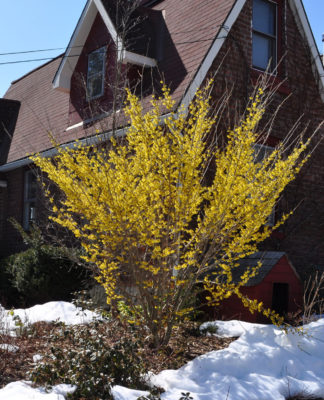
Looking over plant and garden notes from last year, I see that my cultivated witchhazel, the variety Arnold Promise, bloomed in my front yard in mid-March last year. That variety is a hybrid of Chinese and Japanese species. It blossoms later and its blossoms are much, much showier and more fragrant.

Sow Already?

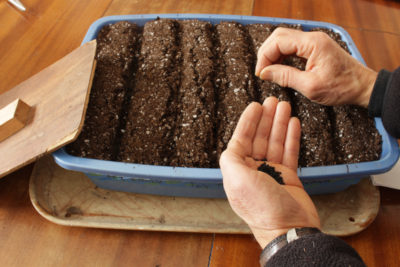
Sowing onions indoors

Last year, sowing onion seeds

According to my notes, I’m due to plant onion seeds sometime soon. Yes, seeds. Seeds are the only way to be able to choose from the widest selection of onion varieties. Still, seeing witchhazel flowers will not be enough to well up in me an urge to plant anything. Tomorrow will be sunny; that should do it.

Update: Except that I chose the sunny day to go skiing instead. The onion seeds can wait. Growth is so slow early in the season that, come early May, there’s little difference in size among seedlings grown from seed planted now or within the next couple of weeks.