A Changing Landscape

Wormy Matters

Charles Darwin did some of his best work lying on his belly in a grassy meadow. Not daydreaming, but closely observing the lives and work of earthworms. All this lying about eventually lead to the publication of his final book, The Formation of Vegetable Mould through the Action of Worms. Darwin calculated that earthworms brought 18 tons of nutrient-rich castings to the surface per acre per year, in so doing tilling and aerating the soil while rendering the nutrients more accessible for plant use.
I wouldn’t find that many earthworms at work in my own grassy meadow. The last glacier, which receded about 12,000 years ago from the northern parts of the U.S., including here in the Hudson Valley, wiped out all the earthworms. Darwin’s meadow was spared because glaciation didn’t reach as far south as where Darwin’s home eventually stood.

Not that there aren’t now any earthworms here. Mostly, these are non-native species that arrived over the past couple of hundred years and continue to arrive as fishing bait, ship ballast, and in soil clinging to the roots of transported plants. Some native earthworms may also have made it up here from New Jersey. Not many, though, with their estimated top travel speed of less than 6 yards per year.
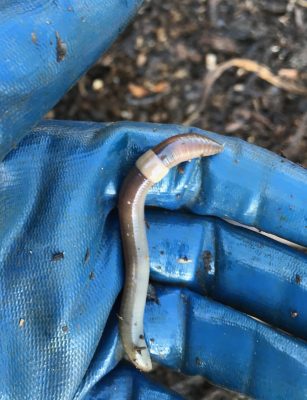
A crazy snake wormThese non-native earthworms are of concern because of the rapidity with which they gobble up organic matter. Their voracious appetites threaten the mountain laurels, rhododendrons, and blueberries that thrive in the organic matter — the leafy mulch — that blankets the forest floors in our nearby Catskill and Shawangunk Mountains.

Those invasive species could effect a change in the landscape we view as we drive along mountain roads and hike the trails.

Grassy Matters

Back to my meadow, which I have also spent a lot of time observing, but from a standing position, usually with a scythe.

Most years the meadow receives a once a year mowing, usually in late autumn, with a tractor. (Early on, I mowed it all summer long with a scythe but the rich soil encouraged lush growth that resulted in tennis elbow. I still scythe parts of the meadow, in moderation.) That once a year mowing is meant to forestall the encroachment of woody plants. In this part of the world, open land typically reverts to forest.

At its best, my meadow presents a lush sea of green that contrasts nicely with the close-cropped areas of lawn near my home. A sinuous path mowed through the meadow, tracing out a different route each season, invites walking through it for more intimate exploration. (I refer to this as “Lawn Nouveau” in the grass mowing chapter of my book, The Pruning Book.)
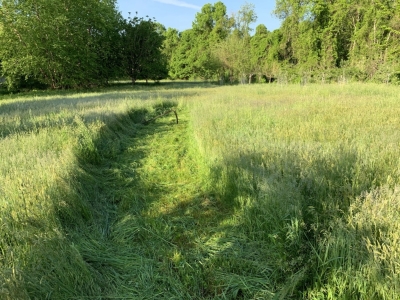
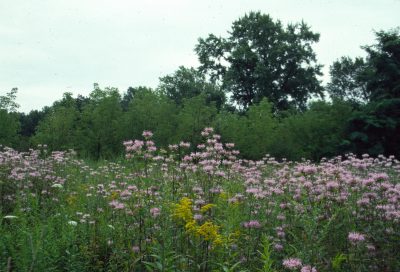
Path through my meadowThrough summer, pale pink milkweed blossoms dot the meadow. Come late summer, purple flowers of bee balm cap the sea of green grass like ocean whitecaps. And then, later and on into autumn, various species of yellow goldenrod bloom in succession. In the cool of the morning, dew and morning sunlight bring sparkle to the show.
Meadow with goldenrodMeadow with monarda

Grasses Return

A couple of seasons ago I noticed that bee balm and goldenrod were getting increasingly sparse, as were the grasses. Each year increasing amounts of multiflora rose, wild blackberries, poison ivy, even an occasional staghorn sumac were honing in, paving the way to a forest.

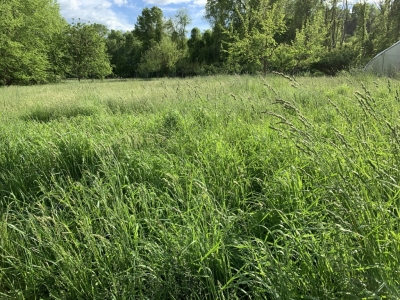
Last summer I decided to tip the balance back to meadow. My plan was simple; all I did was mow the field regularly to lawn height. Grasses, which are monocotyledonous plants with their growing point just below ground height, are pretty much the only plants that tolerate regular mowing (or, in the case of prairies, burning). Mow, and grass will come.

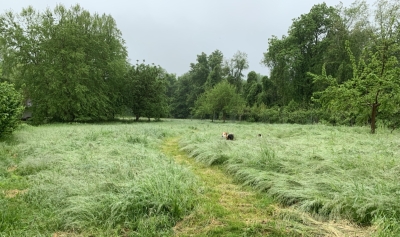
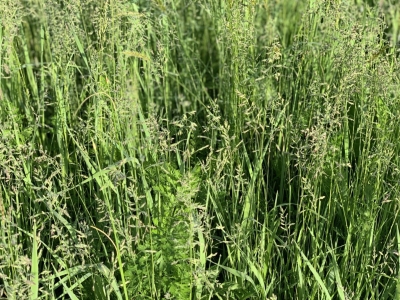
This year, meadow grasses are already growing thickly and a couple of feet high. Looking closely, I see very little poison ivy and friends. I will be interested whether  or not bee balm and goldenrod appear onstage later, in summer. Another season or two may be needed before they make their appearance.Close up of meadow plantsMeadow of wet grass, with dogs
Inevitable Changes

Our forest flora are dynamic. The nearby mountain laurels, rhododendrons, and blueberries, meadows, all landscapes, in fact, are not forever, even without human encroachment. I’m not trying to maintain my meadow in a romanticized primordial state; I just like the look of the grasses, bee balm, and goldenrods.

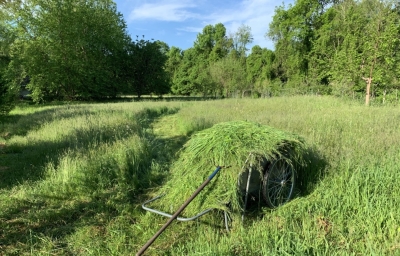
The meadow also has a practical side. My scything provides hay for compost  (along with some horse manure, a waste product of a local stable) and mulch. Taking the hay from limited and different areas each season allows time for the soil to regenerate itself.Meadow with cartful of scythed hay
GARDEN & PLANT SALE, June 1, 2019

Plant sale annoucement for June 1st 2019

Aquatic Matters

Rain, Rain Go Away; And It Did

Now that this spring’s incessant rains have stopped, we can settle in for dry weather. I hope.

Yes, I should be careful about what I hope for, but plants and people generally enjoy clear, blue, skies. For plants, those days mean plenty of light — actually, more than enough, but no harm done — for photosynthesis, which translates to better flavored fruits and vegetables, and conditions inimical to fungal diseases.

Watering can, copper craftA plant only benefits under these conditions, of course, if it also has enough water at its roots. To that effect, yesterday, in celebration of the second clear, sunny day, I turned on and checked out the drip irrigation system that provides that water to my vegetable plants and blueberry bushes. (With mulches and choice of appropriate plants, all other plants are on their own.)
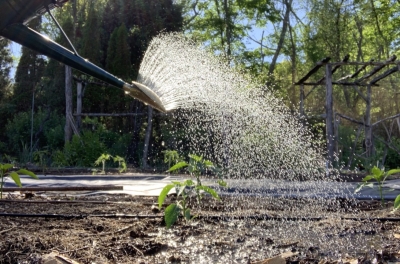
Despite the drip irrigation and self-sufficiency of other plants, some hand watering is called for. Trees and shrubs, their first year in the ground, for instance. Also, newly set out vegetable or flower transplants need assistance until their new roots reach a wetting front. The wetting front gets deeper and deeper as a soil dries out. Even with drip irrigation, the wetting front recedes from the ground’s surface with distance from each drip emitter, taking on the shape of overlapping ice cream cones in the soil with their high points right at the surface where an emitter is dripping water. Newly planted seeds likewise need aquatic assistance until they sprout and their roots dip into the wetting front.

A Good Can Is . . . 

A hose and a hose wand is one way to get water to needy plants, but for places where it’s not worth the trouble of dragging a hose, a good watering can is just the ticket. You think that a watering can is a watering can? Not so. A quick browse through the web reveals a slew of watering cans differing in style and, hence, ease of use. I’ve tried out a few over the years and, of course, have my favorites. 

Size matters. I want a watering can that’s large enough so incessant re-filling isn’t needed for its typical jobs, but not so large as to be unwieldy when filled with water, which weighs in at over 8 pounds per gallon. For houseplants and occasional light jobs, 1.5 gallons works well for me. For more extensive watering, 2 or 3 gallons. The self-serving recommendation in the ad copy for a 3 gallon watering can suggests, “Buy two for a balanced load.” Actually, not a bad idea.

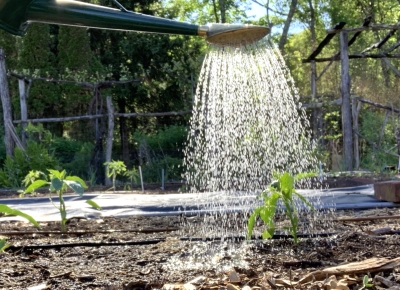
Next, I look at where water exits. Some, usually houseplant watering cans, have merely a spout. Other eater cans have a rose, with little holes for the exiting water. Watering can, rose watering upEspecially for watering seed flats and small seedlings, a rose needs to be gentle enough to release water sufficiently fast without washing soil around or crushing small plants. Watering can, rose watering downSome debris is bound to find its way into any watering can and thence to the rose, which needs to be removable and easily cleared. Watch out for thin, plastic roses, which are bound to crack after a few cleanings.
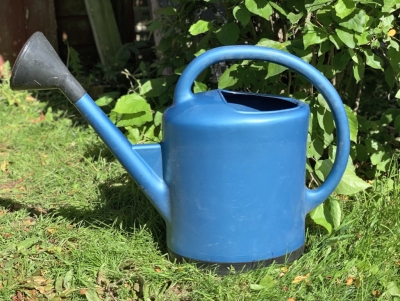
Speaking of cleaning, I like a can with an opening large enough for me to reach into. Then I’m able to just scoop out a leaf or a twig that found its way inside without waiting for its journey to the rose. Too big an opening, though, and water splashes all over when the can is carries; one watering can that I saw on the web — an open metal can with a spout — takes this to the extreme!

The attachment of a watering can’s handle affects its balance when carried or used. Ideally, you’re not struggling to counterbalance the can in either case.

Finally, there’s the material out of which the can is made. I’m wary of any plastic watering can. Haws has been manufacturing quality watering cans since 1886 but even their plastic watering cans are not worth the plastic they’re made from; I’ve had two that either cracked or leaked. A copper watering can is expensive but will last just about forever. 

And the Winners Are (in My Opinion) . . .

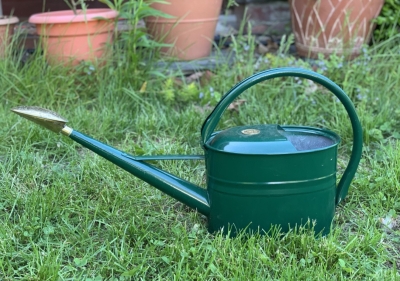
As stated, I have some favorite watering cans. Despite what I wrote in the previous paragraph, three of my four favorites are made by Haws. One is the 1.3 gallon, metal can, more specifically the “Bosmere Haws Slimcan Metal Watering Can, Green”. What to say? Nothing more. It has all the characteristics I seek in a watering can of this volume.Watering can, green Haws

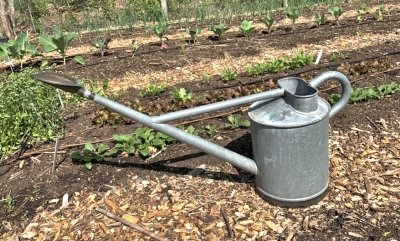
My other two favorites, also Haws, are the same, each with 2 gallon capacity and the same long-reach style and look as the 1.3 gallon Haws. The 2 gallon cans are galvanized, not painted, on their outsides.Watering can, 2 gal Haws

(Galvanized steel does eventually rust. A few years ago, one of my 2 gallon Haws developed pinhole leaks. I’m not complaining; the cans are 30+ years old. I reached inside and dripped some Gorilla Glue, which is waterproof and spreads as it dries, over the holes. That repair is still good after 5+ years!)

Up above, I dissed plastic watering cans — yet another of my favorites is a plastic can, a 3 gallon “French Blue Watering Can”. This one is a thick plastic that seems very crack resistant. It also fills the bill in other ways, especially its balance, which is especially important when I’m wielding a can that can hold 24  pounds of water.Watering can, French blue

One More

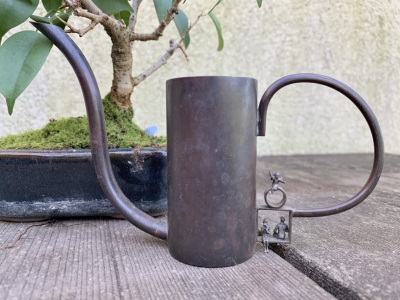
Oh, there’s one more watering can that I really like. It’s more like a watering jar than a watering can, with a capacity of about 1/2 cup. It was purchased at a craft fair. And it is copper. I use it to water my bonsai.  Mostly, though, I like to look at it.Watering can, copper craft

A New, Old Twist on Strawberries

Strawberries White and Early

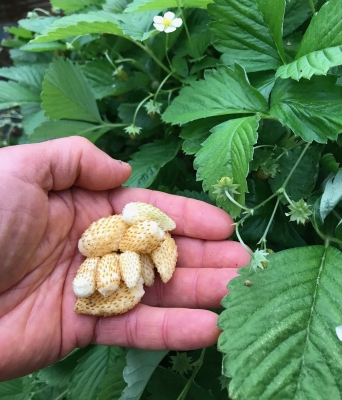
Awhile ago I plucked some ripe strawberries and handed them to Rachel for a taste. Her ho-hum reaction told me that I hadn’t picked carefully enough. Yes, the berries were white, but that’s their color when ripe — and also when not ripe.You should be scratching your head by now. Strawberries that are white when ripe? Strawberries perhaps ready for harvest in early May here in the Hudson Valley?
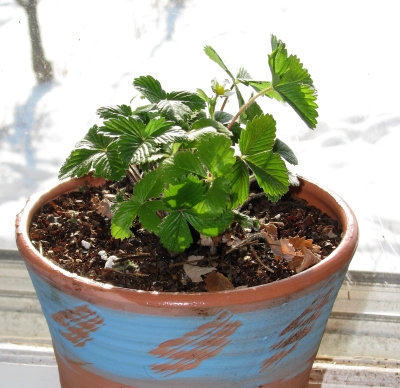
The berries I handed Rachel were alpine strawberries (Fragaria vesca), a different species from our usual garden strawberries (F. X ananassa). They are a kind of “wood strawberry” (often going under their more upscale-sounding French moniker fraises de bois) first encountered about 300 years ago near Grenoble, France. These strawberries are different from garden strawberries in many ways.

For one thing, alpine strawberries are everbearing. They’ll pump out fresh berries as long as given sufficient warmth, water, and nutrients. Mine are bearing now because they’re planted in the ground in my greenhouse. In my pre-greenhouse life they fruited for me in early spring in 3” diameter pots in a sunny window.And no, the plants hadn’t resided in my home and aren’t now in my greenhouse to protect them from winter cold. I wanted an earlier crop. I also grow them outdoors.
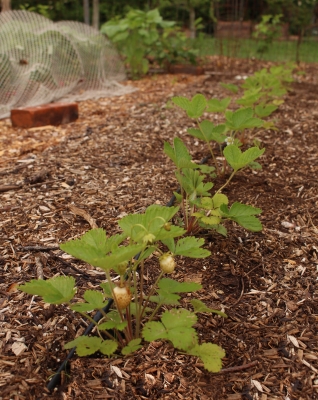
'Pineapple Crush' strawberries

‘Pineapple Crush’ strawberries

Alpine strawberry plants are adapted from where winter temperatures plummet below minus 30°F. to regions that hardly experience winter.

These strawberries also part ways with garden strawberries in not producing any runners. I consider this a plus because the worst weeds in a garden strawberry bed are often the plants themselves. As runners strew about and take root, they crowd each other out. The resulting shade and higher humidity make for lower yields and plants more prone to disease.

About 40 years ago, alpine strawberries were hybridized with garden strawberries, with the resulting plants showing typical hybrid vigor with larger fruits and more robust growth. The variety Florika was one of those hybrids, billed as having very good flavor and sufficient vigor and disease resistance so that it can be planted to create a fruiting meadow. Sara and Rebecka are two other hybrids. (Unfortunately, all are red-fruited.)

I’ve never grown any of these hybrids, but will — very soon. Stay tuned.

Small, But Very Easy to Grow

Alpine strawberries are not the strawberries to grow to fill your freezer for winter. Unless you have a lot of patience, that is, because the berries are small, typically about the size of a dime. (The hybrids bear larger fruits, measuring over an inch long.)

You also will rarely, if ever, find the ripe fruits for sale. If they are truly ripe, they are very, very soft, and very, very perishable. The only way to truly experience these berries them is to grow them yourself (easy) and then harvest them dead ripe (pretty easy).

The plants thrive in moderately rich, well-drained soil in full sun or partial shade. In pots, any basic potting mixture will suffice. Potted alpine strawberriesA planting can be started from plants or seeds, the latter started just as are tomatoes. Plants grown from seeds planted in spring will begin bearing their first season.
New plants can also be made by dividing old plants, cutting the crown into pieces along with their attached roots. As with many herbaceous perennials, division or starting new plants is a necessity as plants age and their centers become woody and decrepit.

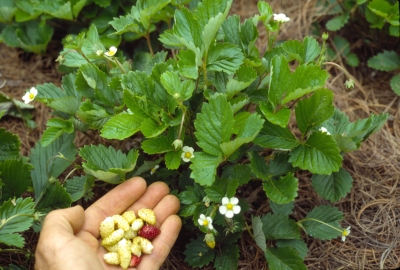
As far as timely harvest, one way is to follow your nose; the berries are extremely fragrant when ripe. Look at the berries: Ripe ones turn from white to creamy yellow, and their seeds darken to brown. Just the gentlest coaxing removes a ripe fruit from its stem.

Scrumptious!!

A number of gardeners grow alpine strawberries, the red-fruited kinds, which come in a number of varieties. There are, likewise, many varieties of white-fruited alpine strawberries. One year I decided to see just how different these varieties are from one another.Red and white-fruited alpine strawberriesIt turned out that all the red-fruited ones were similar, as were the white-fruited ones. For me, the white ones definitely had better flavor. And the flavor could be enjoyed. Why? Because until they are dead ripe, alpine strawberries have taste somewhat akin to cotton soaked in lemon juice. Problem is that birds are very attracted to, and eat, the red fruits no care as to whether or not the berries are dead ripe.
Birds don’t notice the white fruits when they are ripe so leave them alone for our enjoyment.

A few days ago, when I again saw Rachel, I offered her some more carefully picked fruit. She put them in her mouth, blinked and then open her eyes wide, and exclaimed, “Wow!” That’s the usual reaction to the fruit. Ripe, the white fruits are sweet and richly aromatic with a commingling of scrumptious flavors of strawberry and pineapple.

———————————————

Any gardening questions? Email them to me at garden@leereich.com and I’ll try answering them directly or in this column. Come visit my garden at www.leereich.com/blog.

Grape Futures

My Rationale for Pruning so Late

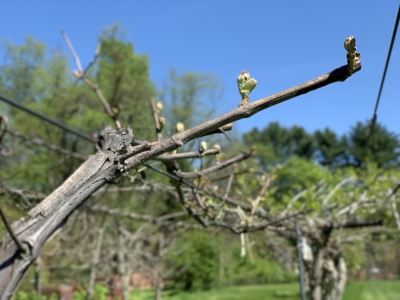
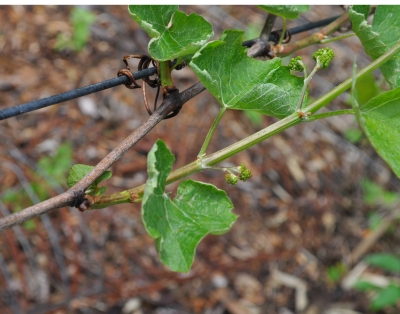
Today I put the finishing touches on pruning my grapevines. Yes, it’s late: The buds have already swollen and expanded into clusters of small leaves. But there’s “method in my madness,” or, at least, my tardiness.

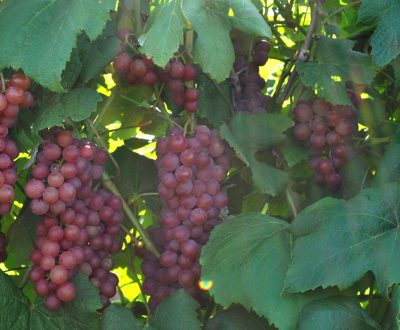
Vanessa grapes

Vanessa grapes

My vines often experience some winter damage, some varieties — New York Muscat, Reliance, and Vanessa, for instance — more than others. Waiting to prune until I see some green saves me from cutting off too many living canes and saving too many dead canes. In winter it’s not so easy to tell them apart.

So I do mostly rough pruning in winter, lopping back canes that have to go whether they’re living or dead. Canes also need to be shortened, even those that are to be eventually saved.

Which brings me to another reason I left the final pruning until today. Plants generally make their earliest growth in the season starting at the tips of shoots or canes. So when I shortened the remaining canes in winter, I didn’t cut them all the way back to their final length. Then if a late frost nips or kills early growth, it’s no problem. The canes are going to be shortened even further — today — to where buds were not as fully awake and susceptible to cold.

But waiting too, too long to prune can be problematic because those swollen buds flick off their resident canes with very little coaxing. Leave too much to prune this time of year and a lot of buds fly off as pruned canes are pulled down off the plant.

Why Prune? How?

A grapevine bears fruit near the bases of shoots that grow off one-year-old canes. Left to its own devices, the vine might grow 50 feet up into a tree, bear so heavily that it can’t provide sufficient energy to pump optimum flavor into each berry, and become a dark, dank, tangled mess of stems — perfect conditions for fungal diseases.
The goal of various methods of training and pruning grapes are the same: to leave a suitable number of canes conveniently positioned for harvest; to provide buds to grow into new, well-placed shoots for fruiting the following season; and to create a form that allows for good light and air circulation. As might be expected of a plant that’s been cultivated for thousands of years, many ways have been devised for training grapes.

The Four-arm Kniffin System is a kind of “cane pruning,” a traditional method of training in eastern U.S.. For support, a two-wire trellis, with one wire 6 feet and the other wire 3 feet above ground, is needed. The mature plant consists of a trunk with four canes growing from it, two trained in opposite directions along the upper wire and two similarly trained along the lower wire.

Pruning begins as four canes to carry the season’s fruits are selected. These canes should be moderately vigorous and originate close to the trunk and near the wires. With this year’s fruiting canes selected, plans for the following season’s crop are made by cutting back some stems to two buds each; these renewal spurs, as they are called, provide points of origin for new shoots (which will become fruiting canes in a year) near the two wires and on either side of the trunk.

Next, lop away all growth except for the four renewal spurs and the four saved canes. Finally, shorten each of the canes to about 6 ft. in length, leaving about 10 buds per cane (not counting bud clusters near the bases of the canes). This leaves ten times four, or 40, fruiting buds on the plant.

Many Methods with the Same Goal 

At the other extreme in pruning is “spur pruning,” where all that’s left is many 2-bud canes (now called “spurs”) from which grow fruiting shoots. “Head training” would be the most basic spur pruning, with the pruned vine left with nothing more than a trunk capped by a number of spurs.
A spur-pruned vine might instead sport a permanent trunk topped by two arms — permanent arms, called “cordons,” in this case — that run in opposite directions along a trellis wire.
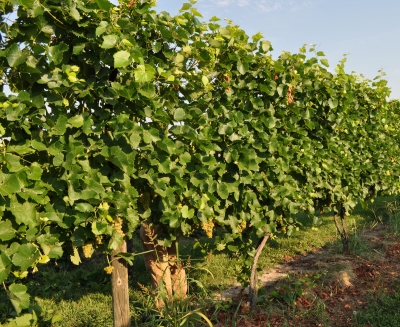
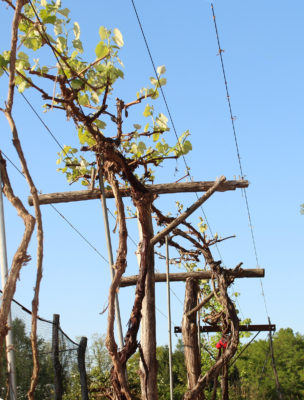

Instead of leaving 4 long canes on which to bear fruit, many short, 2-bud canes are left along the cordons. To get the same number, 40, of fruiting shoots on a spur-pruned vine as on a Kniffen-pruned vine, twenty 2-bud spurs are left. All excess are cut away so that those that remain are 6 to 12 inches from their neighbors. Over time, some spurs will stretch, even after being shorted to 2 buds of one-year-old shoots, further away from the cordon. Lopping these back nearer the cordon puts them back in order.

Where to put all those fruiting shoots growing from the spurs? With “midwire” cordon training, cordons are trained along a wire at 3 foot height, and new shoots are trained upward by weaving them into 3 rows of wires strung at one foot above the cordon wire.
With “high-cordon” training, a trunk rising to about 6 feet is capped by two cordons trained in opposite directions along a wire. Fruiting shoots droop downward.High wire double cordon spur pruned grape
My grapes grow as high cordons, with a wrinkle; their fruiting shoots spread horizontally, rather than droop down. Wooden cross pieces provide this support on my arbor. Although this rigorous pruning puts off how soon the arbor offers relief from early summer sun, the arbor never becomes a tangled mess of stems and disease-ridden berries characteristic of many helter-skelter pruned grape arbors.

The trellis for my other high-cordons have two sets of wires running parallel on either side and one and three feet from the cordon’s wire. These wires provide a ledge on which fruiting shoots can rest, with clusters of grapes dangling just high enough for me to reach for easy harvest.

Plant Sale reminder

Plant sale annoucement for June 1st 2019

TIME TRAVEL

18th Century, Here I Come!

Is that me playing the fife? No.

I just returned from time travel one month forward and a couple hundred years backward. Both at the same time! I did this with a trip to Colonial Williamsburg, Virginia, where black locust trees were in full bloom, which is about a month ahead of when they will be blooming up here in New York’s Hudson Valley.

The impetus for this time travel was Colonial Williamsburg’s Annual Garden Symposium, at which I was one of the presenters. (I did presentations on espalier fruit plants and on growing fruits in small gardens.)

Williamsburg is a magical place anytime of year, and especially so, for me, in spring. (I first fell in love with the place on a family trip when I was 7 years old; on subsequent visits, I’ve forgone the three-cornered hat I wore on that first trip.)

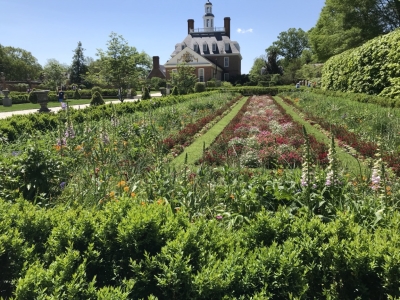
The governor's garden

The governor’s garden

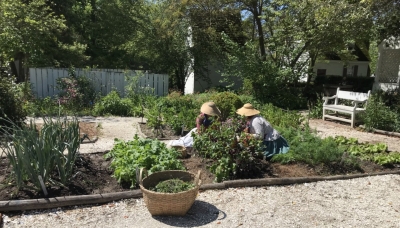
The Symposium included tours through many of the colonial gardens, where we  could see, in action, “colonial” gardeners caring for their plants — in many cases using some of the same techniques we use today. Glass cloches, for instance, covered portions of some gardens to hasten warming of the soil for earlier sprouting of seeds. Colonial vegetable gardeners at workFlowering meads of herbs, flowers, and grasses blanketed the ground beneath most of the orchards, providing — probably unknown back in colonial days — forage for beneficial insects to help protect crop plants.
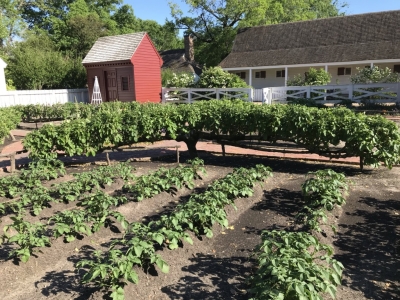
The flowers and vegetables — and fruits in the orchards — are the kinds and varieties grown in colonial times: cardoon, cornflower, chives, cockscomb, pot marigold, nasturtium, hollyhock, Johnny-jump-up, Tennis Ball lettuce, Yellow Crookneck squash, chard, and, of course, corn. Field corn, probably, but also, possibly, sweet corn, which was first given by the Iroquois to settlers in the late 18th century.

Espalier apple trees border vegetable plots

Espalier apple trees border vegetable plots

The gardens in Williamsburg provided and provide more than just sustenance. As in the orchards, flowers mingle with crop plants, in this case, vegetables. Most yards in the reconstructed town are one-half acre, with the land separated into sections with white wood fencing. The whole effect is très charmante. Couple that look with the lack of automobiles within the reconstructed town, and the quiet nights illuminated by the soft glow of fire and candle light (supplemented by electric lights with a candle-like glow), and I think I may want to move back into the 18th century.

Wall Envy

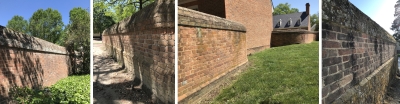
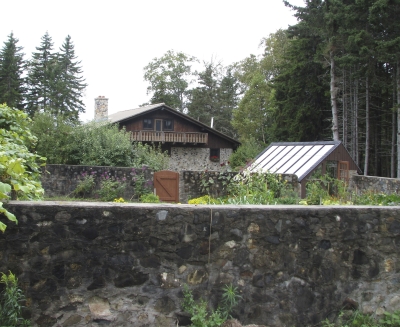
One problem I had with Colonial Williamsburg was wall envy. The church on Duke of Gloucester street, the governor’s mansion, and some other public spaces were enclosed by beautiful brick walls capped with functional and decorative rounded brick.

Most of the homes were covered with white-painted, wooden clapboards. The church and the governor’s mansion were made of brick, which, obviously, harmonized well with their brick walls. Brick wallsMy own home is brick; even a few four-foot-high walls around my vegetable garden and in other areas would improve the general appearance — and provide, warmer microclimates for cold-tender plants or early harvests. Not that the rustic locust fencing and arbors enclosing my vegetable garden look unsightly . . . but I’d like some brick walls.
Incidentally, bricks are made on site at one of the many trades demonstrated within the reconstructed town. I stopped in at the gun shop and stayed soaking up history I never learned in school — how most colonists owned relatively inaccurate muskets which were good enough for hunting and keeping varmints out of gardens, and the real sharpshooters were those with “long rifles,” that is, firearms with rifled barrels that spun their lead shot. But winning a battle wasn’t all about sharpshooters. Long rifles took much longer to reload than muskets, and which side threw the most lead in the air often was what decided who won.

(As part of my immersing myself in 18th century life, I signed up to go to a shooting range to actually fire a flintlock musket. This event, as recorded with 21st century technology, a phone, is documented Musket shooting1, Williamsburg, Musket shooting2, Williamsburg.)

Bricks, rifles, furniture: all these trades are practiced as they would have been in the 18th century. The rifle maker begins his work with nothing more than a block of wood and a block of iron. Four-hundred  hours later, he has in hand a finished rifle. Fabric artisans begin with a sheep or flax seeds and some natural dyes. Cabinetmakers begin with trees or rough cut wood. Their tools are the same as those that to which their 18th century forebears had access.

Plant Envy

In addition to my wall envy, I also experienced the usual plant envy that afflicts me when I go south. Southern magnolia tree reach majestic proportions in Williamsburg; I would like to, but cannot, grow them in this cold climate. Crape myrtle is another, for its flowers and its bark mottled in pastel shades; too cold here for this one also.

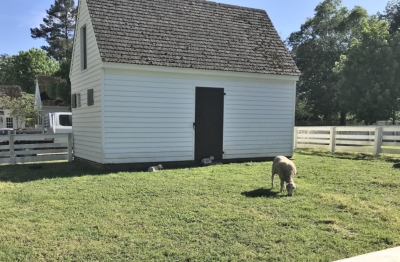
I did come upon a number of specimens of fringe tree (Chionanthus spp.), with which I’m only vaguely familiar. The fringes of white blossoms dangling in profusion from the branches made me want to become more familiar, i.e. to plant, this shrubby tree. It turns out that I could — and will — grow fringe tree.Sheep and a barn

Fruit Tree Pruning

The Why, and the Easiest

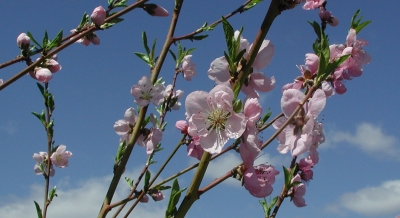
Following last week’s missive about pruning fruiting shrubs, I now move on to pruning my fruiting trees. Again, this is “dormant pruning.” Yes, even though the trees’ flower buds are about to burst or have already done so, their response will still, for a while longer, be that to dormant pruning.Peach blossomsI mentioned flower buds, so these plants I’m pruning are mature, bearing plants. The objectives and, hence, pruning of a young tree are another ball game. As is renovative pruning, which is the pruning of long-neglected trees.
Most fruit trees need to be pruned (correctly) every year. Annual pruning keeps these trees healthy and keeps fruit within reach. This pruning also promotes year after year of good harvests (some fruit trees gravitate toward alternating years of feast and famine) and — most important — makes for the most luscious fruits.

With that said, as I’ve pointed out previously, a number of fruit trees can get by with little or no pruning, nothing more than thinning out congested branches, cutting back diseased branches to healthy wood, and removing root sprouts.

Among these easiest to prune fruit trees are persimmon, pawpaw, juneberry, jujube, quince, and medlar. (These are some of the uncommonly delectable fruits covered in my book Uncommon Fruits for Every Garden.) Trees such as juneberry and medlar are quite ornamental, so I also lop off or back wayward branches on these trees to keep them looking pretty.

Fruits Borne on New Shoots and/or 1-Year-Stems

The most straightforward approach to pruning those fruit trees that absolutely benefit from annual (correct) pruning is by grouping them according to their fruit-bearing habits.

Figs, for instance, are unique in being able to bear fruits on new, growing shoots.

Figlets on new growth

Figlets on new growth

So the way to prune a fig tree — with caveats — is to lop back branches, which promotes new, fruit-bearing shoots. But not too, too far or the fruit will take too long to begin ripening. I prune branches of my potted or greenhouse Brown Turkey fig trees only as far back as their permanent trunks of a couple of feet or more in length.

Also, not necessarily all the stems should be pruned back on figs, because some varieties also — or only — bear fruit on one-year-old stems. My San Piero fig, for instance. I typically leave some one-year-old stems to bear an early crop, and drastically shorten others for the crop on new, growing shoots, which begins ripening later.

Peach and nectarine trees also bear on one-year-old stems, so are also pruned rather drastically.Peach blossoms I shorten some branches to promote new shoot growth for next year’s harvest. I also remove some branches completely to prevent congestion, allowing branches to bask in sunlight, and breezes to dance among them. When finished, you should be able to throw a cat (figuratively) through the branches without touching them.

Fruits Borne on 1-Year + Older Stems

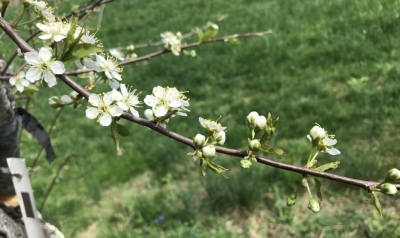
Fruit trees that bear their fruits on one-year-old as well as on older wood are the next grouping, and include plum, apricot, sweet, and tart cherry. The clusters of flower buds on branches of these trees are known as spurs. (Be careful not to put too much general meaning in “spur” because the word parades under a number of guises in the world of gardening.)

Clusters (spurs) of blossoms on plum

Clusters (spurs) of blossoms on plum

Pruning fruit trees removes some flower buds and potential fruits, which is all for the good because it lets the plant funnel more of its flavor-producing energy into fewer fruits so that those that remain are tastier and larger. Cherries, each of whose small fruits demand little energy, benefit the least of these fruits from such pruning so are the least pruned of the fruits in this category.

Apricot gets the most pruning in this group because its fruit spurs are borne on branches up to 3-years-old. That leaves plums, which get a moderate amount of pruning.

And Even Older Fruit-Bearing Stems

Apples and pears, the final grouping, are the most common tree fruits. Their individual branches each continue to bear flowers and fruits for many years.

Pear sput

Pear spur

Look at an older apple or pear branch and along it you see small, branching stems an inch or less long. These stem clusters are called — and I warned you — “spurs.”

Because their spurs live and bear for a decade or more, apple and pear trees require the least pruning of the fruit trees mentioned.

Then again, spurs do age, eventually becoming overcrowded and decrepit. So I thin out and shorten old spurs so that each has sufficient space and is periodically invigorated with stubby, new growth.

Thinning apple spurs

Thinning apple spurs

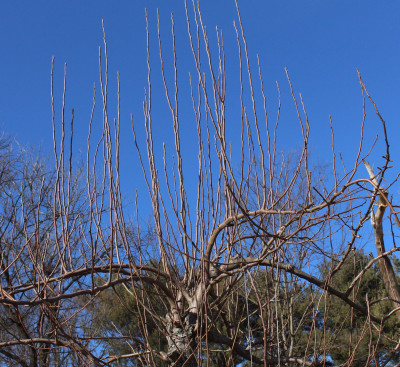
Exuberant, vertical shoots, known as watersprouts, often pop up on apple or pear branches. Mostly, they are unwanted because they’re not very fruitful and, left alone, will shade other parts of the tree. I cut these off right to their bases.

Pear watersprouts

Pear watersprouts

Even better is to grab hold of watersprouts when you first notice them growing and rip them off with a quick downward pull. “When noticed,” in contrast to all the pruning I just wrote about, is not during the dormant season.

Pruning Gets Hectic

Easiest to Prune Plants

Most of the pruning I do is “dormant pruning,” that is, pruning while plants are leafless. A few weeks ago, pruning was a relaxed affair with still-cold temperatures keeping the buds only slowly swelling in anticipation of upcoming growth. Then a few warm days kicked them into gear, making pruning more hectic.

Berries of July

Berries, later

Hecticness is little problem with those plants that are the easiest to prune because the work can be quick; other plants require my standing back with arms folded for some study before every few cuts.

Here on my farmden, easiest to prune plants include mature ornamental trees, shrubs, and vines, and even some fruits. Those fruits are American persimmon, pawpaw, and mulberry. They’re so easy because they can get by with little or no pruning.

Mostly what I do with the three fruit trees, every year or so, is to take a lopper or a saw and hack back . . . whoops, I mean “prune” . . . a tall limb back to a weaker growing, usually more horizontal, side branch. That’s to keep fruit within safe reach or not falling so far of its own accord that it splatters upon the ground. It also doesn’t leave a tree looking like a victim; done correctly and you hardly know that steel has been taken to the tree.

Easy, but Need Annual Pruning

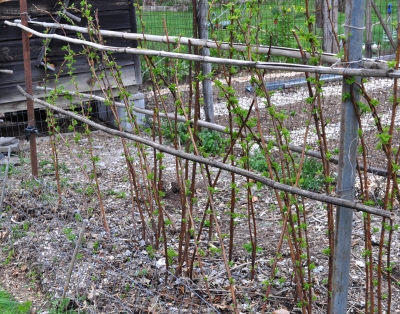
Then there are easy-to-prune plants that do need annual pruning, but pruning them is as easy as following a recipe. Brambles — blackberries and raspberries — are counted in here. They all have perennial roots but their canes are biennial. That is, canes just grow the first year, then fruit and then die their second year.

The first step in pruning these plants, then, is to get down near ground level and cut all the two-year-old canes to the ground. These canes broadcast their age with peeling bark and an old and dead, or dying, appearance.

Gardeners telling tell me about their raspberry or blackberry patches make me cringe. “Patch” does conjure up an image of a cozy, cottage-y planting, but isn’t the way to grow these fruits if you want to make picking easy and limit disease problems. All of which leads to step two of this recipe.

Red or yellow raspberries spread to create a patch by sending up shoots via underground runners; black raspberries and blackberries do so by arching their long canes to the ground where they take root and make new plants. Too many new plants, in either case.

Red raspberry bed, pruned

Red raspberry bed, pruned

So I limit my red or yellow raspberries to a swath only a foot wide, and then within that swath remove enough plants so those that remain are a few inches apart.

With black raspberries and blackberries, I remove any plants closer than 3 to 5 feet apart (depending on their vigor) and then thin out remaining canes in each remaining clump to the fattest and healthiest-looking half-dozen.

One more step for these berries is to shorten red or yellow canes enough to keep them from flopping around. How much depends on how tall they are and how they are trellised, if at all. Black raspberries and blackberries fruit on side shoots; these need to be shortened to about 18 inches long.

(So-called everbearing — aka “fallbearing” — red or yellow raspberries can be pruned as described above. Or, just lop the whole planting to the ground late each fall, sacrificing midsummer harvest but still offering late summer and early fall berries.)

Also Easy

Two more fruits also fall into this easy-to-prune category. 

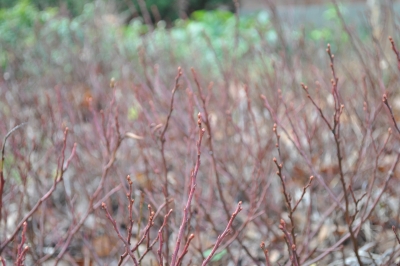
Lowbush blueberries, like brambles, bear on two-year-old (and, to a lesser extent, three-year-old stems). But they grow too many stems to selectively prune them.

So I take my hedge trimmer and every other year, or every third year, cut all stems to the ground.

Shearing lowbush blueberries

Shearing lowbush blueberries

There’s no crop the year they are pruned but dividing a planting in halves or thirds and pruning a different half or third every year circumvents that drawback.

Lowbush blueberries, flower buds

Lowbush blueberries, flower buds

Blackcurrants bear in a similar manner to lowbush blueberries but their stems are few enough for selective pruning. I cut to the ground any 3-year-old stems as well as anything more than the best half-dozen 1-year-old stems.

Blackcurrant, before & after pruning

Blackcurrant, before & after pruning

Just a Wee Bit More Difficult

From here, I move on to shrubs — only slightly more difficult to prune — that bear fruit on older wood, which determines which stems I cut out. 

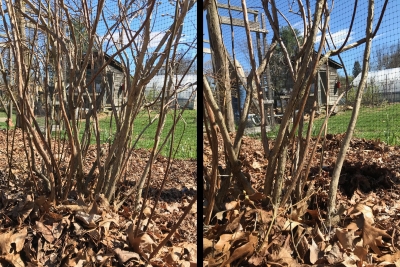
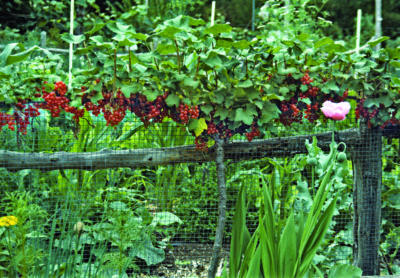
Most gooseberries and redcurrants, for example, bear best on stems 2 and 3 years old. So the strategy here is the same as for brambles, except that the stems that I cut away are those that are 4-years-old. After that I remove excess new stems arising from ground level. When pruning is finished, the shrubs are left with about six each of one-, two-, and three-year-old stems.

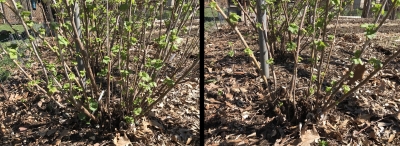
Pruning blueberry bushes also follows the same strategy, except that since the bushes bear well on stems up to six-years-old, I prune away stems older than this and cut to the ground all except the healthiest 4 new stems.

Blueberry before & after pruning

Blueberry before & after pruning

Now on to the fruit trees. Wait, I can’t do it now! I’ve got to run outside, grab my hand shears, lopper, and pocket saw, and do some pruning. Stay tuned next week for fruit tree pruning.

Redcurrant espalier

Redcurrant espalier. How to prune it? Some other time.

For more pruning detail, more plants, and more techniques, see my book The Pruning Book.

SOIL MATTERS

Plastic on My Bed?!

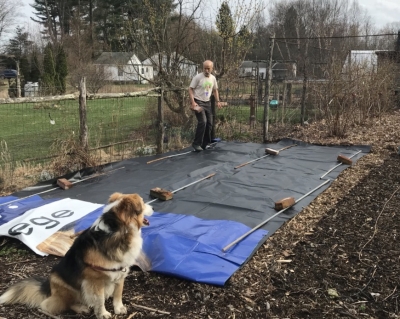
You’d be surprised if you looked out on my vegetable garden today. Black plastic covers three beds. Black plastic which, for years, I’ve railed against for depriving a soil of oxygen, for its ugliness, for — in contrast to organic mulches — its doing nothing to increase soil humus, and for its clogging landfills.Tarped soilActually, that insidious blackness covering my beds is black vinyl. But that’s beside the point. Its purpose, like the black plastic against which I’ve railed, is to kill weeds. Not that my garden has many weeds. But this time of year, in some beds, a few more sprout than I’d like to see.
The extra warmth beneath that black vinyl will help those weeds get growing. Except that there’s no light coming through the vinyl, so most weeds will expend their energy reserves and die. And this should not take long, depending on the weather only a couple of weeks or so.

So, first of all, I’m covering the ground for a very limited amount of time.

Furthermore, that the black vinyl is not manufactured specifically for agriculture. It’s recycled billboard signs, available on line from www.billboardtarps.com and other sources.  For larger scale use, farmers use the material sold for covering silage. 

Old billboard signs or silage covers also improve on black plastic mulch because they are tough. Each time they’ve done their job they can be folded up for storage for future use to be used over and over.

Heavenly Soil

Decades ago, I made a dramatic career shift, veering away from chemistry and diving into agriculture. In addition to commencing graduate studies in soil science and horticulture, I rounded out my education by actually gardening, reading a lot about gardening, and visiting knowledgable gardeners and farmers, including well-known gardener (and better known political and social scientist) of the day, Scott Nearing.
Scott Nearing's gardenI had just dug my first garden which had a clay soil that turned rock hard as it dried, so I was especially awed, inspired, and admittedly jealous of the soft, crumbly ground in Scott’s garden. What a surprise when someone who had worked with Scott for a long period told me how tough and lean his soil had been when he started the garden. A number of giant compost piles were testimonial to what it takes to improve a soil.
I thought of Scott and his soil as I was planting peas a few days ago. My chocolate-colored soil was so pleasantly soft and moist that I could have made a furrow with just by running my hand along the ground. For a long time I’ve appreciated the fact that the soil in my vegetable garden is as welcoming to seeds and transplants as was Scott’s.

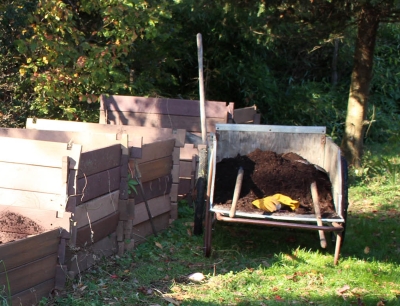
And my dozen or so compost piles, inspired by Scott’s, are testimonial to those efforts. My compost pilesThe soil in my permanent vegetable beds is never turned over with a rototiller or garden fork; instead, every year a layer of compost an inch or so deep is lathered atop each bed, and no one ever sets foot in a bed. That inch of compost snuffs out small weeds, protects the soil surface from washing away, and provides food myriad beneficial microbes (and, in turn, for the vegetable plants).

All sorts of what I consider gimmicky practices attract gardeners and farmers each year: aerated compost teas, biochar, nutrient density farming, fertilization with rock dust, etc. Yet one of the surest ways to improve any soil is with copious amount of organic materials such as, besides compost, animal manures, wood chips, leaves, and other living or were once-living substances. A pitchfork is a very important tool in my garden.

Uh Oh, A Soil Problem

Not all is copacetic here on the farmden.

I make my own potting soil for growing seedlings and larger potted plants. It’s a traditional mix in that it used some real soil. Just about all commercial mixes lack real soil because it’s hard to maintain a sufficient supply that is consistent in its characteristics.

Early this spring, as usual, I sifted together my mix of equal parts compost, peat moss, perlite, and garden soil. This year, NOT as usual, germination of seeds and seedling growth has been very poor. Just today, I re-sowed all my tomato seeds in a freshly made mix from which I excluded soil.

I’m not 100 percent sure that the soil in the mix is the culprit, but it is suspect. I have a small pile of miscellaneous soil that I keep for potting mixes and other uses. Good and bad seedlingsRecent additions to that pile were an old soil pile from a local horse farm and soil from a hole I was digging to create a small duck pond. The latter was poorly aerated subsoil.

Seedlings are growing well in my new mix composed only of compost, peat moss, and perlite.