GOOD BERRIES, BAD(?) BERRIES

Sad, Then Happy

A sad day here on the farmden: the end of blueberry season. Frozen blueberries, that is. Seventy quarts went into the freezer last summer, and a lot more than that into bellies, and now they’re all finished.

A happy day here on the farmden: the first of this season’s blueberries are ripening. These blueberries, and those that were in the freezer, are the large “highbush” (Vaccinium corymbosum) varieties commonly found fresh on market shelves. Also ripening now are “lowbush” (V. angustifolium) blueberries, growing as a decorative, edible ground cover on the east-facing slope near my home.
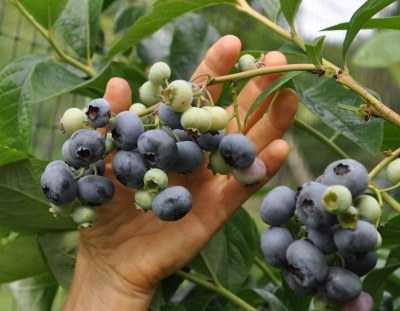
Blueberries ripening
I’ve said it before but I’ll say it again. After many, many years of growing fruits in my not-particularly-good-for-fruit-growing site, blueberries — a native fruit — have always yielded well. Two most important things are adapting the soil to blueberries’ unique requirements, and keeping birds at bay. Birds at bay? Best is a walk-in, netted area.
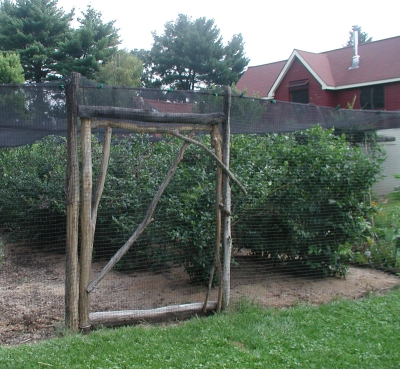
Blueberry, netted
Soil for blueberries needs to be very acidic, with a pH between 4 and 5.5, made so, if needed, with the addition of sulfur, a naturally mined mineral. The pelletized form is best because it’s not dusty. Blueberry roots need good drainage and consistent moisture. They thrive in ground rich in organic matter, maintained with an annual three-inch topping of some weed-free, organic material such as wood shavings, wood chips, straw, pine needles, and autumn leaves.

(That’s the bare bones for success with blueberries. For a deeper dive into growing this healthful, delicious, reliable fruit, stay tuned for my soon-to-be-aired blueberry webinar.)

And More Berry-Like Fruits Coming Along

Just as last year’s apples were losing their crispness and tang and I needed a change from oranges, other berries, in addition to blueberries have started changing color, softening, and turning flavorful.

Black currants are another one of my favorites now ripening. They admittedly have an intense flavor not to everyone’s liking. But everyone likes black currants conjured up into juices, pastries, or jam. Variety matters. My favorites are Belaruskaja, Minaj Smyrev, and Titania. 
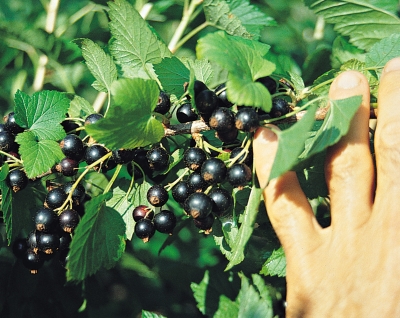
Belaruskaja black currants
Don’t think black currants taste anything like “dried” or “Zante” currants. Those are raisins, originally made from “Black Corinth” grapes, a name then bastardized to “black currant.”

Like blueberries, black currants are easy to grow. But they have no special soil requirements, they fruit well even in some shade, and deer rarely eat the bushes, and birds rarely eat the berries.

Another tasty morsel now ripe is gumi (Elaeagnus multiflora). Birds usually strip this shrub clean of fruit, except this year the crop is so abundant that neither I nor the birds can make much of a dent in it. The berries are a little astringent if not dead ripe. And not at all if the fruit is processed; last year I cooked them slightly, strained out the seeds (which are edible), and blended it before drying it into a “leather.”
Gumi fruit
The gumi shrub itself has silver leaves, providing an attractive backdrop for the red fruits. The flowers are extremely fragrant, and the roots enrich the soil by taking nitrogen from the air (with the help of an actinomycete microorganism.)

Also now abundant, with plenty for all, is Nanking cherry (Prunus tomentosa), a favorite of mine for beauty and easy-to-grow cherries. The cherries are small, usually no larger than about 3/8 inch. But the single pit is also small. Flavor lies somewhere on the spectrum between sweet and sour cherries, very refreshing especially when chilled.
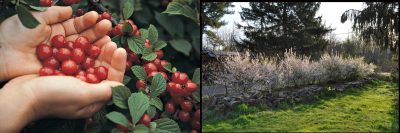
Nanking cherry fruit and bloom

Nanking cherry fruit and bloom

Another Chance, and Then Another

All is not rosy in the berry-size fruit world. Over the years, I had heard about and tried a new fruit in town, edible honeysuckles. In the past, the plants I tried either died over winter or bore very few, very mediocre berries. Since then, edible honeysuckles have come up in the world, with serious breeding work, and I was given the opportunity to try them again. (As Maria Schinz said, “Gardening is an exercise in optimism.”)

But first, what is an edible honeysuckle, which now goes under better names. If called “honeyberry,” it usually refers to Russian species such as Lonicera caerulea app. kamtshatica or edulis. Haskap is a Japanese name applied the Japanese species L. caerulea spp. emphylocalyx, or to hybrids of this species with Russian species. Pure Japanese species varieties are sometimes called Yezberry, after the Island of Hokkaido, called Yez or Yezo Island where they are found. The Japanese species and hybrids are less susceptible to spring frosts than the honeyberries.

This spring I planted out two Yezberry varieties, Solo and Sugar Mountain Blue. The small, blue berries ripen early, and I was eager to give this fruit another try. Solo is bearing. The taste? Awful! Sour, with no other flavor.
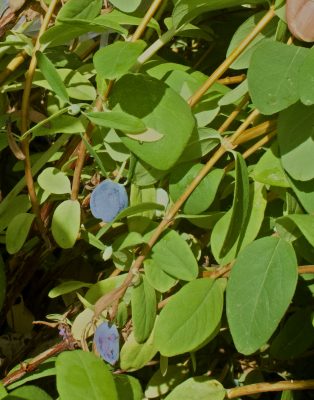
Solo yezberry

Solo yezberry

But I’m not abandoning edible honeysuckles. I’ve learned that the berries need to hang on the branches for a long time before developing full flavor and sweetness. A number of varieties are available, some of which are, according to others, “Delicious when eaten fresh from the plant” and “a bit like a cross between a raspberry and a blueberry. . . sweetness of a raspberry with a hint of pleasant tartness.” Really?!

Many blue berries are still hanging on my Solo bush. I’ll leave them to hang longer there and perhaps morph from “awful” to “delicious,” and will report back. I have hope for this new fruit, not yet high hopes.

At the very least, honeyberries or haskaps might be able to tide me over from the end of frozen blueberries to the first of fresh blueberries.
BAD SEEDS? NO SEEDS?

Edamame Scare

Got a couple of scares in the garden this season. No, not some woodchuck making its way past the dogs and then through some openings in the fences to chomp down a row of peas (which look especially vibrant this year, thank you). And no late frost that wiped out my carefully tended tomato transplants. 

The first scare came last week as I looked down on the bed where I had planted edamame a couple of weeks previously. No green showed in the bed, a stark contrast to the nearby bed planted at the same time with snap beans, the small plants enjoying the warm sunshine and neatly lined up four inches apart in two rows down the bed.

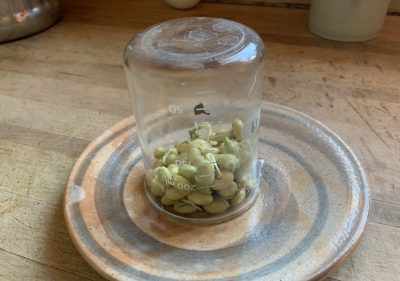
Testing edamame seeds

Testing edamame seeds

Scratching gingerly into the soil of the edamame bed did not reveal any seeds germinating but not yet above ground. In fact, I couldn’t find any seeds at all! Had I opened furrows and forgotten to plant seeds in them before covering the furrow? Doubtful, especially since I had planted another bed, still barren, in the other vegetable garden at the same time. Had a mouse or some other animal cruised underground enjoying a snack every four inches down the row? That would be a very thorough rodent. Plus, he or she would have left a tunnel.

Had the seeds rotted? Possibly, but that would be very quick for them to so thoroughly disappear. Had the seeds been old, which would make them more prone to rotting? I do save my own edamame seed every year, the variety Shirofumi, so that is a possibility. Except that I planted last year’s seed.

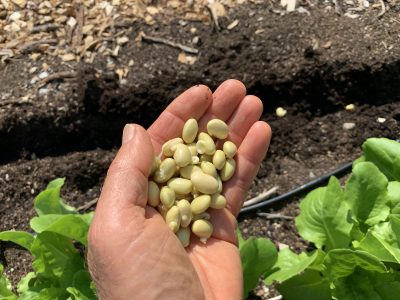
The mystery still exists but there was still time for action. I had additional Shirofumi seed left. Rather than just plant it, I’d test its germination, which I did by sprouting the seeds indoors. After an overnight soak in a beaker, I poured off the water and then rinsed the seeds twice daily. As it turned out seed from 2018 and 2015 didn’t germinate at all.

Last year’s seed germinated very well, and I planted them while their root sprouts were still very short. One week later, the plants have emerged. But the mystery still exists.Planting sprouted edamame

What If?

The second scare of the season is seed-related but hypothetical. What if seeds are unavailable next year, or any year? Or, at least, seeds of some of the varieties I want to grow.

This fear is not all that hypothetical. This spring, because of the surge in interest in gardening, seeds were harder to get.

And in years past, seeds of some of my favorite varieties of vegetables became difficult to find. Sweet Italia pepper, for instance, which I consider the best as far as flavor and early ripening for colder climates. My recourse has been to save my own seeds of these varieties for many years. In addition to Sweet Italia, I also save seed of Pink Pearl and Pennsylvania Dutch Butter popcorn, Otto File polenta corn, and, as mentioned above, Shirofumi edemame.

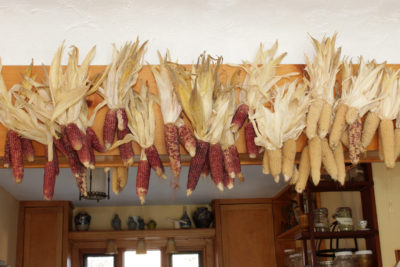
Sweet Italia pepperPopcorn hanging from kitchen rafters

This season, the plan is to save seed of more vegetables.

A few guidelines will make seed-saving a success. First, I won’t save seed from “F-1 hybrids;” they are produced with selected, different parents, so the saved seed will not yield the same variety as the seed that is saved.

Selecting seeds from too few individuals can result in inbreeding depression, or generally weaker plants. So my second guideline is to save a few seeds from a lot of plants, then combine them to put more genetic diversity into the seed packet packet. Saving seed from more than one plant also provides insurance just in case a seed plant dies.

Some vegetable plants — corn, onions, and the cabbage family, for example — are especially prone to inbreeding depression. Saving seeds from Otto File and my popcorns is especially easy since the seeds are dry and mature when ready to eat or save. When I twist the kernels off an ear for eating, I just take out a few to add to my growing seed packet of that particular variety.

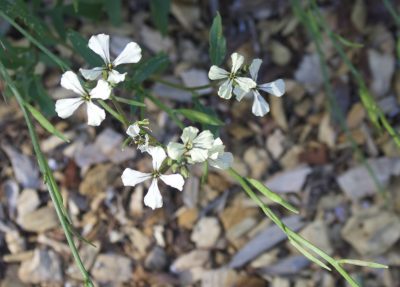
Arugula (Cabbage family) flower and seedpod

Arugula (Cabbage family) flower and seedpod

A third consideration in saving seed is keeping the seed true to variety. Varieties of sweet corn readily cross-pollinate. Again, it is corn, onions, and the cabbage family that are among the common vegetables that readily cross pollinate. So I grow popcorn in one vegetable garden and sweet corn in the other, and Otto File corn out in my meadow between dwarf apple trees. If my Golden Bantam sweet corn were to grow too close to my Pink Pearl Popcorn, the resulting seeds will grow into plants yielding kernels that were less sweet or less poppable. 

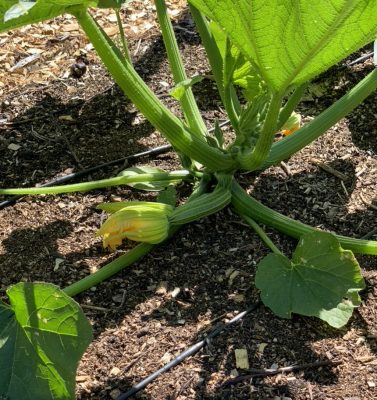
Although squashes have separate female and male flowers on the same plant, which would make them prone to cross-pollination, that’s no problem here. Zucchini flower and fruitI grow only Sweet Mama and Waltham winter squashes. The first variety is botanically Cucumbita maxima and the second is C. moschata; the two species do not cross-pollinate.
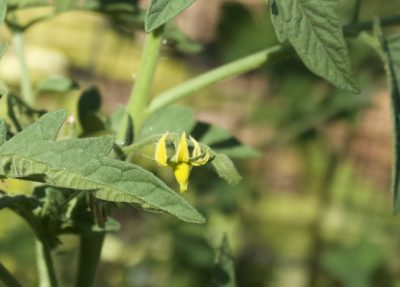
Plants that can self-pollinate, such as tomatoes, peppers, beans, and peas, could be contaminated by pollen from other, nearby varieties. Tomato flowerDistance between varieties can prevent cross-pollination. So can fine mesh bags. I plan to use small organza bags normally sold for wedding favors.
And finally, good storage, meaning dry and cool or cold conditions, makes sure seeds germinate well. Which my edamame did not. Hmmm.

(For more depth in seed saving, see the excellent and thorough book Seed to Seed: Seed Saving and Growing Techniques for Vegetable Gardeners by Suzanne Ashworth.)

ALL FOR THE FUTURE

Seeding Transplants? Again.

Only a couple of weeks ago I finished planting out tomato, pepper, melon, and the last of other spring transplants, and here I am today, sowing seeds again for more transplants. No, that first batch of transplants weren’t snuffed out from the last, late frost when the thermometer dropped to 28°F on May 13th.

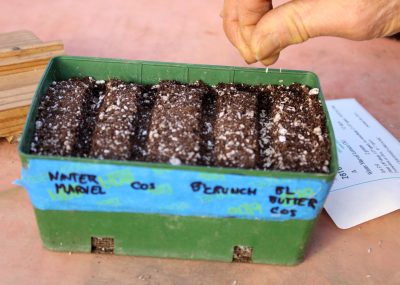
Sowing lettuce seeds in flats
And no, those transplants were not clipped off at ground level, toppled and left lying on the ground, by cutworms. Neither were they chomped from the top down to ground level by rabbits.

I’m planting seed flats today to keep the harvest rolling along right through late autumn.

Future Further

Looking farthest ahead, I have in hand two packets of cabbage seed, Early Jersey Wakefield and  Bartolo. Early Jersey Wakefield is a hundred year old variety with very good flavor and pointy heads, due to mature a couple of months after transplanting. Once those heads firm up, they can keep well out in the garden for a few weeks in the cool, autumn weather. Those I set out in spring, once mature, are apt burst open from rapid growth in summer weather. Bartolo yields firm, round heads that store in good condition after harvest, well into winter. They are ready for harvest 115 days after transplanting.
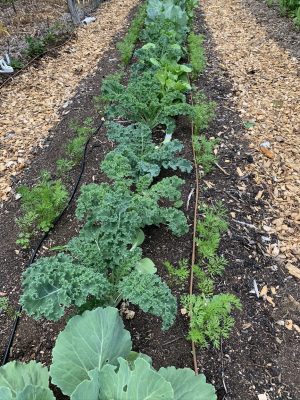
Cabbages and kale interplanted in bed
I plan for any of today’s sowings to spend about a month in their containers before being planted out. Cooler weather and lowering sunlight dramatically slow plant growth around here by early October, so any late ripening vegetables need to be ready or just about ready for harvest by then. Bartolo cabbage, with 30 days in a seed flat plus 115 days out in the garden, is then ripe by . . . whoops . . . the END of October! No wonder Bartolo often didn’t ripen for me in the past. (Nothing like writing about my garden to keep me honest and awake. I should re-read the detailed timing schedule I wrote in Weedless Gardening for various vegetables in various climates.)

Okay, all is not lost for winter storage cabbage. Warm weather, timely water from drip irrigation, and soil enriched with plenty of compost might speed maturity along faster than predicted. Unseasonally warm weather through October would also help ripen nearly ripe heads. And there’s always the fallback, with sure-to-ripen Early Jersey Wakefield.

Still on time, guaranteed, will be today’s sowing of Charming Snow cauliflower, maturing 60 days from transplanting.

That’s it, for now, for the cabbage family. Later on in summer I’ll be sowing Chinese cabbage seeds. Perhaps more kale also, although spring sowings of this almost perfect vegetable can carry on right into winter, even spring if the winter is sufficiently mild.

Future Sooner

For sooner use in the coming weeks will be today’s sowings of lettuce, cucumber, and summer squash. I like lettuce but lettuce doesn’t like hot weather and longs days. Those conditions cause leaves to turn bitter as plants send up flower stalks and go to seed. But if I sow a pinch of seeds in flats every couple of weeks, the transplanted lettuce can usually be harvested small, before it’s socked away enough energy and wherewithal to go to seed.

The cucumber transplants I’ll want on hand to replace cucumber plants that I set out a couple of weeks ago. After a few weeks those spring plantings invariably succumb to powdery mildew and cucumber beetles, which not only feed on the plants but also spread bacterial wilt disease. (Easy identification for bacterial wilt, besides a wilting plant, is the thread of bacterial ooze visible as you pull apart a cut stem.)
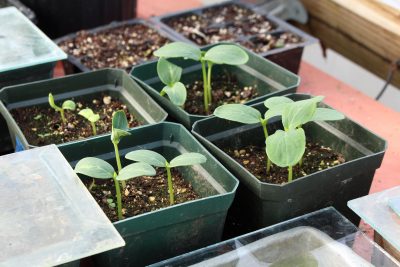
Cucumber seedlings
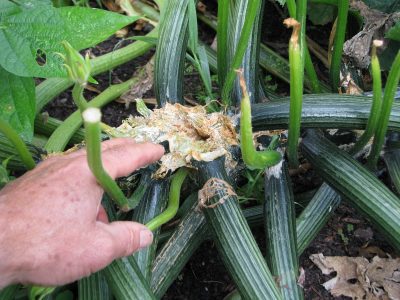
Summer squash plants also peter out during summer, mostly from, again, powdery mildew, and also from squash bugs and vine borers. If squash vines are covered with soil along their stems, roots will form at the nodes, and the plant will continue production. I’ve got to be careful in saving the older squash plants, though; it’s too easy to  have too much of this vegetable.
Squash vine borer damage

Memorial Day, Before, During, and After It

Here in the States, the traditional time to plant a vegetable garden, is for some reason, Memorial Day weekend. But that can’t be true from Oregon to Florida and from Maine to Arizona, with our wide variations in climate!

I did put tomatoes, peppers, and plenty of transplants in the ground here during Memorial Day weekend. But I already had sown seeds or transplants of peas, arugula, lettuce, kale, carrots, celeriac before that weekend. And, as I’ve written above, there’s plenty of planting to be done after that date. Memorial Day weekend is not a seminal date in my gardening calendar.

STIRRING MY BLOOD, CLEARING (PARTS OF) THE MEADOW

Nearing Influence

What struck me most about Scott Nearing was his sturdy appearance, arms hanging loosely from broad shoulders, his near perfect teeth, and the deeply creviced wrinkles of his face. He was 91 years old. Looks aside, his influence on me was deep despite the brevity of my visit.Scott NearingScott Nearing was a professor of economics, a political activist, a pacifist, a vegetarian and an advocate of simple living. And a gardener. For many of these reasons, he was almost a cult figure back in the 1970s when I, a young man, visited him. He was then known mostly for his book Living the Good Life. I had read the book, and decided to drive 1,000 miles from Madison, Wisconsin to show up on his farm, unannounced, in Harborside, Maine.
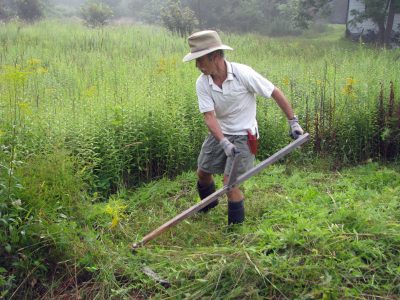
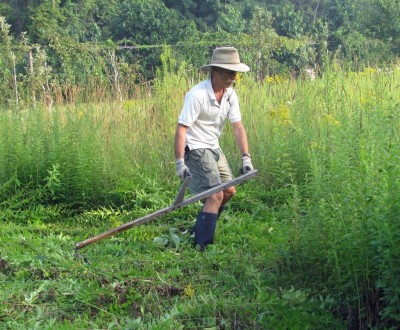
I thought of that visit today as I was swinging my scythe. Would I have been out in the field this morning doing so if I hadn’t made that visit? Scott was a big fan of scything, about which, he wrote, “It’s a first class, fresh-air exercise, that stirs the blood and flexes the muscles, while it clears the meadows.” Lee scythingFor me, working my field in the quiet of early morning, with the sun low in the sky and grasses still moist from morning dew, is sheer pleasure. A morning dance.
From a practical standpoint, no need to worry about waking neighbors with noise of a mower engine, or to worry about getting a mower bogged down in wet spots.

Keeping the Magic

I’ve swung a scythe for many decades. (Not that that makes me an expert in its use; for the first couple of decades I did it wrong. Now, more right.) Two considerations have kept the magic alive.

First, not too much. When I first acquired the acre and a half field to my south, I aimed to keep it a meadow, stemming invasion from woody plants in a natural transition to forest by scything the whole field. Considering the lushness of the vegetation, and how rapidly it grew back, that was a bold undertaking. The result: Something short of sheer pleasure, and tennis elbow.

Salvation came in the form of a small, farm tractor and a brush hog, with which I now mow the bulk of the field once a year.

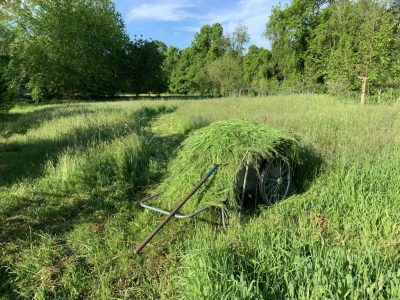
There’s still plenty to scythe, including areas near my fruit and nut trees, and areas too wet for the tractor. I also scythe selected areas of the field proper, changing yearly to allow scythed sections, whose mowings I gather up, to regenerate. Also important: I limit daily scything to no more than a half hour.
Meadow and cart full of hay
The second consideration is to use the right kind of scythe. The so-called American type scythe, with a curved handle and stamped blade, is put to best use decorating the wall of a barn. I use a so-called Austrian type scythe (purchased from www.scythesupply.com), which usually has a straight handle and is lightweight with a razor sharp, hammered-thin blade. The blade needs periodic hammering (peening) for keeping its taper or for repair, and daily dressing with a whetstone.scything, beginning stroke

Blade length is important. Back when I was working the whole field, the job was made harder because of the 36 inch long blade I was using. Sure, you can cut more with a longer blade, but that was too much lush vegetation to plow through in one swing. Nowadays a 22 inch blade strikes a nice balance, not biting off more than I can “chew.”

No Big Field, No Problem

No need for access to a large field to experience the physical and practical pleasures of scything. For many years, my field was only a portion of my original three-quarter acre property. And no matter how large or small the field, no reason to do as Scott did, to “clear the meadow.” On my small property, I practiced what I called Lawn Nouveau, created, as I detail in my book,  The Pruning Book, by sculpting out two tiers of grassy growth. The low grass is maintained just like any other lawn, and kept that way with a lawnmower.

The taller portions need to be scythed but once a year, or more frequently if desired. Raking up mowings from the tall grass portions avoids unsightly clumps or smothering of regrowth. The rakings are good material for mulch or compost. A crisp boundary between tall and low grass keeps everything neat and avoids the appearance of an unmown lawn.
Lawn Nouveau
Lawn Nouveau saves me time because the tall grass needs infrequent mowing and there’s no rush to get it done. The tall grass becomes more than just grass as other plant species elbow their way in. Which ones gain foothold depend on the weather, the soil, and frequency of mowing. An attractive mix of Queen Anne’s lace, goldenrod, chicory, and red clover might mingle with the grasses in a dry, sunny area, with ferns, sedges, and buttercups mixing with the grasses in a wetter portion.

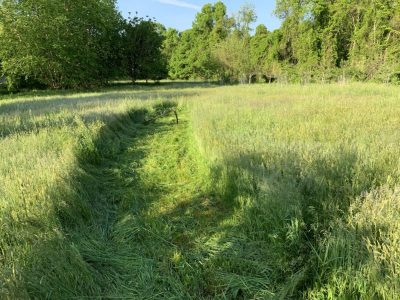
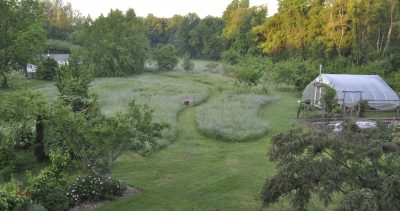
Curves at the interface of high and low grass present bold sweeps to carry you along, then pull you forward and push you backward, as you look upon them. Avenues of low grass cut into the tall grass invite exploration — that was the purpose of today’s scything. Thank you Scott.
Meadow with path

HOT KNOWLEDGE

Between a Rock and a Hard Place

More knowledge makes for a better gardener. That’s what I had in mind with my most recent book, The Ever Curious Gardener, excerpted here:

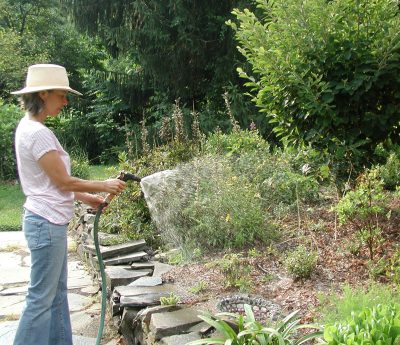
With hot weather here today, and soon to be a regular occurance, I pity my plants. While I can jump into some cool water, sit in front of a fan, or at least duck into the shade, my plants are tethered in place no matter what the weather. And don’t think that plants enjoy searing sunlight. High temperatures cause plants to dry out and consume stored energy faster than it can be replenished. Stress begins at about 86 degrees Fahrenheit, with leaves beginning to cook at about 20 degrees above that.
Watering with hose
One recourse plants have in hot weather is to cool themselves by transpiring water. Transpiration, which is the loss of water from leaves, can cool a plant by about 5 degrees Fahrenheit. Over ninety percent of the water taken up by plants runs right through them, up into the air, exiting through little holes in the leaves, called stomates. Carbon dioxide and oxygen, the gases plants need to carry on photosynthesis, also pass in and out through the stomates.

All this is fine provided there is enough water in the ground. If not, stomates close, transpiration and photosynthesis stop, and the plant warms. Even if the soil is moist, stomates might close in midsummer around midday if leaves begin to jettison water faster than the roots can drink it in. This situation puts most plants in a bind. Should they open their pores so that photosynthesis can carry on to give them energy, but risk drying out, or should they close up their pores to conserve water, but suffer lack of energy?

CAM at work

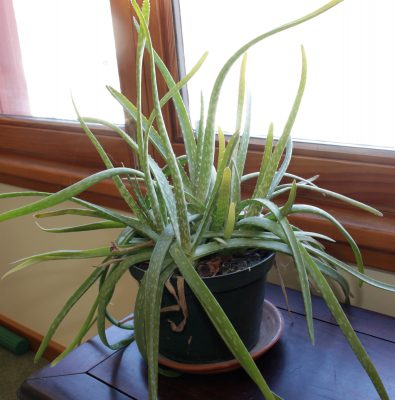
Enter cacti and other succulents (all cacti are succulents—that is, plants with especially fleshy leaves or stems—but not all succulents are cacti): their fleshy stems and leaves can store water for long periods. After more than a year without a drop of water, my aloe plant’s leaves still look plump and happy.

Besides being able to store water in their stems and leaves, jade plants, aloes, cacti, purslane, and other succulents have another special trick, Crassulacean Acid Metabolism, for getting out of this conundrum.

Aloe plant

Aloe plant, more than a year without water!

They work the night shift, opening their pores only in darkness, when little water is lost, and latching onto carbon dioxide at night by incorporating it into malic acid, which is stored until the next day. Come daylight, the pores close up, conserving water, and the malic acid splits apart to release carbon dioxide within the plant, to be used, with sunlight, to make energy.

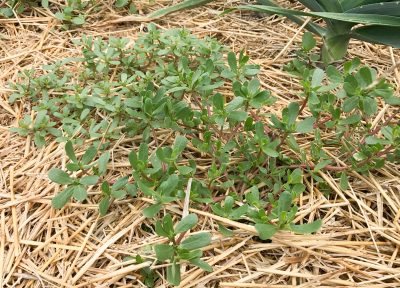
I’ve actually tasted the result of this trick in summer by nibbling a leaf of purslane—a common weed, sometimes cultivated—at night and then another one in the afternoon.
Purslane
Malic acid makes the night-harvested purslane more tart than the one harvested in daylight. Try it.

No CAM? How ‘Bout C4?

Another group of plants, called C4 plants, function efficiently at temperatures that have most other plants gasping for air and water. C4 plants capture carbon dioxide in malate, the ionic form of malic acid, which is a four-carbon molecule, rather than the three-carbon molecule by which most plants—which are “C3”—latch onto carbon.

The enzyme that drives the C4 reaction is so efficient that C4 plants do not have to keep their stomates open as much as do C3 plants. The C4 pathway also does its best work at temperatures that would eventually kill a C3 plant, and cells involved in the various steps are partitioned within the leaf for greatest efficiency.

C4 plants are indigenous to parched climates, but not uncommon visitors in our gardens. Corn is a C4 plant. (Cool climate grains such as wheat, rye, and oats, are C3 plants.)
Tall corn plant
Looking at my lawn, I see another C4 plant. Hot, dry weather in August drives Kentucky bluegrass, a C3 grass, into dormancy. Not so for crabgrass, a C4 plant, which remains happily green.

I also find some other C4 plants, in addition to corn, in my garden. As many vegetables and flowers flag, all of a sudden lambsquarters and pigweed, both C4 weeds (or vegetables, for those who like to eat them), appear as lush as spinach in spring.

Gardener’s Assistance

Can I do anything to help out my plants in hot weather? Keeping the garden watered helps. (Ways to apply water and how much is needed are all-important, and topics unto themselves.)

Sprinkling or misting plants could keep them cool without their having to pull water up from the soil. But the thirty gallons of water that runs up through a tomato plant in a season, or the fifty gallons that flows through a corn plant, is for more than just cooling these plants. It also carries dissolved minerals from the soil into the plant. So it’s debatable how well a plant would grow with too much misting. And besides, wet plants are predisposed to disease.

A better alternative to sprinkling plants is to grow plants adapted to the climate and the season. My lettuce, spinach, peas, and radishes are doing fine now; despite today’s heat, it’s not really all that hot — yet. And nights are still cool. Mostly, I avoid growing these cool weather plants in summer. Except that I like my lettuce salads, so I extend its season by growing it in the shade beneath trellised cucumbers.
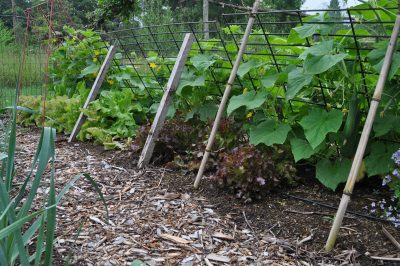
Lettuce & trellised cukes}
Fortunately, tomatoes, cucumbers, peppers, melons, and squashes, although they are neither cacti nor C4 plants, can take quite a bit of heat. They have very deep roots.

LIBERATED, AT LAST

Exposée

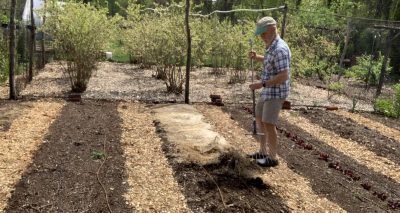
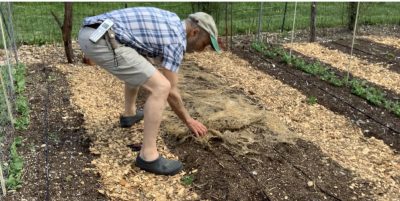
My garden was liberated yesterday, the soil freed at last. That’s when I peeled back and folded up the black tarps that had been covering some of the vegetable beds since early April. My beautiful soil finally popped into view.
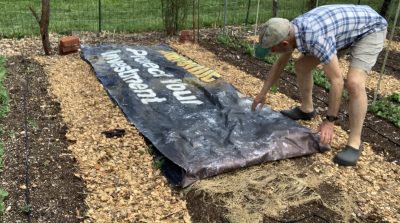
Folding up tart
Covering the ground was for the garden’s own good. “Tarping,” as this technique is called, gets the growing season off to a weed-less start. The black cover warms the ground to awaken weed seeds. They sprout, then die as they use up their energy reserves which, without light, can’t be replenished and built up. (I first learned of this technique in J. M. Fortier’s book The Market Gardener.)

Tarping is very different from the much more common way of growing plants in holes in black plastic film, even if one purpose of the soil covering, in both cases, is to snuff out weeds. Black plastic film is left in place all season long, and then disposed of, usually in a landfill, at season’s end.

Tarping tarps might be silage cover material or — as in my case — recycled, vinyl billboard signs (black on one side). They are left in place for relatively short duration, after which time the ground can be exposed to natural rainfall and air, and is open for blanketing with compost and cover crops. After each use, tarps can be folded up and stored for re-use for many seasons more.

Prescription for Weed-lessness

Tarping is but one part of my multi-pronged approach to weed control, the others of which I detail in my book Weedless Gardening. 

My garden is also weed-less because I never, and I do mean never, till the soil, whether with a rototiller, garden fork, or shovel. Preserving the natural horizonation of the soil keeps weed seeds, which are coaxed awake by exposure to light, buried within the ground and dormant. No-till also has side benefits: preserving soil organic matter, maintaining soil capillarity for more efficient water use, and not disrupting soil fungi and other creatures.

Tilling does loosen the soil structure, but I avoid soil compaction by planting everything in 3-foot-wide beds, saving the paths between the beds for foot traffic.
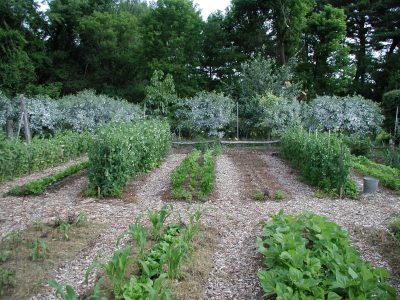
Garden beds
Weed-lessness is also the result of each year covering the ground with a thin layer of a more or less weed-free mulch, just half inch to an inch thick depth. This covering snuffs out small weed seeds that might be present. Other benefits are insulating to modulate wide swings in soil temperature and softening the impact of raindrops so that water percolates into the ground rather than running off. 

What I use for this thin layer of mulch depends on what’s available, what I’m mulching, and, sometimes, appearance. Vegetables are hungry plants so their beds get an inch depth of ripe compost, which, besides the other benefits of mulches, also provides all the nutrition the vegetable plants need for a whole season. Paths get wood chips; it’s free, it’s pretty, and it visually sets off paths from beds. Straw, autumn leaves, sawdust, and wood shavings are some other materials that would work as well.

At the end of the season, beds that have been harvested but aren’t needed for autumn cropping, get a cover crop, which is a plant grown specifically for soil improvement.
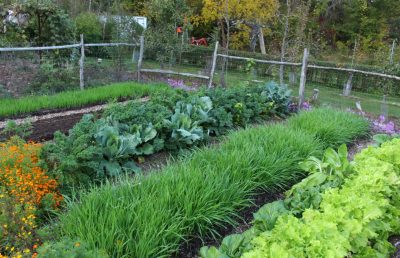
Autumn cover crop
Cover crops provide all the benefits of mulches, plus looking pretty, sucking up nutrients that might otherwise wash through the soil in winter, and growing miles and miles of roots to give the soil a nice, crumbly structure. I plant oats or barley, because the plants thrive in cool autumn weather and then, here in Zone 5, are killed by winter cold sometime in January. The leaves flop down, dead, to become mulch, which I rake or roll up easily before it’s time for spring planting.Raking up oat cover cropClearing oat cover crop by hand

Another ploy for weed-lessness is using drip irrigation. Sure, I could get by without any watering here in the “humid Northeast,” but timely watering gets the most out of the garden. Drip irrigation pinpoints watering to garden plants rather weeds, which would, with a sprinkler, be coaxed to grow, for instance, in paths.

Weed-less but Not Weed-free

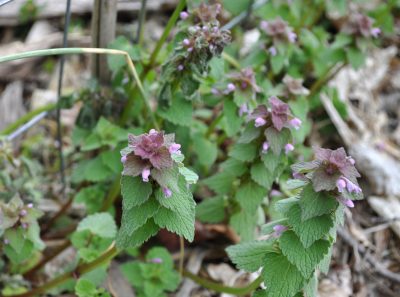
With this multi-pronged approach to weed-lessness, isn’t tarping like “taking coals to Newcastle?” No. I found that even after not tilling, mulching, using drip irrigation, and, especially, cover cropping, some weeds do a figurative “end run”and find their way into some beds. Especially, the last few years, red dead-nettle (Lamium purpureum). Purple deadnettleYes, I know the plant is pretty, provides early nectar for pollinators, and is edible. But its out of place in my vegetable beds. The tarp does it in.
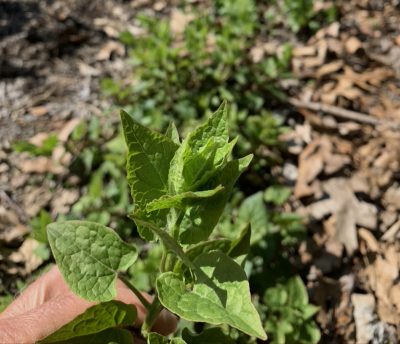
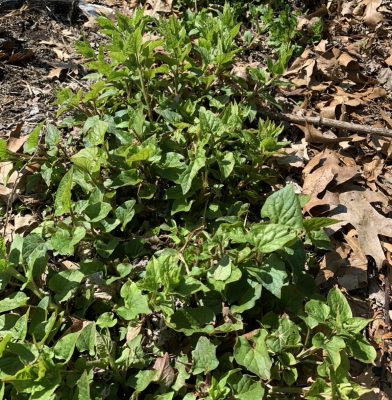
No garden can be weedless. But mine has been weed-less for many, many years.

PERENNIAL VEGETABLES

Hablitzia: What a Name!

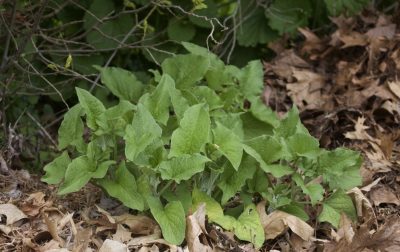
At last night’s appropriately social distanced “zoom” dinner with my daughter, she commented on how tasty my salad looked. “All home grown,” I replied, and held up to the computer screen a leaf of one of the major contributors to my bowl of greenery, Caucasian mountain spinach (Hablitzia tamnoides). “Looks like some leaf you just plucked off a tree,” says she. Yes, it did, but it was as tasty and as tender as any leaf of regular garden spinach.
 Caucasian mountain spinatch
It’s with good reason that the two “spinaches” are so similar: They’re both in the same family, Amaranthacea, also kin to beets, chard, quinoa, lamb’s quarters, and pigweed.

Caucasian mountain spinach has it over conventional garden spinach in a number of ways, most significantly its being a perennial. I planted it last spring and don’t plan on doing so ever again. Not that making new plants would be difficult. They were easy from seed, and cuttings are also said to root easily. The quickest way to have larger new plants would be to divide the clump sometime after the tops have died back for winter or before new sprouts appear.

Being a perennial, Caucasian mountain spinach won’t lose quality as it goes to seed during the warmer, longer days of late spring and summer. White flowers, with a faint aroma of cilantro, appear in June and July, but the leaves still make tasty additions to salads or cooked dishes.

Right now, plants are starting to stretch their leafy stems skyward. Making use of the third dimension in gardening — up — makes for efficient use of garden space, a plus for any plant in an intensive garden. They’d like something on which to climb, which they do by pulling themselves upward in the same way as do clematis vines, twisting their leaf stalks around whatever they can. I’ll be providing a ladder for them made from posts and chicken wire.

Now that I think of it, Caucasian mountain spinach also makes use of the fourth dimension in gardening — time — since it can make its way into the kitchen from when my plum trees bloom until I harvest the last of my apples.

The Good King, and Others

The bed that’s home to Caucasian mountain spinach is also home to another perennial bit of edible greenery, Good King Henry (Blitum bonus-henricus), also sharing the Amaranthacea family. That bed gets some shade in the afternoon, which is all to the liking of Caucasian mountain spinach, not so much to Good King Henry.
Good King Henry
No matter, because Good King Henry is not, in my opinion, nearly as tasty as its Caucasian cousin. The King’s leaves are good cooked, but not great, and not very good raw in salads. One reason I like it so much is for its name, both the common name and the botanical name.

I had hoped the bed would also be home to the perennial leek and perennial onion (Welsh onion) that I sowed and grew last season. But there’s not a sign of either plant this season. I guess they’re not all that perennial, odd since last winter was downright tropical (for here), the thermometer hardly dipping below zero degrees Fahrenheit.

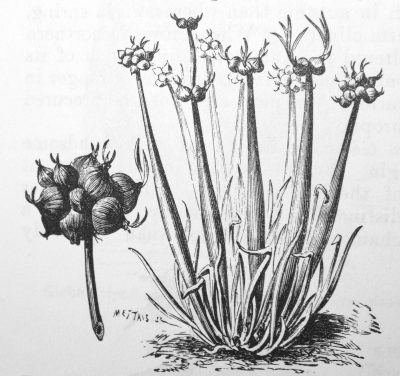
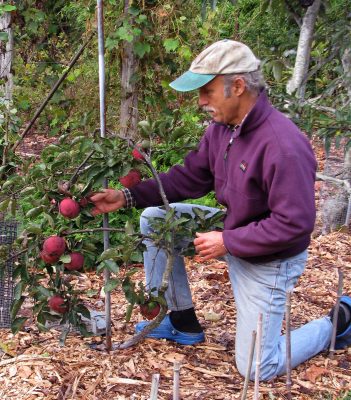
If I wanted early onions, as greens, some kinds are reliably hardy. An interesting one that I grew decades ago is Egyptian Onion, also known as Walking Onion. They “walk” because the cluster of small bulbs atop the green stalks weight the stalks down till they eventually bow to the ground, depositing the cluster a few inches from the plant. Egyptian onionThe bulbs take root, grow, bow, and deposit the bulbs another few inches away, so, unfettered, the plant spreads by “walking” around the garden. I stopped growing it because the flavor was too sharp for me.
One More, This One Well-Known

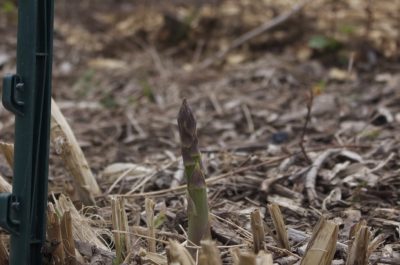
One more perennial vegetable, this one familiar to everyone, is asparagus. I don’t understand why anyone who has a garden doesn’t grow asparagus. Even a flower garden, to which asparagus can offer a soft, green ferny backdrop. A bed offers two months of almost daily harvest. Rabbits and deer don’t eat it, so fencing isn’t needed (except in my garden, where my dogs have developed a taste for it).
Asparagus spear
And pests are rarely a problem. Except for weeds.

Perhaps you’ve been put off by the heroic measures for planting it suggested in older gardening books. That is, digging a deep trench, planting the roots in the bottom of the trench, and then gradually filling it in as the plants grow. Not necessary!

The deep planting suggested was to keep the plants’ crowns beyond the reach of tractors’ cultivator blades. But there’s no reason to cultivate an asparagus bed, and most home gardeners don’t anyway, so make holes just deep and wide enough to cover the roots when planting.

So there you have it, for easy gardening and tasty meals: Plant Caucasian mountain spinach and asparagus, and perhaps, especially if you like the name, Good King Henry.

I MAKE TREES

Here are 3 Easy, Fun Grafts I Made Yesterday

Finally, the weather cooperated and I got around to doing some grafting. I could have done it a couple of weeks ago, as I had planned, but I’m blaming cooler weather for the delay. Not that I couldn’t have done it back then, but things chug along more quickly in warmer weather, so I waited.

Apple tree on very dwarfing rootstock

Apple tree on very dwarfing rootstock

I’m going to describe 3 easy grafts I did yesterday. Which one I chose to do depended on the size of the rootstock on which I was grafting. The scions, which are the varieties I’m grafting on the rootstocks, are all one-year-old stems 6 to 12 inches long and more or less pencil-thick (remember what pencils are?). They have been stored, wrapped to prevent drying out, in the refrigerator so that they are more asleep than the awakening rootstocks.

The principles that make any graft work are all the same. Close kinship of stock and scion. Close proximity of the cambium — the layer just beneath the bark — of the stock and of the scion. All open wounds sealed against moisture loss. And immobilization of rootstock and scion until graft succeeds. My book, The Ever Curious Gardener: Using a Little Natural Science for a Much Better Garden, goes into more detail about the why and the how of grafting.

A Tree Make Over

For starters, I turned to the bark graft, good for grafting on rootstocks a couple or more inches across. This first graft was on a Tyson pear tree whose flavor wasn’t up to snuff, so that graft began with doing a Henry the Eighth, lopping off the tree’s head to graft height, which was a couple feet from ground level.

The bark graft comes with an good insurance policy. That’s because onto each rootstock, depending on its diameter, I can stick 3, 4, 5, or even more scions. Only one scion needs to grow, but the more that are grafted, the greater the chance of at least one growing. 

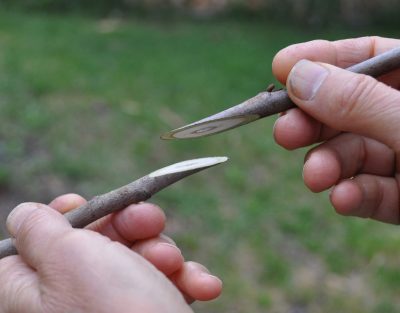
I prepared a scion with a bevel cut 2 inches long, at its base, not quite all the way across from one side to the other. On the opposite side of the cut, I nicked off a short bevel.
Bark graft scion prepared
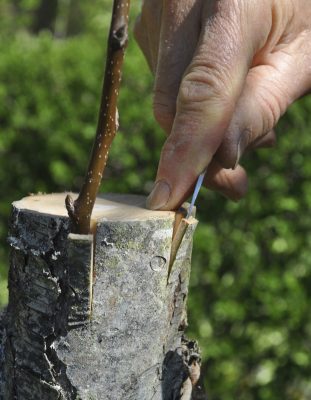
Then, into the freshly cut stub on the rootstock, I made two vertical slits through the bark, each about 2 inches long and as far apart as the width of the base of the scion.
Bark graft rootstock prep
Carefully peeling back the flap of bark welcomed in the long, cut surface of the scion, putting the cambial layers of rootstock and scion in close contact. This was repeated with the other scions, all around the stub. With the peeled back flaps of bark from the rootstock pushed back up against each inserted scion, one or two staples from a staple gun or a tight wrapping with stretchy electrician’s tape sufficed to hold everything in place.

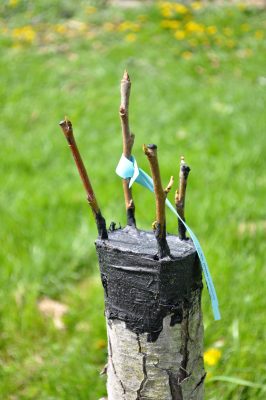
Finally, I sealed all cut surfaces against moisture loss, for which there are a number of home-made and commercial products. My favorite is a commercial product called Tree-Kote, a black goo that works really well and absorbs sunlight.
Bark graft, completed

Another Tree Make Over, For Smaller Trunks

For smaller rootstocks, say 3/4 inch up to a couple of inches across, there’s the cleft graft. This also comes with an insurance policy, though not as good as that of the bark graft because it only gets two scions per graft. Still, it’s easy so chances for success are high.

At the base of each of the two scions, I made two bevel cuts less than halfway through, each two inches long and not exactly on opposite sides. Viewed head on and from below, the uncut portion was slightly wedge-shaped.
Scion ready for cleft graft
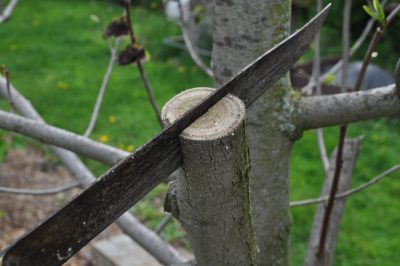
Turning to the rootstock, an older rootstock (OH x F 87), I lopped it off squarely, with a saw, then created a split a couple of inches deep in the middle of the cut surface by hammering a heavy, sharp knife right down into it. After removing the knife, a screwdriver pushed down into the split separated it enough to insert the two prepared scions at each edge of the cleft with their cambiums aligned with the cambium of the rootstock.
Preparing rootstock for cleft graft
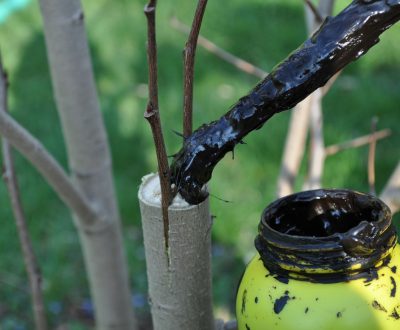
Pulling out the screwdriver caused the springiness of the rootstock to close the cleft and hold the scions securely in place. As with the bark graft, all cut surfaces got smeared with Tree-Kote.
Sealing cleft graft

And Some Baby Tree Grafts

The whip graft is my graft of choice when rootstock and scion are about the same thickness, pencil-thick. Rootstocks for whip grafts were again OH x F87 pears, this time one-year-old rootstocks, pencil-thick.

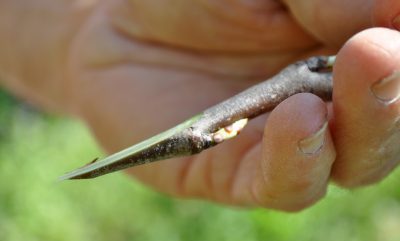
I cut at the bottom of the scion with a smooth, sloping cut an inch to an inch and a half long, and made a similar cut at the top of the rootstock.
Whip graft stock and scion
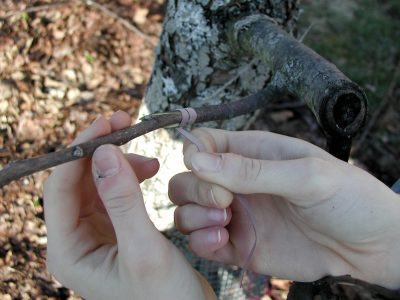
Holding the sloping cuts against each other and aligning just one edge of each if their diameters didn’t exactly match, I bound rootstock and scion together with a rubber grafting strip. (I’ve also used thick rubber bands, sliced open.)

Wrapping whip graft

Wrapping whip graft

As with any graft, cut surfaces must be sealed against moisture loss. Parafilm® helps holds the graft together and seals in moisture. Once my whip graft scions are growing strongly, I’ll cut a vertical slit into the binding to prevent it from choking the plant.

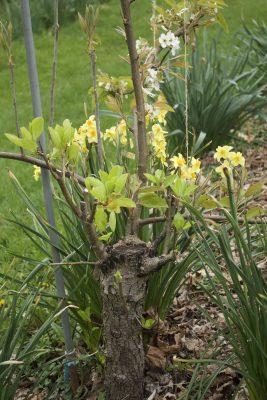
Bark graft 3rd season

Bark graft, season 3, note flowering

There you have it: 3 easy grafts to make new trees or make over an older tree. Now the excitement begins, watching and waiting for new growth. Sometimes, with that large root system fueling growth, a bark graft scion will grow 2 or 3 feet its first season!

PRUNING FOR BEAUTY, FUN, AND FLAVOR

Yew Love

Mundane as she may be, I love yew (not mispelled, but the common name for Taxus species, incidentally vocalized just like “you”). Hardy, green year ‘round, long-lived, and available in many shapes and sizes, what’s not to love? Perhaps that it’s so commonly planted, pruned in dot-dash designs to grace the foundations in front of so many homes.

Still, I love her. For one thing, Robin Hood’s bow was fashioned from a yew branch (English yew, T. baccata, in this case). Two other species — Pacific yew (T. brevifolia) and Canadian yew (T. canadensis) — are sources of taxol, and anti-cancer drug.
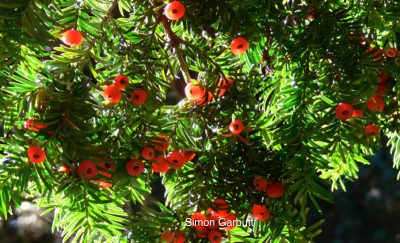
Yew berries
At a very young age, I became intimate with yew bushes surrounding our home’s front stoop, on which my brother and I would often play. Yew’s red berries, with an exposed dark seed in each of their centers, would give the effect of being stared at by so many eyes. Sometimes we’d squish out the red juice, carefully though, because we were repeatedly reminded that all parts of the plant are poisonous. (I’ve since learned that the red berries are not poisonous; but  other parts of the plant, including the seed within each red berry are poisonous.)

If yew has, for me, one major fault, it’s that deer eat it like candy. Interesting, since grazing on yew can kill a cow or a horse.

Mostly, I love yew because she takes to any and all types of pruning. My father once had a very overgrown yew hedge threatening to envelope his terrace. I suggested cutting the whole hedge down to stumps. Following an anxious few weeks when I thought my suggestion perhaps overly bold, green sprouts began to appear along the stump. A few years later the hedge was dense with leaves, and within bounds.

Although usually pruned as a bush, yew can be pruned as a tree. A trunk, once exposed and developed, has a pretty, reddish color. Deer sometimes take care of this job, chomping off all the stems they can reach to create a high-headed plant with a clear trunk. 

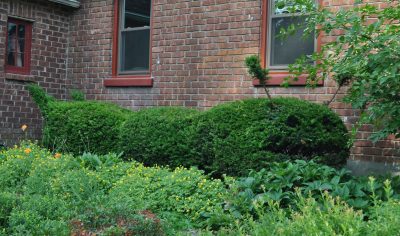
As an alternative to being pruned to dot-dash spheres and boxes, yew hedges can be pruned to fanciful shapes, including animals, or “cloud pruned” (niwaki, the Japanese method of pruning to cloud shapes). Many years ago, I followed the herd and planted some yews along the front foundation of my house, pruning them to one long dash. No dots.
Yew caterpillar
Since then, I’ve converted that hedge to a giant caterpillar and, more recently, tired of the caterpillar and attempted to cloud prune it, not with great success so far. (It’s my shortcoming as a sculptor, not the plant’s fault.) The goal in this case is not the kind of cloud pruning with clouds as balls of greenery perched on the ends of stems. My goal is to blend the four plants together as one billowy, soft cloud.

Facing my kitchen window is another yew, a large one that was planted way before I got here. Its previous caretaker, and up to recently I, have maintained it as a large, rounded cone. Last year I decided to make that rounded cone more interesting, copying a topiary in Britain. The design is in its early stages, awaiting some new growth this year to fill in bare stems now showing in interior of the bush.
Yew topiary in progress

Not Too Late for Peaches

Moving on to more pragmatic pruning . . . peaches. No, it’s not too late. In fact, the ideal time to prune a peach tree is around bloom time, when healing is quick. This limits the chance of stem diseases, to which peaches are susceptible.

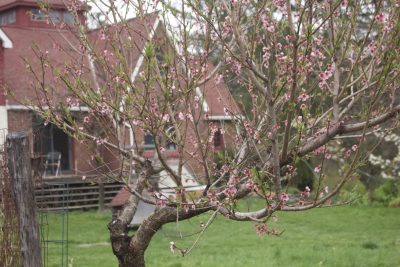
Peach tree, before pruning

Peach tree, before pruning

Peach trees need to be pruned more severely than other fruit trees. As with other fruit trees, the goals are to avoid branch congestion so remaining branches can be bathed in light and air, to plan for future harvests, and to reduce the crop — yes, you read that right — so that more energy and better quality can be pumped into remaining fruits.

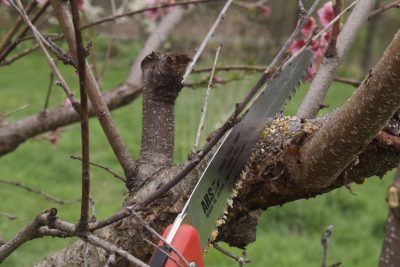
To begin, I approached my tree, loppers and pruning saw in hand, for some Sawing peach limbmajor cuts aimed at keeping the tree open to light and air.
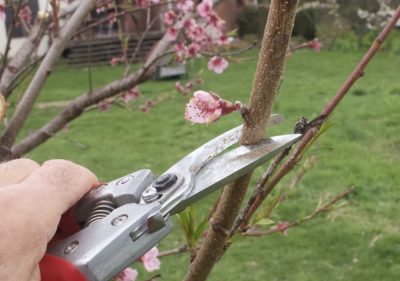
Peaches bear each season’s fruits on stems that grew the previous season. So next, with pruning shears, possibly the lopper, in hand, I went over the tree and shortened some stems. This coaxes buds along those stems to grow into new stems on which to hang next year’s peaches.
Shortening peach branch
And finally, I went over the tree with pruning shears, clipping off dead twigs as well as weak, downward growing stems. They can’t support large, juicy, sweet fruits.

Done. I stepped back and admired my work.
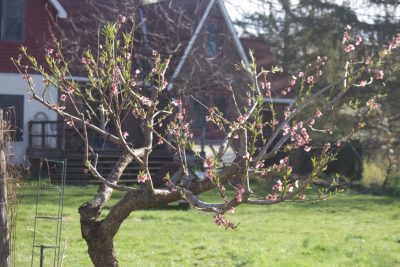
Peach tree after pruningAnd, of course, for more about pruning, there’s my book, The Pruning Book.
Spring: A Manic Time in the Garden

The Season’s Ups and Downs

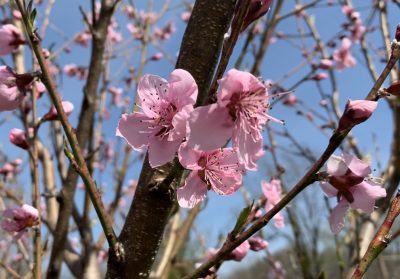
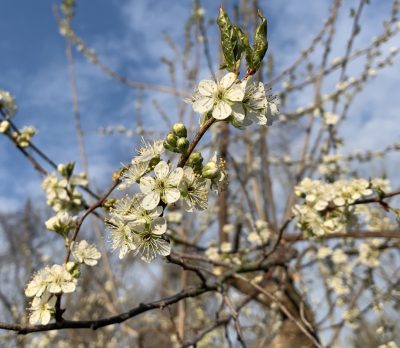
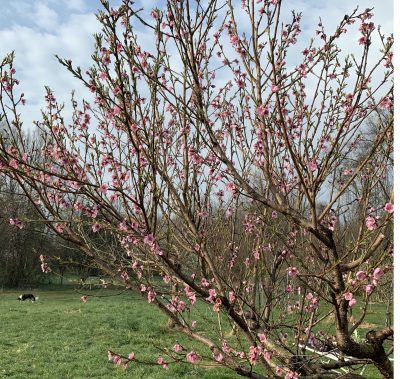
To me, spring can be a manic time of year. On the one hand, no tree is more beautiful or festive than a peach tree loaded with pink blossoms. I’d say almost the same for apples, pears, and plums, their branches laden with clusters of white blossoms.
Peach tree in bloom
And it’s such a hopeful season. If all goes well, those blossoms will morph, in coming months, into such delicacies as Hudson’s Golden Gem and Pitmaston Pineapple apples, and Magness, Seckel, and Concorde pears. My peach tree was grown from seed, so has no name. With all this beauty and anticipation, I can periodically forget the pandemic that’s raging beyond my little world here.

But even as my eyes feast on the scene and I forget about the pandemic, I can’t forget about the weather’s ups and downs. Specifically, the temperature: Frosty weather has the potential to turn blossoms to mush and ruin the chances for fruit. Especially on my farmden, here in the Wallkill River valley. As in other low-lying locations, on clear, cold nights, a temperature inversion occurs, with heat radiated to the clear sky making ground level temperatures low. Cold air is denser than warmer air, so all the cold air flows down slopes to collect in valleys.

There’s not much to do to avert that frost damage. A blanket thrown over a tree would help but my trees are too large and too many. Branches could be sprayed with water; water, in transitioning to ice, releases its heat of fusion as long as it’s continuously applied. A helicopter or a “wind machine” could dilute colder air at ground level with warmer air from higher up. These methods might be used commercially but, to quote the sage of Newburgh (that’s another story), “That’s not gonna happen” here.

Therapy, a Plan

Rather than worrying myself into the manic phase of spring, I’m going to assess the damage and live with it. For starters, I need to know the temperature.

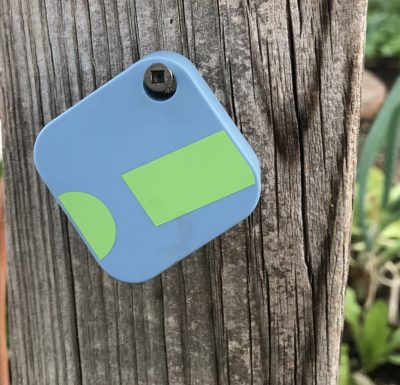
I have been using is a nifty little device called Sensorpush, a 1-inch square cube, perhaps a half-inch thick, that I have mounted outside and that continually transmits the temperature to my cell phone.Sensorpush receiverGreat. Even better, temperature (as well as humidity) is recorded, and can be displayed graphically or downloaded to my computer. So I didn’t have to be awake to find out the mercury hit 32.5°F at 12:16 AM on the night of April 17th and stayed there until it began rising around 7 AM.
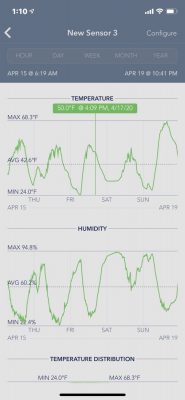
Sensorpush readout
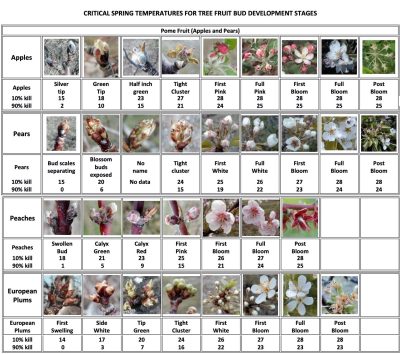
Fortunately, researchers have compiled temperatures at which damage to blossoms occurs. Specifically, damage enough to wipe 10% of the crop, and damage enough to wipe out 90% of the crop. And more specifically, applying those numbers to various kinds of fruits, which vary in their blossom’s cold tolerances. And even more specifically to the various stages of blossoming for each kind of fruit. Generally, less cold is required to kill a blossom the closer it is to bloom time.

Here is a chart compiled and photographed by Mark Longstroth of Michigan State University:
Critical temperatures for fruit buds

So now I can take this information, couple it with data recorded by Sensorpush, and foretell my sensory future, pomologically speaking. Below freezing temperatures since trees awakened have been 24° on April 17th, 27° on April 19th, and 26° on April 21st. Of course, it ain’t over till it’s over, and the average date of the last frost here is about mid-May.

Peach blossoms

Peach bloom

Plum blossoms

Plum blossoms

My plum trees were in full bloom on April 13th, at which time the blossoms are susceptible to 10% kill at 28° and 90% kill at 23°. That makes only 10% loss. The peach tree was also in bloom on that date, and is very similar in it’s blossom’s cold tolerance, so only 10% loss there also, so far.

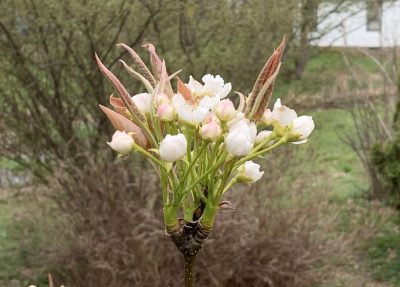
Asian pears were showing “first white” and “full white” on April 19th, when the low hit 27°. That temperature would cause them no damage. The same would be true, going forward, for subsequent temperatures above 27°. The Europeans should be fine because today, April 21st, they are in tight cluster, and cold hardy to 24°.

Asian pear blossom

Asian pear full white

European pear blossom

European pear tight cluster

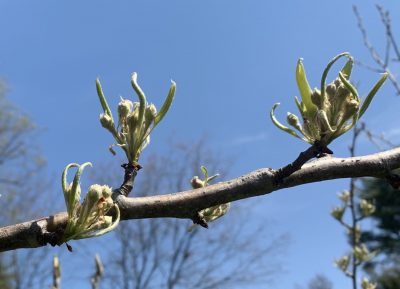
Apples also are fine, also in tight cluster so, according to the chart, undamaged by temperatures above 27°.

Apple blossom pink tip

Apple blossom tight cluster

And a Sprinkle of the Unknown

All this seems very science-y comforting, and it is. As with most garden science, though, things are more complicated, to some extent, than can be easily predicted. For one thing, some variation in cold hardiness undoubtedly exists from one variety to the next. In the case of my trees, I have an American hybrid and some European hybrid plums; they might more generally differ in blossom hardiness. And what about the length of time at a given temperature, and the effect of humidity?

Overall, the chart has calmed me down. Not to mention that a certain amount of fruit loss would be a good thing. A tree has just so much energy, and too big a crop makes for less flavor and size. Only 5% of blossoms of an apple tree need to set fruit for a full crop.

Now, I can move on to worry about insect and diseases that might hone in on my fruit.