WINTER READINESS

For anyone who missed my recent 90 minute webinar on GOURMET COMPOST, the webinar has been recorded and is available for $35 on-demand from Oct. 1st, 2020 until Oct. 8th for $35. The webinar covers options for compost bins, feeding your compost “pets, monitoring progress, what can go wrong and how to right it, when is compost “finished,” and making the best use of your compost. Click below to pay almost by any of a number of ways. Thank you.

Putting Summer in Jars

I’m hunkering down for winter, which includes capturing what I can of summer’s bounty in jars and dried and frozen garden produce. With this year’s hot, sunny weather, tomato plants yielded plenty of fruit — until cut short with a few nights of freezing temperatures about a week ago. Still, I have over two dozen shiny quart jars lined up on a shelf in the basement.

This year, San Marzano, which I (and most of Italy, where San Marzano canned tomatoes are labeled as such) consider to be the best-tasting canned tomato, got segregated into a number of jars all by itself. Other pluses for San Marzano is that it’s an heirloom variety, so I can save my own seed from ripe fruits, and it bears heavily over a long season on healthy, stocky vines.

A past neighbor of mine used to begin his process of canning tomatoes by alternating layers of tomatoes with salt in tall, half-bushel baskets. Other gardeners begin by peeling, perhaps seeding, their tomatoes.

Me? I opt for the quickest method possible, which is: Cut off any bad spots and drop the tomatoes into a large pot with just a half inch of water in the bottom. After being brought to a boil, the tomatoes get simmered until the volume is reduced by one-half, with less reduction for San Marzano’s because of their low water content. Then, a thorough blending with an immersion blender.

New guidelines call for keeping the acidity of canned tomatoes below pH 4.6 to prevent growth of Clostridium botulinum, aka botulis bacteria, by adding 2 tablespoons of lemon juice or 1/2 teaspoon of citric acid per quart. This is because of lower acidity of some modern tomatoes. I do so just to make sure even though my tomatoes’ acidity measured below 4.6. Finally, the canning jars go into the pressure canner for processing for 10 minutes at 15 pounds pressure.

I figure that I can chop up and sprinkle in any flavorings for sauces or soups later, in winter, when I have more time and I know the jar’s end use.

(House) Plants on the Move

I’m a little late this year in readying my houseplants for winter. I know from seasons past that when they come indoors, so do occasional pests. The pests that are most troublesome, the only ones about which I need to do something, are scale insects.

Scale insects aren’t always in evidence now but I know they are there on my citrus, bay laurel, orchid, and staghorn fern plants. By early winter, the pest becomes more obvious as occasional, small brown nodules on stems and leaves. That’s the protective “scale,” beneath which the scale insect is happily sucking away plant sap. 

Scale insects have never killed my plants but do weaken them and – perhaps worse – exude a sugary “honeydew” as they suck sap. This sticky honeydew gets all over floors, furniture, or whatever is beneath the plant. And then a fungus arrives to feed on that honeydew, giving leaves a dark, smoky, haze.

Hard-shell scale on staghorn fern

Hard-shell scale on staghorn fern

My tack for scale insects is to line susceptible plants up in my driveway, then spray them with some relatively benign insecticide such as Ced-o-flora, horticultural oil, neem oil, or pyganic. I’ve been doing that for the past few weeks in an effort to get the young scales before they find shelter beneath their protective shells.

With the last spray finished, in come all my houseplants. Windows are still open at least some days so indoor air is not too different from outdoor air, easing the environmental transition for the plants.

Squirreling Away

Black walnuts are one of my favorite nuts and they’re conveniently abundant and free for the picking, at least around here. Perhaps too abundant. Once there are a couple trees, they beget more and more as squirrels start “planting” them everywhere. My vegetable garden, with it’s soft, rich soil is a favorite spot.

Admittedly, the nuts aren’s so convenient to eat. Their messy husks need to be removed. Then the nuts have to be cured in a dry, cool or cold, squirrel-proof space until around New Year’s Day, And finally, the very tough nuts need cracking. I recommend the ‘Master Nut Cracker’, in my opinion the best nut cracker for those tough shells.

Last year black walnuts were raining down all over the place here and in town. This year, probably because of last year’s overabundance, the crop is light everywhere. How are the walnuts doing where you are?

I’m lucky. One tree here on the farmden that provided most of our nuts in years past, is bearing heavily. Up to a few years ago it was useless, bearing nuts whose innards were almost always spoiled or shriveled. That  might have been because of hurricane Irene back in 2011, when the nearby Wallkill River flooded its banks to wash over here and rise about four feet up that tree’s trunk.
black walnuts in jar
I cracked a few of the nuts this year to see how the nutmeats look. They’re well-filled and a nice, white color inside. But not edible, as I wrote, until they’re cured. Until January, we can enjoy what’s left of last year’s nuts.

CREATURES LARGE AND SMALL

Identity Crisis?

For the past couple of months, I’m not so sure that my duck knows that she’s a duck. She and another female duck once shared a drake, and they all lived together in their own “duckingham palace.”

  Sometime after the other female and the drake were taken by a predator, probably a fox or coyote, I thought our remaining female might enjoy some company at night. So I coaxed her to take up nightly residence with our three chickens — a rooster and two hens — who have their own house (“chickingham palace?,” actually more palatial than duckingham palace).
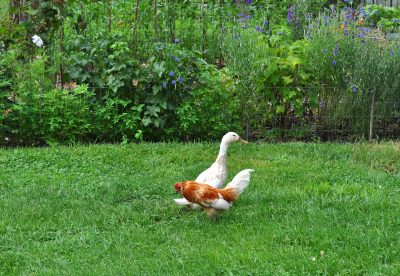
Chicken & duck, off to work
Not only has Ms. Duck moved in with the chickens at night but she also wanders around with the flock by day. Her special companion is the rooster, especially since the two chicken hens decided to spend much of their days sitting on imaginary eggs. Neither hen has laid a real egg for over a month. So the female duck and the rooster stroll together each day, gobbling up insects, weed seeds, and some vegetation, except, of course, within the fenced confines of the vegetable gardens. I’ve even caught them in flagrante delicto.

  The duck, being a duck, enjoys water. Her idea of a pond is the 3-foot-diameter children’s sandbox repurposed with water that we’ve provided for her bathing pleasure. During the bath, the rooster stands nearby, watching and seemingly trying to figure out what’s going on with his water-loving belle.

Beetles and Vespids

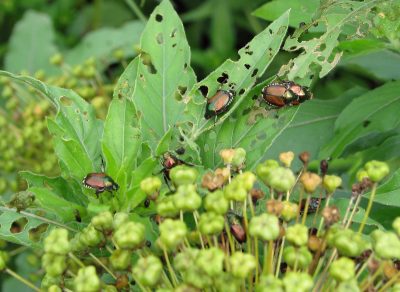
This season has seen both an abundance and a lack of some other, smaller creatures here on the farmden. In July, I saw a few Japanese beetles and braced for an onslaught, ready to repel them with a spray of neem extract or kaolin clay if things got ugly. Although I heard about the beetles descending in hordes on some other gardens near and far, I’ve hardly seen any all summer since then.
Japanese beetles
This beetle-less trend has been going on here for a few years. I’m not sure exactly why. Japanese beetles do have some natural predators and diseases, including beneficial nematodes. Whatever’s helping out, I’m thankful that they’re doing their job.

  Making up for a lack of Japanese beetles has been an abundance of yellowjackets, reflecting, perhaps, good weather conditions, for them, in spring. In contrast to honeybees, yellowjacket colonies do not overwinter; only the queens do. But the bigger the colony this summer, the more young queens develop to fly off and find winter quarters to build up colonies next summer. These insects start out the season feasting on high protein foods but have now shifted to sweets.

European hornets are also in abundance, with their large size looking more frightening than the yellowjackets but, in fact, not nearly so aggressive. They do have a bigger appetite for fruits, though, often hollowing out whole apples to leave nothing but most of the skin, intact.
Apple being damaged by European hornet
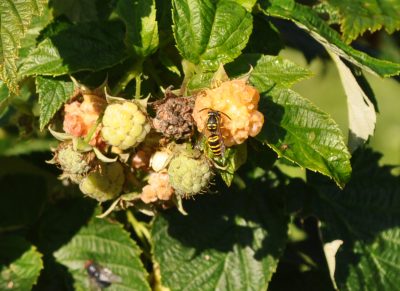
Yellowjackets and European hornets have made me more cautious when berry-picking. The insects are capable of breaking through thin skins so are actually robbing a significant part of the late summer raspberries. A close eye is needed to avoid harvesting an angry yellowjacket along with a berry. Early in the morning, they are especially grumpy when wakened from their resident berry. 
Yellow jacket on raspberry
Yellowjackets and European hornets are also a problem on compost piles in progress. Fresh additions to the pile, especially sweet ones such as melon rinds, quickly need covering with a layer of hay or manure. This hides the food and gets it composting.

  Although yellow jackets are beneficial in the garden for eating plant pests, their present habits mostly outweigh the good, for me, at least. (I’m allergic to their stings.) I destroy any nests I happen upon with torch or insecticide. Insecticides with mint as their active ingredients are very effective.

A Bag for Protection

  Grapes have tougher skins than raspberries, skins that can resist yellowjackets. That is, until a bird takes a peck or a couple of diseased berries split open.

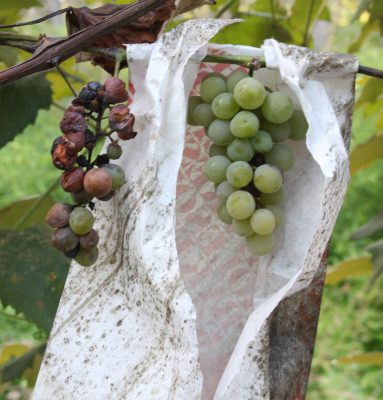
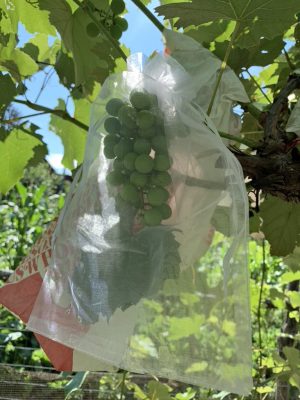
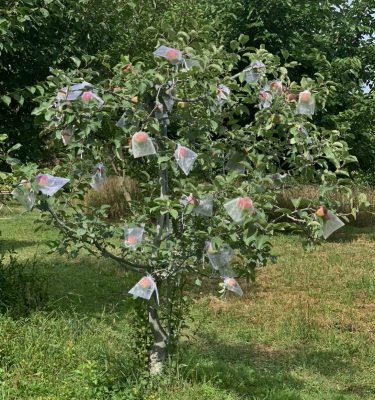
  In anticipation of problems with yellowjackets, European hornets, honeybees, birds, insects, and diseases, earlier this summer we enclosed 100 bunches of grapes in white delicatessen bags. Not that all unbagged grapes get attacked. But the bagged bunches can be left hanging the longest to develop fullest flavor. Most of the time, we tear open the bags to reveal perfect bunches of grapes.
Bagged vs unbagged grapes
For the first time, this year, I enclosed some grape bunches in organza bags. (Organza is a fine mesh fabric often used to enclose such items as wedding favors.) These bags were working really well until the European hornets got hungry enough to poke feeding holes in them. This ruined some of the berries and allowed access to fruit flies.
Organza bagged grapesThe first grapes of the season, Somerset Seedless and Glenora, started ripening towards the end of August. The first of these varieties is one of many bred by the late Wisconsin dairy farmer cum grape breeder Elmer Swenson. The fruits of his labors literally run the gamut from varieties, such as Edelweiss, having strong, foxy flavor (the characteristic flavor component of Concord grapes and many American-type grapes) to those with mild, fruity flavor reminiscent of European-type grapes. Somerset Seedless is more toward the latter end of the spectrum and, of course, it’s seedless. Swenson red and Briana, which are ripe as you read this, are more in the middle of the spectrum.

  As you might guess from Elmer’s location, all the varieties that he bred are very cold-hardy.

Thanks, Elmer.

GOURMET COMPOST WORKSHOP/WEBINAR

WEBINAR: GOURMET COMPOST FOR YOUR PLANTS   

Learn the why and the how of making a compost that grows healthy and nutritious plants, everything from designing an enclosure to what to add (and what not to add) to what can go wrong (and how to right it). Don’t bother stuffing old tomato stalks, grass clippings, and leaves into plastic bags; just compost them! The same goes for kitchen waste. Learn what free materials are available for composting.

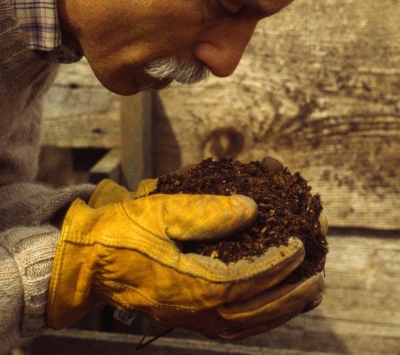
Smelling compostAlso covered will be the best ways to use your “gourmet compost.” Good compost is fundamental to good gardening; it put the “organic” into organic gardening, making healthy soil and healthy plants. Plus a segue into compost tea.

Whether your interest is to produce a material that’s good for your garden or to recycle kitchen and garden waste, this workshop will teach you all you need to know to make good compost.

Bring your questions.

Date: September 23, 2020 
Time: 7-8:30 pm EST
Cost: $35

Register for this webinar at:
https://us02web.zoom.us/webinar/register/WN_XmctJm_9QLWlKmW4hK1Lhg

After registering, you will receive a confirmation email containing information about joining the webinar.

COMPOST, KALE, A FLOWER, AND AN ODD ONION

Ins and Outs of Compost

Mostly, what I’m doing in the garden these days is making or spreading compost. Lots of good stuff — old vegetable plants, hay, weeds, rotted fruits — is available to feed my compost “pets.” And compost spread now has the ground ready for planting in spring.

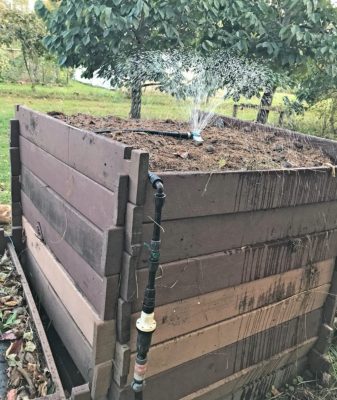
Do you have any questions about composting? Want to know how to make best use of cocompost pile being wateredmpost? Interested in details about how to make gourmet compost? This is a reminder that on Wednesday, September 23, 2020 from 7-8:30pm EST, I’ll be hosting a webinar about composting. For more information and registration, go to https://leereich.com/workshops.

A recording of the webinar will be available for a limited time period to anyone who registers but can’t make it to the live presentation.

Kale, You’re More than Beautiful

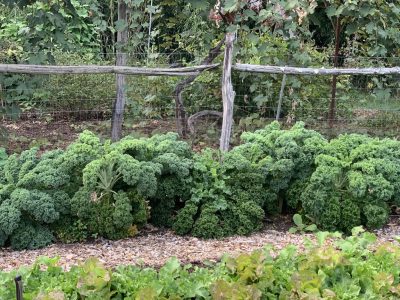
I’m lucky enough to have a French window of two big, inward swinging panels out of which I can look over my vegetable garden every morning. Oddly enough, the garden bed that is catching my eyes these mornings for its beauty is the bed mostly of kale plants.

No, it’s not a bed of colorful, ornamental kale, not even a reddish kale such as Russian Red. I grow just plain old Blue Curled Scotch kale, which is no more bluish than any other kale, or any other member of the whole cabbage family for that matter. What catches my eye each morning is the way the curly leaves flow together like an undulating wave of verdant frilliness.
Kale, from upstairs window
My vision could be swayed by my knowing that kale is such a healthful vegetable, being especially rich in calcium and vitamin A. Or the fact that it’s so easy to grow. I sowed the seeds in early March, set out transplants out in early May, have been harvesting it since the end of May, and will continue to do so probably well into December. (Another bed of kale, which I seeded right out in the ground at the end of May, is also looking good.) 

Unlike broccoli, whose prime is past once buds open into flowers, or cabbage, which splits if left too long, kale doesn’t need to be harvested at just the right moment. It just keeps growing taller, with more leaves, if left alone.

The only thing kale needs protection from is rabbits and woodchucks, like most vegetables, and from cabbage worms. A fence and two dogs keep rabbits at bay. One or two sprays of the biological pesticide Bacillus thurengiensis, sold commercially under such trade names as Thuricide and Dipel, is all that’s needed for the worms (they’re actually caterpillars, not worms). Or nothing. Some years, damage is light enough so that no control is necessary.

What more could I ask for from a plant: good looks, good health, and good flavor?
Row of kale

Kiss Me Over the Garden Gate

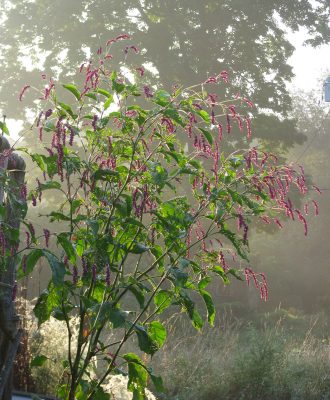
I take it upon myself to personally promote the revival of an old-fashioned flower: kiss-me-over-the-garden-gate (Persicaria orientalis). It’s big, it’s beautiful, and it’s distinctly old-fashioned.

If you know the weed called smartweed, you have a hint of what kiss-me-over-the-garden-gate looks like. Smartweed is a trailing weed, usually no more than a foot or so high, with what look like small droplets of pink dew at the ends of its stems.

Kiss-me-over-the-garden-gate looks like smartweed on steroids, the “droplets” the size of bb’s and, rather than trailing, the plant rises with robust arching stems to more than seven feet high. It’s just the right height and form for growing next to a garden gate, which is where my plants sometimes grow.
kiss me over the garden gate
Kiss-me-over-the-garden-gate is a little hard to get started because the seeds germinate slowly and erratically. My plants thankfully live up to their reputation of being self-seeding annuals. The self-seeding plants come up more robustly than the coddled few seedlings I used to transplant each year.

Kiss-me-over-the-garden-gate’s self-seeding habit is restrained enough to keep it from being frightening. All I do each spring is weed out the few extra plants, as well as those that stray too far from my garden’s gate.

Evergreen Onions

For many years, in addition to starting onions from seed, sown in February, I also would go the more conventional route and bought a few “sets” for planting. Sets are those small bulbs that grow first to become scallions, which are mostly leaf, then go on to fatten into bulbs that can be harvested and stored.

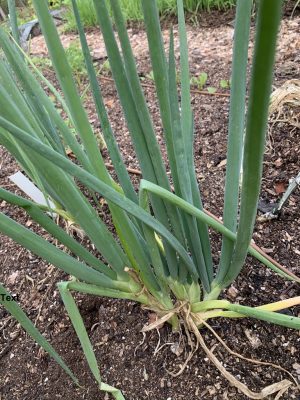
Nowadays, instead of planting sets for scallions, I grow bunching onions, yet another type of onion, one that never ever makes fat bulbs. I’ve sown them in February for later transplanting, or directly in the garden. They always remain scallions, never bulbing up, and multiply by growing new baby plants at their bases.
Evergreen onion
The variety I grow, Evergreen Hardy White, can allegedly live through winters here. Come spring, the plants can be divided to make more scallions for eating and for growing. (I’ve always eaten them all; this year I’ll leave some to challenge their winter hardiness.)

Tops of my bulbing onions dried down and were harvested weeks ago, but these bunching onions never cease to maintain their fresh, green scallion-y character.

I’M NO MICHELANGELO, BUT . . .

Lawn Nouveau

I’m taking up sculpture. Not in bronze, Carrara marble, or granite, but with plants.

My easiest sculpture is one I’ve been doing for years. I can’t really say “working on for years” because every year it vanishes, to be started anew each spring. It’s “lawn nouveau,” as I call it in my book, The Pruning Book, and then go on to describe the technique as “two tiers of grassy growth . . . the low grass is just like any other lawn, and kept that way with a lawnmower. The taller portions are mowed infrequently – one to three times a year, depending on the desired look (and my need for hay) — with a scythe or tractor.” The sharp, defining line between the high grass and the low grass is integral to the design.
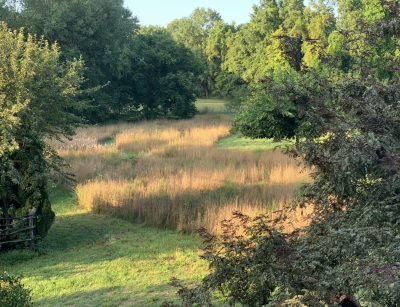
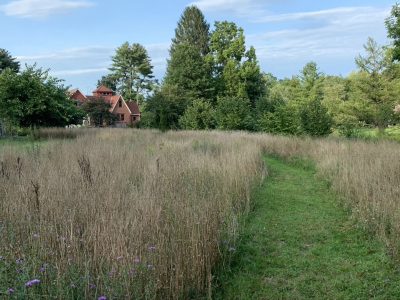
Meadow in September
I’m lucky to have a meadow bathed in sunlight bordering the south side of my property. But even a small yard might be able to accommodate lawn nouveau. My three-quarter of an acre yard did before the meadow shifted to my care. (Previous owners had maintained it as very large lawn with weekly or biweekly mowing.)

This sculpture has many pieces to it.

One is how I manage it with mowing the whole meadow either at the end or the beginning of the growing season, a necessary task or the meadow will naturally revert over time to forest. Even a once a year mowing might be insufficient, as I realized a couple of years ago with the increasing encroachment of woody shrubs and vines such as poison ivy, grape, and multiflora rose.

Repeated mowing during one season brought the meadow back in order, mostly with grasses. Over time I expect and hope for a resurgence also of more goldenrods, bee balms, and other herbaceous, flowering plants.
Meadow of an autumn passed
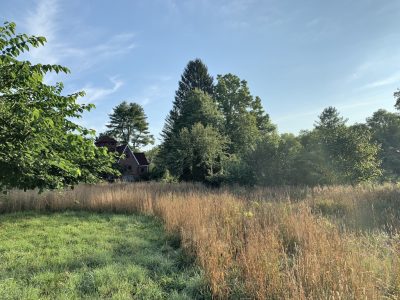
The look of the meadow is also influenced by a season’s weather. And by the progress of the season, the meadow’s appearance being very different as grasses morph from succulent green leaves in spring to late summer’s tawny shoots and seed heads. Late summer also brings on showy flowers.
Meadow in spring
Even the time of day; it’s early morning appearance is quite different than its appearance at various times throughout the day, all dependent also, of course, on what’s happening up in the sky. All this making for a very interesting sight of varying beauty.

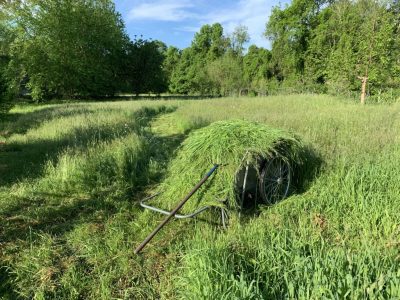
A lot of this is either beyond my control or very unpredictable. What is neither is my mowing during the growing season. Each spring I lay out a path, maintained by mowing with my tractor, that wends its way through the meadow.
Meadow path
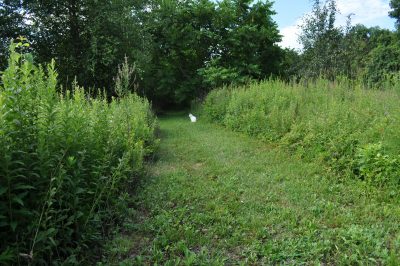
The goal is to make it inviting and practical. Practical because it carries you to the end of the meadow into a bosk of maples, river birches, and one large buartnut tree, and then on to a studio building.
Path leading to bosk
Meadow, looking north
This year I decided to also sculpt more edges of the meadow, cutting the high grass with a scythe to a pattern that matches the flow of the path within. One of my favorite views of the meadow is from an upstairs window, its height allowing me to visually swallow the whole view.

A Head for Yew

Another plant sculpture here is a large yew that I’m carving to become a fifteen foot high head. This one is easy enough because I’m merely copying one of a series of such heads living in a public garden in Britain.

The bush is old, 40 years at least, and has always been pruned to a cone shape with slightly rounded rather than straight sides.

Creating the facial features has involved some deep pruning down into the center of the bush. Yew is a forgiving plant, readily resprouting from even old wood. Problem is that some of those interior stems are old and dead.
Yew head
The challenge, then, is time, to be patient for sprouts to grow where light now is penetrating. And then to trim those sprouts so that all levels of the sculpture present green surfaces.

Cloudy Aspirations

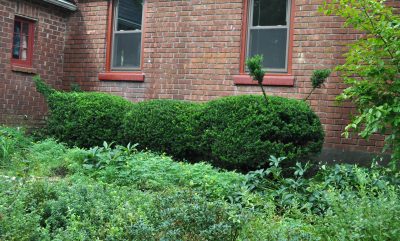
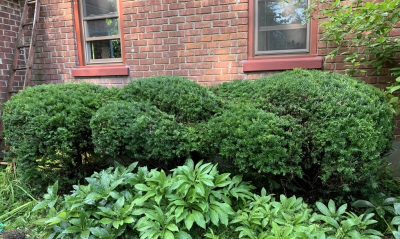
And finally, my most difficult sculpture, one for which I each year claim improvement, but not success. The plants: yews again. In this case, there are four of them, all maintained four to five feet high so as not to block the windows of the wall they front.

Originally, they were pruned as a standard yew-along-house-foundation hedge. A few years ago, I morphed them into something more interesting and humorous, a giant caterpillar, with some success. (My inspiration here was the work of Keith Buesing, topiarist extraordinaire of Gardiner, New York.)
caterpillar yew
More recently for these plants, I decided to try a method of pruning known as okarikomi, a technique that originated in Japan. In this case, a group of shrubs, rather than maintaining their individual identity, are pruned to flow together to create a scene reminiscent of billowing clouds or a distant, rolling landscape.
Okarikomi yew
Thus far, I’m not pleased with my pruning. But every year I make some changes and it looks better than it did the previous year.

Plants are very forgiving. Every year, even during each growing season, I have opportunity to change my sculptures according to my whims or what looks nicer to me. What will the meadow, the yew head, and the okarikomi yews look like next year?

And Composting

In case you didn’t notice my previous post, I will be holding a composting workshop/webinar Wednesday, September 23, 2020 at 7 PM. For more information, go to www.leereich.com/workshops.

COMPOSTING WORKSHOP/WEBINAR

COMPOSTING WORKSHOP/WEBINAR

Presentation by Lee Reich (MS, PhD, researcher in soil and plants for the USDA and Cornell University, decades-long composter, and farmdener*):

Learn the why and the how of making a compost that grows healthy and nutritious plants, everything from designing an enclosure to what to add (and what not to add) to what can go wrong (and how to right it). Don’t bother stuffing old tomato stalks, grass clippings, and leaves into plastic bags; just compost them! The same goes for kitchen waste. Learn what free materials are available for composting. “Bring” your questions about this important topic. 
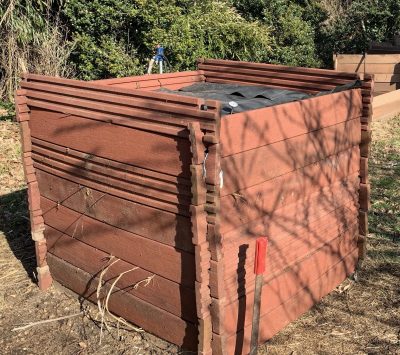
Compost bin
Also covered will be the best ways to use your gourmet compost. Good compost is fundamental to good gardening; it put the “organic” into organic gardening, making healthy soil and healthy plants.

Whether your interest is to produce a material that’s good for your garden or to recycle kitchen and garden waste, this workshop will teach you all you need to know to make good compost.

Space for this workshop/webinar is limited so registration is necessary. Sign up soon to assure yourself a space.

Date: September 23, 2020
Time: 7-8:30 pm EST
Cost: $35

Register for this webinar at:

https://us02web.zoom.us/webinar/register/WN_XmctJm_9QLWlKmW4hK1Lhg

After registering, you will receive a confirmation email containing information about joining the webinar.

*A farmdener is more than a gardener and less than a farmer.

DAILY GRAPES

As The World Turns…

Over the years, gardening has made me more and more aware of our planet’s annual track around the sun. How quaint. It gives me a certain kinship with the peasants at work in the 15th century painting for the month of September of Les Très Riches Heures de Duc de Berry.
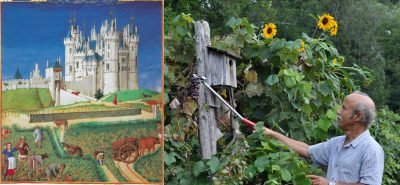
Picking grapes, 15th and 21st century

Picking grapes, 15th and 21st century

As with those peasants, September is a month when I have abundant fruits for harvest. Like the peasants, I’m harvesting grapes; it’s been a bumper year. Unlike the peasants, my grapes are destined for fresh eating rather than being sullied by fermentation into wine. (Okay, okay, just kidding, although I am not a fan of drinking wine.)

First to ripen here were the varieties Somerset Seedless and Alden. With an abundance of varieties and fruits, I can afford to be picky, so this will be the last season here for Somerset Seedless. It’s too prone to pest problems and the fruit never loses enough of its tannin-y taste for my palate.
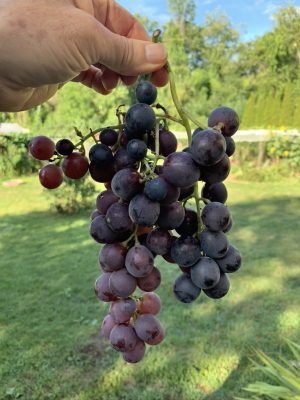
Alden grape

Alden grape

Alden is also threatened with my saw and shovel because it bears lightly and is also plagued with pest problems. But excellent taste and texture make it worth keeping.

Following on the heals of those earlier varieties are Swenson Red, Lorelei, Glenora, and Vanessa. The latter two are very good but would not be worth keeping if they weren’t seedless. In my experience, the most flavorful grapes are those with seeds. Swenson’s Red is a variety that pretty much everyone loves. They’d also love Lorelei if they got to taste this not very common variety.

Finally come Edelweiss, Wapanuka, Brianna, and, bearing for the first time, Cayuga White. The first three are not yet quite ripe. Even at this stage, they are delectable. Cayuga White is still proving itself, or not.
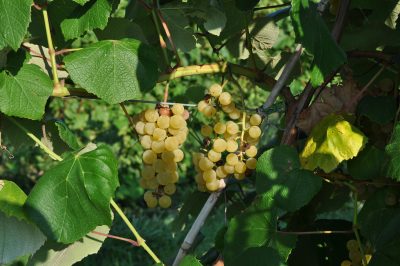
Edelweiss grape

Edelweiss

Looking to the future, newly planted Bluebell, Alpenglow, and Dr. Goode should yield a few berries next year. Also an unknown variety that I propagated from an old vine growing at a friend’s Orchard.

With their bold flavors, you’re not likely to find any of the varieties I mentioned at a supermarket, possibly even a farmer’s market. Plant them!

Variety Choices

A few caveats: The Wallkill River Valley, site of my farmden, is far from ideal for fruit growing. As a valley, it’s colder than surrounding land (zone 5) and is laden with damper air that encourages disease. An abundance of wild grapevines in the bordering 6000 acres of forest provides a place for insects and disease to get their start.

Nonetheless, I get good crops without resorting to sprays. This is possible by providing a sunny site with good air circulation and making the best of it with trellises, and — very important — annual pruning. Also by choosing varieties to plant based on pest, disease, and cold resistance. 

Many grape varieties are hybrids of European and American species, the Europeans chosen for their flavor (flavor, that is, from a Eurocentric perspective), the Americans for their toughness to pests and more rigorous growing conditions. American varieties have a unique flavor, called foxiness and typified by that of Concord, as well as a slip skin. European varieties are sweet with a crunchy texture.

As far as flavor and texture, varieties span the spectrum from those that are more like European grapes to those more like American grapes. My final, but very important, consideration in choosing a variety is flavor, and I mostly prefer the flavors of varieties toward the American end of the spectrum.

Of course, the choice widens for grape enthusiasts in more Mediterranean climates, where European varieties can also be grown, and in the Southeast, where the native muscadine grapes grow wild and are cultivated.

Bagging, for Pests

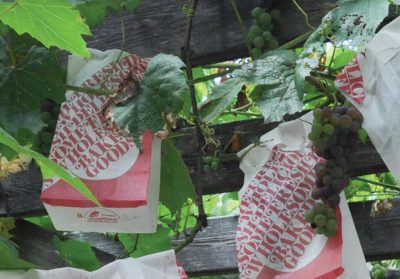
Many birds and insects, especially yellow jackets and European hornets, also enjoy my grapes. They leave plenty for me, but crucial to harvesting the best of the best tasting grapes here is bagging.

Years ago I figured that the longer a bunch of grapes hangs on the plant, the tastier it gets (to a point), but also the more chance of attack by insects and birds. So I bought 1000 bakery bags that happened to have “Wholesome Fresh Delicious Baked Goods” printed on them. Paper bagged grapesPerhaps the label made the bags even less attractive to grape-hungry birds and insects; at any rate, they worked very well, usually yielding almost 100 late harvest, delectably sweet and flavorful, perfect bunches of bagged grapes each year.
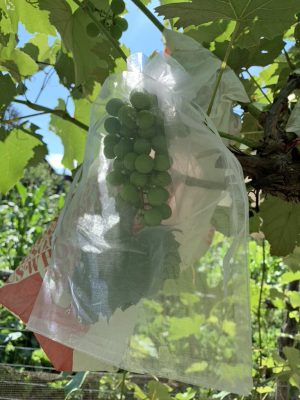
This year, I thought organza bags might work well. Bagged grapes, organzaOrganza is an open weave fabric often made from synthetic fiber. Small organza bags typically enclose wedding favors; the bags come in many sizes. Organza bags have the advantage over paper bags of letting in more light. A mere pull of the two drawstrings makes bagging the fruit very easy; paper bags involve cutting, folding, and stapling. Organza bags also re-usable. (The bags also work well with apples which, in contrast to grapes, require sunlight to color up.)
In the15th century painting, peasants just pile bunches of their grapes into large, wooden tubs. I gently set only enough bunches for immediate consumption into a woven basket. Different methods, but we’re all tuned to the progress of our planet around its sun.

More details about growing grapes — and lots of other fruits — in my book Grow Fruit Naturally.Apples, bagged with organza
UPCOMING COMPOSTING WEBINAR/WORKSHOP

Presentation by Lee Reich (MS, PhD, researcher in soil and plants for the USDA and Cornell University, decade-long composter, and farmdener*):

Learn the why and the how of making a compost that grows healthy and nutritious plants, everything from designing an enclosure to what to add (and what not to add) to what can go wrong (and how to right it). Don’t bother stuffing old tomato stalks, grass clippings, and leaves into plastic bags; just compost them! The same goes for kitchen waste. Learn what free materials are available for composting. “Bring” your questions about this important topic.

Also covered will be the best ways to use your “gourmet compost.” Good compost is fundamental to good gardening; it put the “organic” into organic gardening, making healthy soil and healthy plants.

Whether your interest is to produce a material that’s good for your garden or to recycle kitchen and garden waste, this workshop will teach you all you need to know to make good compost.

Space for this workshop/webinar is limited so registration is necessary. Sign up soon to assure yourself a space.

Date: September 23, 2020 
Time: 7-8:30 pm EST
Cost: $35

Register for this webinar at:
https://us02web.zoom.us/webinar/register/WN_XmctJm_9QLWlKmW4hK1Lhg

After registering, you will receive a confirmation email containing information about joining the webinar.

*A farmdener is more than a gardener and less than a farmer.

Smelling compost

SICKNESS, MY CORN NOT ME

An Interesting Puzzle Unfolds

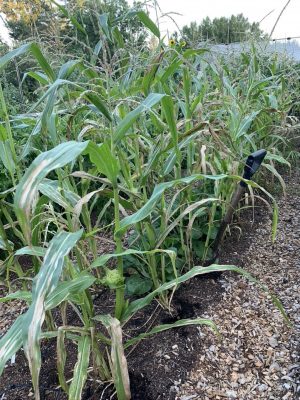
Sudoko and Scrabble and other games and puzzles offer endless hours of entertainment and stimulation. Or so I hear.  I get those challenges and rewards from my garden. Case in point is a bed of sweet corn which has been stunted all season long and then last week, almost suddenly, all the plants’ leaves turn sickly as well. Needless to say, ears are developing poorly or not at all. Why, I asked?

I have to backtrack. Each year I plant 4 beds of corn, each about 20 feet long, which supplies plenty of ears for fresh eating and freezing. I spread out the harvest season by planting a new bed every two weeks after the previous planting. Each bed, like other beds in my vegetable gardens, is spread each year with a one-inch depth of compost to maintain fertility (as well as other benefits).
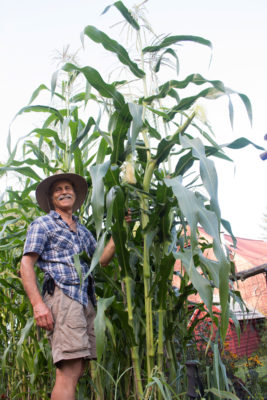
Tall Golden Bantam corn
At first I thought perhaps there was a fertility problem with the stunted bed. But, as I wrote, all the beds get the same fertility treatment. Watering is also the same, via drip irrigation. And early-season Chinese cabbage plants sharing that bed with the corn look fine and healthy.

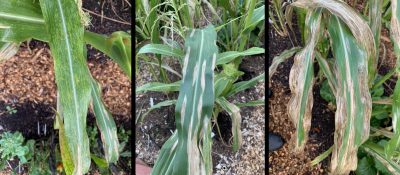
The suddenly sickly leaves were very telling, with yellow streaks that turned to tan, dead spots. It didn’t take long to nail down the cause to Stewart’s Wilt, also known as bacterial wilt. Two culprits are at work here. The first is a bacterium (Pantoea stewartii), which needs a friend to actually get inside and infect a corn plant. That friend is the corn flea beetle (Chaetocnema pulicaria). The beetles overwinter as adults, with the bacteria in their gut, and emerge in spring to feed on and infect corn plants. Seeds from infected plants can also grow up infected, although this is relatively rare.

Other evidence supports my finger-pointing. The corn flea beetle doesn’t tolerate cold weather well, making the disease more prevalent after milder winters. Check. Last winter was the warmest winter in decades. Stewart’s Wilt is also most prevalent in hot summers and dry summers. Check. Check. One of the most susceptible varieties is Golden Bantam, which I grow. Check.

Disease development

Disease development on leaves

Fertility can play a role, with ammonium nitrogen and high phosphorus levels favoring the disease, and high calcium and potassium decreasing plant susceptibility. Probably not a factor; phosphorus level is high in my beds, as are levels of potassium and calcium. Based on growth in the rest of the garden, there’s no reason to suspect ammonium levels are too high.

Why This Year?

Putting a name to the problem is not the end of my puzzle. 

One remaining question is why the one bed was so severely infected, and not the other three. Golden Bantam is an heirloom variety, with seed saved each year — for the past 100 plus years — from self-pollinated plants. Although basically the same, all Golden Bantam plants are not clones, that is, genetically identical. Slight differences could exist between “lines.” I had more than one source of Golden Bantam seed this year. I always assumed that all the Golden Bantams are sufficiently identical, so I never record which source or sources I planted in each bed. It could be that one bed was planted with seed of a more susceptible line.
Infested bed
Another possibility for the unique performance of the last bed could be that it’s development coincided with the flea beetle’s development such that it was rendered more susceptible. Earlier ripening corn generally is less susceptible than later ripening ones.

I’m tending toward the theory that this growing season presented a unique “perfect storm” of conditions that favored the disease.

Looking Forward

The most important part of solving this puzzle, of course, is: what to do? I don’t particularly like the flavor or texture of modern supersweet hybrids, even if many are wilt resistant. Some popular old varieties — Country Gentleman and Stowell Evergreen, for example — are wilt resistant. But — and not to be a picky eater — those varieties are white corns; I like yellow corns.

More than that, I like Golden Bantam sweet corn. This variety was the most popular variety early in the 20th century. Although the pathogen was identified by, of course, F. C. Stewart in Long Island, New York in 1895, not much could be done to control its devastating effects until resistant hybrids were developed. The first of these was bred from two lines of Golden Bantam, in 1923. It wasn’t long before 70 tp 80% of canned corn was of this variety, Golden Cross Bantam.

Golden Cross Bantam is still available today. The plants are sturdier, more productive, more uniform in ripening than Golden Bantam, and wilt resistant. I’ll plant it next year. (I may have accidentally grown it a few years ago. Given Golden Bantam’s popularity, “Bantam” was included in the names of many hybrids and genetic lines. For more about my experience see my blog post from September 1, 2016.) I hope Golden Cross Bantam, seed of which I already ordered, tastes as good as my original Golden Bantam.

I’ll also plant a few hills, labeled as to seed source, of the real Golden Bantam to see if Stewart’s disease appears and, if so, if severity varies between those sources.

Puzzle complete, till next year.

Golden Bantam, a hit since 1906

Golden Bantam, a hit since 1906

READY FOR 2021

Why Now?

For the past week or so I’ve been getting parts of the garden ready for next year. Too soon, you say? No, says I.

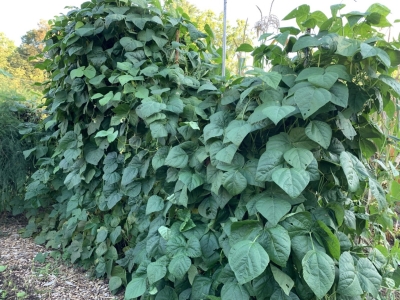
Pole beans

Pole beans

A bed of corn and a bed of bush beans are finished for the season. Not that that’s the end of either vegetable. I planted four beds of corn, each two weeks after the previous, and the two remaining beds will be providing ears of fresh Golden Bantam — a hundred year old variety with rich, corny flavor — well into September.

The bed of bush beans will be superseded by a bed of pole beans, planted at the same time. Bush beans start bearing early but peter out after a couple of harvests. Pole beans are slower to get going, but once they do, they keep up a quickening pace until slowed, then stopped, by cold weather.

Why, you may ask, ready those beds now for eight months hence? One reason is that the garden is always such a flurry of activity in spring that I welcome one less thing that needs doing then. Also, part of garden preparation is thorough weeding (which I also keep up with, though less thoroughly, all season long). Any weeds checked now means less weed seed to spread around the garden and, in the case of perennial weeds, less opportunity to gain a foothold.

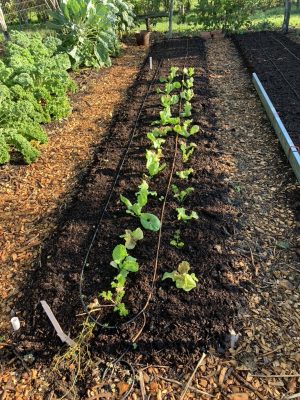
Bed of lettuce and chinese cabbage

And later in the season…

Planted bed, endive, lettuce

And, later in the season

And beds prepared now need not sit idle till spring. Right after getting the old bean bed ready for spring, I’ll plant it with vegetables that thrive in the cool weather of fall, vegetables such as lettuce, endive, turnips, Chinese cabbage, and winter radishes. The bed will be ready as soon as fall vegetables are harvested and out of the way.

And How? Simple.

No magic potions or secret techniques ready my beds now for next year. What’s needed, besides weeding and fertilizing, is to maintain or increase levels of soil organic matter. Organic matter is integral to good fertility, maintaining a diverse population of beneficial soil microbes, and improving soil aeration and moisture retention. It’s what put the “organic” into organic gardening.

The way I provide all this can be summed up in one word: compost.

Okay, there is more to it. My vegetable garden is laid out in beds that are 3 feet wide with 18 inch wide paths between them (and a 5 foot wide path up the middle of the garden for rolling in cartfuls of compost). Soil in the beds has not been tilled or otherwise unduly disturbed for decades, which has many benefits that I delve into in my book Weedless Gardening.

First step in getting the garden ready for next year is to remove all existing plants, be they corn, bean, or weed plants. I excise most plants, including weeds, by grabbing each near its base and giving it a slight twist to sever it from its fine roots, which are left in place. Coaxing with my Hori-Hori knife is sometimes needed. Corn plants definitely need coaxing, which I do by digging straight down around the base of each plant and then giving it a yank. After all this, I smooth out the ground, if necessary, with the tines of a rake or pitchfork.

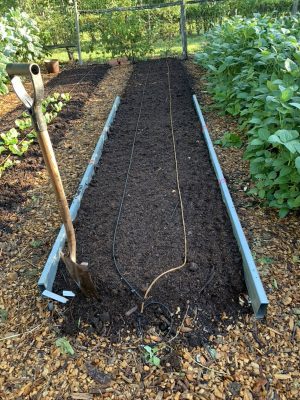
A one inch depth of finished compost should provide all that intensively grown vegetables require for a whole season. That one inch of compost is laid down like a rich icing right on top of the bed. Finished!
Composted garden bed
Okay, there’s sometimes a little more to it. I noticed weak growth in one of the later corn beds, possibly due to nitrogen deficiency, although untimely, temporary malfunction of my drip irrigation system at a critical growth stage for the corn is another possibility. Just too make sure, I will sprinkle some organic nitrogen fertilizer (soybean meal) in that bed when I prepare it.

(I could test the soil for some other nutrient deficiency, but after years of using compost made from diverse feedstuffs, some other nutrient deficiency is doubtful. There’s no good test for nitrogen because of its evanescence in the soil.)

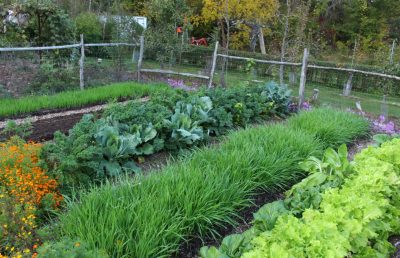
Okay, there’s sometimes even a little more to my soil prep. If a bed is finished for the season and I have enough cleared beds for all the cool season vegetables, I could just prepare the bed, as above, and that would be the end of the story. But I don’t like to look at bare ground, so beds cleared and prepared early enough in the season, which is about the end of September here in Zone 5, get planted with a cover crop. Cover crops protect soil from wind and water erosion, latch onto nutrients that would otherwise leach down and out of the ground, and crumble the soil to a fine tilth with their roots. And going into winter, I’d rather look at a lush, green cover crop than bare ground.

Cover crop in autumn

Cover crop in autumn

My usual cover crop of choice is oats or barley. Both thrive in autumn’s cool, moist weather. They mesh well with no-till because they winterkill here in Zone 5.

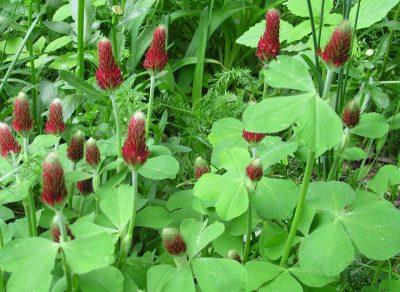
This year, especially for my beds of corn, which is a nitrogen-hungry plant, I’ll mix crimson clover in with the oats or barley. As a legume, the clover will enrich the ground with extra nitrogen that it extracts from the air. And the vivid crimson flower heads, sitting atop stalks like lolliopops, will look nice.
Crimson clover