A DELECTABLE PEACH

A Time Machine

A few days ago, a fuzzy orb that I held in my hand became a time machine. This time machine was a peach, and time travel took place immediately after I took a bite out of it. There I was, no longer eating the peach on my friend Wendy’s farm — Wendy is a botanical artist, https://drawbotanical.com — but in the backyard of my youth, biting into a peach from our backyard tree. (Our home “orchard” also consisted of two crabapple trees, whose fruit was morphed under the direction of a great aunt into jelly, and a pear tree that I remember bearing only one fruit that I watched daily only to find it, one day, gone, picked prematurely by my sister.)
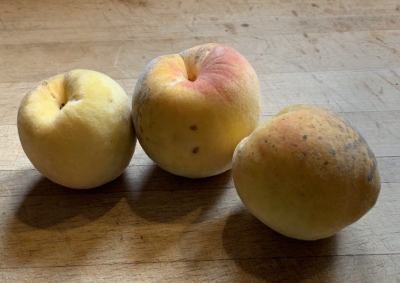
Wendy's peaches
Back to the time machine peaches. These peaches would never sell at a supermarket, even a farmers’ market. Their skin was very fuzzy and a washed out yellow color, some with just a hint of a blush. I remember, when I worked for Cornell University Roger Way, the apple breeder at the time, bemoaning the fact that “Americans eat with their eyes.” Spots from peach scab disease on many of the fruits did nothing to increase their visual appeal.

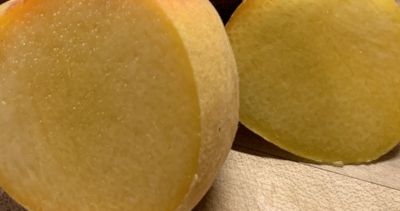
“Would never sell,” that is, unless a taste was offered. Protected within that admittedly ugly skin was a meaty, golden yellow flesh. The flesh was sweet and, in contrast to most peaches these days, very rich-tasting, with a strong peachy flavor. It’s that peachy flavor that whisked me backwards in time.Wendy's peach, cut
I Make a New Peach Tree

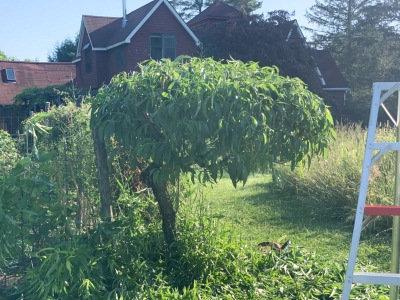
Peach tree, hedged

Long gone peach

This year has been the best ever fruit year in decades around here, even right here on the farmden, where the low-lying site is not very fruit-friendly. Peaches always fail here; a few weeks ago I finally cut down my one tree. Twice over the past years I planted apricot trees, knowing that they are one of the fruits least likely to succeed around here. I was right; they are long gone.

Against my better judgement I am going to once again venture into peachdom. Perhaps Wendy’s peach is resistant to peach ills: brown rot, plum curculio, oriental fruit moth, bacterial spot, and peach scab. (Yes, her fruits were afflicted by scab, but not enough to diminish the pleasure of biting into them.)

Wendy isn’t sure of the variety name of her tree so I can’t order that one from a nursery. No matter.

Pits saved from some of the fruits can be grown into whole new trees. Seed-grown peach trees grow quickly and can take only three or four years before their branches are adorned by fruits. Plant a peach pit now, and it will not sprout until next spring, even if you keep it warm. Like other temperate-zone fruits, the seeds need to be stratified, that is, they must experience winter before they’ll sprout. If they sprouted now, the young, tender seedlings would succumb to winter cold.

Plant the pit outdoors, and it will be naturally stratified. I prefer to fool the pit by cracking the outer shell, soaking the seed in water for a few hours, then putting it in a plastic bag, along with moist potting soil, in the refrigerator. Refrigerator-stratified seeds sprout more quickly than outdoor planted seeds because once the outdoor-sown seeds have experienced enough cold, a total accumulation of about 1,000 hours of temperatures between 30 and 45 degrees Fahrenheit, they have to await spring warmth before they’ll grow. 

Seeds stratified in the refrigerator will often sprout in the bag within a couple of months, at which point they need to be planted. I plan to pot them up and let them grow in the greenhouse.

Seed-grown fruit trees generally don’t bear fruit identical to the fruits from which the seeds came. It depends on what variety pollinated the flower that became the fruit, and how the chromosomes got juggled around. Peach trees are self-pollinating, which reduces the variability from fruit parent to fruit child, so there’s a good chance that a seed grown peach tree will yield tasty fruit. In contrast, plant an apple seed and there’s about one in 10,000 chance that the fruit from the resulting chance will even be edible.

If I wanted an exact replica of Wendy’s peach, I could beg a branch from her tree and graft it onto a peach rootstock. What’s a peach rootstock? It could be any peach tree grown from seed.

And Almonds!

Despite apricot’s strong nomination for the tree crop least like to succeed around here and, actually, pretty much everywhere in eastern North America, it does not win the prize. Almond trees are less likely to succeed. With that said, in this best of all years for fruit, here in the Northeast, at least, Wendy managed to harvest her first (and perhaps her only) crop of almonds this year.

Almonds are closely related to peaches. Their common ancestor diverged six million years ago with the separation resulting by the lifting of the Himalayan massif. Both plants suffer from the same insect and disease problems. 

Two characteristics put almonds in the most likely to fail category. First, in humid climates, the nuts themselves are apt to spoil. And second, almonds have a very low chilling requirement. (Just as seeds have chilling requirements before they will sprout, flower and stem buds also have chilling requirements before they can sprout.) With a low chilling requirement, almonds would likely break dormancy and flower with the first hint of warm weather in spring, then succumb to likely subsequent frosts.

But not this year.

Needless to say, I will not be giving almonds a try on my farmden.
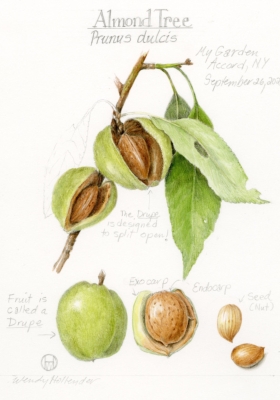
Almond Illustration, by Wendy

Almond illustration, by Wendy
FOXY GRAPES

A Bad Rap

The word foxy has not been complimentary to grapes. It refers to the dominant flavor in one of our native species, the fox grape (Vitis labrusca). Around 1880, the botanist William Bartram went so far as to suggest that the epithet foxy was applied to this grape because of the “strong, rancid smell of its ripe fruit, very like the effluvia from the body of a fox.” (Others more generously suggested the epithet came about because foxes ate the grapes, or because the leaves resembled fox tracks.)

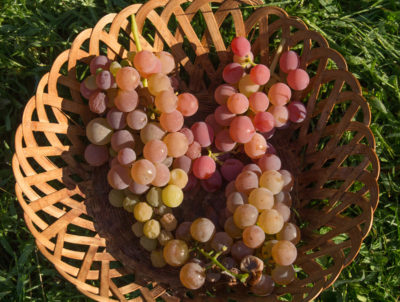
Glenora and Vanessa seedless grapes

Glenora and Vanessa seedless grapes

Although native Americans ate this grape, early white settlers, well before the time of Bartram, had been unimpressed by the flavor. In 1672, John Josselyn wrote that fox grapes had “a taste of gunpowder.” Two Dutchmen visiting New York in 1679 recounted how they “went along the shore to Coney Island . . . and discovered on the roads several kinds of grapes still on the vines, called speck [fox] grapes, which are not always good, and these were not; although they were sweet in the mouth at first, they made it disagreeable and stinking.”

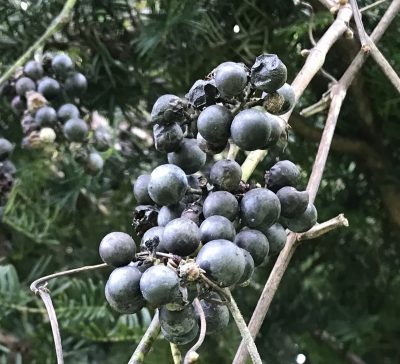
Fox grapes

Fox grapes

Wherever white settlers landed in America, they attempted to establish plantings of the grape with which they were familiar, the European wine or vinifera grape (V. vinifera), which was the grape cultivated in the Old World since biblical times. In America, vinifera culture began as long ago as 1619, when the best vines and skilled growers were brought from France to establish a vineyard in Virginia. That planting and virtually all subsequent plantings in the East failed because vinifera grapes can’t tolerate the cold winters or the insects and diseases to which our native grapes are accustomed.

What’s the Difference?

In spite of repeated, futile attempts at growing vinifera grapes in the East, few people considered growing our tougher, native grapes before the nineteenth century. Only then were superior varieties developed, beginning with Catawba about 1820.
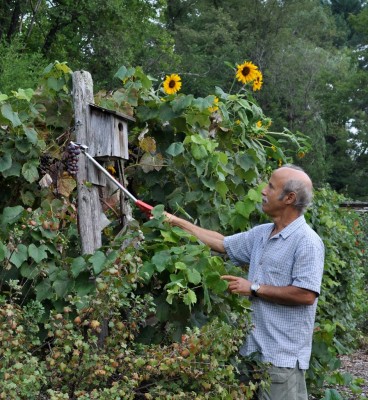
Picking grapes
One reason for the delayed interest in fox grapes was because vinifera is the better fruit for wine, and it was not until the nineteenth century that fruits generally were appreciated for fresh eating. (“Wine” recalls another possible source for the epithet foxy; horticulturalist Liberty Hyde Bailey suggested in 1898 that the name arose due to “the lively foxing or intoxicating quality of the poor wine which was made from the wild grape.”)

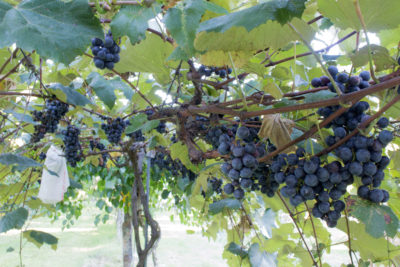
As you might imagine, fruits of vinifera and fox grapes are quite different. You can pick out the difference from the grocer’s shelf today. The fox grape is represented by Concord: bite into a berry and the thick skin slips off the jelly-like meat, releasing a strong, aromatic, though not excessively sweet, flavor. The vinifera grape is represented by Thompson Seedless: eat the whole berry, tender skin and all; the fruit is sweet, with a neutral flavor. Vinifera berries are less apt to shake off the bunches, so ship better, which is one reason why Concord grapes usually show up in markets only near where they are grown.

Concord grape

Concord grape

I Like Foxiness

All this verbiage isn’t an academic exercise in grape history. If you grow grapes, as I do, survival of the vines and taste of the fruits is important. Vinifera are occasionally grown with success in the Northeast, but 300 years of mostly failure should teach something.

For those gardeners who strive for a grape akin to vinifera, there are hybrids between vinifera and fox grapes. Actually, most grape varieties these days are hybrids of vinifera, labrusca, and often some other species. Hybrids exhibit the full spectrum in flavor, hardiness, and pest tolerance, depending on which varieties were used as their parents. 

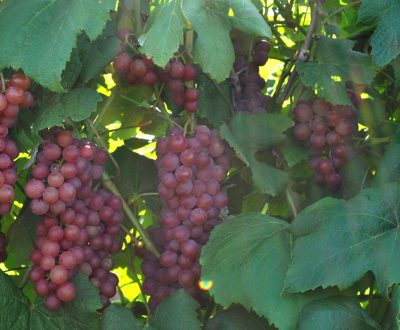
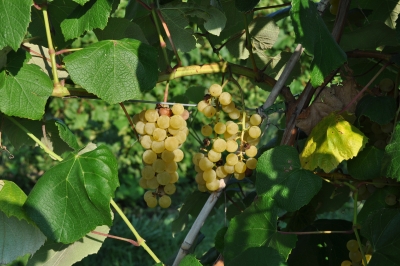
If you live in a environment inimical to vinifera grapes and you’re interested in growing grapes closer in flavor (or lack thereof, in my opinion) to Thompson Seedless, hybrids such as Himrod and Lakemont are fairly cold hardy and can be grown at favorable sites, preferably south facing slopes in full sun. A bit more foxy, unfortunately only fairly cold hardy, is Vanessa, a delectable small berry which is pale red, crisp, sweet and flavorful.

Vanessa grapes

Vanessa grapes

I have grown one vinifera variety, thus far in a large pot in my greenhouse. This one, Perle de Csaba, and I’m sure some other viniferas, does have a distinctive, delicate flavor, besides being sweet and seedless, and wrapped in a tender skin.

Notwithstanding the previous testimony against foxiness in grapes, I happen to like my grapes foxy. And I’m not alone: Ulysses P. Hedrick, who wrote The Grapes of New York early in the last century, conceded that many vinifera grapes “are without character of flavor” compared to American grapes, which are “more refreshing . . . do not cloy the appetite,” and make a better juice. My taste preference is fortunate, because in my farmden, here in the bottom of the bottom of a frost pocket, grapes are particularly prone to both cold injury and disease.

Edelweiss grape

Edelweiss grape

Despite my affection for foxy grapes, for many years my farmden lacked a good ol’ Concord vine. I finally planted one about 6 years  ago, ate the fruit for a couple of years, then decided the flavor didn’t warrant my growing it. Yesterday I tasted a friend’s Concord grapes and they were delicious. What’s up? Did my nursery source for my Concord vine mix up labels? Could the difference be due to terroir, a concept that takes into account almost everything: soil, climate, slope, sunlight, the geology and geography of a particular region, and as much more as needed to lend it a certain mystical quality? (I delve into terroir in depth in my book The Ever Curious Gardener.) I took a cutting to make a plant and in a few years will check out the flavor of that “Concord” here.

For the past few weeks, I have Elmer Swenson, a dairy farmer and grape breeder who lived near the Wisconsin-Minnesota border, to thank for the grapes I am eating. Some of my favorite varieties reflect his skill as a breeder. Swenson Red berries are medium sized, sweet, fairly foxy, and just slightly slipskin. I do wish that Edelweiss was not so vigorous, but the berries are deliciously sweet and foxy. Also delicious and foxy is Brianna. And for a variety leaning towards the vinifera end of the gustatory spectrum, there’s Somerset Seedless. Thanks Elmer.

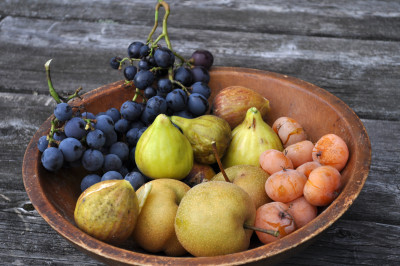
Fruit bowl with fig, grape, persimmon, nashi

Fruit bowl with fig, grape, persimmon, nashi

HAVE SOME SYMPATHY

Soil That is Too Good?

 I don’t expect to elicit much sympathy from moaning about the problem with my soil here on the farmden; the problem is that it’s too good. Wait! Don’t roll your eyes or, worse, stop reading. Allow me to present my case.
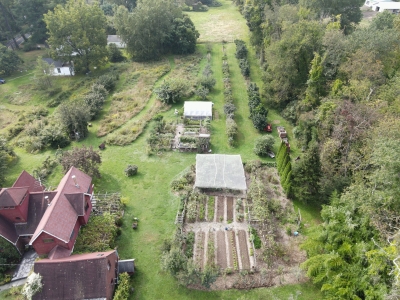
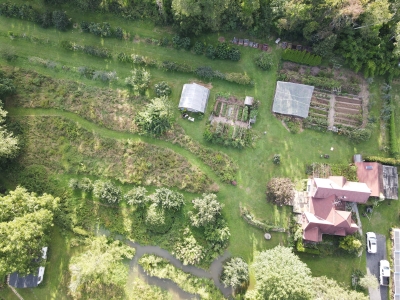
Aerial view of farmden
The setting: A valley cut through with a small river (the Wallkill River) in New York’s Hudson Valley. River bottom soil, specifically young alluvial soil, rich in nutrients, a silty clay loam with perfect drainage. Also naturally rich in nutrients. No rocks.

So what’s the problem? One problem is too much growth from plants that I’m not cultivating — weeds, everything from stilt grass and garlic mustard to wild blackberries and poison ivy to ash and cherry trees. Every minute of every day they are making the most of this rich ground and trying to insinuate themselves into my plantings. They creep into the edges of the vegetable gardens, settling in especially well right at the bottom of any fencing, where they are hard to weed out. 

My land is backed by forest running up to hills, then mountains, with soil that’s pretty much the opposite of what I have down here in the valley. It feels like that forest is just waiting for me to let up weeding and mowing, ready to spring down here and engulf my plantings.

That feeling is pretty much borne out in the one-third of an acre meadow to the south. Once a year mowing keeps the meadow a meadow. Yet even in the few months of each growing season, joe-pye-weed and ragweed stand almost 9 feet high and goldenrod, monarda, and grasses grow densely.

Looking at the herbage more closely I see multiflora rose, staghorn sumac, grapevines, and other woody plants elbowing their ways in here and there. And cherry, red maple, red oak, and poplar trees keep trying to introduce their progeny into the meadow to morph it into forest. Which isn’t a bad thing except that I scythe parts of that meadow for harvesting the herbage, not woody plants, to feed my compost, and grow apples, kiwis, pawpaws, hazelnuts, and other fruits and nuts that I cultivate in and around the meadow.

Errant and Robust

Even some cultivated plants grow a bit too well here.

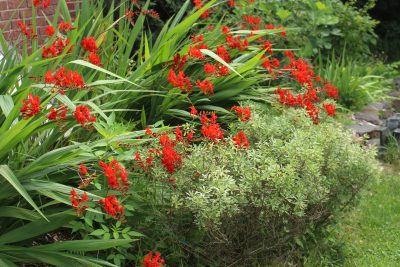
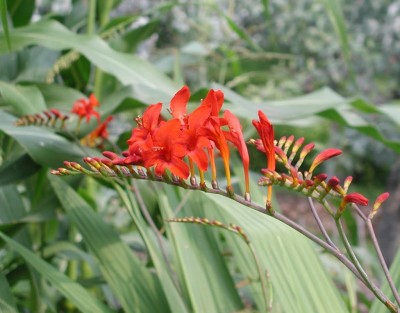
Crocosmia, for example.  Towards the end of summer, this South African, summer-flowering bulb sprouts a tall, thin flower shoot about four feet high. The shoot curves over and then fire-engine red flowers open sequentially along the upper portion of the curve.
Crocosmia up close
Many years ago I planted crocosmia here and, as directed, dug the corms up at the end of the season for winter storage, just as I would do for dahlias. Those first few seasons, the plants hardly bloomed before frost killed the tops.

Long story short is that the original planting, which has since grown to a clump of plants, now blooms reliably each August, and does so without my having to ever dig the corms up for winter. Good so far, except that the plant evidently also now ripens seeds, and these seeds find their way elsewhere on the property. That would not be so bad except that in this rich soil one little seedling soon multiplies into a clump of vigorous plants that can threaten the existence of other plants.
Crocosmia
My tack in reining in crocosmia is lopping off all spent flower heads wherever I spot them with a hedge shears, and digging out seedlings where they are not wanted.

This summer I even noticed a crocosmia seedling in the meadow. Hmmm. I recently saw, in a video documentary about color in the natural world (Life in Color with David Attenborough, highly recommended), a field of crocosmia in its native habitat, the flowers hovering over the field like a red mist. Do I want that in my meadow? Should I transplant some corms there? Would my rich soil and the apparent footloose habit of crocosmia create a future nightmare? If so, could I awaken from that nightmare with one whole season of mowing that portion of the field? Grasses are pretty much the only plants that tolerate repeated mowing.

Permaculture Ideals

All this is part of the reason I wince when I’m accused of practicing permaculture (although my agricultural perspective and much of what I do does happen to align with those of permies). Permaculture’s origins are in the poor soils and dry climate of Australia. Plant a tree there, give it water, nutrients, mulch, and you’re not inviting half the plant world in as too-close neighbors. But try this here on my farmden — or in any other place with hot summers and sufficient natural rainfall — and those “neighbors” will be at the door.

Even among cultivated plants grown cheek to jowl in the various “guilds,” growth eventually becomes so rampant that it’s a major job to keep growth among plants balanced so each plant gets what it needs in terms of light and air.

Most permaculture sites outside of climates such as Australia, our Southwest, and the Mediterranean, that I have seen mingle plants nicely on paper and look good when first planted. After a few years, though, they become a tangled mess of plants with low yields of poor-quality fruits and vegetables.

Permaculture seems to encompass a broad philosophy, broad enough so a well-known local permaculturalist once told me, contrary to my opinion, that I was practicing permaculture. I asked him, “Ok, then; what isn’t permaculture?” He replied, “Everything is permaculture! (Except commercial agriculture).”

All this is not to say that I don’t side with permaculturalists in certain key practices. Like them, I minimize soil disturbance. I also practice interplanting, such as the blackcurrants and pawpaws, favor pest resistant species, such as hardy kiwifruit and gooseberries, and let my ducks have almost free rein here. I also have my requisite shiitake logs, fire wood pile, and solar cells.

COMPOST, LOOKING AHEAD, LOOKING BACK

Spring Readiness

  I’m frantically getting ready for spring. A large portion of that readying means making compost. Compost piles assembled now, while temperatures are still relatively warm, have plenty of time to heat up right to their edges, quickly cooking and killing most resident weed seeds, pests, and diseases.
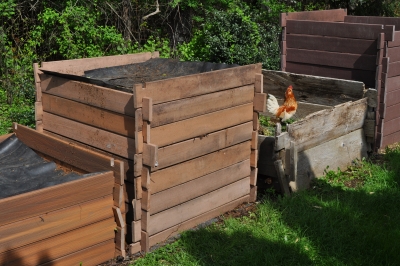
My compost binsI like to think of my compost pile as a pet (really, many pets, the population of which changes over time as the compost ripens) that needs, as do our ducks, dogs and cat, food, water, and air. Today I’ll feeding my pet — my compost pet — corn stalks, lettuce plants that have gone to seed, rotten tomatoes and peppers, and other garden refuse. Plenty of organic materials are available to feed compost piles this time of year.
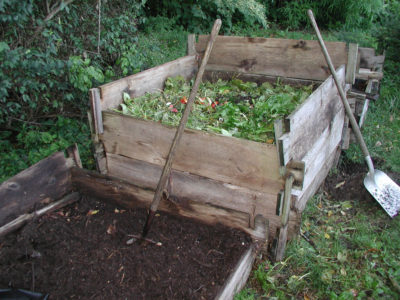
  In case you’re wondering, no, I’m not taking a close look at each leaf, stalk, and fruit to make sure it’s free of pests before getting tossed on the growing pile, as is suggested by some people. Look closely enough, and you’d find that just about everything would have some hostile organism on it. But given some combination of time and heat, a well-fed compost pile will take care of such potential problems.
Compost, in the makingJoseph Jenkins, in his excellent (and fun-to-read) book, The Humanure Handbook, quotes research showing complete destruction of human pathogens in humanure composts that reach 145°F for one hour, 122°F for one day, or 109° F for one week. The same should be true for plant pathogens and pests. For decades, I’ve tossed everything and anything into my compost piles and never noticed any carry over of pest or disease problems.
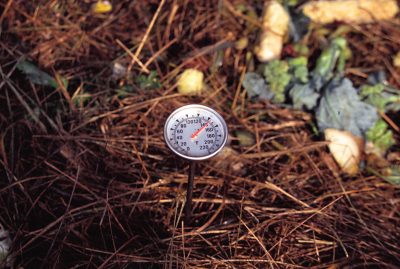
  Heat and time also do in weed seeds. Survival depends on the kind of weed: Research shows that a couple of weeks at 114°F kills pigweed seeds, while only about a week at that temperature kills seeds of tomatoes, peppers and their other kin in the nightshade family. Generally temperatures of 131°F for a couple of weeks kills most weed seeds.

  Heat and time aren’t the only threats faced by pathogens, pests, and weed seeds in the innards of my compost piles. In addition to heat, various antagonistic organisms — including friendly (to us) bacteria, fungi, and nematodes — stand ready to inhibit their growth or gobble them up.
Compost thermometerThis time of year, my compost piles dial the heat up to around 140°F, and hold that temperature for a couple of weeks, or more, before slowly cooling down.
Weedy Revenge

  Speaking of weeds, they also make excellent food for my compost pet. What sweet revenge I get tossing mugwort, creeping Charlie, and woodsorrel onto a growing compost pile and then get them back transmuted as dark, rich compost.

  Other organic materials that go into my compost piles are a mix of goldenrod, bee balm, grasses, yarrow, and whatever else is growing in my south field. I cut parts of it with a scythe, let the scythings wilt for a day, then rake and pitchfork them up.
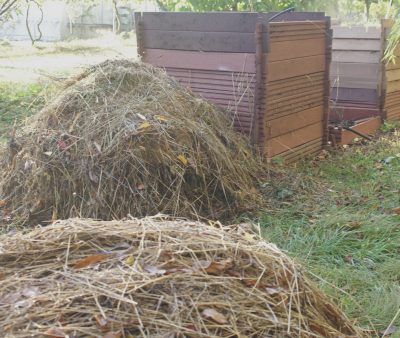
Haystacks and compost pilesAlso on the menu is some horse manure from a nearby stable, which I like mostly for the wood shavings that provide bedding for the horses. The manure itself furnishes nitrogen, which compost pets need for a balanced diet — 20 parts carbon to 1 part nitrogen but no need to be overly exacting because it all balances out in the finished compost. Lacking manure, soybean meal is another nitrogen-rich feed, as are grass clippings and kitchen waste.
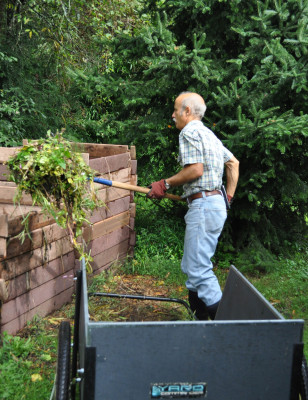
Organic materials feed compost pile.Feeding a variety of compost foods provides a smorgasbord of macro- and micronutrients to the composting organisms and, hence, to my plants. Every few inches I also sprinkle on some soil, to help absorb nutrients and odors, and some ground limestone, to lower acidity of our naturally increasingly acidic soils, and to improve the texture of the finished compost.

The Annual Cycle of Compost Here

  Compost made this time of year typically gets turned next spring, then, later in the growing season, pitchforked into the garden cart for spreading on vegetable beds. 

Turning compost

A one-inch depth of ripened compost supplies all that bed needs to grow intensively planted vegetables there for the whole growing season.Spreading compostIt was too late to plant a late vegetable crop in the bed I just cleared of old corn stalks, so I blanketed that bed an inch deep in compost. The same goes for a bed in which grew an early planting of zucchini.
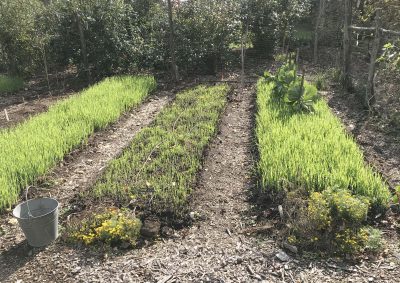
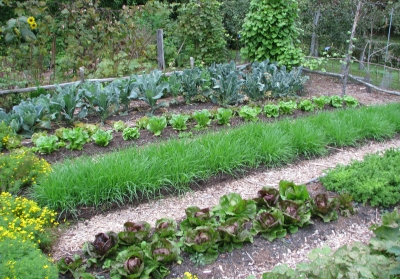
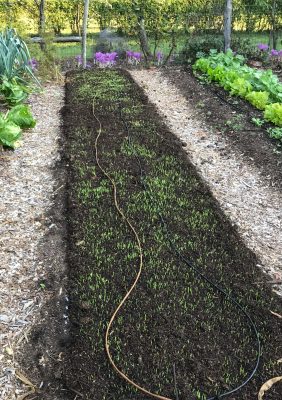
  Any beds that get cleared before the end of this month will get, before I lay down that blanket of compost, a dense sprinkling of oat seeds. The seeds will germinate and the seedlings will thrive in the cool weather of autumn and early winter.

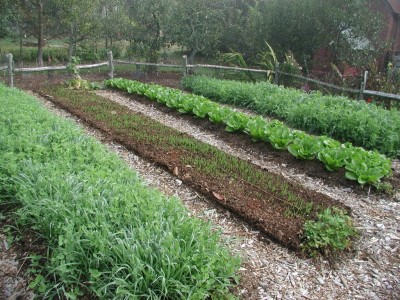
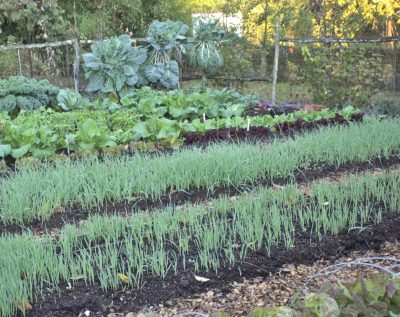
Cover crop, 3 beds with cabbage

This “cover crop,” as it is called, protects the soil surface from pounding rain and insulates the lower layers. The oat roots latch onto nutrients that might otherwise wash down through the soil. And as the roots grow, they nudge soil particles this way and that, giving the ground a nice, crumbly structure that garden plants like so well.

  Beds cleared after October 1st get only compost, no oats, which is almost as good. In all honesty, I’ve never noted any difference in the soil or in vegetable plant growth from using compost alone as opposed to compost plus a cover crop. That much compost, year after year, probably way overshadows the effect of a cover crop. The green cover does look nice going into winter, though.

(I deal more in-depth with composting, using compost, and cover crops in my book Weedless Gardening.)Oat cover crop

AN ANCIENT FRUIT, STILL POPULAR

You’ve caught me at a good time. I’m just now dipping my toes into figdom, and in the next few days expect to be swimming in a sea of fresh, ripe figs.
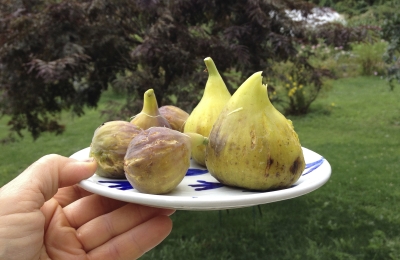
Some figs on a plate
You’ve never tasted a fresh, ripe fig? Don’t judge them by what you might buy in the market. Ripe figs are very perishable so for commercial purposes must be harvested slightly underripe. But figs don’t ripen at all after harvest, which is why market figs are but a shadow of the real thing.

Fresh, ripe figs are ubiquitous in California, Florida, and other mild winter regions, so perhaps are ho-hum to those living in those parts. Not here in New York’s Hudson Valley though, where winter temperatures dipping to minus 20 degrees Fahrenheit are no surprise!

Five Ways with Figs

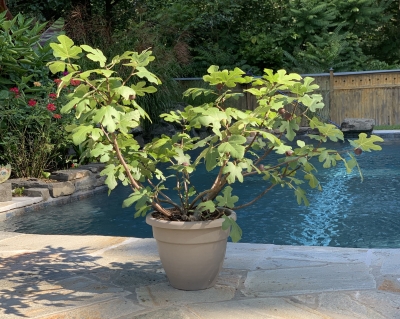
I — and you —can grow figs in cold climates by one of five techniques I describe in my new book, hot off the press, Growing Figs in Cold Climates. The easiest way is to just plant the fig in a pot that can bask in sunlight outdoors in summer, and then be moved to a cold (ideally 30-45° F), but not frigid, location for winter. Figs are subtropical, not tropical plants, that actually enjoy this winter rest.
Potted fig tree
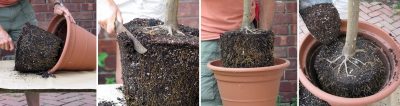
Fortunately, fig is a very adaptable plant. You can lop back its roots each winter, so you can pack new soil around its roots without having to move the plant to a bigger . . . and bigger . . . and bigger pot. You can prune stems more severely that most other fruit plants so it can be maneuvered through doorways for its winter rest. And no need for light in winter. And no pollination is necessary. And pest problems are rare.
Repotting a large plant
Of course, there’s lots of wrinkles to getting a fig plant to fruit well in a pot: What’s the best potting mix? How do you prune for best yields? When do you move the plant to its winter quarter, to its summer quarters? How do you hold back growth waiting for equable spring weather?

Another method that I describe in my book is planting a fig tree outdoors (yes, here, where winters are frigid) and training it as an espalier. Espalier is the training of a plant’s stems, often a fruit plant, to an orderly, usually two dimensional pattern. With fruit plants generally, and figs specifically, the result is more than just good looks; you get to pick lots of very high-quality fruit.
Espalier fig outdoors
I have trained my plant to the form of an upside down L, consisting of a foot-high, permanent trunk and one permanent, horizontal “arm.” (I’m starting another plant, this one trained to a low T, with horizontal arms running in opposite directions.) Each summer vigorous shoots grow from the topside of the arm and bear fruits. New figs are born along the ever elongating shoots, ripening over a long period beginning with the oldest ones, lower down, until shoot growth and fruit ripening is halted by cold weather and short days.

In late fall, I cut every shoot back to its origin on the horizontal arm. Then I insulate the plant beneath a blanket of autumn leaves topped with a tarp to shed water, then perhaps more leaves to hide the tarp from view. Come spring, the cycle of fruiting, pruning, and insulating begins again.

Devil’s Details

With any of the methods described in my book, the devil is in the details, matching, for instance a particular method of growing the plant to the pruning technique and a variety’s bearing habit.

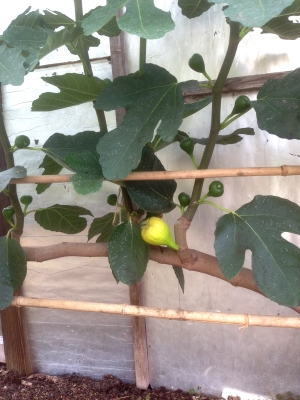
Speaking of bearing habit, that’s another characteristic of figs that make them such adaptable plants, able to be grown for their fruit even far from their native hot, dry, mild winter home in southern Arabia. While a peach tree bears fruits on stems that grew the previous season, and an apple tree usually bears fruit on stems two, three, or more years old, a fig tree might bear fruit on new, growing shoots; on one-year-old stems; or on both, all depending on the variety. So there’s not necessarily a need to have stems survive winter in order to get a crop the following season.

Early figs on old part of stem, later figs developing on new shoot

Early figs on old part of stem, later figs developing on new shoot

A nice offshoot (sic) of this bearing habit, for fig lovers/growers everywhere, is that fig plants are very quick to come into bearing. I’ve had plants bear the season after I rooted them from cuttings!

And many fig varieties potentially bear two crops each year. First to ripen is the crop borne on one-year-old stems. Later, the so-called main crop is born on new, growing shoots; this is the crop that continues ripening as the shoot grows, until stopped by cold weather and short days.

Why We Lust for Figs

I am among the many people, all over the world, who have wanted to grow figs. Fig was the first fruit I planted many years ago when I began gardening. I was living in Madison, Wisconsin where winter temperatures regularly plummeted to minus 25 degrees Fahrenheit!

Why the lust for figs? Perhaps because fig originated in one of the cradles of civilization, and is one of the oldest of cultivated fruits. It is the most mentioned fruit in the Bible (remember when Adam and Eve “knew that they were naked; and they sewed fig leaves together, and made themselves aprons.” It’s also one of the two sacred fruits of Islam, and figures prominently in Greek mythology.
Adam and Eve
Flavor has to figure in: A fully ripe fig is soft and juicy, with a honey sweet, rich flavor. If you already grow figs, I’m hoping my book will help you grow better or more figs, or be able to manage them more easily. If you haven’t yet experienced the rewards of growing figs, you have a treat in store for you.
Me eating a fig

SWEET CORN OP-ED

Ah, the Good Ole’ Days

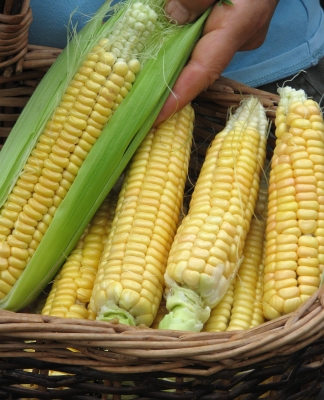
The good ol’ days seemed to have had snowier winters, greener grass, and more toothsome apples. Perhaps it was so. One thing those good ol’ days definitely did not have was sweeter sweet corn. Only in the past few decades have plant breeders found new genes that shoot the sugar content of sweet corn sky-high.
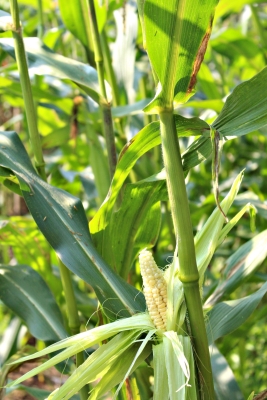
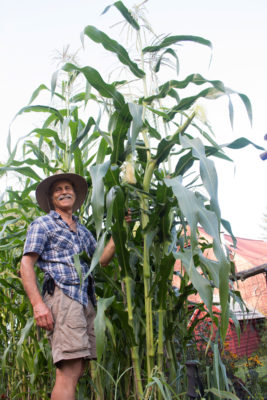
corn on stalk
Papoon corn, the first recorded variety of sweet corn, probably originated as a chance mutation of a single gene of field corn. That gene, the so-called sugary gene (abbreviated su), brought the sugar level in corn from four percent up to ten percent.

We gardeners have tried to make the most of that ten percent ever since the time when 18th century Plymouth, Massachusetts gardeners first grew Papoon corn. We pick an ear just when each kernel is creamy and as sweet as can be. Since sugars in corn start changing to starch as soon as the ear is picked, we eat the corn right out in the garden or else rush it to the kitchen to a pot of already boiling water. In only one day, half that sugar will turn to starch.

Quantum Corn

Sweetness in sweet corn took a quantum leap around the middle of the last century as a result of two genes. The first gene, called the shrunken-2 gene (abbreviated sh2) because of the way the dried kernels shrivel up, pushes the sugar level in corn up to a whopping thirty-seven percent. Not only that, but even two days after picking, that corn still has twenty-nine percent sugar.

The variety Illini Xtra Sweet was the first of the appropriately-named “supersweet” sweet corns. Other varieties with this gene are Early Xtra Sweet, American Dream, and SignatureXR. Kernels of these varieties have thick skins and lack a creamy texture.

The second gene responsible for sweeter sweet corn is the “sugar enhanced gene” (abbreviated se). The se gene is effective only in combination with the su gene of regular sweet corn, and the combination of the two genes results in varying degrees of sweetness, typically about twice as sweet as traditional sweet corn, and tender kernels. 

Still no need to scurry to the kitchen with se varieties, because they also retain their sweetness for a long time, but only because they start out sweeter. Kandy Korn EH, Sugar Buns EH, Silverado, and Snow Queen EH are varieties with the se gene. Many of these varieties have “EH,” which stands for “everlasting heritage,” in their names.

Juggling genes around to get the best of all worlds resulted in two more hybrid types of corn. “Synergistic” (syn) varieties have some su kernels from traditional sweet corn added to each ear of supersweet (shr) corn, typically about 25%, in an effort to balance sweetness, creaminess of texture, and tenderness. “Augmented sh2” varieties have some se and su genes added to an sh2 parent, basically combining all of the above genes, resulting in more sweetness and less toughness.

In case you’re wondering, none of these varieties are necessarily genetically modified (GM). All can be produced with traditional corn breeding techniques.

What’s Not to Love

Why doesn’t every gardener plant these new sweet corns? (Because of their sweetness and their ability to hang on to it longer after harvest, pretty much every farmer does limit their planting to these newfangled corns these days.) One reason not to plant these varieties is because these varieties need special care. Their seeds are finicky, and will rot just as soon as grow if planted in soils that are too cool, too dry, or too wet. Soil microorganisms also like that extra sweetness. Even after the seeds have been coaxed to germinate, the resulting seedlings often lack vigor. 

The sweeter sweet corns can lose almost all their sweetness if the wrong pollen blows onto their silks. Basically, all of the above varieties need to be isolated from all of the other above varieties except for the combination of traditional (su) varieties and sugar enhanced (se) varieties, although cross-pollination between the latter two will dilute full expression of each variety’s characteristics. The only way to minimize contamination between varieties is to separate them by at least 250 feet, or else plant varieties whose maturities differ by more than two weeks.

And what about flavor: Is sweetness all we want from sweet corn? The sweeter sweet corn varieties tend to taste watery and lack a “corny” flavor. If breeders could develop a sweet corn with ninety-five percent sugar, would that be even better? 

Corn with thirty-seven percent sugar tastes too sweet to many gardeners. I remember years ago stopping at the farmstand of one of the large local growers and asking them if they had any Golden Bantam, an old fashioned variety of sweet — not supersweet — corn for sale. The farmer’s wife grinned sheepishly and said they grow that variety for themselves.

Golden Bantam sweet corn, non-hybrid

Golden Bantam-m-m-m-m

A milk chocolate bar, with about fifty percent sugar, isn’t all that much sweeter than a supersweet variety of corn, some of which can have as much as 44% sugar.

For some of us, traditional sweet corn varieties — such as, in addition to Golden Bantam, once-popular varieties as Seneca Chief, Stowell’s Evergreen, Country Gentleman, and Silver Queen — are as delicious as corn needs to be if they are picked at just the right stage, then eaten within minutes. Ten percent sugar, especially when coupled with with a rich, corny flavor, and some degree of chewiness, is enough for me.

In the past, I’ve heaped praise on Golden Bantam corn, which was the standard for excellence in sweet corn a hundred or so years ago. I grow only this variety, more specifically “8-row Golden Bantam,” which distinguishes it from many Golden Bantam sired hybrids, such as Golden Cross Bantam and Top Cross Bantam.

Golden Cross Bantam corn

Golden Cross Bantam (not bantam)

Last year I feared I hit a bump in the road with Golden Bantam, as one-quarter of my planting yielded nothing worth harvesting due to what may have been northern corn leaf blight. I went ahead and planted 8-row Golden Bantam again this spring and am happy to say that the corn looks fine.

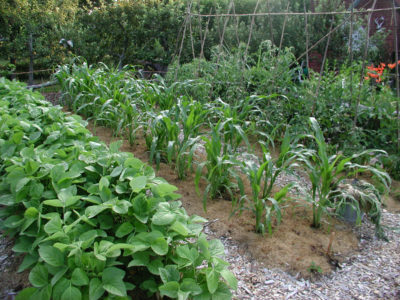
Four 20 by 3 foot beds, with double rows of “hills” 2 feet apart in each row and 3 plants per hill, provides all our household needs for fresh steamed or roasted ears and frozen kernels for winter.

Bed of sweet corn

Bed of sweet corn

BEAUTIFUL DESIGN AND UGLY BLIGHT

Who Made This Garden?

I visited a most beautiful garden this week, one in which all the elements of garden design were deftly combined. At ground level groundcovers presented pleasing and harmonious shades of green and varying leaf textures. Leafy plants, lichens, and mosses all contributed to the symphony, the whole scene knit together by large slabs of underlying rock.

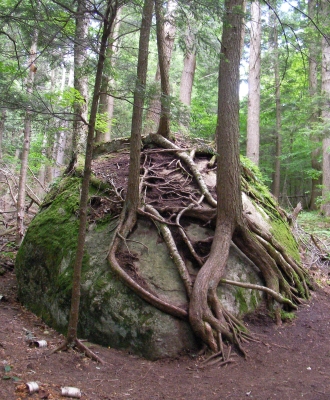
In places, low-growing junipers and deciduous shrubs and trees brought the garden up from ground level. Particularly striking was a very large boulder atop of which grew some trees whose exposed roots embraced the boulder before reaching to the ground for water and nourishment. Green moss growing on the boulder erased any starkness from this vignette.
Tree on Adirondack rock
Shakkei, or “borrowed scenery,” an important element in Japanese garden design, played an important role. Distant mountain peaks created a dramatic backdrop in some views.

This garden also utilized what I like to call “luscious landscaping,” that is, the incorporation of dual purpose plants -– for beauty and for eating -– into the landscape. Lowbush blueberry, a plant whose dainty flowers hang like white bells in spring, whose healthy, green foliage ignites in crimson come fall, and whose stems glow red in winter, formed the bulk of the groundcover species. A few lingonberry plants interspersed here and there promised red berries in autumn and evergreen leaves as a foil for those red blueberry stems in winter.

And just where was this wonderful garden? Or gardens, I should say. They were in the high peaks of New York’s Adirondack mountains. The garden designer? God or one described by Darwin, take your pick. Beautiful, at any rate. 

Blight Here in the Valley

Back down here on the flatlands, the word “blight” is often bantered around in connection with tomatoes this time of year – your tomatoes, my tomatoes, basically, everybody’s tomatoes! A few years ago, it was late blight (Phytophthera infestans) that was the blight that was of special interest. Attacking both tomatoes and potatoes, this is the same disease that caused the potato famine in Ireland in the 19th century.

Late blight was a problem in the northeast that year due to a particular confluence of events: infected tomato plants offered at “big box” stores gave the blight its start and rainy, humid conditions kept it going.

Diseased tomato plants

A few years ago; not this year.

The disease does not overwinter here in the north, except on infected potato tubers stored or left in the ground through winter. The way late blight arrives in the north is either on infected transplants or by hitchhiking up from southern fields, where it does overwinter, when weather conditions are just right. The spores can travel about 15 miles at a shot with the right winds coupled with cool, moist weather.

My tomato plants had their usual midsummer splotches and yellowing that year. I usually find pest problems more interesting than scary, I got a little worried about late blight. I tested for it by pulling a splotchy leaf off a plant, sliding it into a plastic bag, and waiting a day. White, fuzzy growth on the leaf would mean late blight. Testing was negative, although blight did eventually show up.

Only under the most severe conditions will I take special measures to control late blight. That year presented those conditions. I decided to spray my tomato plants, a measure to which I’d never before resorted. And it’s not because I grow mostly heirloom tomatoes; pretty much any and every tomato variety is susceptible to late blight. I used one of many copper sprays that are organically approved, still taking care not to dowse nearby other plants and to thoroughly protect myself while spraying.

Blight. What’s That?

That’s not to say all my tomato plants are the pictures of health this year, or any year. They do get some leaf yellowing and loss due to disease. Three diseases, in fact. One is the already mentioned late blight. The other two, which do rear their ugly heads reliably every year, are early blight and septoria leaf spot.

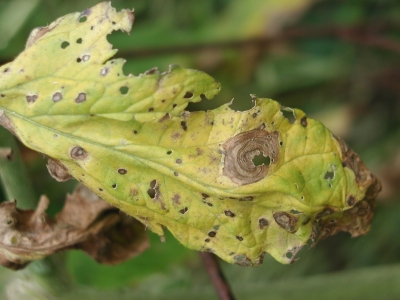
If you look closely at the leaf damage, you can tell which one(s) your tomatoes are hosting. Early blight (Alternaria solani), the most common of the three, marks leaves with dark-brown, round spots a half-inch in diameter, each surrounded by concentric rings.

Early blight

Early blight

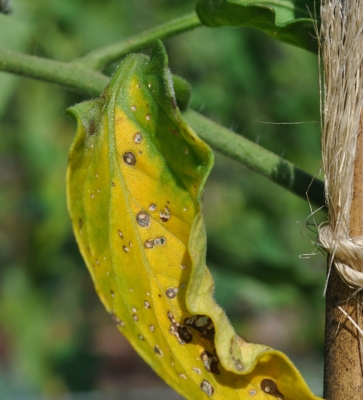
Septoria leaf spot (Septoria lycopsersici) causes spots that are small, round and gray, each surrounded by a single, dark margin.

Septoria leaf spot

Septoria leaf spot

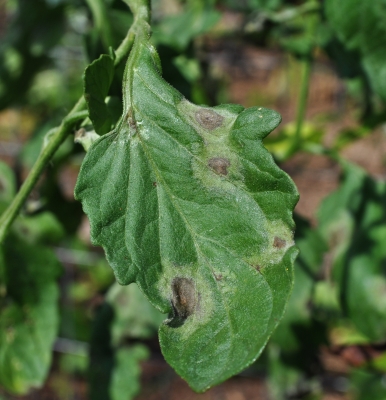
And late blight causes greenish-black splotches.

Late blight

Late blight

The names of any one of the leaf spot diseases is enough to conjure up fear of plague, but fortunately, all three can be lumped together when it comes to control. The first line of defense against any of the leaf-spot diseases is to keep disease spores away from tomato plants. Spores spend the winter in old plant debris, then are awakened and splashed onto new tomato leaves by rain during the growing season. Early blight and septoria spend the winter in old tomato refuse on the ground. Potato tubers can overwinter this far north on stored potato tubers that are planted out for the next season.

All of which makes a good case for a thorough garden cleanup each fall. At the end of the season I load up my garden cart and haul over to the compost pile old tomato and potato stems, leaves, and fruits. 

During the growing season, any mulch — my choice is compost — keeps raindrops from splashing spores up onto plant leaves. Removing infected leaves during the growing season may also help control disease spread. I leave leaves intact, figuring more photosynthesis makes for stronger plants (except, of course, for any leaves too far gone to make a significant contribution to the plant).

Crop rotation each year moves tomato plants away from any spores left from the previous season’s crop. Plant tomatoes in a new location in the garden each year, never returning them to the same spot until four years have elapsed — admittedly a tall order in a small garden.

Another line of defense against leaf spot diseases, many diseases for that matter, is to create an environment inhospitable to them. Fungi thrive in dark, moist, humid places. Let plants bask in full sun without obstructions such as weeds, fences, or other garden plants that would slow air circulation. 
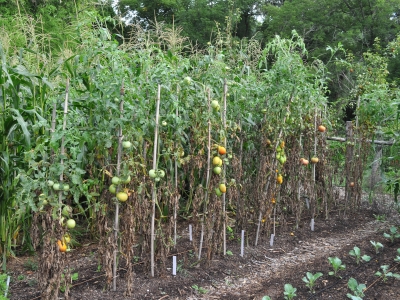
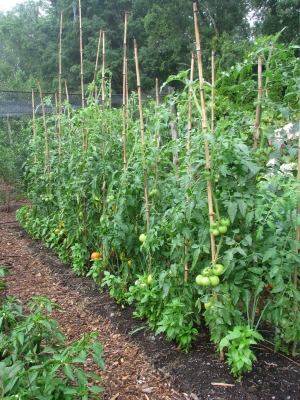
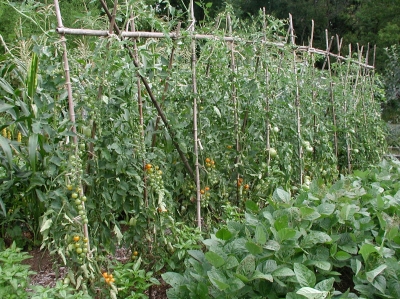
Staked tomatoes
I train each tomato plant to a single stem, which is staked, putting distance between the leaves and any spores on the soil, and exposing the plant to better air circulation. Spaced 18 inches apart, the plants yield less per plant than tomato plants allowed to run wild, but because they utilize a third dimension — up — more tomatoes per land area. Also earlier and with bigger fruits.

Staked tomatoes

MORE THAN JUST PEACHES AND PLUMS HERE

Preiselbeere, Kokemomo, Puolukka, Partridgeberry, Cowberry, Rock cranberry — or Lingonberry, They’re All the Same Fruit.

  Besides enjoying the season’s plums and peaches, I’m also enjoying a few uncommon fruits. Uncommon now. These fruits have been enjoyed by humans somewhere at sometime, just not extensively now. 

The most familiar of these to most would be lingonberries (Vaccinium vitis-ideae). As jam, in jars, that is, unless you’re Scandinavian, where this fruit is very popular harvested from the wild and then used in drinks, sauces, and pancakes.
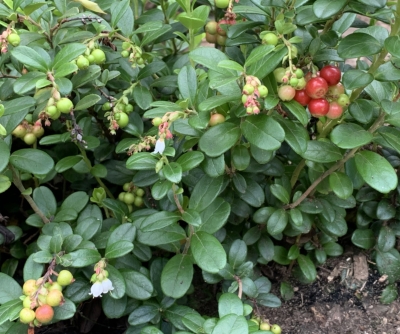
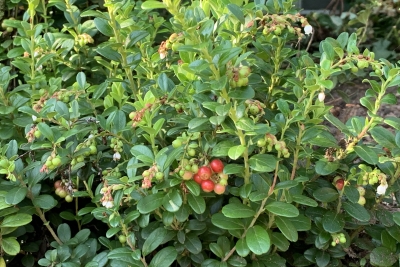
Lingonberry fruit and flowers
Lingonberry, which is native throughout colder regions of the northern hemisphere, is often compared with our native cranberry. I think that does lingonberry an injustice. Both are diminutive plants, spreading as their stems root where they touch the ground, so could be edible groundcovers. Both are evergreen, but while lingonberry’s dainty leaves have the same green gloss as those of holly, and retain it all winter, cranberry leaves turn a muddy purple with the onset of cold weather in late fall.

I recently read that the berries are “not good to eat in their raw state as they are quite bitter.” That writer evidently never tasted lingonberries; I eat them raw all the time and find them delicious. And it’s not because my taste buds are so robust. I’d never pop a cranberry, which is closely related to lingonberry, into my mouth. Too, too sour.

Lingonberry is now ripening fruits — and it’s also blossoming! The plants bloom twice each season, yielding an early and a later crop. Lingonberry fruit and flowersIf not harvested, the later crop hangs, looking pretty and in good condition for eating, through autumn and on into winter.
Lingonberry with snow
To thrive, the plant needs similar conditions to those enjoyed by blueberry, cranberry, mountain laurel, rhododendron, and other lingonberry relatives. In addition to good drainage and abundant humus, the soil needs to be very acidic, with a pH ideally between 4.5 and 5.5.

Right after planting and then each year thereafter, some time between fall and spring, my lingonberries get mulched with a one- to two-inch depth of some finely divided, organic material that is not too rich in nutrients: sawdust, woodchips, chopped straw, or shredded leaves, for example. The mulch sifts down through the leaves and stems to keep the ground cool and moist, prevent frost from heaving plants in winter, and decompose to maintain high humus levels in the soil — all of which translates to larger berries and more of them.

The plants require little care beyond regular watering for the first couple of seasons.

Centuries of Flavor

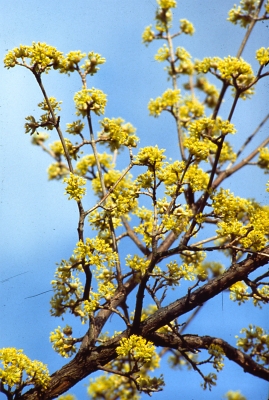
Also ripe now is a fruit that has been enjoyed by humankind for the past seven thousand years (although not so much now)! At a site in northern Greece, early Neolithic peoples left traces of their meals of cornelian cherry (Cornus mas), along with remains of einkorn wheat, barley, lentils, and peas. It was also well-known to the ancient Greeks and Romans. The hard wood was reputedly the wood for chariot axles.
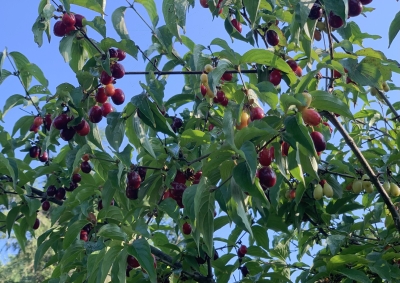
Cornelian cherry fruit
The plant was grown in monastery gardens of continental Europe through the Middle Ages and was introduced to Britain about the sixteenth century. By the eighteenth century, the plant was common in English gardens, where it was grown for its fruits which sometimes were called cornel plums.

The fruit was familiar enough to be found in European markets even up to the end of the nineteenth century. Cornelian cherries were especially popular in France and Germany, and the fruit reputedly was a favorite with children.

Native to regions of eastern Europe and western Asia, the cornelian cherry is still appreciated for its fruit in certain parts of these regions. Baskets of kizilcik, as the Turks call the fruit, are found in markets of Istanbul. The fruit is a popular backyard tree in gardens of Moldavia, Caucasia, Crimea, and the Ukraine.

When the fruit was popular in Britain, it was made into delicious tarts, and shops commonly sold rob de cornis, a thickened, sweet syrup of cornelian cherry fruits. The juice also added pizazz to cider and perry.

Depending on ripeness, fruit flavor varies from sweet to tart. It has a distinctive flavor and can be used in cookery at all stages. If tart fruit is allowed to sit for a day or two or three, the flavor becomes less tart and more mellow.

Cornelian cherry is a favored ingredient of Turkish serbert, a fruit drink sold in stores and from portable containers carried like knapsacks on the backs of street vendors. In the Ukraine, cornelian cherries are juiced, then bottled commercially into soft drinks. There, the fruits also are made into conserves, fermented into wine, distilled into a liqueur, and dried.

The plant is actually not a true cherry, but a species of dogwood. It is still widely, but mostly planted as an ornamental for its very early show of small, yellow blossoms, around the first day of spring here on the farmden.
Cornelian cherry flowers
Cornelian cherry is among my most successful fruit crops. Despite its early bloom, it has never failed to bear. Birds, insects, and diseases have little effect on production. Pruning is unnecessary. What else can you ask for from a fruit plant?

(I am still looking for some good recipes that use this fruit and lingonberry for possible inclusion in an update of my book Uncommon Fruits for Every Garden. Got something? Both fruits are covered in my currently available books, Landscaping with Fruit and Grow Fruit Naturally.)

Intoxicatingly Delicious?

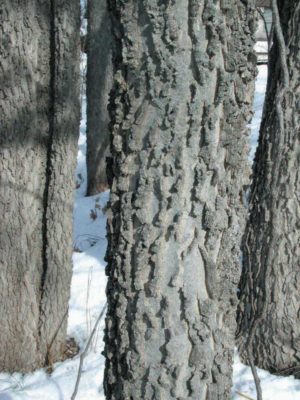
This last fruit is very uncommon, and I didn’t plant the tree mostly for its fruit. Hackberry (Celtis occidentalis) bark is gray with corky ridges that, especially in winter when illuminated by low-hanging sunlight, has that crisp, achromatic quality of photographs of the lunar landscape.

Hackberry bark

Hackberry bark

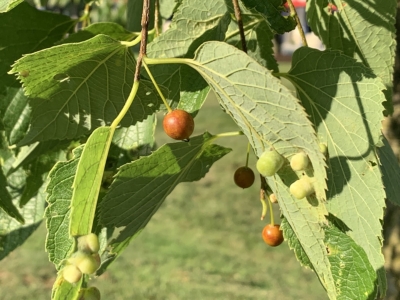
The fruit itself is refreshingly sweet, like a date. Problem is that the fruit is pea sized and contains an almost-pea-sized seed. So the fruits nothing more than a thin covering over the seed.
Hackberry fruit
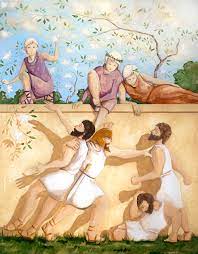
More prominent in the human diet is a close relative, one name of which is the lote tree (C. australis), which even figure in Greek mythology. When Zeuss drove Odysseus’ ships off course, the sailors finally found refuge in the Island of the Lote Eaters. Eating the fruits caused a pleasant drowsiness, to the extent that the sailors, forgetting their homes and friends, wished for nothing more than idling away on the island. Odysseus had to drag them back onto their ships.
Island of the lote eaters
The lote tree, native to Europe and temperate regions of Asia, is pretty cold-hardy (Zone 5). I have ordered seeds and should get to taste fruit of the lote tree in a few years. I might never leave the farmden.

COVER CROP CONFUSION

How Much Soil Organic Matter?

In last week’s blog I kept jumping the fence about cover crops. First I extolled their benefits. Then I wrote that they’re probably unnecessary in my heavily composted ground and possibly to blame for poor growth of some corn and tomatoes. Finally, I wound up stating that I do grow some cover crops anyway. No wonder I caused some confusion.
Oat cover cropsAll this prompted one reader, Peter, to comment with some specific questions that might also be of interest to some of you. I will now try to answer them.
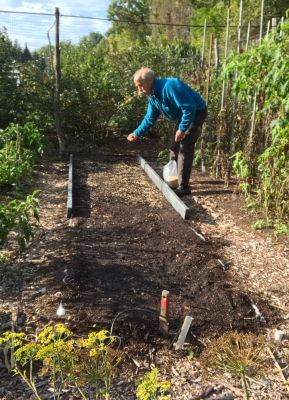
His first question was: “How is percentage of organic matter in the soil determined.” “Organic matter” is carbon compounds; as such they can be oxidized, and when this happens they are lost from the soil as carbon dioxide and water. Microorganisms do this naturally in any soil as they feed on organic matter, in so doing releasing minerals associated with the organic matter in forms that plants can use for nourishment.

The way to test the percentage of organic matter in the soil is to weigh a sample, oxidize the organic matter, then weigh it again to measure the loss. Oxidation can be done by burning the sample at high temperature. Another way is to chemically oxidize a weighed sample using potassium dichromate and then measure how much dichromate is left after the reaction. (The latter reaction is more accurate than burning because carbonates in a soil will also lose carbon dioxide when heated, affecting the final weight.) 

Peter, I suggest against determining the percentage organic matter of your soil in your kitchen. Soil labs generally include percentage organic matter along with other test results. (I cover soil testing in my book Weedless Gardening.)

Peter also reported that his soil tests very high in phosphorus, potassium, magnesium, and calcium. Soils to which have been added lots of organic matter typically test very high or excessive levels of phosphorus and potassium. That doesn’t present a problem, possibly because, as I wrote last week, “Conventional soil tests are for mineral soils, not soils that are very high in organic matter.”

As far as the high levels of calcium and magnesium, I’m not sure about that. Excessive applications of dolomitic limestone would cause that, and that would also be reflected in a high pH.

To Cover Crop or Not to Cover Crop, That is the Question

Now for a more difficult question. Why do I plant cover crops if I don’t think they’re of benefit in my soil? I guess that’s because I’m aware of the known benefits of cover crops. If nothing else, the cover crop obviously protects the ground’s surface from the pounding of raindrops and wide swings in temperature. Even if I don’t notice any positive impact, they may be there, more subtly. And then there are the still unknown benefits of cover crops.
Cover crop, 3 beds with cabbageThe major, consistent negative impact of my late summer of fall planted oat cover crops has been to increase the number of weeds the following spring, specifically henbit (Lamium amplexicaule). For the past couple of years I’ve dealt with that problem by tarping those beds in spring for a couple of weeks or more. Or, not as good, just pulling out the henbit.

Because I only cover crop beds that are no longer needed for vegetable plants towards the end of the growing season, growing the cover crops doesn’t take up space in which I could otherwise grow vegetables.

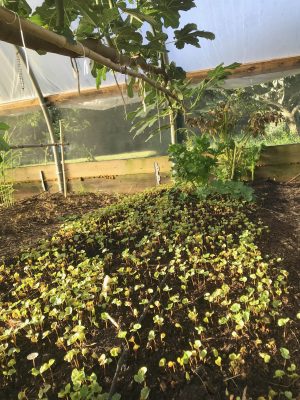
Buckwheat sprouting in greenhouse

Buckwheat cover crop in greenhouse

It’s also almost no trouble to sprinkle the oat seed over the bed before laying down the inch of compost each bed gets every year.
Sprinkling oat seed
And finally, I have to admit that I like the lush green look of the oat leaves, the leaves maintaining that look almost until the first day of winter. And even after that, they flop down on the ground, dying, but then hiding the brown compost beneath a tawny blanket.

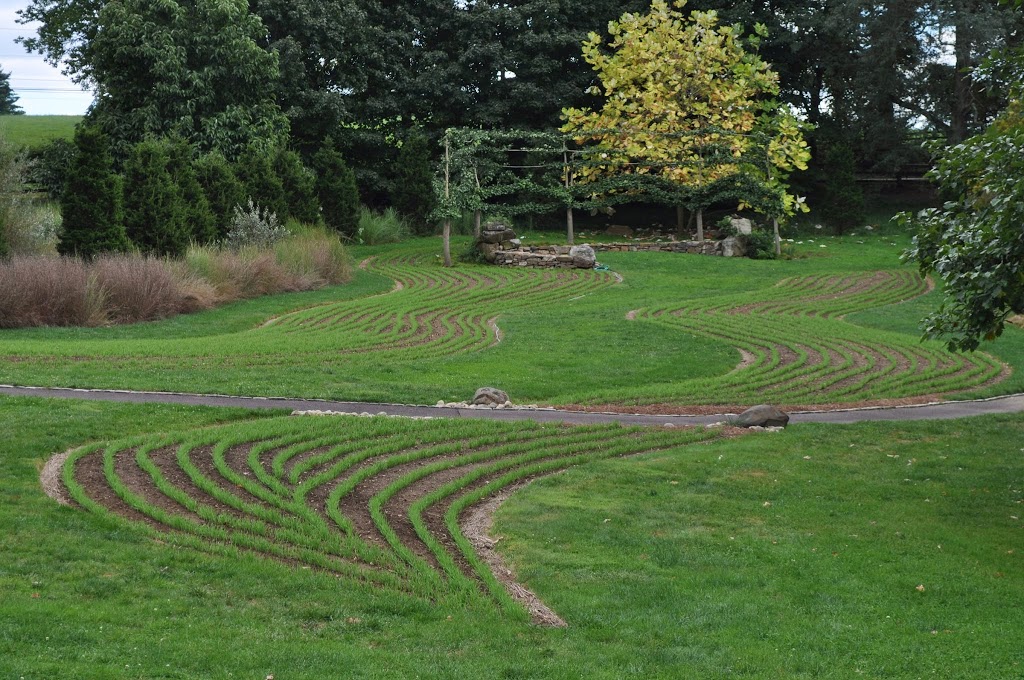
Rye cover crop at Chanticleer Garden

Rye cover crop at Chanticleer Garden

Timely Planting

Last question: “When is the latest time to plant the cover crop?” Cooler weather and diminishing sunlight dramatically slow plant growth in autumn. Oats like that cool weather, and will germinate and sprout pretty late in the season. But there comes a time when so little growth will ensue that oats or any other cover crop is not really worth planting.
Oat cover crop sprouting
Here, about half way up New York’s Hudson Valley (USDA Hardiness Zone 5), I figure on the latest date to make planting a cover crop worthwhile is about October 1st.
Oat cover crop in October