AN ICEY BEGINNING, WITH KIWIS

Pruning Weather

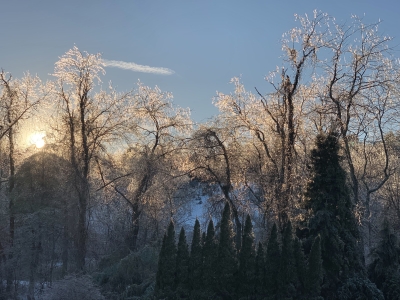
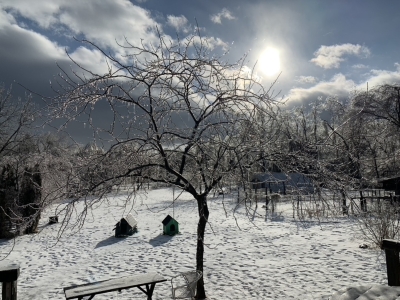
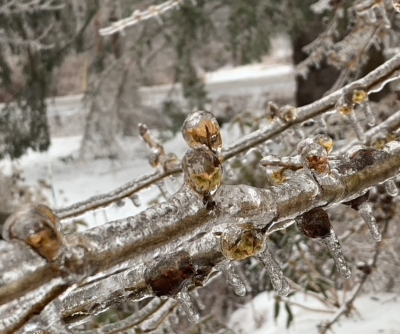
Yesterday was a fine day for pruning, windless with a sunny sky and a temperature of 19 degrees Fahrenheit. The ice storm had turned this part of the world into a crystal palace, with branches clothed in thick, clear sleeves of ice. Ice covered honeylocust treeFrom an auspicious vantage point, a pear tree glowed like a subdued holiday tree as hints of sunlight’s reds and blues refracted from the natural prisms on the branches.
Witchhazel flowers encased in ice

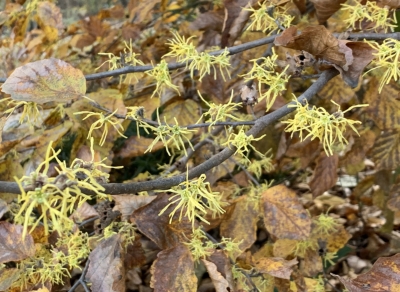
Witchhazel flowers

What a pleasant setting for pruning! The usual recommendation is to hold off pruning until after the coldest part of winter, which typically occurs in late January and early February, is over. I’ll admit to rushing outdoors, pruning shears in hand, before that time period, with some plants not long after they dropped their leaves in autumn. That was with plants, such as gooseberries and currants, least likely to be damaged by cold weather. 

I was anxious to begin pruning in earnest as an excuse to get outdoors and because I have lots of plants to prune, mostly fruit plants. It all needs to be done before leaves unfurl in spring. And, as spring inches closer, sowing seeds, spreading compost, and other gardening activities increasingly vie for my time.An icy cathedral of overarching trees
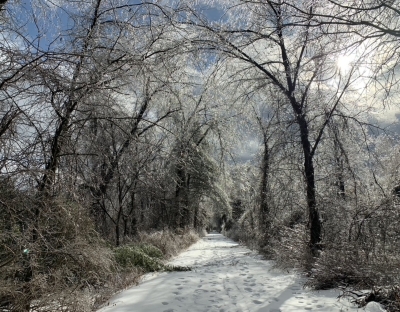
So I’m out in the crystal palace working on my hardy kiwifruit vines (Actinidia arguta and A. kolomikta). In case you’re unfamiliar with this plant, it’s a dead ringer for the fuzzy, kiwis you see in the markets — except that hardy kiwifruit is grape-size with a smooth, edible skin. The resemblance is even greater beneath the skin — except that hardy kiwis are sweeter and more aromatic. And while a fuzzy kiwi vine will sulk or die back below 10 degrees Fahrenheit, hardy kiwis tolerate winter weather below minus 20 degrees Fahrenheit.

Kiwi Training and Pruning

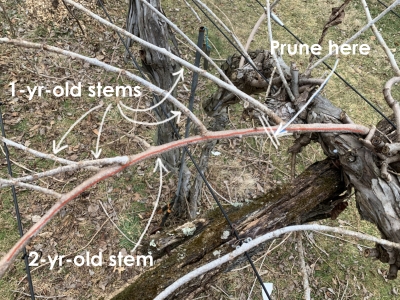
A hardy kiwi vine bears fruits on new, growing shoots originating off one-year-old stems. Actinidia pruning detailThe goals in pruning are to keep the plant reined in to a convenient size for easy harvest, to eliminate enough stems so that those that remain bathe in sunlight and air, and to coax growth of new stems off which will emerge, the following year’s fruiting shoots.
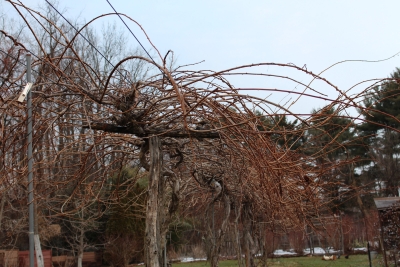
Kiwi vine, before pruning

Kiwi vine, before pruning

Pruning also removes plenty of one-year-old stems. That cuts down yield but lets the vines pump more goodness into fruits that remain, for better flavor. (Pruning kiwis is described and also diagrammed in my book The Pruning Book.)

Training a kiwi vine to some sort of system keeps the vigorous growth organized. My plants grow on a trellis of metal or locust T-posts spaced 15 feet apart, with 5 wires (actually nylon monofilament) running perpendicular to and spaced out across to the tops of the T’s. Each kiwi trunk runs from ground level up to the middle wire, at which point it bifurcates into two permanent arms, called cordons, running in opposite directions along the middle wire. Fruiting arms grow out perpendicularly to the cordons and the wires, draping themselves over the two outermost wires on either side of the the cordons.

I actually began pruning a couple of weeks ago, starting to disentangle the stems by walking along on either side of the row with my cordless hedge shear, shortening any stems to a few inches beyond the outermost wires. Yesterday I began cutting any two-year-old stem — any stem that fruited last summer — back to its origin or to a one-year-old stem near the its origin. The one-year-old stems, those a little more than pencil thick of moderate vigor, will bear fruiting shoots this year in late summer or fall.

After all this pruning, plenty of one-year-old stems remain, too many for top notch fruit. So I’ll move down the cordons and remove enough one-year-old stems so that none is closer than eight to twelve inches from its neighbor.Pruned kiwi vine
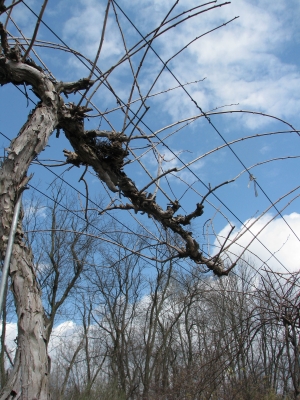
Not done yet. In spring, after growth has begun, I’ll clip each one-year-old stem back to about 18 inches.

If you grow grapes, you probably noted that they bear and can be pruned similarly to the kiwis. I even grow some grape vines along the same trellis as the kiwi vines.

The main difference is that grape vines’ one-year-old shoots can be cut back more severely than the kiwi stems. Mine get shortened to a couple of buds each, which is only about three inches, from the cordon; it’s called spur pruning. Everything else is the same.

Ice is Nice, Sometimes

Those sleeves of ice on the kiwis actually made pruning easier. A sharp tug on a cut stem quickly disentangled it and let it slide free from its neighbors.Ice encased kiwi stems
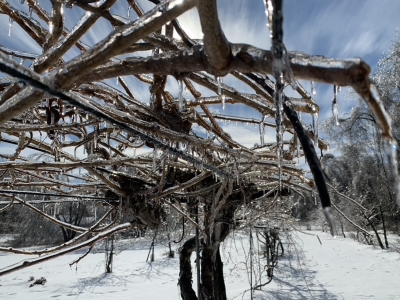
All this ice did, of course, weigh down branches of large trees which, coupled with strong winds after the storm, sent many limbs plummeting to the ground. Particularly surprising were my birch trees, a tree known for the limberness of its trunk, a characteristic immortalized in Robert Frost’s poem Birches: 

I’d like to go by climbing a birch tree,
And climb black branches up a snow-white trunk
Toward heaven, till the tree could bear no more,
But dipped its top and set me down again.
That would be good both going and coming back.
One could do worse than be a swinger of birches.

This storm was more than two of my multi-stemmed birches’ trunks could bear; they cracked. But Mr. Frost was writing about white birches. Mine are river birches.
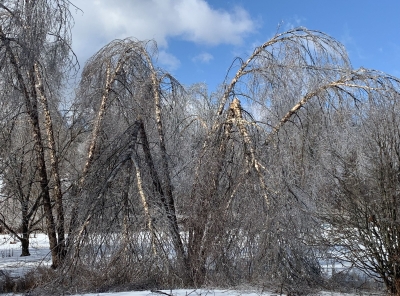
Birches broken by ice
Late afternoon view of icy trees

A HOUSEPLANT, AN “ALMOND,” AND PAPER

Easiest Houseplant of All?!

What with the frigid temperatures and snow-blanketed ground outside, at least here in New York’s mid-Hudson Valley, I turn my attention indoors to a houseplant. To anyone claiming a non-green thumb, this is a houseplant even you can grow. 

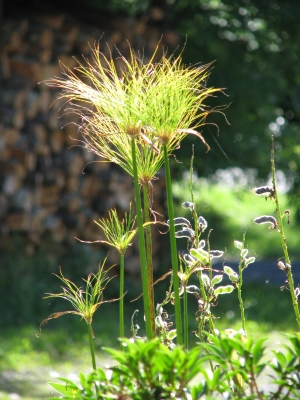
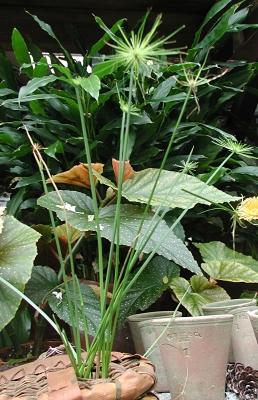
Most common problems in growing houseplants (garden plants also) come from improper watering. Too many houseplants suffer short lives, either withering in soil allowed to go bone dry between waterings, or gasping for air in constantly waterlogged soil. Also bad off yet are those plants forced to alternately suffer from both extremes.King Tut cyperus

The plant I have in mind is umbrella plant (Cyperus alternifolius); it requires no skill at all in watering. Because it’s native to shallow waters, you never need to decide whether or not to water. Water is always needed! The way to grow this plant is by standing its pot in a deep saucer which is always kept filled with a couple of inches of water. What could be simpler?

One caution, though. The top edge of the saucer does have to be below the rim of the pot. Umbrella plants like their roots constantly bathed in water, but not their stems.

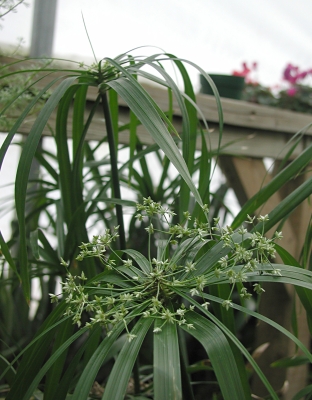
Lest you think that umbrella plant sacrifices good looks for ease of care, it doesn’t. Picture a graceful clump of bare, slender stems, each stem capped with a whorl of leaves that radiate out like the ribs of a denuded umbrella.

cyperus plant

The stems are two to four feet tall, each leaf four to eight inches long. A dwarf form of the plant, botanically C. albostriatus, grows only a foot or so high, and has grassy leaves growing in amongst the stems at the base of the plant. There’s also a variegated form of umbrella plant, and a wispy one with especially thin leaves and stems. Cyperus  flowers

Umbrella plants aren’t finicky about care other than watering. They grow best in sunny windows, but get along in any bright room. As far as potting soil, your regular homemade or packaged mix will suffice. Umbrella plants like a near-neutral pH, as do most other houseplants.

Want More?

As the clump of stems ages and expands, they eventually get overcrowded in the pot, calling out to be repotted. You could move it to a yet larger pot, or make new plants by pulling apart, cutting if necessary, the large clumps to make smaller clumps and potting each of them separately. 

One way wild umbrella plants propagate is by taking root where their leaves touch ground when the stems arch over. You can mimic this habit indoors if you want to increase your umbrella plant holdings without dividing the clump. Fold the leaves down around the stem with a rubber band, as if you were closing the umbrella. Cut the stem a few inches below the whorl of leaves and poke the umbrella, leaves pointing upward, into some potting soil — kept constantly moist, of course.

An Almondy Relative

Though you may be unfamiliar with umbrella plant, you probably have come across its near-relatives either in the garden or in literature. One relative is yellow nutsedge (C. esculentum), a plant usually considered a weed and inhabiting wet soils from Maine down to the tropics. 

The edible nutsedge, also C, esculentum, usually called chufa or earth almond, is not invasive, at least in what I’ve read from many sources, and in my experiences growing the plants. It’s a perennial that has been cultivated since prehistoric times and was an important food in ancient Egypt.

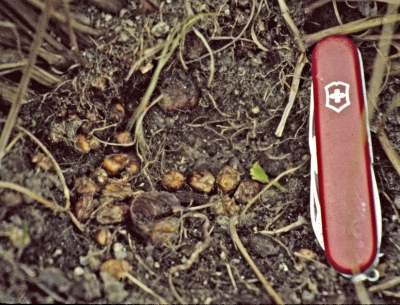
But esculentum in the botanical name means “edible,” and refers to the sweet, nut-like tubers the plant produces below ground. I grow this plant, and now consider it quite esculentum, with a taste and texture not unlike fresh coconut. Chufa tubersThe main challenge with this plant is clearing and separating the almond-sized tubers from soil and small stones.

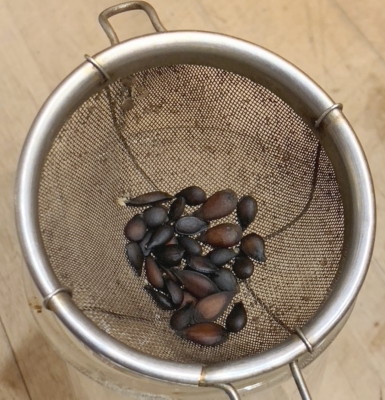
Storage improves their flavor, but they must be dried for storage, at which point they become almost rock hard. Give them an overnight soaking and they’re ready to eat as a snack or incorporate into other edibles or drinkables.

Paper Plant

Umbrella plant’s other famous relative is papyrus (C. papyrus), a plant that once grew wild along the Nile River. In ancient times, papyrus was used not only to make paper, but also to build boats and as food. Papyrus looks much like umbrella plant, and being subtropical, also would make a good houseplant. But with stems that may soar to fifteen feet in height, except for the diminutive variety King Tut, this species is too tall for most living rooms.

The Egyptians never recorded their method for making papyrus into paper but the Romans learned the process from the Egyptians and Pliny the Elder, a Roman, wrote about it in the first century B.C.

Genuine, Egyptian papyrus

Genuine, Egyptian papyrus

Here’s how: You  put on your toga and sandals (the latter also once made from papyrus), and prune down a few umbrella plant stalks. Cut the stalks into strips and, after soaking them in water for a day, lay them side by side in two perpendicular layers. Make a sandwich of the woven mat surrounded on either side by cloth, to absorb moisture, surrounded on either side with pieces of wood, then press.

In Egyptian sunlight, you could figure on the paper being dry and ready for use after about three weeks. Cut it to size to fit your printer.

SOWING PEARS AND LETTUCES

For the Long Haul

Among the must-have tools for any good gardener are hope, optimism, and patience. I thought of all three last week as I was planting some seeds.
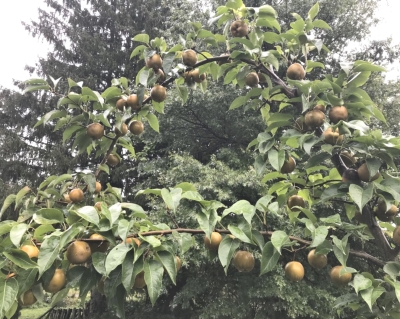
Asian pear, Korean Giant
The first of these seeds especially emphasizes patience. They were a few pear seeds I saved from pears I had eaten. After being soaked for a couple of days in water, the cores were soft enough for the seeds to be squeezed out, after which they were rinsed, and then planted in potting soil.

I put the planted seeds near a bright window in my basement where the cool (about 40°) temperatures would, in a couple of months, fool the seeds into feeling that winter was over. They would sprout.

Given time, those seeds would grow to become pear trees and, given more time (ten years, possibly more) go on to bear fruit. Those seeds came from Bosc and Passe Crassane pears. The genetics of the resulting trees will represent the sexual union of egg cells within the flowers with whatever male pollen happened to fertilize those eggs. As a result, said trees would bear fruits different, and probably worse, than the fruits from which they were taken. (There’s less than 1 in 10,000 chance of a seedling apple tree bearing fruit as good or better than the fruit from the mother tree; the ratio for pears should be similar.)

Shortening the Long Haul, and Other Benefits

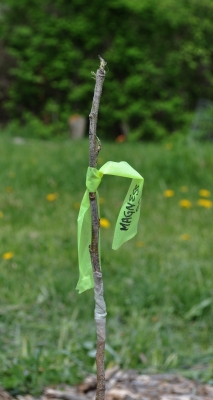
Grated tree, year 1

Grafted tree, this one NOT interstem

So why will I be wasting all that time nurturing these plants? Because they’re not for fruit. They’re for rootstocks, for grafting. Pears and most other tree fruits are very hard to root from cuttings, so are propagated by grafting a stem of a good-tasting pear low on a rootstock.
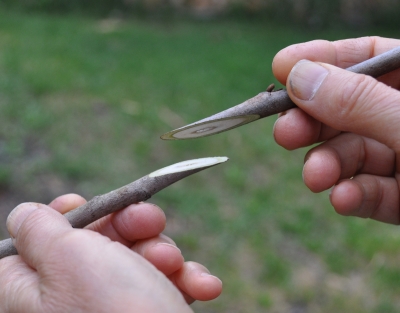
Whip graft of stem to rootstock
So-called “seedling” rootstocks make for very sturdy trees, well anchored and genetically diverse so some scourge can’t wipe out a whole bunch of equally susceptible, genetically identical trees. On the other hand, seedling rootstocks make for very large trees that are very slow to induce bearing in their grafted portions.

Enter from stage right: clonal rootstocks, that is, plants reproduced asexually (cuttings are one example of asexual plant propagation) so that all members of the clone are genetically identical. Some clonal pear rootstocks — with such unalluring names as Pyrodwarf and OH x F 87 — have been developed that make smaller grafted trees that also are quicker to come into bearing. (I delve more deeply into the nitty gritty of grafting in my book The Ever Curious Gardener: Using a Little Natural Science for a Much Better Garden.)

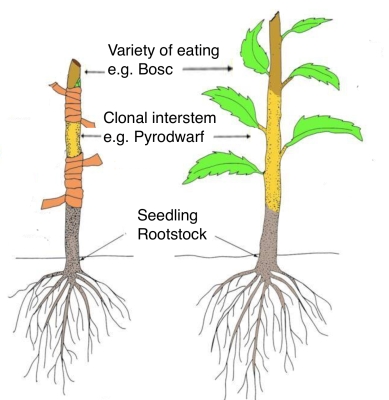
My plan is to make interstem trees, each one by grafting a 9 inch stem of one of the clonal rootstocks near the base of a seedling rootstock, and then some variety for eating, such as Passe Crassane, atop the clonal interstem. That 9 inch clonal interstem has the same good effects as if it was used as a rootstock, except that the interstem trees also have sturdy root systems and genetic diversity at their roots. Because plants grow from the tips of stems, the heights of the grafts above ground remain the same even as the tree grows.

Parts of interstem tree

Parts of interstem tree

I’ll do both grafts at the same time, next spring. I’m hopeful, optimistic, and have patience that I’ll be biting my first pears from these trees within 5 years.

Lettuce be Hopeful, Patient, and Optimistic

The other seeds for this week’s sowing were four varieties of lettuce. No, not for eventual outdoor planting, but for planting in the greenhouse in spaces that will open up where some of last autumn’s lettuce will have been harvested.

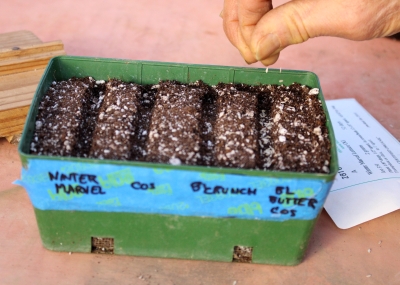
It’s chilly in the greenhouse, where temperatures drop into the 30’s at night and on cloudy days, too chilly for good sprouting of lettuce seeds. Sowing lettuce seeds in flatsSo I sowed them in a 4×6 inch seed flat filled with potting soil, then moved the flat in front of a sun-drenched, living room window. Once the lettuce seeds sprouted, which was in a few days, I moved them to the greenhouse. Warmer temperatures are needed to sprout a seed than to grow a plant.
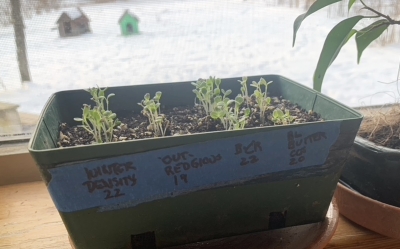
Lettuce sprouting in flat
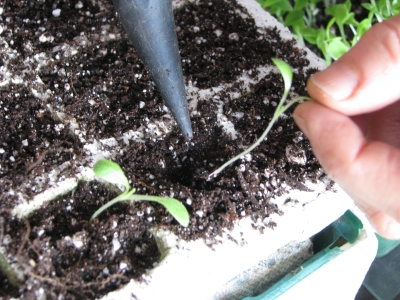
The seedlings should not, of course, remained crowded in their mini-furrows in the flat. So once the seedlings grow a little larger, I’ll gently lift each one by its leaves, coaxing it up and out of the flat, and then lower the roots into a dibbled hole in one potting-soil-filled-cell of GrowEase. And so on, until each of the 24 cells has a small plant in it.

Moving small lettuce seedlingsI use this same method to keep up a steady supply of lettuce and other seedlings all through summer, the plants typically needing about a month in the GrowEase before they’re ready to transplant into the ground. Not so in winter, with the sun still hanging low in the sky and greenhouse temperature still cool. I estimate that it won’t be until early March before the lettuces will be ready to plant in the ground in the greenhouse.

No matter; I’m hopeful, optimistic, and patient. And I’ll still be harvesting some of last autumn’s lettuce beyond that date.

LESS SALT IS BETTER

What Does “Salt” Really Mean?

A few years back, one of my neighbors planted a hemlock hedge along the road in front of their house as a screen from the road. Sad to say, the future does not bode well for this planting. The hemlocks very likely will be damaged by road salt.  And the prognosis is similar for those stately sugar maples that line so many streets. Truck spreading saltChemically, road salt — at least the more traditional “road salt” — is the same as the stuff in your salt shaker, sodium chloride. Either sodium or chloride ions can be toxic to plants. Chlorine is a nutrient needed by plants, but it is classed as a micronutrient, needed in minute quantities. Too much is toxic. Sodium is not at all needed by plants.

In a broader sense, a “salt” is any ionic molecule, that is, a molecule of two or more atoms in which electrons, which are negatively charged, are donated from one atom to another. Who gets what depends on how easily an atom or atoms can lose one or more electrons and how hungry another atom or atoms is for those electrons. That ability to donate or be hungry for an electron depends on the number of positively charged protons in an atoms nucleus and the number and arrangement of electrons around the nucleus.

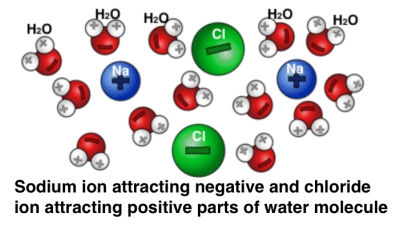
In the case of table salt, the sodium easily loses one electron and the chloride atom is hungry for it. The once neutral sodium atom becomes, after losing an electron, a positively charged sodium ion. The once neutral chloride atom, after gaining an electron, becomes a negatively charged chloride ion. And bingo, these two oppositely charged ions are strongly attracted to each other; they bond.Salt and water ionsWhat happens when water enters the picture? A water molecule, because of its shape has a slightly imbalanced charge distribution. The negatively charged side of the water molecule gets attracted to the sodium ion of table salt, and the positively charged side of the water molecule gets attracted to the chloride ion. 
Salt Problem in Winter, and Beyond

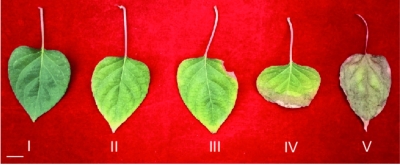
Any salt (ionic molecule), not only sodium chloride, attracts water so will simulate drought if in excessive amounts in the soil in the same way that potato chips dry out your lips. This leads to common symptoms of salt injury. First evidence of salt injury is browning of leaves, starting along the leaf margins. Early fall coloration and defoliation also can occur. More severe injury is manifest by twig or branch dieback, or death of a whole plant.

Progressive symptoms of salt damage

Progressive symptoms of salt damage

Salt also has an adverse effect on the soil itself, which is particularly insidious since it’s not as obvious as a dead plant. Over a period of time, sodium in salt can pull soil particles together, squeezing air out of the soil. As a result, roots suffocate.

Plants suffer most from salt in dry soils, so any plant exposed to salt in winter will benefit from mulching and watering during summer droughts. Watering also leaches sodium out of the soil, which improves soil porosity. Gypsum further aids in fluffing up a soil made too compact by sodium, by displacing sodium in the soil with calcium.

Honeylocust

Honeylocust

Plants vary in their tolerance to salt. In addition to hemlock and sugar maple, the following trees and shrubs should not be planted where they will be exposed to salt: red maple, American hornbeam, shagbark hickory, dogwoods, winged euonymus, black walnut, privet, Douglas fir, white pine, crabapples, beech. Plants with a moderate tolerance to salt include: Amur maple, silver maple, boxelder, red or white cedar, lilac. Deciduous plants with high tolerances for salt include: Norway maple, paper and grey birches, Russian olive, honeylocust, white or red oaks, black locust, and many of the poplars and aspens.

For my neighbors who wanted an evergreen hedge, better choices would have been: white spruce, Colorado blue spruce, or Austrian pine. Perhaps even yew, since the site was somewhat shaded.

Mitigation or Avoidance

An obvious way to limit problems with road salt on plants, even salt that you might spread on your driveway or paths, is to use less salt, or none at all. (After once slipping on ice in my driveway and suffering a slight concussion, I became very aware of weighing damage to plants against damage to humans.) Fortunately, there are ways to keep all creatures happy.

Traction on ice or snow can be increased by spreading sand or sawdust.

A very effective technique, one that uses less salt, used by some road crews is to spray a salt solution on dry roads before a weather event that will bring slippery conditions.

When salt must be used, use a minimum amount or substitute a salt other than sodium chloride. Calcium chloride, for instance, is a salt that is only a tenth as toxic to plants as sodium chloride. One of the best materials as far as effectiveness with minimum damage to vehicles, concrete, and vegetation, is calcium magnesium acetate (CMA); but it’s expensive.

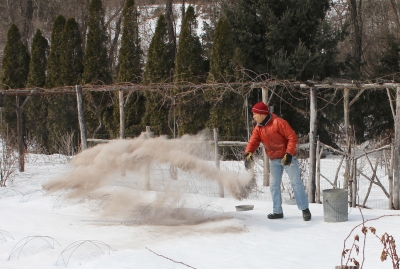
Salts that are fertilizers, such as ammonium nitrate or calcium nitrate, melt ice and at the same time nourish plants. Salts other than sodium chloride still need to be used with caution, for they can cause salt desiccation and/or nutrient imbalances in plants.Spreading woodashMy favorite treatment for icy conditions here at home is spreading wood ash. Effectiveness comes from the dark color absorbing sunlight to speed melting, a slight grittiness increasing traction, and its salt content. Of course, access to wood ash means you or an ash-rich friend burns wood for heat. 
For all its benefits, wood ash is a mess if tracked indoors. I take off my shoes or boots in the mudroom.

THE BEST HERB FOR A NORTHERN WINTER

Calamity Avoidance

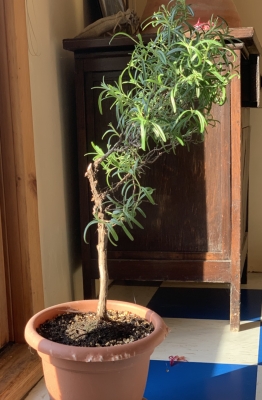
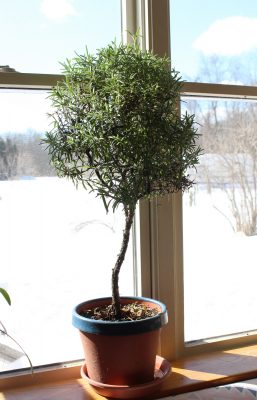
A horticultural calamity averted. Again. Deb was snipping some leaves from our potted rosemary “tree” for salad dressing and said she noticed that the plant looked a little wilty. I was skeptical. Rosemary leaves are so narrow and stiff that they hardly broadcast their thirst. Still, quite a few rosemary plants have succumbed to winter drought here.Potted rosemary tree in winter

I checked the plant and, in fact, the leaves did look a bit wilty. The probe of my sort-of-accurate electronic moisture tester (which I nonetheless highly recommend) confirmed Deb’s diagnosis. The soil was very dry but, luckily, not to the point of killing the plant.

Allow me to digress . . . Soil scientists represent soil moisture levels with four descriptors. Right after a thorough watering, a soil is “saturated,” with all pores filled with water. Saturation is not desirable in the long term because roots need to “breathe” to do their work of drawing in nutrients and water, which is why plants exhibit the same symptoms from either dry or sodden soil.

Without additional water, gravity begins to pull water down and out of the larger pores of a saturated soil. Once gravity has pulled all the water it can from a soil, the soil is at “field capacity,” much to the pleasure of resident plants. At this point, large pores are filled with air yet some water, which is available for plants, is retained within smaller pores and clinging to soil particles.

Roots continue to slurp more and more water from the soil, but with increasing difficulty because water within even smaller pores and clinging even closer to soil particles is increasingly tightly held there by capillary attraction. Although the soil has moisture, it’s mostly inaccessible to plants. “Wilting point” has been reached.

Eventually, the only moisture left in the soil is that held very tightly in the very smallest pores and pressed tight against soil particles. That’s “permanent wilting point” from which, as the name implies, there’s no turning back. The plant will die.

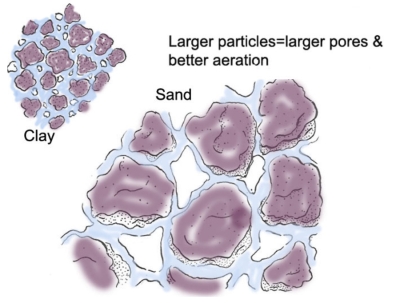
The actual amount of water in a soil at any of these stages depends on the range of particle sizes in the soil. Clay soils have tiny particles, with tiny spaces between them, so have more water at wilting and permanent wilting point than do sandy soils, with their large particles and large pores.

Soil water vs. particle size

At or near field capacity, sands have more air and less water than clays.

Where were we? Oh, my rosemary plant. I’m figuring it was just teetering on the edge of wilting point. Needless to say, I watered both my rosemary “trees.”

(For a lot more about soil water and how to make the best of it, see my book The Ever Curious Gardener: Using a Little Natural Science for a Much Better Garden.)

Dry Air, Moist (Enough) Soil

You’d think — I once did — that rosemary, because in the wild it billows down dry hillsides overlooking the Mediterranean, would be resistant to drought. It does tolerate dry air. But those wild plants’ roots are in the ground where they can forage far and wide for moisture; not so in a pot.

Also, my rosemary plants are coddled with relatively consistent warmth in winter and a potting mix rich in nutrients. Couple this with low light conditions, even near a south-facing window, and you get very succulent growth. I don’t know what rosemary plants growing on a Grecian hillside are doing now, but my plants are growing like gangbusters. All that succulent growth transpires lots of water, and is very susceptible to drought.

Rosemary, half survived

Left half of this rosemary expired last summer

Once my plants go outdoors in summer, their leaves mature and toughen and growth is less succulent. They do still need sufficient moisture, so I have drip tubes on a timer quenching their thirst (and that of other plants). Except, that is, when the timer’s battery needs replacing and I don’t notice it. That was last summer. The plants were not at the permanent wilting point but a number of branches, which I pruned off, dried up, dead.

In Praise of Potted Rosemary

All this is not to frown upon growing rosemary where it can’t survive winters outdoors. On the contrary, I consider rosemary to be the finest herb for indoor growing. Flavorwise, it packs a powerful punch, unlike chives, for example, a plant that needs to be practically decimated if you really want to flavor something with it. Merely brushing against my rosemary plant releases an aromatic, piney cloud.

Rosemary is also a very attractive houseplant whether grown as a scraggly shrub reminiscent of the wild plants in their native haunts, trained as dense cones, or — as are my plants — as miniature trees. The leaves retain a healthy, verdant look, unlike those of basil, which look sickly and out of their element in dry, relatively dark and cool homes in winter.

Rosemary also rarely suffers from any insect or disease problem.

And finally, properly cared for, rosemary is perennial so can provide aroma, flavor, and beauty   for many, many years.

But you and I do need to pay close attention to watering.

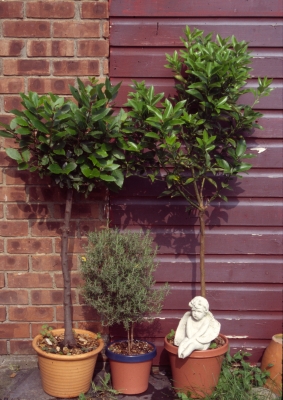
standard bay, rosemary, citrus

Rosemary, with its compatriots, bay and citrus, in summer

A PEAR, 170 YEARS LATER

A Luscious Fruit in Winter

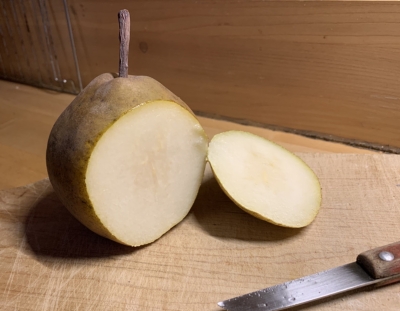
All fruits did well this past season but it was especially a banner year for pears. Why do I mention this now? Because we’re still eating them and they are delicious. “Them” is actually just one variety — Passe Crassane, not a variety you’d find on a supermarket shelf, but which is available as a tree.Passe Crassane pear sliced
Timely harvest, storage, and ripening of pears melds art and science; since this was my first crop from Passe Crassane, I was wary as I sliced off a taste. It was like slicing through butter, a good omen. The flesh was “white, fine. melting, [sugary], perfumed, and agreeably sprightly,” to quote from The Pears of New York, U. P. Hedrick’s 1921 classic. Delicious.

The seed for this pear was sown, literally, by one Louis Boisbunel in Rouen, France in 1845. Ten years later, the tree showed its worth and the fruit made its debut. Passe Crassane is a winter pear that needs to be harvested mature — here, in early November — and then kept in cold storage for a couple of months to ripen to full flavor. Under ideal storage conditions, fruits keep well for months.

This variety was very popular in its century of origin, and its cultivation spread to Italy, Spain, Germany, and England. Commercially, stems were dipped in a red wax to prevent water loss during storage; those red-tipped stems became a signature of Passe Crassane. By the 20th century, Passe Crassane had fallen out of favor because of its susceptibility to diseases, including dreaded fireblight.

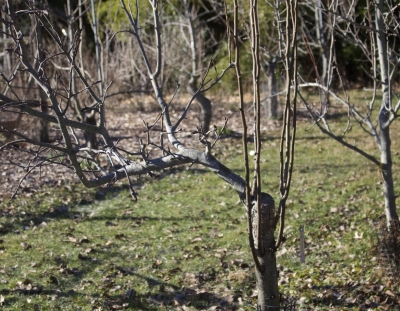
(My tree was struck by what I thought might be fireblight a year and a half ago, so I had drastically lopped it back well below what might have been blighted portions, planning to graft the stump to another variety. Fortunately, one older branch remained below the lopping and that branch, for the first time this past season, bore fruit, heavily. I’ll let the tree re-develop from one of the few watersprouts that shot skyward where the tree was lopped.) Passe Crassane lopped

The Hard Part of Growing Pears

Apple, cherry, and other common tree fruits are usually beset with pest problems that make them hard to grow. Not so for pears. The hard part about growing pears is knowing when to harvest them and then ripening them to perfection.

Yeh, yeh, I’ve read all about various indicators that show pears are ready for harvest: 1) When the fruit stalk separates easily from the stem as you lift and twist; 2) When the skin color lightens slightly; 3) When the small lenticels on the skin turn from white to brown; 4) When the first fruits start to drop. And, my favorite, recording the harvest date, once you get it right, and then harvesting on about that date every year.

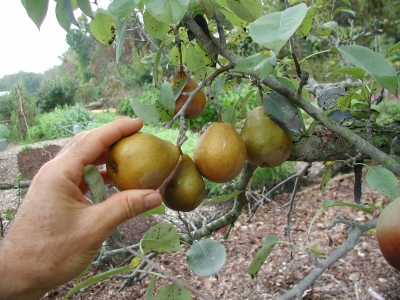
Picking Seckel pear

Picking Seckel pear

No matter what the method, a pear should be firm, not at all soft, once ready for harvest. Pears ripen from the inside out. So fruit left on tree to thoroughly ripen is mostly brown mush on the inside by then. 

All those indicators notwithstanding, I am much better at timely harvesting of pear varieties I’ve grown and harvested for a number of years.

So much for harvest; now for storage. On or near freezing is ideal. Cold temperatures slow ripening, and, for all except very early varieties, primes the fruit to begin ripening.

Ethylene, a natural, gaseous plant hormone can unduly speed ripening. Mature pears give off very little ethylene; not so for harvested apples and many other fruits, so keep these other fruits away from the pears unless a whole lot of pears are needed ready for eating soon. (I cover ethylene more thoroughly in my book The Ever Curious Gardener: Using a Little Natural Science for a Much Better Garden.)

Finally, on to ripening, which occurs as fruits are brought into warmth, ideally a cool room, 60-70 degrees F. I press a finger against the stem end of the fruit, and if there is any give at all, the fruit is ready for eating.

All this finickiness with harvest, storage, and ripening is unnecessary with Asian pears, which are different species from European pears. Let Asian varieties ripen thoroughly on the tree, meaning they remove easily with a lift and twist, and are fully colored. Then eat. Or keep them refrigerated, and get them out to eat whenever you’re so inclined.

Asian pear, Korean Giant

Asian pear, Korean Giant

WILL THE TRUE BALSAM PLEASE STAND UP?

Cold Enough for Balsam Fir?

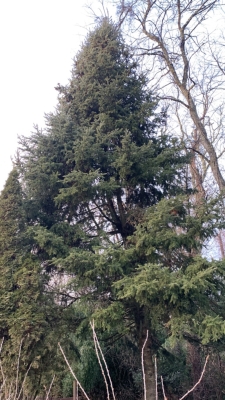
Ah, to sit by the fire on a cold winter’s eve. The fire’s warmth suffuses me with somnolence and drives into the air a resinous, woodsy aroma from my fresh cut balsam fir branches draped about the room or steaming on the woodstove. 

Balsam fir

Balsam fir (Abies balsamea) would be an oddity amongst my plants. Here in the colder part of Zone 5, blackberries and some of my grapes have been pushed to their northern limits. Balsam fir would be unique in being a plant pushed to its southern limit. Most of my plants require well-drained soils. Balsam fir grows in well-drained soil, but it also will grow in swampy land, even very acidic (pH 5.0-6.0), swampy land

Balsam fir is native from northern New England to the tundra and mountaintops further south. I live in lowland. In those cold, moist locales where they are native, the trees grow slowly to become dense, pyramidal spires 50 feet tall with dark, shiny green, flattened needles. (Flattened needles are one way to distinguish firs from spruces, Picea species, which have rounded needles.)

Long ago I realized that it might be just too hot here in summer to grow balsam fir. Numerous books that I consulted warned about the futility of trying to grow balsam fir where it’s not native. Excessive heat would cause the needles to fall prematurely, leaving the tree, after a few decades, thinned out and unkempt. The prognosis for successful growing of balsam fir here seemed slim.

Looking Elsewhere for Balsam

So I looked into getting my balsamy aromas elsewhere. Many plants yield “true” balsam, an aroma based on resins or oleoresins containing benzoic acid, cinnamic acid, or both. It’s too cold here, though, to grow most plants with this true balsam aroma: Balsam of Peru and Balsam of Tolu, from Myroxylon pereirae and M. balsamum, respectively, both trees of Central America; and liquid storax, a balsam from Liquidambar orientalis, a tree of Asia Minor, or from the Javanese plant Altingia excelsa.

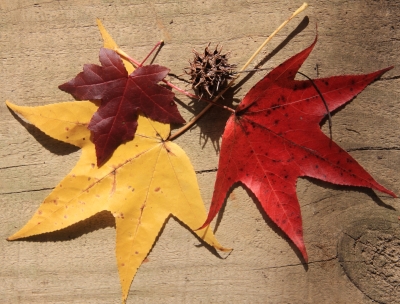
One plant that is hardy here and does yield true balsam is sweetgum (Liquidambar styraciflua), which yields a balsam known as liquidambar, or copal, balsam. One problem with sweetgum is that it’s not an evergreen, so would not fill the bill for aromatic, winter greenery. A very pretty tree, though.

Sweetgum leaves & gumballs

Sweetgum leaves & gumballs

I emphasized “true” balsam above because there are other balsams that are something less than “true,” which means they lack both benzoic and cinnamic acids. Balsam fir, whose balsam goes under the names of Canada balsam or Canada turpentine, does not yield a true balsam. Two other less-than-true balsams are Balm of Gilead (Mecca balsam), from the Middle Eastern plant Commiphora opobalsamum, and Gurjun balsam, from Indian species of Dipterocarpus. Here, cold would snuff out the life of either of these two plants.

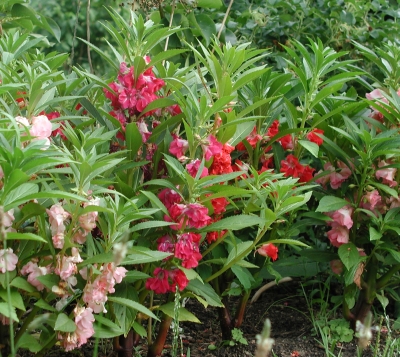
The question of winter survival is a moot point for annual plants, and there are two annuals with “balsam” in their name. One of these is garden balsam, Impatiens balsamina, a relative of impatiens. I’ve occasionally grown this very pretty, old-fashioned annual, but don’t recall any woody, resinous odor.

Garden balsam

Garden balsam

Another balsam is balsam apple, Momordia balsamina, a vining cucumber relative which produces gherkin-shaped, yellowish red “apples.” I’ve never grown balsam apple, but doubt it has the desired aroma. None of its relatives that I have met — winter squashes, summer squashes, gourds, pumpkins, and luffas — have any odor of balsam.

I Give Balsam Fir a Try Anyway

So where did this leave me for my balsamy winter greenery? Eighty years ago I could have just gone out and bought a Christmas tree. Balsam fir was the most popular Christmas tree until the 1930s. Then, its general popularity was superseded by Scotch pine, which grows faster and holds its needles better.

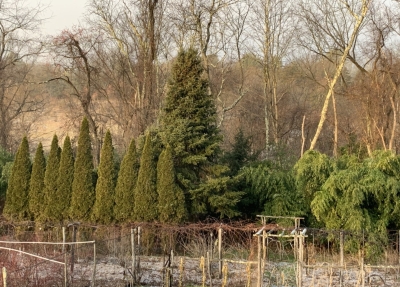
Almost 30 years ago, the poor prognosis notwithstanding, I went ahead and planted a few foot-high balsam fir seedlings in a partly shaded rear portion of my yard. The soil there is rich and perfectly drained.

My 30-year-old balsam fir

My 30-year-old balsam fir

Trees took well to their new home. Unfortunately, our puppy Stick liked to play with the trees, not to their benefit. Fortunately, one tree escaped his antics. That tree is still alive, actually more than alive. I can cut all the aromatic branches I want from this robust, now 36.4 foot high tree!

THERE ARE LOTS OF NUTS OUT THERE

I’ve written recently about how bountiful this past season has been with fruits. Well, botanically, at least, “fruits” includes “nuts.” More on this later.* The nut harvest was also abundant.

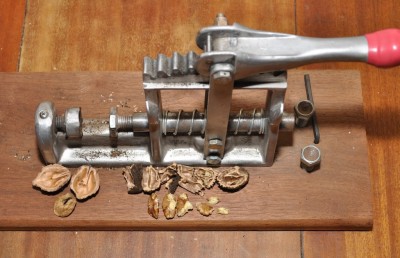
Except for last year, just about every year has been a good year for black walnuts. But this year,  it didn’t take long to pick up and fill baskets quickly. After being husked, cleaned, and then left to cure in a squirrel-proof loft, I’ve started cracking them (with my ‘Master Nutcracker’). Large, plum, tasty nutmeats drop free from the shells.Black walnuts and Master Nutcracker

A Surprise Nut

What surprised me most was the harvest of English walnuts, botanically Juglans regia and also known as Persian walnuts. (The moniker “English” may be because of the significant role played by English sailors in distributing the nuts around the world.) Persia, or Eastern Europe is where this plant originated. Early on, humans introduced it to other parts of the world, including England, where Romans brought them 2,000 years ago. In the seventeenth century, the nuts and the wood of these trees was held in such high esteem in parts of Europe that a certificate of having planted a certain number of trees was needed before a man was allowed to marry.

Walnuts arrived in my garden in 2006, from seed from cold-hardy trees handed out at the Saratoga, New York meeting of the New York Nut Growers Association. I planted six of the walnut seeds. Because I have limited space and did not have high hopes for success, I arranged them in two stations of three plants each, with about 30 feet between the stations. In contrast to plants propagated asexually, such as by grafting or cuttings, plants grown from seed have some genetic diversity, in the same way you and your siblings are diverse from each other. I figured that eventually I would remove all but the one best tree at each station.

Despite the threat of frost killing blossoms in spring, walnut blight, defoliation by anthracnose disease in summer, and squirrels robbing all the nuts in fall, I was able to harvest plenty. Earlier in the season, I did notice that not all trees were bearing, or bearing well, so I cut down two of the slackers, one from each station.

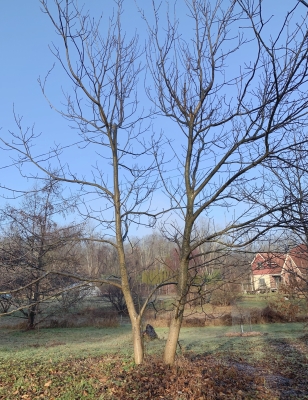
English walnut trees, 15 years ol

English walnut trees, 15 years ol

As far as differences in the nuts from tree to tree, it’s hard to say for sure at this point except to say the nuts on one of the trees may have been smaller. I’ll take a more quantitative look next year.

Walnut trees are known to be slow to come into bearing. There’s a Flanders folk saying that goes, “By the time the tree is big, the planter surely will be dead.” Well, I planted the trees from seed, they have borne and grown fairly big, and I’m not dead.

Still Waiting

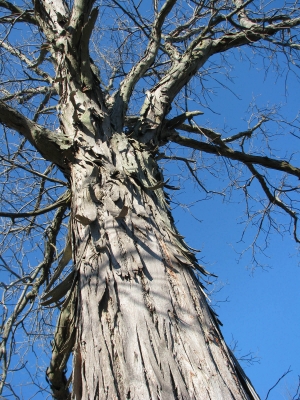
Two nut trees whose first fruits I’m eagerly awaiting are both shellbark hickories (Carya laciniosa). Shagbark hickory (C. ovata) is very common around here and throughout eastern U.S., and is notable for its — duh! — very shaggy bark and tasty but small and hard to crack nuts. Shagbark hickoryShellbark hickory’s native range doesn’t extend as far east and south as shagbark’s. It’s found mostly along the Ohio and Mississippi Rivers, and bordering regions; nowhere, though, is it common. Also, the bark is less shaggy. The clincher is that shellbark nuts are much larger, around two inches long, and with thinner shells, so you get more bang for your buck with each nut you crack.
I planted the varieties Simpson and Grainger, both of which were selected for easy shelling. (Nut alert! I have since learned that Grainger is, in fact, a shagbark hickory, albeit a variety selected for large shells that crack out well.)

But how about some nuts! Simpson was planted in 2014 and Grainger in 2015, and both grow very slowly, about twelve inches per year. Bearing age is reputedly only a few years with a grafted trees, which, being named varieties, both were. 

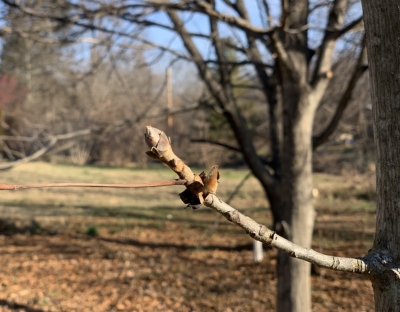
Nuts or no nuts, the trees are beautiful, their leaves turning a rich, golden yellow in autumn and, in winter, the stout branches punctuated and capped by fat buds.Shellbark hickory buds

Botanical Nuts, and Not

*Back to fruits: A fruit, botanically, is any seed-bearing structure of a flowering plant formed from a ripened ovary along with seeds and other structures. A nut is a kind of fruit, in this case with a kernel surrounded by a hard nutshell. A nut’s shell does not open to release the kernel. So all nuts are fruits but all fruits aren’t nuts. Botanically speaking.

Some fruits commonly called nuts, such as almond, pistachio, Brazil nut, walnut, pecan, and macadamia, are not true nuts; they are dry drupes (which doesn’t sound very complimentary, does it?). A nut is a dry drupe whose kernel is enclosed within a stony pit surrounded by flesh and a skin. Think of a peach. That’s a (non)dry drupe.

Chestnut, hazelnut, oak, and birch are examples of true nuts.

That’s all botany. Out on the street, we call lots of things nuts. Peanuts, for example, which are actually legumes, just like peas and beans.

THE WISDOM OF SEEDS

Tweaking the View

Finally, today, I’m planting seeds. “Too late to plant seeds,” you say? Or, perhaps you’re thinking that it’s way too early, with the coldest days of the year still about a month away. Well, the seeds I’m talking about aren’t vegetable or flower seeds; they’re tree and shrub seeds.

Planting seeds is a way to get lots of new plants at little or no cost. The seeds I’m going to be planting are ones that I collected this past summer, fall, and yesterday.

I already grow way too many plants but I need these plants for a barrier. The rear of my property backs up to a rail trail which, from spring through fall, is a wall of greenery in a swath about twenty feet wide. Nothing special, just whatever popped up there naturally, mostly bush honeysuckles and some viburnums nearby with black cherries and ashes further in. Grape or bittersweet vines clamber up whatever they can latch onto. Leafless, now, these plants don’t present a particularly pretty sight.

What’s needed is some winter color and greenery. Closer in, I’m planning a screen with winterberry (Ilex verticillata), Meserve holly (Ilex x meserveae), and arborvitae (Thuja occidentalis, this one purchased as plants).

A couple of larger trees — black tupelo (Nyssa sylvatica) and red maple (Acer rubrum) — will beef up the naturally rag tag mix of trees further in.

Nanking cherry spring and summer

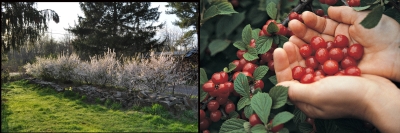
I’m also sowing seeds of Nanking cherry (Prunus tomentosa). It’s one of my favorite large bushes for its spectacular show of pinkish white blossoms in early spring and its equally spectacular show and abundance of delicious, juicy, small cherries in summer. All on a carefree, very tough and very cold-hardy plant.

Seed: Awaken

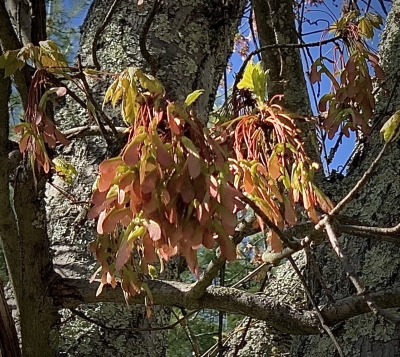
Seeds of woody plants that ripen in early summer will sprout almost as soon as they touch down to soil. Red maple (Acer rubrum) is a good example of an early-ripening seed.

Red maple seeds in early summer

Red maple seeds in early summer

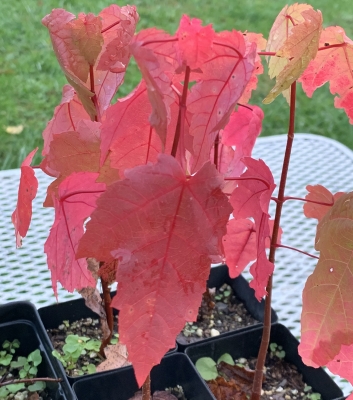
A friend collected some from his trees. I sowed them, they sprouted quickly, and I now have some healthy seedlings a foot or so tall.

Red maple seedlings

Red maple seedlings

Many woody plants bear seeds that don’t ripen until late summer or early fall. If these seeds sprouted as soon as they touched soil, the resulting tender, young sprouts would succumb to winter cold. To avoid this, they sit and wait until they feel that winter has passed. They gauge this, via their hormones, by the amount of cold they’ve experienced. Levels of the hormone abscisic acid, which keeps seeds dormant, decrease as cold wears on.

Seeds typically need exposure of one to two months, or about 1,000 hours, in a moist, cold environment before they can be convinced that it’s safe to sprout. Cold temperatures, between about 30 and 45 degrees Fahrenheit, not frigid temperatures, are what flick this switch. Depending on location, such temperatures might be experienced partly in fall and partly in spring, or mostly in fall.

Other types of dormancy might also need to be overcome before a seed will sprout. Some seeds have a separate dormancy for root growth, overcome with warm, moist conditions. Root growth must precede shoot growth.

Warm, moist conditions also may be initially needed for seeds with especially tough coats, to soften them or give microbes the opportunity to erode the surface.

Practical Matters

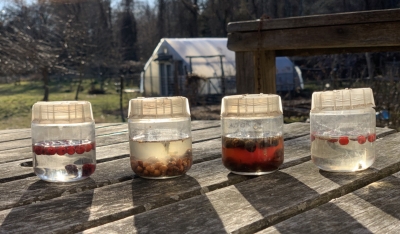
To start, I’m soaking the winterberry, holly, black tupelo, and Nanking cherry seeds in water for a couple of days, changing the water daily. Soaking does three things: First, it makes sure the seeds are well hydrated; second, it makes fruits fall apart to release their seeds; and third, it leaches out potential sprouting inhibitors. Sprouting inhibitors prevent seeds within moist, fleshy fruits from sprouting within.

Winterberry, Nanking cherry, black tupelo, and winterberry seeds

Winterberry, Nanking cherry, black tupelo, and holly seeds

In a couple of days, I’ll plant my soaked seeds in flats of potting soil, water them, cover them, and set them in my garage. (The holly and winterberry fruits still are more or less intact so I’ll just plant the whole fruits in the potting soil.) In the garage, temperatures are somewhat moderated as compared with outdoor temperatures.

As soon as the seeds sprout — still, after many years of doing this, an exciting moment for me — I’ll move them to a bright window, the greenhouse, or, depending on outdoor temperatures, outdoors.

After a few inches of growth, individual plants get more space in their own pots or a nursery bed. And, after a year or two, they move to their permanent homes.

I took seeds for the hollies and winterberries from clonal plants, that is, plants of named varieties. Clonal plants are exact replicas of the mother plants from which they were propagated. The holly varieties were all female, the variety Blue Princess, except for one male, Blue Boy, there to provide pollen so the Princesses would bear their flashy red berries. I can’t remember the variety name of my female winterberry.

Each of the seedlings I’ll be growing will be a genetic mix, each different from each other and their mothers, although not necessarily obviously so. In the case of holly and winterberry, half of the seedlings will, theoretically, be the more desirable females. (One male can sire as many as about eight females.)

All this may seem like a lot of trouble when I could just purchase plants from a nursery. But I find looking at a mature plant that I planted very rewarding. The amount of satisfaction I get is indirectly proportional to the size of plant I started with. Hence, growing trees and shrubs from seeds is especially satisfying.

Hackberry seedlings 2013; trees now 15' tall!

Hackberry seedlings in 2013; trees are now 15′ tall!

And Never the Twains Shall Meet

Detente, Plant Style

“Oh, East is East, and West is West, and never the twain shall meet,” wrote Kipling a hundred years ago. Not so with respect to gardening. The Far East, spared the great sheets of ice that descended upon North America during the Ice Ages, has been a treasure trove of plants. Though distance, water, and culture kept the gardening worlds of the East and the West separate for millennia, the gap began to narrow just over two-hundred years ago.

The first plants to trickle out of China were those plants most accessible to foreigners — cultivated plants growing at and around seaport towns. It was not until the

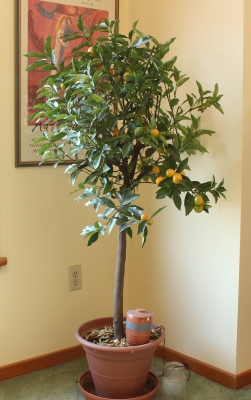
Potted kumquat

Potted kumquat

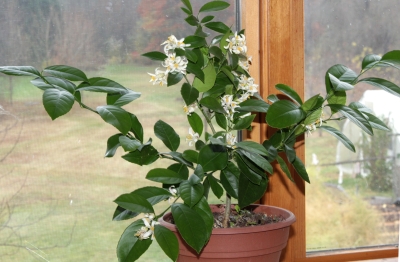
middle of the nineteenth century that plant explorers pressed inland to open wide the treasure chest of wild and cultivated plants, many of which have found their way into my garden. These plant explorers are honored in plants that bear their names. Fortunella, or kumquats (the genus was changed recently, with kumquats now in Citrus), named for Robert Fortune. I grew kumquats, wintering them indoors at a sunny window, for many years. Citrus meyerei, the Meyer lemon, named for Frank Meyer; my two Meyer lemon plants, also at sunny windows, are just beginning to send out new shoots, soon, with flowers.

(There is a darker side to “East meets West.” Up until the middle of the 19th century, Japan was isolationist, which was not to the liking of U.S. commercial interests. President Millard Fillmore enlisted “Admiral” Matthew Perry to force his boats into Japan’s Edo Bay to intimidate the Japanese into opening their ports to American trade, as well as other concessions. This gunboat diplomacy was successful.)

Meyer lemon in bloom

Meyer lemon in bloom

Trans-Pacific Cousins

From the Far East came plants for which we had no counterparts, plants such as the gingko tree. There also came plants more, or at least equally, valuable as related plants found here. We have our redcedar (Juniperus virginiana); from China comes Chinese juniper (J. chinensis). Our redcedars turn drab brown in winter, but the Chinese species remain lush green throughout the year.

Common witchhazel (Hamemalis virginiana) and vernal witchhazel (H. vernalis) are understory shrubs of American forests; Asian forests likewise have two witchhazel

Arnold's Promise witchhazel

Arnold’s Promise witchhazel, today

species: Chinese (H. mollis) and the Japanese (H. japonica). The Asian species blossom at different times than the American species, so are useful for extending the period of witchhazel bloom. My Arnold’s Promise variety of witchhazel, a hybrid of the Chinese and the Japanese species, is in bloom right now although blooms often wait until midwinter to open

Where East really does meet West in gardening is in hybrids of Eastern and Western species. The hybrid tea rose, common in American gardens from New England to the Southwest, is one example. “Tea” in the name traces back to a tea-scented rose (Rosa gigantea) from China. For centuries, the Chinese hybridized this summer-flowering climber having huge, yellow flowers with a dwarf form of another species, R. chinensis. In the nineteenth century these hybrids were further hybridized with European roses to make hybrid tea roses.

Pest Control

American plant breeders sometimes have had to look across the Pacific to find plants with resistance to a disease originally brought to America from the East. Chestnut blight turned up at New York’s Bronx Zoo in 1906, and within fifty years, the tops of American chestnuts (Castanea dentata) were dead or dying in seven million acres of Appalachian forests. The roots, which are not affected by the blight, keep sprouting new shoots, which then die after a few years, but keep the blight fungus “fed.”

Blight on chestnut bark

Blight on chestnut bark

Japanese chestnut (C. crenata) and Chinese chestnut (C. mollisima) evolved with the blight and show some resistance to it, so have been hybridized with the American species to produce blight-resistant trees, such as the variety Sleeping Giant. These trees lack the grandeur of the American chestnut, but they do make larger nuts. My chestnuts, the varieties Colossal, Marigoule, and Precoce Marigoule, are hybrids of European chestnut (C. sativa) and Japanese chestnut. They’re all blight resistant, but resistance is a matter of degree. My Colossal is finally succumbing to blight.

Dutch elm disease entered America via Europe, but entered Europe from Asia, probably about the time of World War I. Once again, Asian elm species — Chinese elm (Ulmus parviflora) and Siberian elm (U. pumila) — are resistant to the disease. Hybridization has produced such disease-resistant varieties as Patriot and Accolade.

Plants of Asia even have been useful in providing resistance to diseases not originating in Asia. Fireblight disease of pears was first noted in New York’s Hudson Valley at the end of the eighteenth century. Some Asian pear species are resistant to fireblight. Over a hundred years ago, hybrids between Asian and European pears that showed some resistance to blight were produced, at first by accident. These original hybrids did not taste very good, but did make pear-growing possible in blight-prone southeastern U.S.

The story isn’t yet over. Expeditions still return from such areas as remote villages and forest of China and the Himalayas to yield “new” plant treasures.