
PRETTY EDIBLES
Don’t Pigeonhole Them
Look around your vegetable garden: Aren’t some of these plants pretty enough to be grown as ornamentals, perhaps shoulder to shoulder with marigolds, delphinium, and others in a flower garden or at the feet of shrubbery?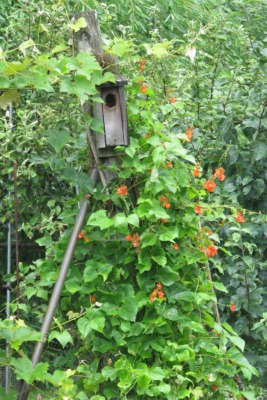
Imagine, if you will, a twining vine with sprays of scarlet flowers poking out from lime green foliage. The plant, scarlet runner bean, is so attractive that you might consider the edible pods as merely incidental — until you taste their rich, meaty flavor. Some other pole beans are also ornamental. Purple Peacock and Purple Pod Pole are varieties with purple flowers and purple pods. And Trionfo Violetto has purple veins in its leaves as well.
Not for its flowers and not for its bold color, asparagus is, nonetheless, another vegetable as pretty as it is toothsome. A double row towards the rear of a flower bed provides a feathery backdrop, the perfect foil for bright flowers — red geraniums or deep blue delphiniums, for example. 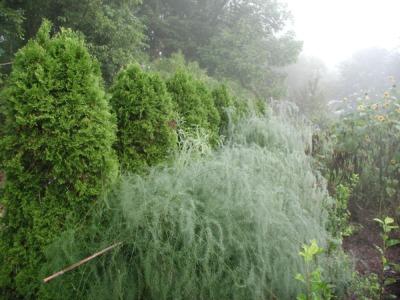 That feathery backdrop does have to wait until harvest is over after about six weeks, when we must let the plants grow freely without being harvested, so roots get re-fueled for next spring. The new asparagus foliage fills in quickly.
Consider the Leaves Also
Flowers need not be the only source of eye catching color in your flower bed. For some bright red from spring well into fall, plant a variety of Swiss chard that has red leaf stalks. No need to sacrifice the show when harvesting chard, because if you cut the plants’ outer leaves, the inner ones remain to grow and show. The varieties Burgundy and Ruby have maroon leaves, while those of Rhubarb Chard are dark green.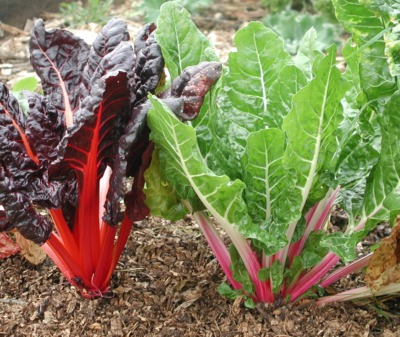
And speaking of rhubarb — real rhubarb, this time — here’s another ornamental edible. Rhubarb has dark green leaves, larger than dinner plates, on the ends of red leaf stalks splayed out in a whorl. Equally decorative are the foaming white flowers sitting atop the flower stalks.
Silvery leaves are always welcome in the flower garden, blending well with all colors. The silvery gray leaves of cardoon are bold and jagged, while those of seakale are wavy and scalloped.
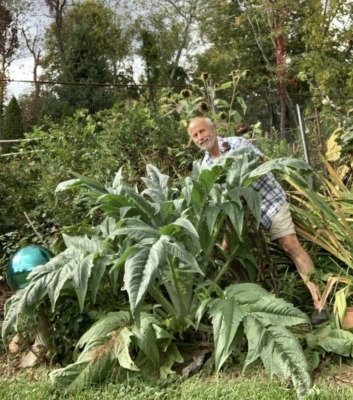
Cardoon
Leaves of both these vegetables need blanching before you can eat them. A straw collar, with the tops of the leaves poking through, might be attractive and effective for cardoon. Blanche seakale by covering new growth in spring with a flowerpot.
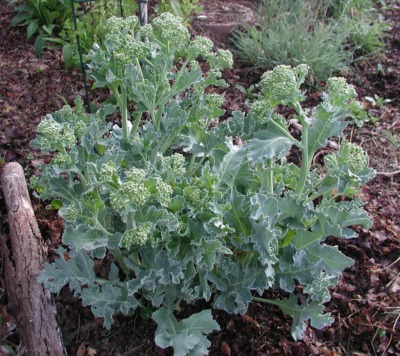
Seakale about to flower
Both cardoon and seakale are perennial. After a few spring meals of seakale in spring, remove the flowerpot and let the sun shine in so that the leaves, along with clusters of pale yellow flowers, develop. I’ve read and once thought that cardoon would be perennial only where winters are mild or the plant can be protected for winter. Not so: I’ve grown cardoon for a number of years now despite temperatures dipping here to well below zero.
If you can get a cardoon plant to survive winter, you are in for a real treat, because then the plants flower, bursting with bristly, azure spheres. Even if you cannot get cardoon to overwinter, the plant is easy enough to renew from seed each year.
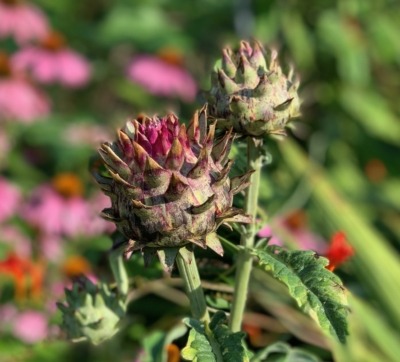
Cardoon flower budding
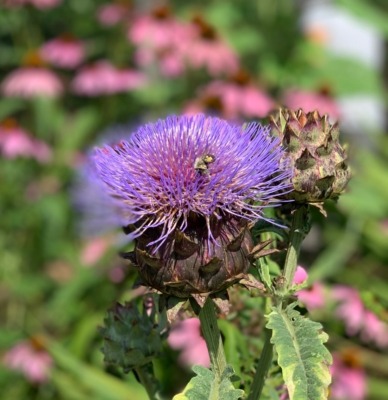
Cardoon flower
And for Some Native Americans
Two colorful vegetable that are, in fact, more usually grown in the flower garden than in the vegetable garden are various amaranths. Joseph’s Coat (Amaranthus tricolor) is one kind, with multicolored leaves.
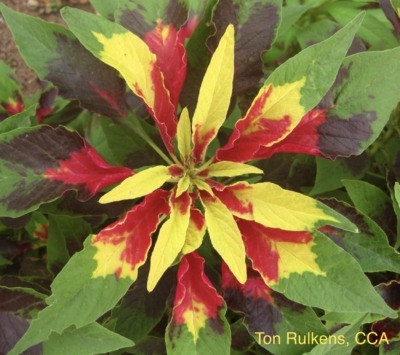
Joseph’s coat
Love-lies-bleeding (A. caudatus) is another kind, grown for its tiny flowers that dangle from the ends of stems in clusters that look like plush bell pulls. Like its near relative, quinoa, love-lies-bleeding yields edible seeds. Leaves of both Joseph’s coat and love-lies-bleeding are best cooked, and taste like spinach, another relative.
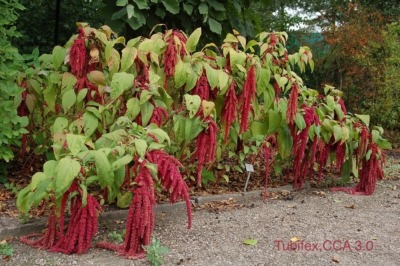
Love-lies-bleeding plant
Jerusalem artichoke is another pretty vegetable. I would be cautious about planting it in a vegetable garden because it multiplies enthusiastically. Each year the knobby roots, to me having the taste and texture of a combination of white potato and water chestnut, sprout stalks six feet high, or more. 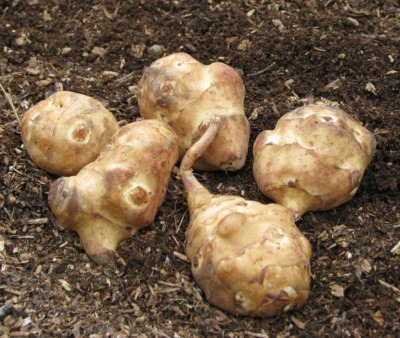 The show begins in early fall, when each branch on those stalks is capped by a sunflower about the size of your palm.
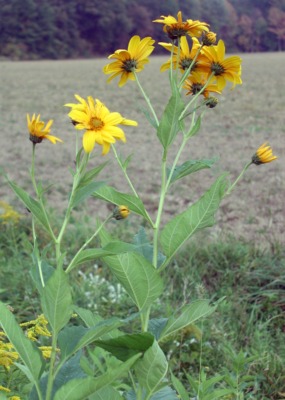
Jerusalem artichoke flowering
No, the plant isn’t from Jerusalem. It got the word “Jerusalem” in its name by a bastardization of the Italian word for sunflower, which is girasole. And artichoke? Some people — not me, though — think the taste is similar to artichoke, which is, in fact, a relative.
Jerusalem artichoke is native to central and eastern North America. I’ve often admired wild plants growing along the edges of fields. If you grow Jerusalem artichoke in your flower garden, no need to sacrifice any flowers to eat the tubers; harvest can wait until after the flowers fade.



I once grew artichokes (topinambour in France where I lived for many years), in my Brooklyn garden. Big mistake! I love to eat them, but they are extremely difficult to eliminate from the garden when necessary. The smallest piece of root left in the ground will grow again.
Interesting. I can imagine them rooting from little pieces of root but not to the extent that it would take great effort to remove all of them. I tried growing them; it’s too cold here for them to overwinter, even with a little protection. And the few that I did get were too small to be satisfying given the effort and space involved.