
TRAINING SESSION
A Trunk-to-be
So you planted a tree — perhaps a few trees — this spring. The first years those trees are in the ground, while permanent limbs are developing, are going to be important to their future strength and beauty. Pruning is one way to direct development, and the best time for this is when trees are small. Small cuts made on small trees leave correspondingly small wounds.
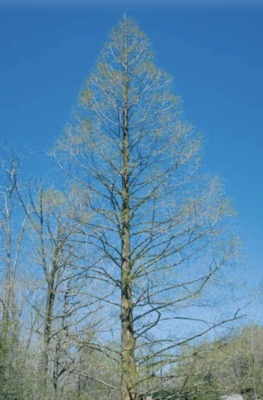
Dawn redwood
For starters, help your young tree to develop a sturdy trunk. For most trees, this means allowing only a single stem to be the main axis. Skyward growing stems are the most vigorous, so select the most vertical, strongest one for the trunk-to-be. Shorten, cut away, or bend down any other stems competing for the role of top dog.
If you’re tree isn’t sufficiently small naturally (because of genetics or being grafted on a dwarfing rootstock), you’ll be controlling its height by pruning. Begin before the tree reaches its desired height. Stop upward progress of that trunk-to-be by cutting it back to a weak, more horizontally oriented branch. Done early on, only a small cut is needed and the crown of the tree will retain a natural upward flow to gradually smaller branches rather than looking as if it has been butchered.
Well-connected Arboreally
Also, right from the get-go, help your young tree build up a framework of permanent side branches that are strong, well-connected, and, of course, look good. Don’t select permanent branches starting too low on the trunk, though; the distance of any of these limbs from the ground never changes.
Gaze along the trunk to select main branches, keeping in mind three ideals to strive for: successive main branches spaced six to twelve or more inches apart (depending on final size of the tree), originating in spiral pattern up the trunk, and growing out from the trunk at wide angles.
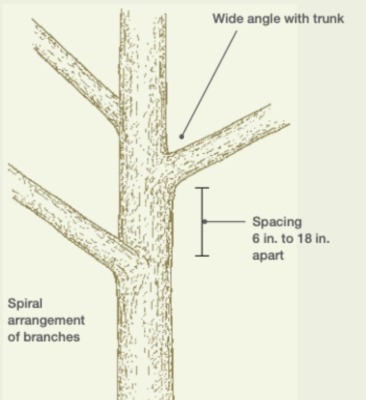
Selection of branching on trunk-to-be
The spacing and spiral arrangement ensure that each branch has sufficient nourishment and enough room to develop. Remember that trees grow from their tips, so spacing between branches will never change. But the branches will thicken with age, in this way moving closer to each other each year.
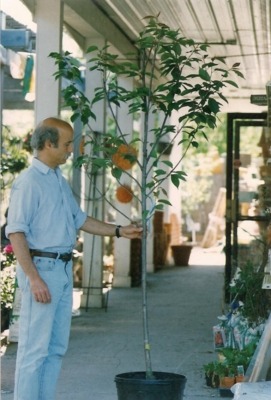
Nursery tree, looks nice but branches are too close
The wide angle is a sign of a strong union. If a narrow-angled branch is particularly well-positioned, bend it down or else cut it all the way back when it is only a few inches long; a wide-angled shoot will often grow in its place. A branch with a diameter less that one-third the diameter of the developing trunk also foretells of a future, strong union.
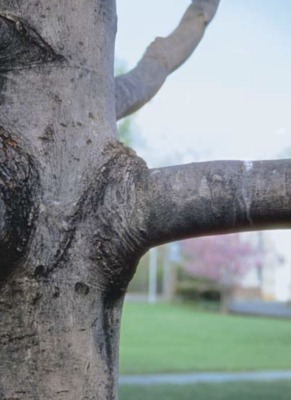
A sturdy branch
Continue to select main branches over the first few years that your young tree develops. As these main branches grow, they will develop their own side branches. For side branches that are strong and have sufficient room to develop, choose those that are at least two feet back off the developing trunk and are thinner than the main branches themselves.
Noncompliance and Over-Enthusiasm
Some young trees are reluctant to branch. Coax branching of the leading stem on such a tree by cutting it back by a little when it has grown a few inches above where you want branching. A shoot from the remaining top bud usually continues growing nearly vertically, as a continuation of the leading stem, while one, perhaps two, lower buds grow out as side branches. If necessary, repeat this procedure at each level where you want branching.
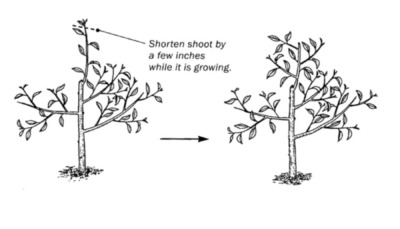
Coaxing branching on leading shoot
Your young tree will undoubtedly grow many other branches in addition to those that you have selected to become permanent ones. Leave most of these for awhile, especially weak ones. They help feed and thicken the trunk and guard the thin new bark against sun burn. If any of these temporary branches begin to grow too much, pinch back their tips occasionally. Remember, though, that temporary branches are temporary; cut them off completely after a few years.
Now don’t go wild pruning your young trees. We want our young trees to grow, and any pruning slows growth. Do only what pruning is absolutely necessary, no more. And do it sometime in the next couple of weeks, or else wait until late next winter. Now has the double advantage, to you, of less pruning needed, and to the plant, of less wood removed.
For more about pruning trees — and most other plants — see my book, THE PRUNING BOOK.
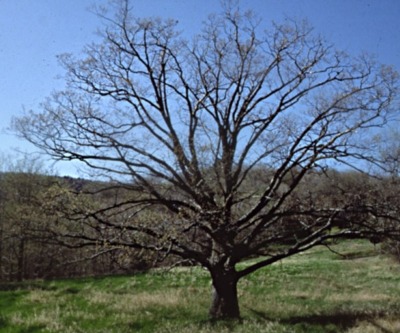
Trees eventually express their own character. Contrast this white oak’s form with that of dawn redwood, shown at the beginning of this post.



Hi Lee, I recently purchased a couple of foot-high rooted elderberry plants. I took a hike to see them growing in the wild, and saw some 5′ adults with single stems, and some with multiple stems. Which do you think is better?
Also, my partner and I will be down in New Paltz this coming weekend, performing on historic musical instruments at the Huguenot Festival. If you happen to come by, please say hello! Best wishes, Sondra
Elderberry naturally grows as a multi-stemmed shrub about 6 feet tall. That’s the way I’ve grown it.
My elderberry tends to resist pruning and spreads like the brooms in fantasia.
How does it “resist pruning?” You cut a stem and it is gone. I guess you probably mean that pruning does’t stop it from resisting spreading.