
A Changing Landscape
Wormy Matters
Charles Darwin did some of his best work lying on his belly in a grassy meadow. Not daydreaming, but closely observing the lives and work of earthworms. All this lying about eventually lead to the publication of his final book, The Formation of Vegetable Mould through the Action of Worms. Darwin calculated that earthworms brought 18 tons of nutrient-rich castings to the surface per acre per year, in so doing tilling and aerating the soil while rendering the nutrients more accessible for plant use.
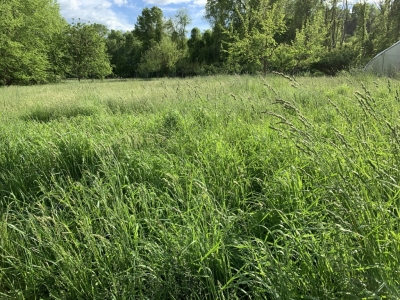 I wouldn’t find that many earthworms at work in my own grassy meadow. The last glacier, which receded about 12,000 years ago from the northern parts of the U.S., including here in the Hudson Valley, wiped out all the earthworms. Darwin’s meadow was spared because glaciation didn’t reach as far south as where Darwin’s home eventually stood.
Not that there aren’t now any earthworms here. Mostly, these are non-native species that arrived over the past couple of hundred years and continue to arrive as fishing bait, ship ballast, and in soil clinging to the roots of transported plants. Some native earthworms may also have made it up here from New Jersey. Not many, though, with their estimated top travel speed of less than 6 yards per year.
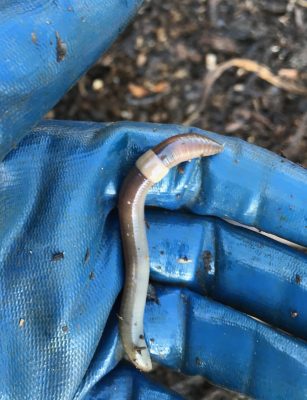 These non-native earthworms are of concern because of the rapidity with which they gobble up organic matter. Their voracious appetites threaten the mountain laurels, rhododendrons, and blueberries that thrive in the organic matter — the leafy mulch — that blankets the forest floors in our nearby Catskill and Shawangunk Mountains.
Those invasive species could effect a change in the landscape we view as we drive along mountain roads and hike the trails.
Grassy Matters
Back to my meadow, which I have also spent a lot of time observing, but from a standing position, usually with a scythe.
Most years the meadow receives a once a year mowing, usually in late autumn, with a tractor. (Early on, I mowed it all summer long with a scythe but the rich soil encouraged lush growth that resulted in tennis elbow. I still scythe parts of the meadow, in moderation.) That once a year mowing is meant to forestall the encroachment of woody plants. In this part of the world, open land typically reverts to forest.
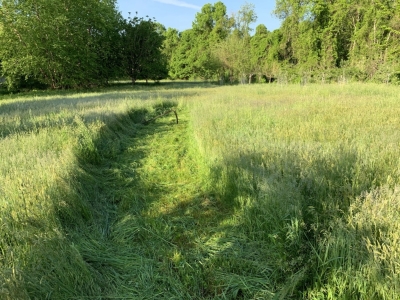
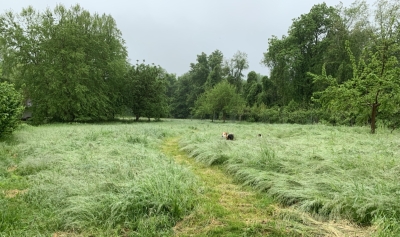
At its best, my meadow presents a lush sea of green that contrasts nicely with the close-cropped areas of lawn near my home. A sinuous path mowed through the meadow, tracing out a different route each season, invites walking through it for more intimate exploration. (I refer to this as “Lawn Nouveau” in the grass mowing chapter of my book, The Pruning Book.)
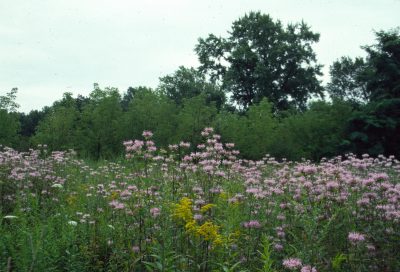
 Through summer, pale pink milkweed blossoms dot the meadow. Come late summer, purple flowers of bee balm cap the sea of green grass like ocean whitecaps. And then, later and on into autumn, various species of yellow goldenrod bloom in succession. In the cool of the morning, dew and morning sunlight bring sparkle to the show.

Grasses Return
A couple of seasons ago I noticed that bee balm and goldenrod were getting increasingly sparse, as were the grasses. Each year increasing amounts of multiflora rose, wild blackberries, poison ivy, even an occasional staghorn sumac were honing in, paving the way to a forest.
Last summer I decided to tip the balance back to meadow. My plan was simple; all I did was mow the field regularly to lawn height. Grasses, which are monocotyledonous plants with their growing point just below ground height, are pretty much the only plants that tolerate regular mowing (or, in the case of prairies, burning). Mow, and grass will come.
This year, meadow grasses are already growing thickly and a couple of feet high. Looking closely, I see very little poison ivy and friends. I will be interested whether or not bee balm and goldenrod appear onstage later, in summer. Another season or two may be needed before they make their appearance.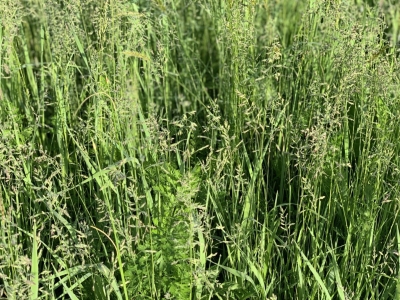
Inevitable Changes
Our forest flora are dynamic. The nearby mountain laurels, rhododendrons, and blueberries, meadows, all landscapes, in fact, are not forever, even without human encroachment. I’m not trying to maintain my meadow in a romanticized primordial state; I just like the look of the grasses, bee balm, and goldenrods.
The meadow also has a practical side. My scything provides hay for compost (along with some horse manure, a waste product of a local stable) and mulch. Taking the hay from limited and different areas each season allows time for the soil to regenerate itself.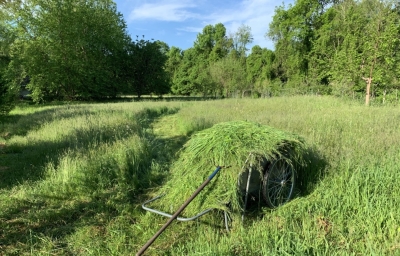
 A plant only benefits under these conditions, of course, if it also has enough water at its roots. To that effect, yesterday, in celebration of the second clear, sunny day, I turned on and checked out the drip irrigation system that provides that water to my vegetable plants and blueberry bushes. (With mulches and choice of appropriate plants, all other plants are on their own.)
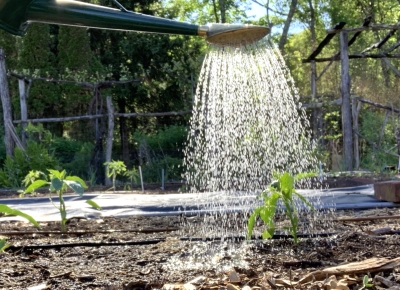
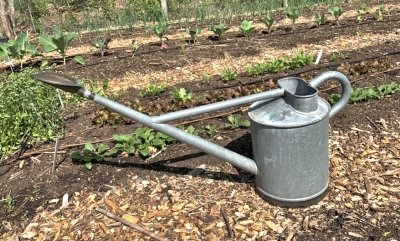
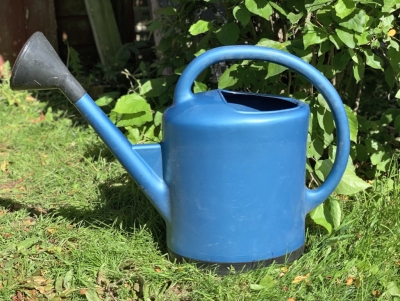
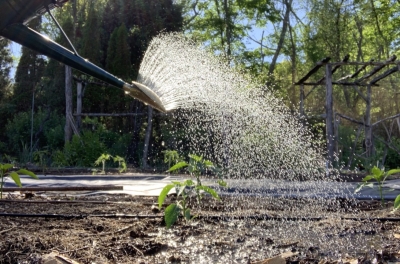 Especially for watering seed flats and small seedlings, a rose needs to be gentle enough to release water sufficiently fast without washing soil around or crushing small plants.
  Some debris is bound to find its way into any watering can and thence to the rose, which needs to be removable and easily cleared. Watch out for thin, plastic roses, which are bound to crack after a few cleanings.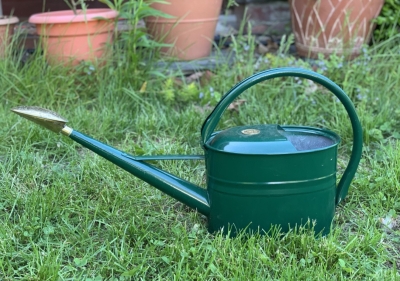
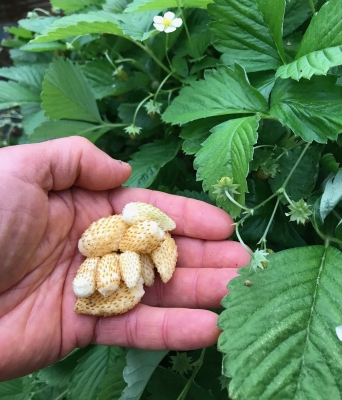 You should be scratching your head by now. Strawberries that are white when ripe? Strawberries perhaps ready for harvest in early May here in the Hudson Valley?
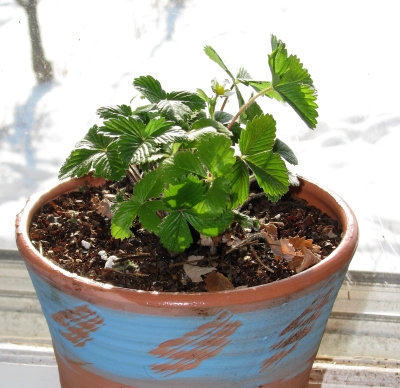 And no, the plants hadn’t resided in my home and aren’t now in my greenhouse to protect them from winter cold. I wanted an earlier crop. I also grow them outdoors.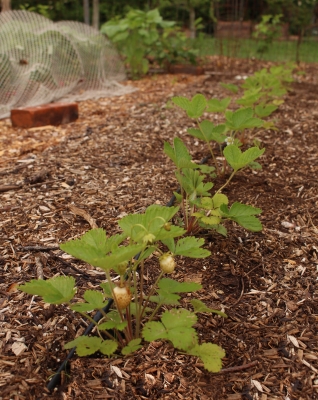
 A planting can be started from plants or seeds, the latter started just as are tomatoes. Plants grown from seeds planted in spring will begin bearing their first season.
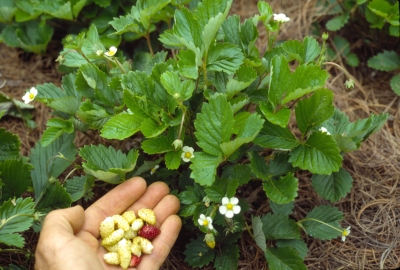 It turned out that all the red-fruited ones were similar, as were the white-fruited ones. For me, the white ones definitely had better flavor. And the flavor could be enjoyed. Why? Because until they are dead ripe, alpine strawberries have taste somewhat akin to cotton soaked in lemon juice. Problem is that birds are very attracted to, and eat, the red fruits no care as to whether or not the berries are dead ripe.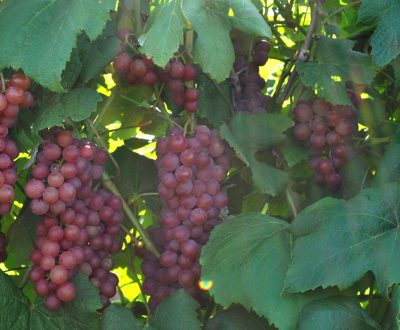
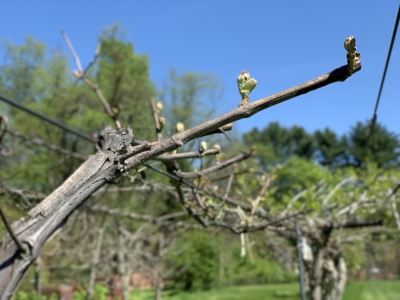
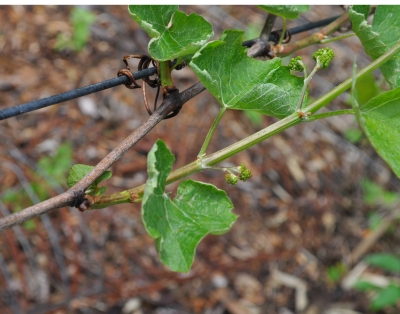
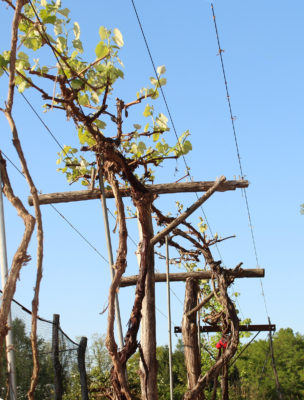
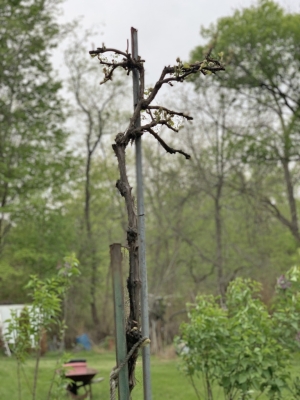 A spur-pruned vine might instead sport a permanent trunk topped by two arms — permanent arms, called “cordons,” in this case — that run in opposite directions along a trellis wire.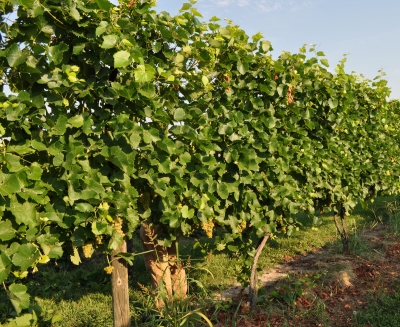

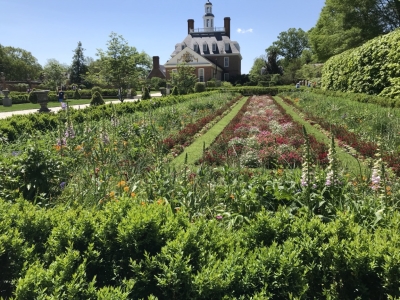
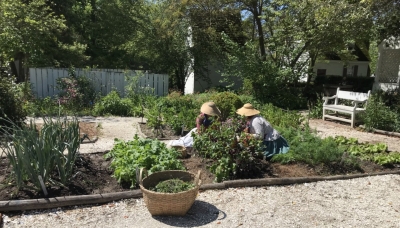 Flowering meads of herbs, flowers, and grasses blanketed the ground beneath most of the orchards, providing — probably unknown back in colonial days — forage for beneficial insects to help protect crop plants.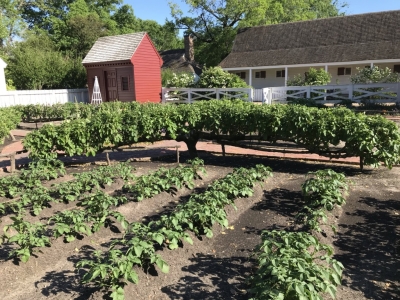
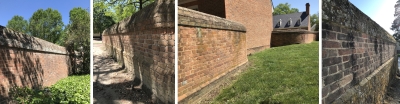 My own home is brick; even a few four-foot-high walls around my vegetable garden and in other areas would improve the general appearance — and provide, warmer microclimates for cold-tender plants or early harvests. Not that the rustic locust fencing and arbors enclosing my vegetable garden look unsightly . . . but I’d like some brick walls.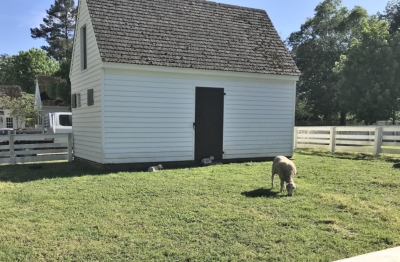
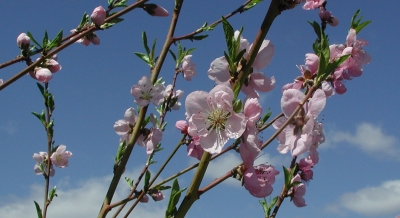 I mentioned flower buds, so these plants I’m pruning are mature, bearing plants. The objectives and, hence, pruning of a young tree are another ball game. As is renovative pruning, which is the pruning of long-neglected trees.




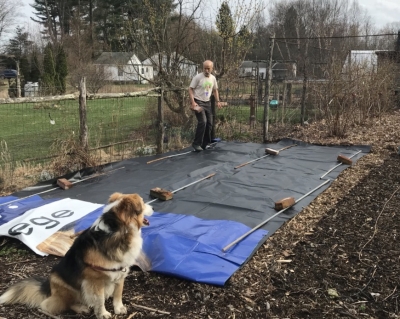 Actually, that insidious blackness covering my beds is black vinyl. But that’s beside the point. Its purpose, like the black plastic against which I’ve railed, is to kill weeds. Not that my garden has many weeds. But this time of year, in some beds, a few more sprout than I’d like to see.
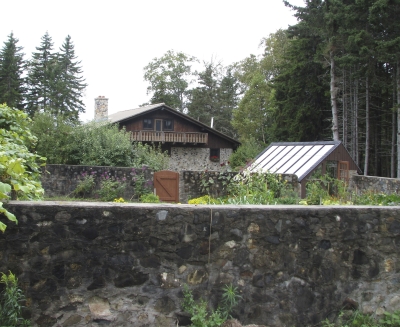 I had just dug my first garden which had a clay soil that turned rock hard as it dried, so I was especially awed, inspired, and admittedly jealous of the soft, crumbly ground in Scott’s garden. What a surprise when someone who had worked with Scott for a long period told me how tough and lean his soil had been when he started the garden. A number of giant compost piles were testimonial to what it takes to improve a soil.
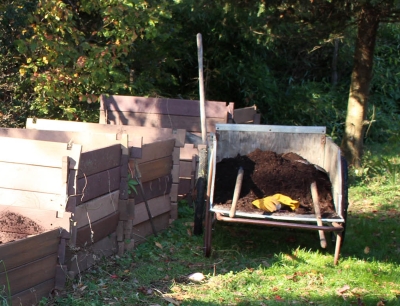 The soil in my permanent vegetable beds is never turned over with a rototiller or garden fork; instead, every year a layer of compost an inch or so deep is lathered atop each bed, and no one ever sets foot in a bed. That inch of compost snuffs out small weeds, protects the soil surface from washing away, and provides food myriad beneficial microbes (and, in turn, for the vegetable plants).
 Recent additions to that pile were an old soil pile from a local horse farm and soil from a hole I was digging to create a small duck pond. The latter was poorly aerated subsoil.