Keep on Composting

One Problem in Cold Weather

I don’t let cold weather put the brakes on my composting, at least my role in it. For the bacteria, fungi, and other workers in my compost pile, it’s another story. Come cold temperatures, and their work come screeching to a halt or near halt (which depends on the degree of cold, the size of the pile, the mix of ingredients, and moisture).

But that’s no reason for me to abandon composting.

The main problem, as I see it, with composting in winter is not the workers not working. Pile up food scraps another organic materials winter, and composting will re-convene when warm weather arrives again in spring. The problem is that those food scraps offer a smorgasbord of tasty, easy calories for rodents. Which is not good.

(Lest you’re feeling fuzzy and warm to these furry creatures, a short list of what they could bring along to you would include hantavirus, leptospirosis, lymphocytic chorio-meningitis, rat-bite fever, salmonellosis, and tularemia, all of which are as bad as they sound. And that’s only a partial list.)

I take a multi-pronged approach, then, to keeping rodents at bay yet carrying on with my role in composting.

Population Control

My first line of defense is to keep rodent populations in check.

The top layer of the compost pile is not the only place where rodents might find a meal. In autumn, I clean up any rodent treats that might be lying around such as ears of corn, old squash and tomato fruits, and baskets of filberts or black walnuts. As appropriate, they go either onto the compost pile or into animal-proof storage.
Compost with fresh materials
Sammy, Daisy, and Gracie also help out. They are, respectively, a dog and a dog and a spayed cat, who spend most of their time outdoors. (I know, I know about the problem with cats and birds. But I’m trying to strike a balance. A few less birds weighed against soaring rodent populations seems reasonable. And anyway, Darwinian selection may be going on here for birds that are increasingly learning to avoid Gracie. At least, not to get too graphic, judging from the “gifts” Gracie brings back to show off.)

Dogs on porch

Dogs at “work”

I support the work of Sammy, Daisy, and Gracie by doing some trapping on my own, mostly of rabbits and squirrels because they can damage or kill plants, and pilfer my food. Black rat snakes, which sometimes go so far as to lay their eggs in my compost pile, also help out.
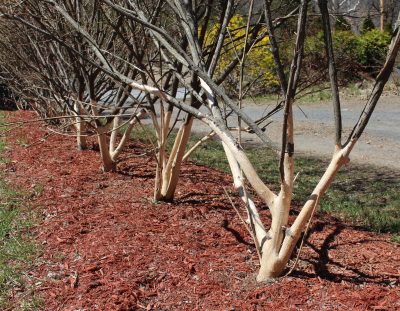
Mouse damage
Mouse damage

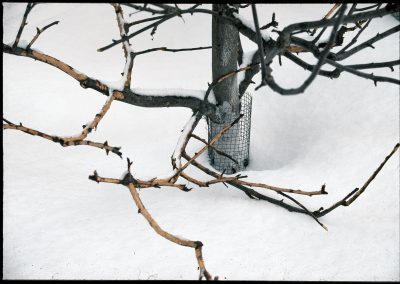
Rabbit damage to branches

Rabbit damage to branches

Exclusion

My second line of defense is to keep rodents out of my compost pile. A number of heavy-duty plastic or metal, animal-resistant compost bins are available for sale, and all work pretty well — as they should, since any pile of organic materials will eventually turn to compost. Their usual limitation is that they many lack sufficient volume for a critical mass if you want to make hot compost.

I made my own compost bin, actually bins. Having two or more allows compost to mellow in one bin while the other one or ones are still cooking. My bins are rodent-proofish. They are so, first of all, by my setting them up in flat ground upon which I first lay down a large enough piece of 1/4 inch or 1/2 inch mesh hardware cloth to keep the critters from tunneling up from below.
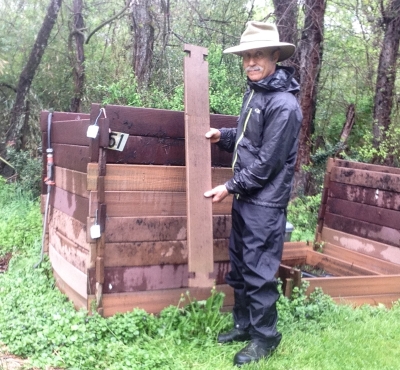
Commpost bin board
The bin itself is made of notched, fake wood (such as used for decking). As the notched pieces slide together, the tolerances were designed to be close enough to deny rodents access. Ah, but “there’s many a slip ‘twixt the cup and the lip;” my carpentry skills fell a little short of making all those notches small enough, which would be less than 1/2 inch, to allow entry by even a mouse. Still, the bins work pretty well.

I detail the material I used and the construction of the bins at https://leereich.com/2019/06/my-compost-for-a-bin.html.

Scavenger Friends

Rodents are wily creatures, and I expect that they could somehow jump and climb their way up the bins to the top of the pile where the freshest delicacies have been most recently placed. Originally, I planned to make rodent-proof covers to the compost bins, but they never got out of the early planning stage.
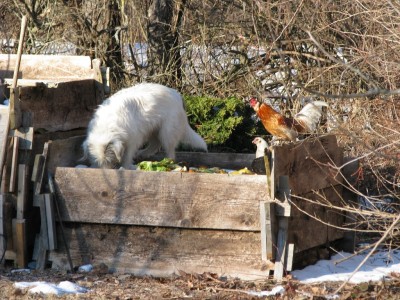
Dog and chickens on compost pile
Turns out that my dogs are very good jumpers, and also very fond of kitchen scraps. My ducks are adequate fliers/climbers, and likewise show interest in this department. So the plan here is to deposit compostables from the kitchen onto the compost-pile-in-progress each morning, when ducks and dogs are out and about. They clean up all of the most desirable and calorie-laden stuff, leaving little or nothing for any rodents who, excepting squirrels, are mostly nocturnal.
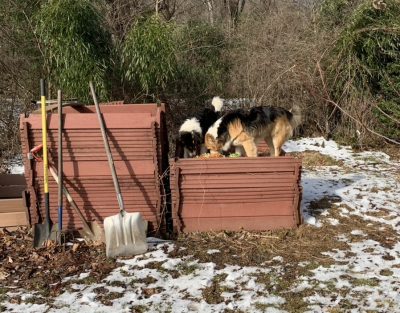
Dogs on compost pile
Note: As I re-read what I’ve written I realize that I could be accused of not being pc for a number of details stated. Sorry. But composting itself is very pc, and reality often involves striking balances to get the most desirable results.
To Shred or Not To Shred, That is the Question

Organic Matters

My friend Margaret Roach (https://awaytogarden.com) is a top-notch gardener but not much of a tool maven. She recently said she considers me, and I quote, “the master of all tools and the king of compost” when she asked for my thoughts on compost shredders. (I blushed, but perhaps she was just softening me up for questioning. In fact, her tractor is better than mine.)

Of course I have thoughts about compost shredders.
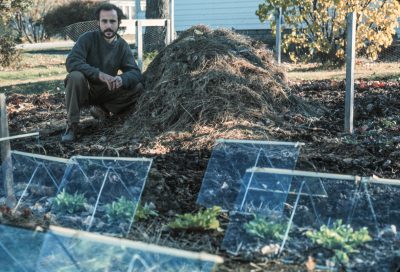
Me, in my garden in 1970s
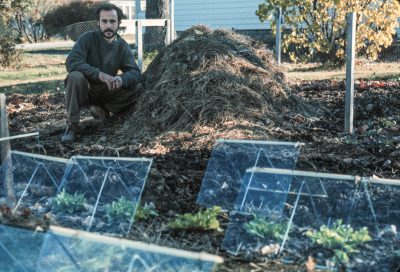
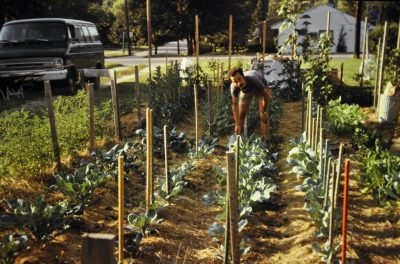
Climb with me into my time machine and let’s travel back to the early 1970s, to Madison, Wisconsin, where you’ll find me working in my first garden. Like any good organic gardener, early on I appreciated the many benefits of organic materials in the garden, an appreciation bolstered by my having recently began my studies as a graduate student in soil science.

I was hauling all the organic materials I could lay hands on into my 700 square foot vegetable garden. From near where I parked on the agriculture part of campus I could load up large plastic garbage cans with chicken or horse manure for my compost piles. 

Also for my compost piles, and for mulch, was tall grass mowed by road crews along a major roadway, easily scooped up with my pitchfork and packed into those garbage pails. Nowadays, gathering such mowings would be difficult because the flail mowers now used chop everything up rather than lay down the long stalks of yesteryears’ sickle bar mowers. Gathering roadside mowings may also now be illegal. And, in retrospect, those mowings were (and still are) probably contaminated with lead and other heavy metals from nearby traffic.

Garden, Madison, 1970s

Garden, Madison, 1970s

Anyway, I now have my own one acre field which I scythe and brush hog for mulch and feeding compost piles.

Bulk and Speed

But I digress . . . Margaret was asking about compost shredders.

One benefit of organic materials in gardening is their bulk; they are mostly carbon, hydrogen, and oxygen, which, over time, ends up as carbon dioxide and water. That decomposition is a good thing because it represents the feeding of soil life and, as decomposition proceeds, plant nutrients are slowly released into the soil.

A downside of all that bulk is that it takes up a lot of space. The decomposition rate is influenced by the materials’ ratios of carbon to nitrogen, inhibitors such as lignin, and particle size. A given volume of smaller particles has greater surface area, accessible to being nibbled away by microbes, than does that same volume of larger particles. Like perhaps many beginning gardeners, I was in a rush to have better soil than the sticky clay I was dealing with.

Enter garden shredders. I headed down to the local Sears Roebuck and Company and purchased a new, gasoline-powered shredder. Back in the garden, I set it up and in little time was reducing large volumes of leaves to smaller volumes of shreds.

That activity probably lasted about 20 minutes before two thoughts entered my head. First, one reason I was gardening was because it was — or could be — good for the environment. I could grow vegetables more sustainably that most farmers of the day, and the vegetables would not have to be transported to me. Shredding seemed, then, a waste of energy. Second, the chugging of the engine didn’t seem to jive with a bucolic activity such as gardening. Fortunately, the shredder could be returned; I packed it up and got my money back. (Unless powered by solar, wind, or some other renewable energy source, and electric shredder also spews carbon dioxide et al. It just does so elsewhere.)

And anyway, there’s no particular need, generally, to speed up the composting process. If you need some finished compost immediately because of poor planning or a beginning garden, there are plenty of places where you can purchase good quality compost. Build a couple or more piles of your own, manage them well, and you’ll have “black gold” always ready in due time.

Solar Enters the Picture

I do still occasionally use a compost shredder — but it’s very quiet and it’s solar powered.
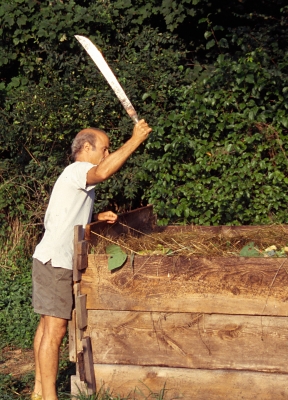
Chopping compost with machete
Also very inexpensive because it’s nothing more than a machete. If I’m piling very rough material such as corn or kale stalks, or very airy material such as old tomato or pepper plants, or large fruits such as overgrown zucchinis onto my compost pile, I’ll chop them with a machete as I add them. (It’s also therapeutic: If everyone spent some time chopping their compost ingredients, as needed, with a machete, the world would perhaps be a more peaceful place.)
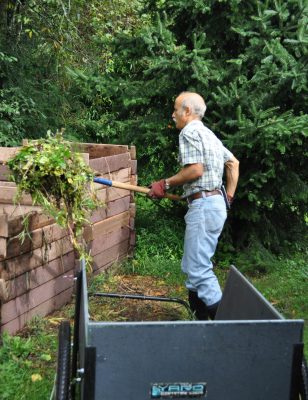
Adding material to compost pile
The bottom line is that there’s no reason that you must shred any material for composting. That is, unless it’s absolutely necessary to speed things up or reduce their volume. Is it really necessary? Usually not.

Rosemary Tips

Secrets to Survival

I’ve killed plenty of rosemary plants over the years, typically in late winter. At least that’s when I’d discover that they were dead. Casually brushing against the plant would bring dried leaves raining to the floor.
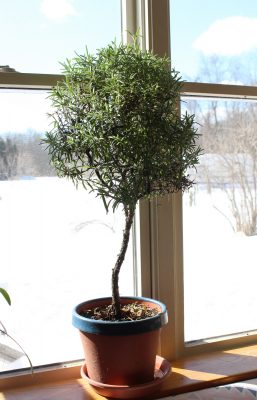
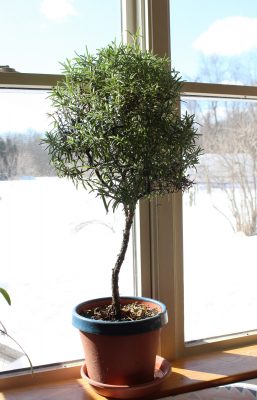
Potted rosemary tree in winter
Problem is that rosemary has naturally stiff leaves. They don’t wilt to broadcast that the plant is thirsty. And then it’s too late; the plant tells you it’s dead as it’s leaves flicker down.

Perhaps like you, I knew that rosemary is native to the Mediterranean region. The picture in my mind is of the plants thriving on a sun-drenched, dry, rocky hillside in poor soil. True enough, except below ground the roots are reaching deep or wide for water. Which my potted plants can’t do.

Following this latter realization — duh! — I haven’t lost a rosemary plant in years. The secret to keeping a potted rosemary plant happy is to keep it well watered, never letting the potting mix dry out. If in doubt, water.

Rosemary roots also need to breathe, and the way that is assured is by adding plenty of perlite to the potting mix. My mix is 1/4 by volume each of perlite, garden soil, compost, and peat moss. The latter two ingredients help retain moisture while, at the same time, provide for aeration.

Making a Rosemary Tree

I mentioned last week that I grow my rosemary plants as miniature trees, a form also known as “standards.” Here’s how I make mine.

(“Standard” does seem like an odd word to describe such a plant until you realize that the “stand” in “standard” does indeed mean just that. “Standard” comes from the Old English words standan, meaning to stand, rather than flop around, and ord, meaning a place. Further muddying the horticultural waters, in fruit growing a “standard” is a full size tree, as opposed to a dwarf tree.)

The easiest way to set a rosemary plant on the road to standard-dom is to begin with a small plant. Rosemary comes in upright or creeping varieties. Upright varieties, such as Majorca Pink and Salem, are naturally inclined to “stand,” but creeping varieties are also easily coaxed in this direction.

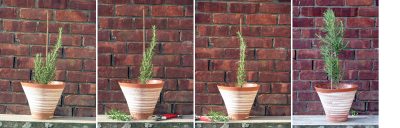
Single out a vigorous and upright growing stem as the standard’s future trunk. In the case of a creeping variety, just select any healthy stem and stake it upright to a dowel or thin shoot of bamboo. Shorten all side shoots to direct the plant’s energy into that trunk-to-be.
First 4 steps in training rosemary standard
The goal, in the weeks ahead, is to promote elongation and thickening of the trunk-to-be. To that end, keep cutting away any new stems sprouting from the base of the plant. Keep pinching back to just a few leaves any side shoots. Doing so keeps them subordinate but lets them help thicken the trunk.

Once the trunk reaches full height, goals change: time to stop growth and create a bushy head. But how high is “full height?” It’s all for show, and what looks good depends on how big a head you are going to give the plant and how big a pot the plant will eventually call home. Generally, a head two to three times the height and just slightly more than the width of the pot looks good. Stop growth at the desired height by pinching out the tip of the trunk, a simple operation that awakens growth of buds down along the trunk.
Second four steps in training rosemary tree
Create the bushy head by repeatedly pinching — and thus inducing more branching — all growth that sprouts from the top few inches of the trunk. Now define that head more clearly by completely removing all stems and leaves further down the trunk.

All these prunings need not be wasted, of course. They could be used as flavoring or as cuttings to make yet more plants.

(Creating standards and other methods of pruning all plants is covered in more detail in my book, The Pruning Book, available from the usual sources or, signed by me if you wish, here.)

On Going Rosemary Tree Care

Over time, the bushy head grows larger and larger — too large if left unfettered. So pinch back growing tips regularly, which you’ll probably be doing anyway as you enjoy the rosemary added to tomato sauce or chopped and sprinkled on fish. Unless you’re crazy for rosemary, that amount of pruning won’t be enough to contain the ever expanding head.

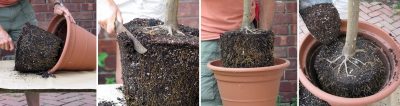
And below ground, roots eventually fill their flowerpot. Then they will need more room and access to more nutrients. So once a year, in spring, I tip my plant out of its pot, shear off some roots and soil around the edge of the root ball, then put it back in the pot with new potting mix in the space opened up.
Repotting a standard
Right after I repot the plant, I also give it its annual haircut, shearing the head an inch or so back all over with a pruning or grass shears. Water well and watch the plant fill out with new growth.

All those shearings could, of course, be dried for future use. But why do that? You now have plenty of fresh rosemary, year ‘round. Just don’t neglect watering.
Rosemary standard

I Think My Vegetables are Nutritious

Nutrient Declines in Fruits and Vegetables

Growing vegetables is really quite simple. You put the seeds or transplants into sunny ground, you water and weed, and then you harvest your bounty. For that small effort, you can put on your plate food that is organically, sustainably, and (very) locally grown. Perhaps even richer in nutrients than food you can buy.
Healthy, healthful, vegetables
Studies over the past 15 or so years have documented a general decline in nutrients in our fruits and vegetables. Some people contend that our soils have been mined for their nutrients, worn out from poor farming, and therefore no longer able to provide us with nutritious food. The cure, according to these “experts,” is to sprinkle mineral-rich rock powders on the soil to replenish and rebalance that which has been lost. It all sounds very logical.

You might have sensed a big “but” looming. Here it is: But . . . further studies have pinned that nutrient decline on a dilution effect from increased yields. Pump up production with nitrogen fertilizer and water, or by breeding for increased yields, and nutrient concentrations decline; it’s as simple as that.

The final nail in the “worn out soil” coffin comes from side-by-side plantings of low- and high-yielding varieties of specific vegetables. The higher yielding varieties end up with lower concentrations of minerals and protein. The problem, then, if there is one, can be blamed on breeding and farming practices aimed at producing more bulk.

But . . . 

I’m not concerned with nutrient decline in my own garden. First of all, I’ve chosen the varieties I grow — Blue Lake beans, Cherokee Purple tomatoes, Lincoln peas, Early Jersey Wakefield cabbage, Ashmead’s Kernel apple, and Fallgold raspberry, as examples — with

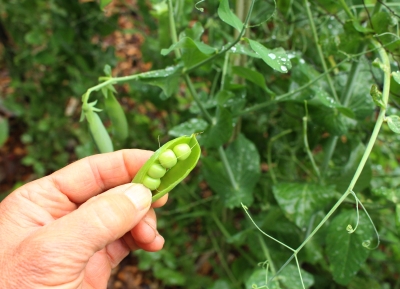
one thing in mind: flavor! Peas in podIt just so happens that the most flavorful fruit and vegetable varieties are ones that have been around a long time. Yields may not be heavy, but these varieties are rich in flavor. (And perhaps nutrients. Anyway,
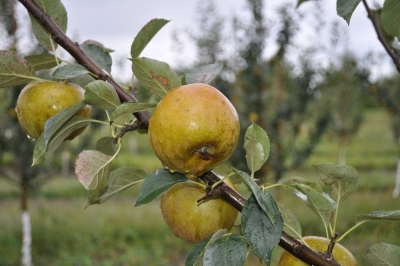
Ashmead's Kernel apple

Ashmead’s Kernel apple

if something doesn’t taste that good, I’m not going to eat much of it, so it’s irrelevant how high it is in nutrients.)

I’m also not concerned with nutrient decline because I don’t push yields to the max with repeated applications of soluble, nitrogen-rich fertilizers. My soil management is simple: One inch of compost per year spread on top of the ground of permanent vegetable beds; compost, wood chips, hay, and/or leaves around my fruit plants. As these organic materials decompose, nitrogen and other essential nutrients are bled slowly into the soil only in response to warm temperatures and moisture, the same environment that spurs plant growth.
Spreading compost
That compost is not serving up only nitrogen to my plants, or even just the big three nutrients, nitrogen, phosphorus, and potassium. Into my compost goes orange peels from Florida, avocado skins from California, and other kitchen waste, garden trimmings, some weedy hay, and, occasionally, horse manure. So the ground gets a wide variety of organic materials that, in turn, feed the compost and, in turn, feed the soil and the plants a wide spectrum of nutrients. And just to make sure that my soil lacks nothing, I occasionally sprinkle some powdered kelp around.
Herbs for Flavor, in Winter, Not Nutrition

Even if herbs were rich in nutrients, their nutritional contribution to our diets would be minimal because of the relatively small amounts actually eaten. But the small amounts needed to pizazz up a tomato sauce or frittata in winter also make herbs ideal for growing indoors in winter. A little goes a long way. 

The basic problem is that many cooking herbs are Mediterranean plants that, of course, thrive best in Mediterranean conditions, with bright hot sun beating down on them. So the expectations and the reality of a windowsill herb garden often diverge. Forget about growing basil or oregano in January.

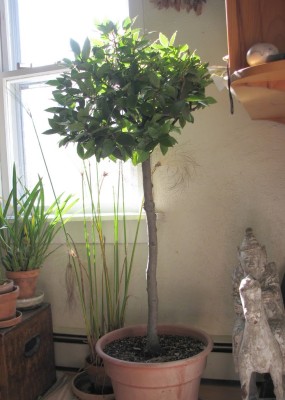
With that said, I nominate two herbs perfect for indoor growing in winter. The first is bay laurel. This plant, a small tree trained as a “standard,” has spent the last 29(!) winters near a sunny window. A freshly plucked leaf brings to soups and stews a flavor only hinted at by the dried leaf; to me, in addition to its distinctive flavor I sense an oleaginous quality hinting of olive oil.

Bay laurel tree

Bay laurel

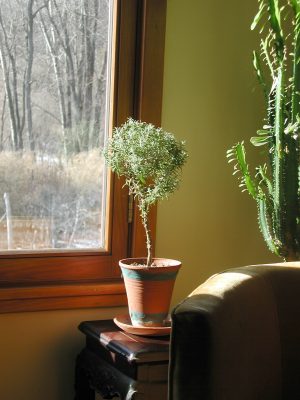
The second herb, rosemary, is my favorite for indoor growing. Rosemary tolerates being trained as a standard or fanciful topiary; it looks equally good left to its own devices to grow as a relaxed, small shrub.  (Mine are trained as standards.) Pinching off a few stem tips

Small, indoor rosemary "tree"

Small, indoor rosemary “tree”

with leaves not only puts some warm, Mediterranean sunshine into tomato sauce but also encourages growth of side shoots to keep the plant dense with shoots and leaves.


Once spring warmth has settled in around here, the bay laurel and rosemary will move outside to bask in the full force of Hudson Valley sunshine. 

What Midwinter, Spring-like Weather Will Do

My Garden’s A Mess!

After some really frigid weather a month ago followed by more or less seasonal cold, temperatures did a loop de loop and we’ve had a couple of days in the high ‘60s. Very unseasonal, to say the least, and perhaps another indication of global warming, but welcome nonetheless. Those temperatures, coupled with brightening sunshine, made me want to get my hands in some dirt.

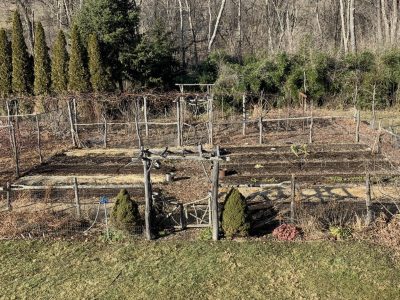
A large, second-story bedroom window overlooks my main vegetable garden. The weather made me see it in a different perspective — it looked messy. 

I pride myself on putting everything in order each fall so that (quoting from Charles Dudley Warner’s 1886 My summer in the Garden) “The closing scenes are not necessarily funereal . . . A garden should be got ready for winter . . . neat and trim. . . in complete order so that its last days shall not present a scene of melancholy ruin and decay.”

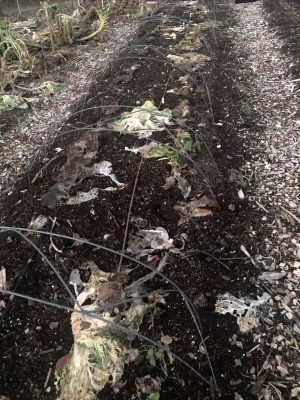
Messy garden, January

Not a pretty picture

Endive, dead in January

Endive, dead in January

Although I had mostly cleaned up spent vegetables and dressed the beds with an inch-deep layer of compost, early wintry weather put an end to that. Now, what I saw outside was too much “melancholy ruin and decay” from a few beds of late cabbages and their kin and tunneled beds of endive. The wilted, dried, browned leaves of unharvested endive lay flat, covering those beds.

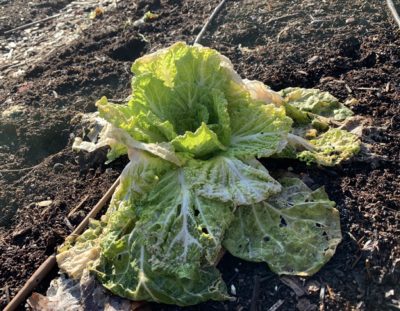
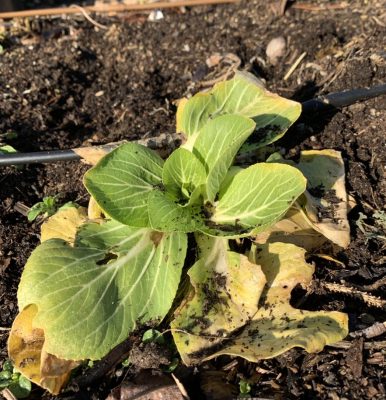
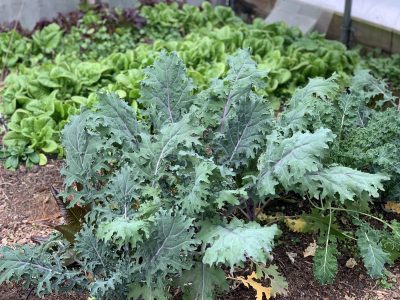
Spring-like temperatures offered me the opportunity to get my hands in the dirt. I grabbed my hori-hori knife and gathered up frozen or dessicated leaves and plants for carting over to the compost pile. What a shock to even find some signs of life still out there in the beds: some arugula, some kale plants, and a couple of plants of baby pak choy and michili Chinese cabbage.
Michili chinese cabbagePak choy in garden, January
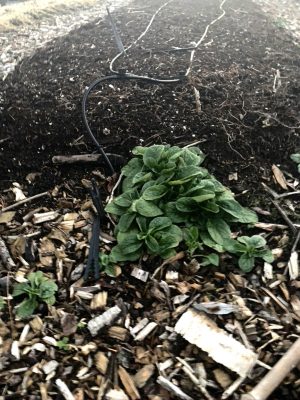
Coldest temperatures (minus 20 degrees F. here) typically arrive in late January. Those temperatures will do in these plants. Except for mâche, of course, which was also still alive in the garden, spry and green as if temperatures had never already dropped near zero, and which always survives winter.

Mache, in garden in January

Mache, in garden in January

Garden after cleanup

Garden after cleanup

First Seeds

That spring-like weather also gave me the urge to sow some seeds. These would be the first of the year, a seed flat of lettuce and baby pak choy to mature in early spring in the greenhouse. For some irrational reason, I’m never that confident that those tiny specks are actually going to sprout, even though I’ve done this successfully for decades.

Perhaps my lack of faith comes from my first experiences sowing seeds. That was many years ago when, as a graduate student, I lived in a motel room that had been converted into an apartment and began my first garden as an adult. I sowed all sorts of vegetable and herb seeds in peat pots that I set in trays on a shelf on a wall near a window.

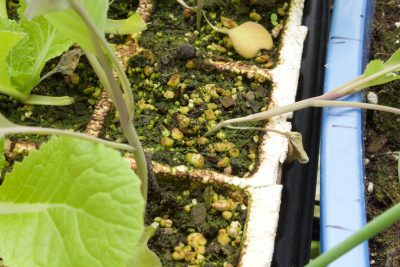
All those seedlings died — and that was my abrupt introduction to “damping off,” a disease that attacks seeds and newly emerged seedlings. Imagine the disappointment of a beginning gardener (me) watching seedling stems pinch in at he soil line and topple over — the telltale symptom of damping off disease.
Damping off, cabbage

First Disease

I soon learned that damping off was not uncommon, even among experienced gardeners. The disease is caused by any one of a few soil dwelling fungi that raise their ugly head (figuratively) given the right conditions (for them). One obvious way to try to avoid the problem is to sterilize the potting media.

Most commercial potting mixes are sterile, as were the peat pots I was using. The problem is that the culpable microbes are everywhere, waiting to attack when conditions are just right, conditions that I unknowingly provided in my motel room. The peat pots were excessively moist; the air stood still; and little light entered the room — perfect for damping off development.

Nowadays, my seedlings rarely experience damping off. The plants get off to a good start at temperatures they enjoy, bathe in light in my greenhouse or sunny windows (or, in the past, cozied up very close to fluorescent bulbs), and a fan keeps the air moving. I also add sufficient perlite to my potting mixes so that excess water drains feely down and out of the mix. A thin layer of well-draining material, such as sand or calcined montmorillonite clay (kitty litter) can also help.

Years ago, soothing brews of chamomile tea would also come to the rescue — for the seedlings, not for me. That tea hasn’t been needed for a long time. I also don’t pasteurize or sterilize my potting mixes. Beneficial microbes, from the compost in my mix, and good growing conditions have thankfully made damping off nothing more than a distant memory for me.

Catalog and Weather Watchin’

Armchair Gardening

Pretty much the only “gardening” I’m doing now is thumbing through the seed catalogs arriving in dribs and drabs in my mailbox. I’ve ordered and received what I thought I’ll need, but you never know; maybe there something else interesting out there to grow.

Among the most fun of these catalogs, and strictly for the plant-crazed, is “The 2020 Ethnobotanical Catalog of Seeds,” which used to be called Hudson’s Seed Catalog. The catalog originates in the Santa Cruz mountains of California (once home to Ken Kesey) but offers seed from all corners of the world. Only recently have they come online, at www.jlhudsonseeds.net.
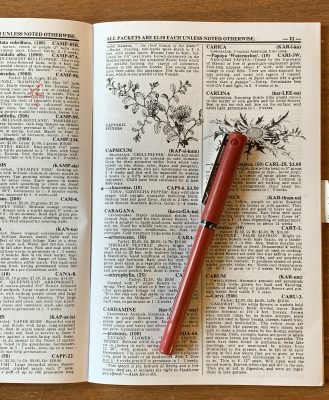
Hudson catalog
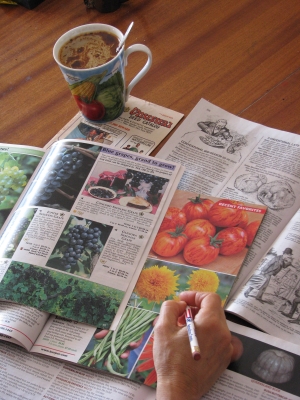
I’ve ordered from this catalog for decades, each winter pleasurably and slowly wading through the almost 100 black-and-white pages of small print listings of botanical names and descriptions. For this first run through the catalog, I sit poised with red pen, ready to make a star next to any seed listing that looks particularly interesting. After I go through the whole catalog once, I’ll re-examine all those starred listings and select which seeds to actually order and grow.

Judging from what I’ve so far starred, I seem this year to be drawn to scented plants. Achlys triphylla, also known as vanilla-leaf or sweet-leaf, is one such plant: “Dense spikes of tiny flowers held above the trifoliate fan-shaped leaves. Moist woods from B.C. to California. The sweetly fragrant leaves were highly valued by settlers, who hung bunches in their houses. Sow 1/4″ deep in rich woodland soil, and keep moist. Slow to germinate.”

Another is Adenophora lilifolia, also known as ladybells. This one is described as “sweet-scented light blue 1/2″ wide bell-shaped nodding flowers borne profusely in summer. Very hardy perennial to 1-1/2 to 3 feet, with round, heart-shaped basal leaves. Eurasia. Cultivated in Japan for the thick, edible roots. Germinates in 2 weeks.” For only $2.50 a seed packet, oodles of each of these plants can be growing in and perfuming my backyard this summer.

  It’s not just visions of fragrant, comely, or tasty plants that make this catalog fun to read. Berkheya purpurea is native to Africa, with a common name Zulu warrior. How many plants conjure up an image like that!? The plant seems to me less warrior-like, with flowers that are large, silvery-blue to lavender daisies with dark centers. Interesting, but I don’t need another daisy for now. 

Short quotes interspersed throughout the catalog set the tone and are food for further thought. Here’s one from Thomas Jefferson: “It does me no injury for my neighbor to say there are 20 gods or no God. It neither picks my pocket nor breaks my leg.” Or, going back 17 centuries, to Aesop: “Any excuse will serve a tyrant.” And then forward, to General Douglas MacArthur: “ If you win, you stand only to lose. War contains the germs of double suicide.” Or, to another American general, Dwight Eisenhower: “Things are more like they are today than they have ever been before.”

  So far, I’ve only gotten as far as “D” in the seed listings. There’s still time.

Where’s Winter?

Aren’t temperatures supposed to get colder and colder and colder until the end of this month, and then get warmer and warmer and warmer? That’s how temperatures generally trend in coastal regions, near large bodies of water, and in western Europe. Not so here in the Hudson Valley and over most of continental North America.
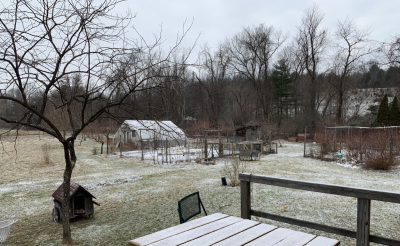
Current winter scene
In my garden, the low was 3 degrees in early December and the high was 59 degrees a couple of weeks ago. Such fluctuations are not that uncommon over much of continental U.S. If you don’t like winter, you welcome those balmy winter days; if you like winter and/or like plants, those balmy days make you shudder.

  Plants that can take our cold weather like the weather to stay cold all winter. Each time temperatures warm, especially after we’ve had a spell of cool weather, these plants start to awaken slightly from their winter slumber. The closer to spring and the warmer the weather, the more they awaken. Problem is that the more awake a plant is, the more likely damage, even for a cold-hardy plant, from subsequent frigid weather.

  All this makes a good case for growing native plants. They’re more used to our mercurial weather and know better than to let a winter warm spell entice them out of their slumber.

  However, many cultivated plants are not native. I like to grow fruits, and any fits of warm weather in weeks to come are going to make me nervous about the apples, plums, hardy kiwis, and pears, all non-native and sometimes awakening early enough to be damaged by subsequent cold.

Blueberries, pawpaws, persimmons, raspberries, and mulberries should be fine. Let’s hope for steadily cold weather and plenty of snow for the rest of winter.

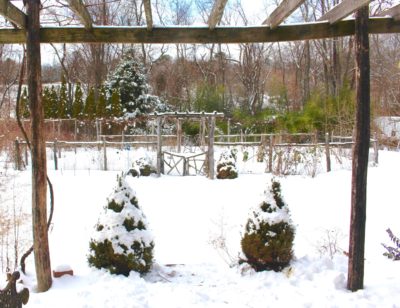
Past winter garden scene

Older winter scene

SEED TIME

Late this Year

This year I’m late, but not too late, with my seed orders. Usually, I get them in by a couple of weeks ago.

The only seeds that I’ll soon be planting are those of lettuce, arugula, mustard, and dwarf pak choy. They’ll fill any bare spaces soon to be opening up where winter greens have been harvested. No rush, though, because I have seeds left over from last and previous years of these vegetables, and they keep well if stored under good conditions.
Greenhouse greens
I’ve usually sowed onion seeds early also, in flats in the greenhouse in order to give plants enough time to become large transplants. Large transplants translates to large plants out in the garden before long days force them to shift from growing leaves to, instead, swelling their bulbs. More leaves before that shift makes for larger bulbs.

Last year, because of poor onion germination in the flats, I ended up getting fresh seeds and sowing them directly in the garden in early spring. Keeping the bed moist promoted quick germination and, by August, the bulbs stood up well, size-wise, to those from seeds sown in the greenhouse in past Februarys.

Seed Longevity

Onion and leek seeds don’t keep very well. Viable seeds are living, albeit dormant, embryonic plants which do not live forever. Conditions that slow biological and chemical reactions, such as low temperature, low humidity, and low oxygen, also slow the aging of seeds.

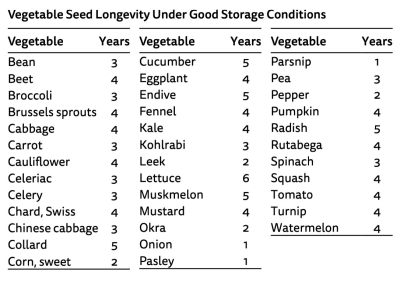
Seeds differ in how long they remain viable. Except under the very best storage conditions, it’s not worth the risk to sow onion, parsnip, or salsify seeds after they are more than a year old. Two years of sowings can be expected from seed packets of carrot and sweet corn; three years from peas and beans, peppers, radishes, and beets; and four or five years from cabbage, broccoli, Brussels sprouts, cucumbers, melons, and lettuce. 
Chart of vegetable seed longevity
Among flower seeds, the shortest-lived are delphinium, aster, candytuft, and phlox. In general, though, most annual flower seeds are good for one to three years, and most perennial flower seeds for two to four years. 

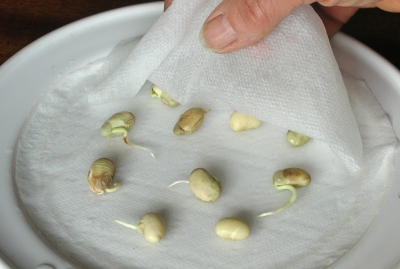
In a frugal mood, I might do a germination test for a definitive measure of whether an old seed packet is worth saving. Counting out 10 to 20 seeds from each packet to be tested, I spread them between two moist paper towels on a plate. Another plate inverted over the first plate seals in moisture and the whole setup then goes where the temperature is warm, around 75 degrees.

After one to two weeks, I peel apart the paper towels and count the number of seeds with little white root “tails”. If the percentage is low, the seed packet from which the seeds came gets tossed into the compost pile. (I don’t give them away!). Or, I might use the seeds and adjust their sowing rate accordingly. 
Seed testing
No one knows exactly what happens within a seed to make it lose its viability. Besides lack of germination, old seeds undergo a slight change of color, lose their luster, and show decreased resistance to fungal infections. There’s more leakage of substances from dead seeds than from young, fresh seeds, so perhaps aging influences the integrity of the cell membranes. Or, since old seeds are less metabolically active than young seeds, the old seeds leak metabolites that they cannot use.

Finally, Get My Orders In

Today I dug out my shoeboxes of seeds from the unheated workshop and noted what was missing and what was too old.

Needed still are yet undetermined, good varieties of Brussels sprouts, celeriac, semi-hot pepper, and melon. (Any suggestions for good varieties?) Also one or more packets of Bartolo cabbage, Blues Michili cabbage, Shintokiwa cucumber, Golden Bantam 8-row sweet corn, Blacktail Mountain watermelon, Carmen pepper, Mammoth sunflower, and Empress of India nasturtium.
Ordering seeds
And, of course, some tomato varieties need replenishment: Sungold, Anna Russian, Nepal, Carmello, San Marzano, and Amish Paste. They will join Belgian Giant, Pink Brandywine, Paul Robeson, and Blue Beech out in the garden.

A colorful and flavorful growing season is in the offing.

PRETTY BARK AND TASTY NUTS

Bark Giveaway

Walking in the woods or an arboretum this time of year is a good time to play a game of tree identification. You say, “But trees are leafless!” No problem. Often, all you need is to look at the bark.
Paperbark birch bark
You might think a white-barked birch would be an easy identification. Not necessarily. A white-barked birch might be, instead, a European birch (Betula pendula). This one is distinguished from our native paper birch (B. papyrifera) by the dark, diamond shaped fissures on its bark. Or Himalayan birch (B. jacquemontii) or Asian white birch (B. platyphylla). Of course, these last three species aren’t likely to turn up in our woodlands.

I’m often snagged by cherry birch (B. lenta), whose bark isn’t white at all, but whose young bark resembles young cherry bark, then morphs with age into longitudinally elongated plates. The giveaway for cherry birch comes with breaking a small twig and smelling wintergreen.

Trees like red oak (Acer rubrum), sugar maple (A. saccharum), hop hornbeam (Ostrya virginiana), and ash (Fraxinus spp.) are easy to identify once you know their bark.

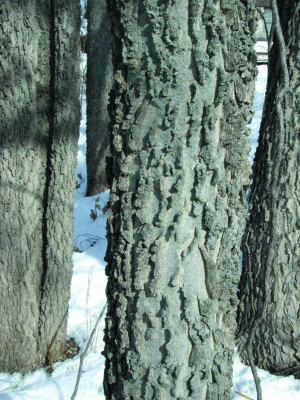
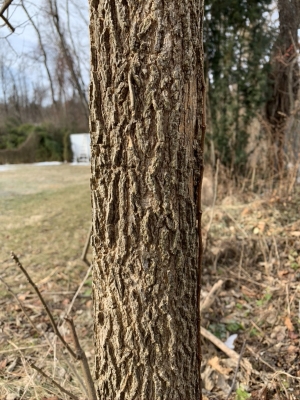
I can immediately identify hackberry (Celtis occidentalis) because its bark is one of my favorites, pure gray and punctuated by corky ridges.
Hackberry bark
On a clear, wintry day when the sun hangs low in the sky, the shadows create a pattern that recalls those crisp, achromatic photographs of lunar landscapes.

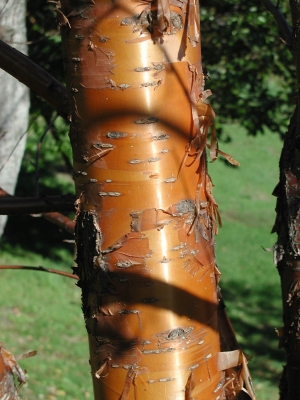
Another of my favorites is American hornbeam (Carpinus caroliniana), whose bark looks like striated muscle. And juneberry (Amelanchier spp.), pale gray with charcoal gray striations. And paperbark maple (Acer griseum), with shiny, copper-red bark.

Paperbark maple bark

Paperbark maple bark

If tree bark offers no leads about a tree, a few dead leaves on the ground or clinging to stems can help out. Beech leaves make identification especially easy because beech is among the few trees that clings to almost all its dead leaves all winter. The lower leaves of some oaks also are reluctant to drop.

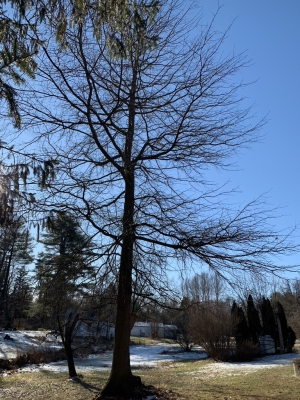
Bark, leaves, and aroma aren’t the only things that scream out a tree’s name. Everyone knows the distinctive weeping form and light-colored young bark of weeping willows. Less universally known is the very distinctive form of pin oaks (Quercus palustris): lower limbs sweep downward, mid-height limbs grow out horizontally, and upper limbs point skyward.
Pin oak tree form
On most trees, stems are alternate, that is, they don’t grow directly opposite each other. So if a tree — one that grows wild in the northeast, at least — has opposite stems, I can limit the choices to just a few trees: dogwoods, maples, ashes, or catalpa.

This tree game is more than fun; it’s also useful for identifying firewood. A couple of years ago, I bought some firewood that was billed as swamp oak, which is sometimes a name for pin oak. The firewood’s bark had distinctive, long, flat-topped ridges, which a friend finally identified as belonging to American linden (basswood, Tilia americana). It’s not very good for firewood.

(For a lot more about identifying trees by their bark, in the Northeast, at least, see the book Bark by Michael Wojtech.)

Chestnuts Roasting on an . . . Well, not Exactly

Moving indoors, to the fruits of my labor. Or, rather, the nuts of my labor.

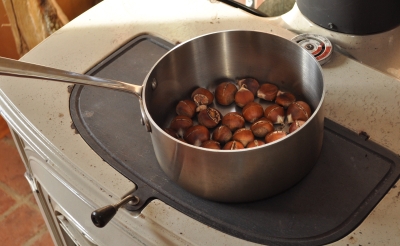
A few years ago I came up with yet another way to roast chestnuts, one that makes the pellicle, that thin, brown skin clinging to the nutmeat, easy to remove. After giving each nut a slit perpendicular to its axis, I spread the nuts in a shallow layer in a covered pan set in a hot oven or on top of the wood stove for 45 minutes. During that time the nuts steam from their own moisture. Then off comes the lid for another 15 minutes of cooking to let the nuts roast and the shells and pellicles (the skin around each nut) turn crisp.
Chestnuts roasting
Massaging each nut without breaking up the nutmeat cracks the shell and the pellicle so that both come off easily — usually. The nuts have the mealy texture of a baked potato and a wonderfully sweet flavor.

Bark Futures

I’m planning to enjoy more fruits — or, rather, nuts — of my labor in years to come. Two Korean pine (Pinus koreansis) trees should eventually get me home-grown pine nuts. As should a lacebark pine (P. bungeana).

The lacebark pine, once it gets older, will also bring me attractive bark to admire as it naturally peels away in brown, rust, green, and cream-colored patches.

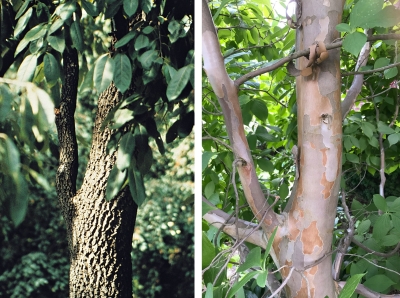
Other home-grown bark beauty here includes persimmon (Diospyros virginiana), whose bark is like alligator skin (but not scary), Japanese stewartia (Stewartia pseudocamellia)

Bark of persimmon and sterwartia

Persimmon (left)                           Stewartia (right)

and my previously mentioned favorite, hackberry, a fast growing tree now almost 15 feet tall that I started from seed I pulled off an old tree. The hackberry’s bark is just starting to develop those attractive, corky ridges.
Young hackberry bark

FOR THE GARDENER WHO HAS EVERYTHING

How Cold? How Humid?

Do you want to send a really good gift to a really good gardener? (Perhaps that gardener is you.) Problem is that most really good gardeners have pretty much everything they need except for expendables like string, seeds, or potting soil (unless they make their own. Don’t despair; I’ve come up with a few items many really good gardeners with (just about) everything they need might find useful.

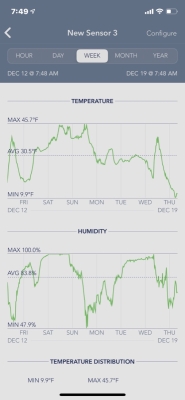
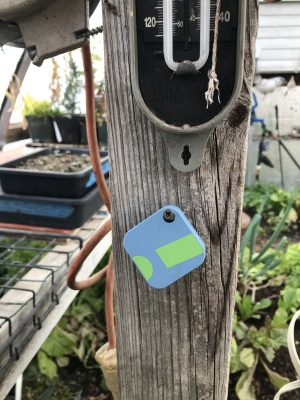
At the top of my list is a nifty, little device with the odd name of Sensorpush. It’s not much bigger than an inch square pillbox, less than 3/4 inch thick, that you place wherever you want to monitor temperature and humidity — from your smartphone, via bluetooth.

Sensorpush, graph of the week's outdoor conditions

Sensorpush, graph of the week’s outdoor conditions

Sensorpush, screen shot of current readings

Sensorpush, screen shot of current readings

Couple it with the WiFi Gateway and temperature and humidity can be monitored from anywhere on your smartphones. I periodically checked on my greenhouse and the outdoor temperatures here in New York when I was recently thousands of miles away in Israel.

SensorPush in greenhouse

SensorPush in greenhouse

My original use for the Sensorpush was for the greenhouse, to alert me, which it can do, if  temperatures drop to a minimum that I set at 37°F. I now have another, outdoors, which alerted me to the one late frost (28°F) last spring which wiped out the crop on my peach tree. I may also put ones in my freezer and walk-in cooler. 

All past information is available graphically and can be downloaded to a computer.

Water is Important

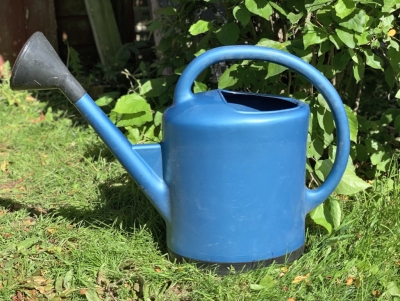
Much, much more low-tech is my new favorite watering can. It’s not any old blue watering can, it’s the French Blue Watering Can. It has everything I would look for in a watering can: hold lots of water, in this case 3 gallons; good balance when being carried and in use; and water exiting in a stream that’s gentle but not too slow. For optimum balance, get two, one for each arm.
Watering can, French blue
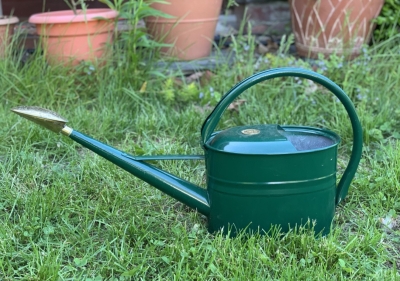
Although the French Blue Watering Can now beats out my previously favorite Haw’s 2 gallon, zinc plated cans, which are, admittedly, more visually elegant, Haw’s is still in the running with their beautiful, copper-enameled, 2 quart watering can that I use mostly indoors. For indoors, it’s a good volume, and the long spout can reach in among plants for more pinpoint watering once its rose is removed.
Watering can, green Haws

Books, of Course

I can’t help but mention books. Those that I mentioned last week were general categories; the really good gardener has, of course, some very specific interests and expertises. And there are books for these (I’ll stay away from my special interests to avoid having to mention, once again, any of the books that I have authored). 

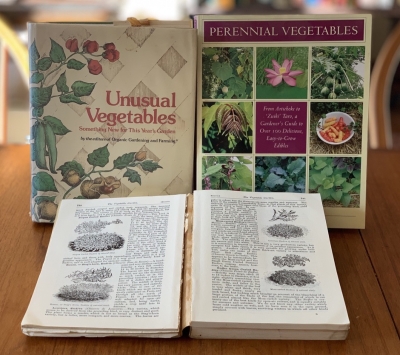
So, for instance, if you’re interest is in unusual vegetables, you could start with A. C. Herklots’ 1972 publication Vegetables of Southeast Asia. The book is especially rich in “greens,” including shepherd’s purse (Capsella bursa-pastoris), garland chrysanthemum (now Glebionis coronaria), and honewort (Cryptotaenia japonica). Also a slew of “Asiatic cabbages.” For something even less contemporary, there have been various printings of The Vegetable Garden by Vilmorin-Andrieux,scion of the famous French seed company. In addition to many common vegetables, of which many interesting varieties are mentioned, ferret around in the book and you’ll also find some unusuals: olluco (Ullucus tuberosus), rampion (Campanula Rapunculus), and seakale (Crambe mariitima).
Books, unusual vegetables
Eric Toensmeier’s Perennial Vegetables offers a much more contemporary take on unusual vegetables. Most of the vegetables mentioned are not really perennial in cold climates but they surely are unusual. The last I heard, very few people were growing nashua (Tropaeolum tuberosum), Chinese artichoke (Stachys offinis), chufa (Cyperus esculentus var. sativa), or winged bean (Psophocarpus tetragonobolus).

Tools and Plants

Finally, I’d like to give a shout out to the five advertisers on my blog posts (to your right). These are not just any old companies that choose to advertise. They represent businesses whose products and, in some cases, owners I know and trust (by experience) to offer the highest quality products.

Let’s start with the two nurseries. Looking for a place to buy high quality plants of pawpaw, persimmon, quince, medlar, or even more common fruits. Raintree Nursery is the one. I’ve even sent them stems from some of my more unique plants to propagate. Cummins Nursery is the go to nursery for a very wide selection of varieties of apple, pear, peach, and other familiar tree fruits on a variety of rootstocks. The rootstock helps determine such tree characters as size, adaptability to various environments as well as how soon and how much fruit you’ll pick.

(Incidentally, a nursery tree grown hundreds of miles away can be just as adapted to your site as one grown around the corner. Genetics is important, so an Ashmead’s Kernel apple grown in Washington is genetically identical to one grown in New York, or anywhere else.)

With all those new plants, some tools will be needed to help care for them. For everything from high quality soil sampling tubes to grafting supplies to hoes to tripod ladders (very stable, I own two different sizes), look to Orchard Equipment Supply Company (OESCO).

If you’re looking very specifically for cutting tools — pruning shears, pruning saws, loppers, pole saws, and the like — look no further than ARS. You can’t go wrong purchasing an ARS tool. After writing a book about pruning, I was sent many samples of pruning equipment; among the shears, ARS — specifically the VSX Series Signature Heavy Duty Pruner — is my favorite, with good weight, good steel, replaceable parts, and easy opening with just a firm squeeze of the handles. They slightly edged out my Felco and Pica shears.

Scythe Supply sells just one thing: scythes. But they offer the best of the best, as well as sharpening services and instruction. Don’t expect one of those picturesque, old scythes often turning up at garage sales, more useful for decorating a barn wall than cutting tall grass. Scythe Supply scythes are super light and well balanced with blades hammered razor sharp like those of Samurai swords. One-time Congressional candidate, homesteader, and swinger of a scythe into his nineties, Scott Nearing had this to say about scything: “It is a first-class, fresh-air exercise, that stirs the blood and flexes the muscles, while it clears the meadows.” So true. I use my mowings for compost and mulch.

THE GIFT OF EXPERIENCE, OTHERS

READ ALL ABOUT IT

I’ve heard wizened gardeners boast at how many years they’ve been gardening, impressing newbies with their unspoken knowledge. I’ve never been much impressed by anyone’s years gardening as an indicator of horticultural prowess.

I speak from experience: I’ve swung a scythe for many decades, which may lead others to believe me to be a long time expert scyther. Not so. A few years ago, after 25 years of scything, I learned I was using it incorrectly. (Unfortunately, earlier on I had the hubris or ignorance to describe it and its use for a magazine article which included a sepia-toned photograph of me swinging it — wrong, I subsequently learned).
Lee scything
On the other hand, as a newbie gardener I had access to one of the best agricultural libraries in the country (I was in graduate school in agriculture at the time), and voraciously devoured its holdings. After only a couple of years of gardening and reading, I had — in all modestly — a vegetable garden to vie those of much more seasoned gardeners.
Lee, 1974, in garden
Most gardeners pretty much do what they’ve done year after year. Even if new techniques, tools, and plants were tried annually, it would take a long time to make sense out of all of it. Enter books, a streamlined way to garner “experience.” Not firsthand, of course, but a way to learn from the successes and failures of others who chronicled their horticultural ups and downs. Also a way to learn more generally about what makes gardens tick, the soil types, the insects, the climates, the many plants that you or I may never grow — nor, perhaps, want to after learning about them. It all makes for a better and more resilient gardener.

BOOKS, FROM THE GROUND UP

Over the years I have both purchased and been sent review copies of many, many gardening books. As I look over my bookshelves I see a number of them — some old, some new — that, in my opinion, would be must-reads for gardeners, beginning or otherwise. Interestingly, none of the titles have the word “organic” in them. Not to worry; any good gardening is organic.

The following books can’t help but represent my biases for writing styles and interests. Still, I’ve forced myself to leave out some favorites because they’re neither foundational nor perhaps would be generally of interest.

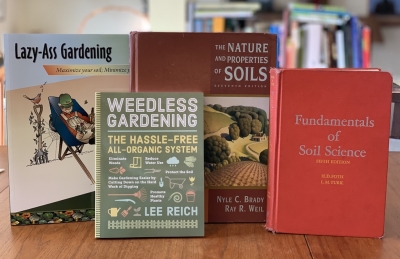
Good gardens start from the ground up, so let’s start with some books about soil. For the basics, see Robert Pavlis’ Soil Science for Gardeners: Working with Nature to Build Soil Health. For more intimate knowledge and understanding, turn to Fundamentals of Soil Science by Henry D. Foth and Lloyd M. Turk, or, much more deeply intimate, The Nature and Properties of Soils by Ray R. Weil and Nyle C. Brady. And then Lazy-Ass Gardening: Maximize Your Soil, Minimize Your Toil by Robert Kourik and — I almost forgot to mention! — Weedless Gardening by yours truly.
Books about soil
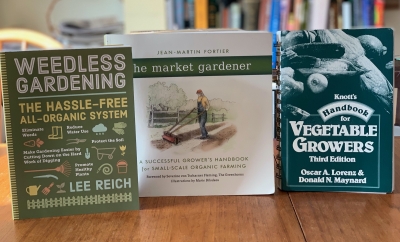
With the ground covered, vegetable can be planted. For oodles of very useful, basic information in the form of tables, there’s Knott’s Handbook for Vegetable Growers. It’s mostly for farmers, but also very useful for gardeners, as is The Market Gardener by J. M. Fortin. Also, again, my book Weedless Gardening.
Vegetable books
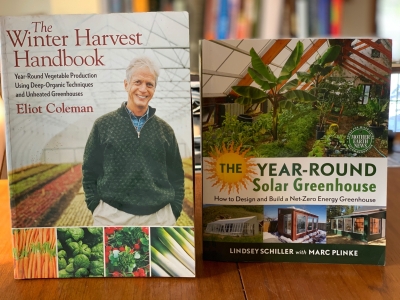
Even here in New York’s Hudson Valley, where winter lows commonly plummet to minus 20°F, fresh, home-grown vegetables are possible. Elliot Coleman has explored and innovated many of the ways in Four-Season Harvest and The Winter Harvest Handbook. My greenhouse is currently packed with living, fresh greenery, growing slowly and ready for harvest now and over the next few months. If I had read Lindsey Schiller and Marc Plinke’s The Year Round Solar Greenhouse before building mine, I would have made it even more efficient as far as heat production and retention.
Vegetable 4 season books
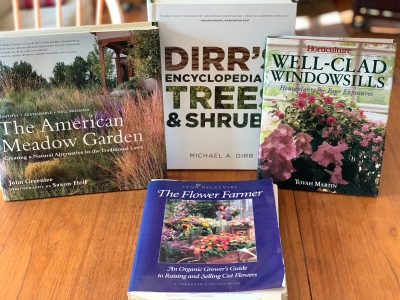
One can’t live on bread alone. For sprucing up appearances, good books include The American Meadow Garden by John Greenlee and, indoors, Well-Clad Windowsills by Tovah Martin. For solid, good information on trees, shrubs, and vines, I turn to my dog-eared copy of Dirr’s Encyclopedia of Trees and Shrubs. For flowers, The Flower Farmer by Lynn Byczynski.
Flower and tree books
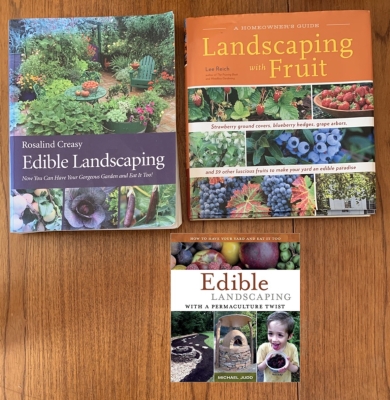
Of course, no need to choose between living on bread alone or prettiness. You can often have both — on the same plant. That was the theme of Rosalind Creasy’s Edible Landscaping, which covered all kinds of plants from asparagus to wheat, as well as my more focused in its scope Landscaping with Fruit, going from alpine strawberries to wintergreen. Integrating edible plants in the landscape is an important component of permaculture; for a fun and short but thorough overview of the too often too seriously presented theory and practice of permaculture, I’d turn to Edible Landscaping with a Permaculture Twist by Michael Judd.
landscape books

AND ROUNDING THEM OUT . . .

Many of the books on my shelves are of a more general nature. Early on in my gardening life, I frequently dipped into them; not so much these days. Still, my keeping them on the shelves is evidence of their value to me. 
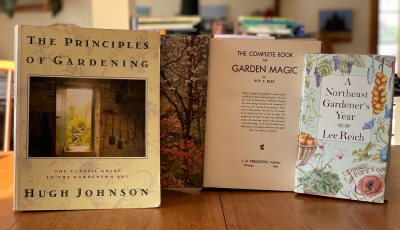
General garden books
One of the best for a broad overview of everything from garden history, design, botany (and much more) is Hugh Johnson’s Principles of Gardening. Also painting a broad stroke but more on the nitty gritty of what to so when, and how to do it in the garden, through the year is my A Northeast Gardener’s Year (my first book, back in 199!) and Roy Biles The Complete Book of Garden Magic. The latter was published in 1951, so take some of the recommendations, especially those for pesticides with a grain of salt. But you’ll know to do that that after poring through all the other books I mentioned.
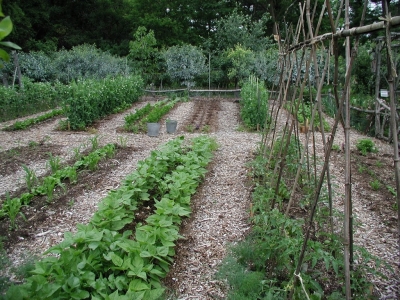
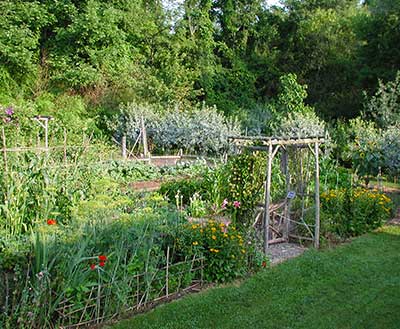
north vegetable garden from the south