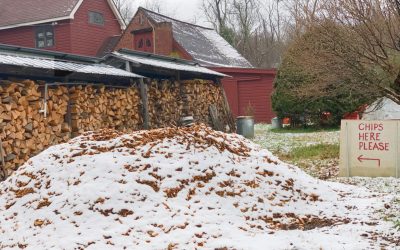
TELLING SNOW

I Grow Taller

“Make hay while the sun shines” is fine advice in its season. For winter, how about? “Prune while the snow is high and firm.” 

My apple and pear trees are semi-dwarf, presently ranging from seven to eleven feet tall. Even though I have a pole pruner and various long-reach pruning tools, I still carry my three-legged orchard ladder out to the trees with me to work on their upper branches. Sometimes you have to get your eyes and arms and hands right up near where you’re actually cutting.
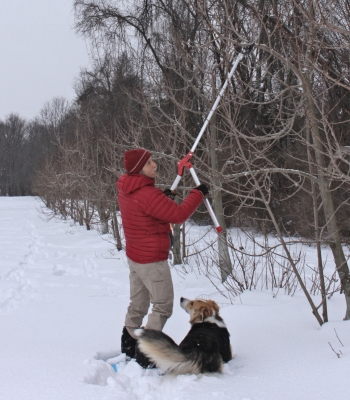
Pruning on snow
A few years ago, as I was looking out the window and admiring the foot or of snow on the ground, I realized that all that snow could give me a literal leg up on pruning. If I stayed on top of the snow, that is. While the snow was still soft, I was able to do this by strapping on a pair of snowshoes, which I bought, used, just for this purpose. (For travel through snow, I prefer to glide, on skis.) When the snow melted a little and then froze, the icy crust that formed was able to support my weight sans snowshoes.

In any case, when there’s a good depth on the ground, such as today, I gather my tools – minus the stepladder – and walk tall out to the trees.

 Top Down Pruning

Plants, like other creatures, have hormones, and a hormone (called auxin) in every plant generally coaxes uppermost portions to grow most vigorously. Which is why old apple trees become topheavy, with most shoot growth high up. The upshot of this habit is that most fruit is borne high in the branches, out of reach, and lower branches are shaded to become unproductive and prone to disease. 

  Ideally, then, the best place to start pruning is with the most vigorous branches, highest in the tree. That’s also the last place you want to start if you’re standing at ground level. Perched atop a good depth of snow next to my smaller trees, starting near the top was much easier.

  If I get high enough (in the tree), I can imagine that I’m hovering above the branches, looking at them from the perspective of ol’ Sol, which is a good perspective for a grower of fruit trees. This allows a more objective perspective on which branches are going to be blocking light or otherwise cramping others for space.
Pruning in snow
Letting more light and air in among the branches and, at the same time removing potential fruits with pruned branches, channels more of each tree’s energy into perfecting those fruits that remain. Remaining fruits are then healthier, larger, and more flavorful, especially for naturally larger fruits such as apples, pears, and peaches

Snow Tales

The snow is a blank canvas that records some winter activities. My dogs’ footprints are obvious and telling. They are provincial in their travels, having beaten paths from their doghouses, where they sleep, to the driveway, where they greet humanity, and to the deck, where they lie in the sun.
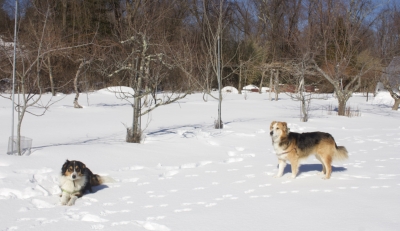
 Daisy and Sammy at work

Daisy and Sammy at work

Less frequent are their forays out into the hay field to do their business and to see if anything interesting is creeping around out there.

The small, padded footprints of my cat hasn’t beaten out paths. The cat more randomly explores out-of-the-way nooks and crannies. She also likes to steer clear of the dogs, who consider her just another small animal worth chasing.
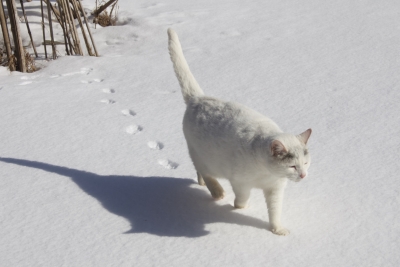
Cat, Gracie at work

Gracie at work

The distinctive footprints that I’m keeping the closest eye out for are those of rabbits and deer. Now, about when I typically delude myself that all danger has past, periods of warmer weather start coaxing rabbits to wander about and eye my trees and shrubs as food. Now is also when cottontail rabbits start reproducing, the first of up to five litters for this year, with a half dozen or so bunnies per litter! Very cute, but deadly to my plants.

  This winter, a couple of deep snows either brought deer here or displayed their abundance with tracks in the snow. For the rabbits, who feed on young trees and low branches, I sometimes make up a spray of white latex paint, water, eggs, cinnamon, and hot pepper. That needs to be re-applied about now. Traps I set out for them are thoroughly and safely (for the rabbits) buried in snow. Perhaps I’ll dig them out and re-set them.

The uncluttered expanse of snow makes it easy to see where I put my pruning tools as I prune the apples and pears. The snow also makes it easy to see where I drop the prunings.

Deer tracks in the snow

Deer tracks in the snow

And why do I care where I drop my prunings? Because I can then quickly look at them to see if any bark has been gnawed off those freshly cut branches. And what would gnaw bark off those freshly cut branches. Rabbits!

No sign of rabbits – yet, at least – on those prunings as well as on tracks in the snow. Thank you Gracie (my cat).

The dogs’ are supposed to be keeping deer at bay, but do so only if they are out and about when deer are around. This year I’ve been relying on Bobbex repellent, which I spray monthly on branches that would be within reach of the deer. So far, the sprays have been 100% effective even on trees with deer tracks right beside them in the snow.

Get Ready for Spring

I will be hosting a WEEDLESS GARDENING webinar on Monday, February 22nd for $35.  It will run from 7-8:30 pm EST and there will be plenty of opportunity to ask questions. For details, go to www.leereich.com/workshops. Or trust me, and go right to registration (required) at https://us02web.zoom.us/webinar/register/WN_WqSCBtOGTqqjGgbOHOuxfg 
A NAME FOR A NAME, AND A WEBINAR

(The following is adapted from my book, A Northeast Gardener’s Year.)

It’s Not All in a Name

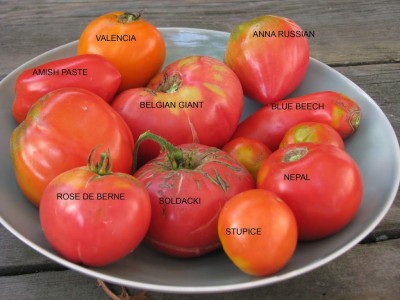
With only a name to go on, which tomato would you choose to grow: Supersonic or Oxheart? If the name Oxheart seems a bit too gruesome, make the choice between Supersonic and Ponderosa. My guess is that most gardeners would choose Oxheart or Ponderosa for a tomato, Supersonic for an airline. What compels a contemporary plant breeder to give a tomato a name like Supersonic?
Heirloom tomatoes
Many old-time names of vegetables – Oxheart and Ponderosa tomatoes are examples — were a lot more appealing than some of the newer names. It could even be that a good name is part of the reason a vegetable of yore still appears in today’s catalogues amongst all the new hybrids.

What’s the Difference?

These names I am talking about are “cultivar” names, or what were once called “variety” names. Problem is that the word “variety” can have two meanings with respect to plants, referring either to a horticultural variety or a botanical variety. To avoid confusion between the two meanings, the word “cultivar” was written into the International Code of Nomenclature of Cultivated Plants in 1958.

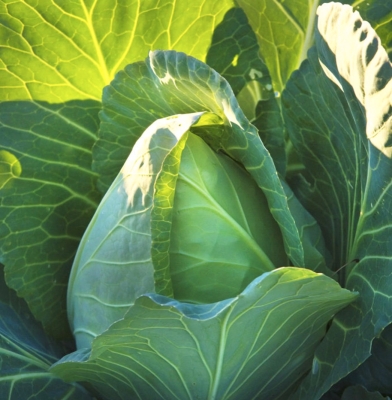
A botanical variety is a naturally occurring population of plants one subdivision below the species level. A cultivar is a cultivated variety of plant. All cabbages are Brassica oleraceae var. capitata; all broccolis are Brassica oleraceae var. italica. Early Jersey Wakefield is one cultivated variety, or cultivar, of cabbage, designated, in full, as Brassica oleraceae var. capitata cv. Early Jersey Wakefield. No need to rattle off this whole name when you’re looking for a pack of this seed. Just ask for “Early Jersey Wakefield cabbage.”
Early Jersey Wakefield cabbage

Why That Name?

Many old-time cultivars have interesting names, interesting sometimes for no other reason than because the rationale behind the name is not immediately obvious. As I thumb through a catalogue of vegetable cultivars, I can’t help but wonder why anyone would name a parsnip cultivar The Student. The same goes for Old Bloody Butcher corn and the Missing Link apple. Such names surely were not chosen as marketing ploys. In the case of the string bean cultivar Lazy Wife, the rationale behind the (sexist) name is not at all obscure (old-fashioned string beans had to be de-stringed). Compare such clever names with those of some of today’s cultivars — Superhybrid eggplant, Green Duke broccoli, or Bounty green bean.

Some of the old cultivar names have a nice ring to them. Who can resist growing a corn called Country Gentleman, or a bean called Red Valentine? Such names are more appealing than cutesy names like Kandy Korn corn or Tasty Hybrid pepper. Well, at least the pepper is Tasty Hybrid, rather than Tastee Hybrid.

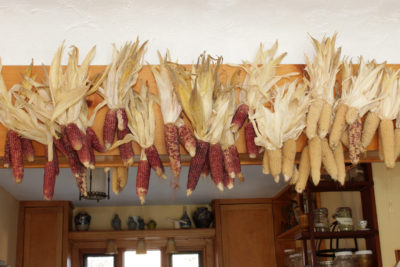
Popcorn: Old Dutch Buttered and Pink Pearl

Popcorn: Old Dutch Buttered and Pink Pearl

Which cultivar name sounds more appealing to you: Red-Cored Chantenay carrot or Six-Pack carrot? Calabrese broccoli or Packman (or is it Pac-Man?) broccoli?

Some of the old names might have had appeal in their day, but just would not fly today. With metropolitan New York City looming closer than ever, Hackensack melon can’t evoke the bucolic tang it did back in 1929. And I doubt that any plant breeder today would name a beet cultivar Detroit Dark Red. Nothing against Detroit, but it is a name better applied to an automobile or a kind of music than to a beet cultivar.

Calm Down

Before you lovers of Supersonic, Jetstar, and Ultra-Boy tomatoes get your hackles up, remember that I’m not knocking the quality of these varieties — whoops, cultivars — but only their names.

In fact, appealing names often were assigned to cultivars of dubious merit in the past. The name Sops of Wine makes my mouth water more than did the actual apple. The same goes for Maiden Blush apple – beautiful name (and beautiful fruit), but mediocre eating quality. On the other hand, how about the luscious, relatively modern apple with the vapid name of Jonagold. The appellation was derived simply by combining the names of its parents, Jonathan and Golden Delicious.

As you peruse seed racks, garden catalogues, and websites in the coming weeks, think about what makes you choose one cultivar over another. By the way, for flavor, I highly recommend Early Jersey Wakefield cabbage.

Get Ready For Spring, With a Webinar

I will be hosting a WEEDLESS GARDENING webinar on Monday, February 22nd for $35.  It will run from 7-8:30 pm EST and there will be plenty of opportunity to ask questions. For details, go to www.leereich.com/workshops. Or trust me, and go right to registration (required) at https://us02web.zoom.us/webinar/register/WN_WqSCBtOGTqqjGgbOHOuxfg .
GET YOUR DUCKS IN ORDER FOR SPRING

WEEDLESS GARDENING WORKSHOP/WEBINAR
Presentation by Lee Reich (MS, PhD, researcher in soil and plants for the USDA and Cornell University, decade-long composter, and farmdener*)
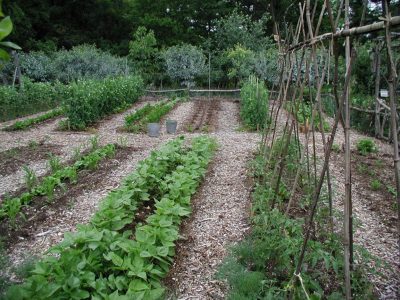
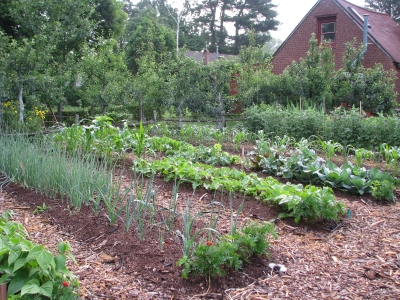
Vegetable garden
Introducing a novel way of caring for the soil, a 4-part system that minimizes weed problems and  maintains healthy plants and soil. Learn how to apply this system to establish new plantings as well as to maintain existing plantings. The principles and practices are rooted in the latest agricultural research and are also applicable to sustainable, small farm systems. 

Success comes from emulating rather than fighting Mother Nature who, as C. D. Warner wrote (My Summer in the Garden, 1887), “is at it early and late, and all night; never tiring, nor showing the least sign of exhaustion.”

Space for this workshop/webinar is limited so registration is necessary. Sign up soon to assure yourself a space.

Date: February 22, 2021 
Time: 7-8:30 pm EST
Cost: $35

Register for this webinar at:
https://us02web.zoom.us/webinar/register/WN_WqSCBtOGTqqjGgbOHOuxfg 
After registering, you will receive a confirmation email containing information about joining the webinar.

*A farmdener is more than a gardener and less than a farmer.

FROM GROCERS’ SHELVES TO MY FLOWER POTS

Exotic, tropical fruits are turning up more and more frequently on grocers’ shelves these days: dates, papayas, guavas, and others. I look upon these fruits opportunistically, because within each lies dormant seeds that can be coaxed to become exotic, if not beautiful, indoor plants that might even provide a delicious fruit harvest. Such plants provide a break from the humdrum of spider plants, philodendrons, and Swedish ivies. 

Seeds of tropical fruits usually germinate best if planted as soon as the fruits are eaten. Cold-climate fruits, in contrast, have innate inhibitors that prevent seed germination until they feel that winter is over.

So all that’s necessary to grow most tropical fruits is to wash their seeds and sow them in potting soil, using the old rule of thumb of burying a seed to twice its depth. And then wait.

DELICIOUS, BUT HARD TO SAY

  I have harvested fruit grown from the seed of a grocery store bought pineapple guava, also known as the feijoa (pronounced FAY-HO’-A, from the generic part of its unwieldy Latin name, Feijoa sellowiana, recently change to Aca sellowiana). The fresh seeds, scooped from the fruit, germinated and grew.
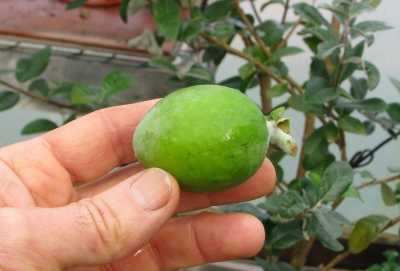
Feijoa fruit
Feijoa seems to me an ideal plant to grow. Even outdoors where it’s native, the tree is small, so does not mind being kept five foot high in a pot which can be carried indoors during our frigid winters. The plant is subtropical rather than tropical, so can stand a bit of cold, down to about 10 degrees Fahrenheit. 

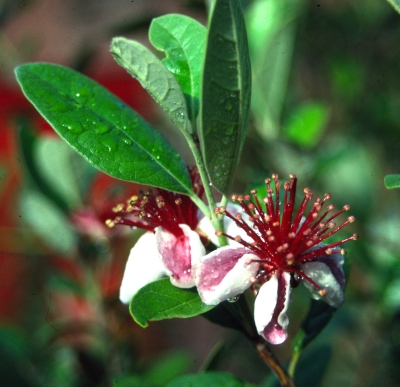
Feijoa has leaves which are shiny and dark green on their upper surfaces, and felt-like and silvery on their lower surfaces. My plant spends winter decorating a sunny, south-facing window in a cool room in my house. The flowers’ stamens are arranged in a tuft like a red bottlebrush, and the petals are thick, purple and white. Those petals are very edible and very delicious, with a sweet, pineapple-minty flavor.
Feijoa flower
But best of all is the fruit itself. Beneath the thin skin is a gelatinous center with a spicy pineapple flavor. My feijoa plant hasn’t provided sufficient harvest to satisfy my feijoa-ish needs.

A LONG TIME TO WAIT FOR A DATE

The waiting period for a date fruit can be a long time, even a long time for the seed to germinate. But stop for a moment and think about deserts, where dates are native. Should a date seed send up a leafy shoot with the first hint of moisture? Of course not. The dry desert air would dehydrate the sprout in short order. When a date seed germinates, first its thick taproot grows straight downwards, seeking permanent moisture, long before even a small sprout appears aboveground.

I once planted some date seeds (first making sure they came from unpasteurized dates). Knowing that I would have a long wait before the first sprouts emerged, I planned to watch the roots grow to keep myself from becoming too impatient. I put an inch of water in the bottom of a peanut butter jar, slid a tube of rolled-up blotting paper (watercolor paining paper would probably also work well) into the jar, and then “planted” the date seeds halfway up the jar, pressed between the glass and the paper. 

As predicted, the roots appeared and thrust downwards before there was any sign of a shoot. When I eventually became bored watching the progress of the roots, I planted the seedlings in potting soil.

Leaves finally did poke up through the soil, an event that was far from dramatic. Each emerging seedling looked like a green toothpick stuck into the soil. In time, the “toothpicks” did unfurl into a succession of fan-like leaves which would match any ordinary houseplant for beauty and tolerance of neglect. 

Fruit production from a homegrown date palm is well-nigh impossible. The plant grows slowly. Climate here in northeastern U.S. is suboptimal, to say the least. And only female plants produce fruit, so enough plants would have to be grown to flowering size to ensure at least one male (for pollination) and one female (for fruit).
Date fruit on plant

Date palm orchard

Date palm orchard, Israel

PA-PA-PAPAYA

One winter day a number of years ago, I planted seeds from a papaya fruit I had just eaten. Having seen papayas growing wild throughout the tropics, I assumed they would not be hard to grow. I scooped the seeds from the fruit, washed them to remove their gelatinous coating, and sowed them immediately. 

Growing papayas proved as challenging as growing dates. In this case, not only were the seeds slow to germinate, but the young seedlings were extremely fragile and subject to damping-off. I nursed a single survivor beyond this wimpy initial stage, and, in time, it began to grow robustly.

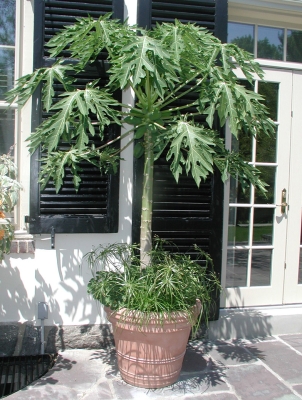
Potted papaya at Chanticleer

Potted papaya at Chanticleer

In the tropics, papayas are short-lived trees that often bear their first fruits as early as eleven months after seed is sown. My papaya tree was outgrowing its one-foot-diameter pot when warm weather arrived, so I decided to plant it outside and hope for fruit. Imagine the astonishment of my neighbor, who grew up in Florida, when he saw a tropical papaya tree in my garden! 

Unfortunately, my plant succumbed to the first fall frost before it had a chance to fruit. Fruiting would have been chancy anyway, because papaya plants come in various combinations of sexes. Some plants have only male flowers; others only female flowers; and still others have bisexual flowers. Papaya have been known to switch their sex under certain conditions. To fruit, my single plant would have needed bisexual flowers, which remained so.

  The feijoa, date palm, and the papaya take their place in the long line of avocados, prickly pears, tree tomatoes, kumquats, lemons, tangerines and other forgotten grocery store plants that once were and, in some cases, still are part of my indoor jungle.

Lemon, Kumquat, Opuntia, Tree tomato

Lemon, Kumquat, Opuntia, Tree tomato

MYCO-WHAT?

It’s Greek To Me (and You)

This far north, there’s only a little to do garden-wise this time of year, so let’s sit back and ponder the wonders of plant life. Mycorrhiza, to be specific. Wait! Don’t stop reading! Sure, the word “mycorrhiza” appears intimidating. But mycorrhiza are important in your garden, in the forest, to your trees and shrubs, maybe even to your houseplants.

First, the pronunciation. Say: my-ko-RY-za. It sounds nicer than it looks. 

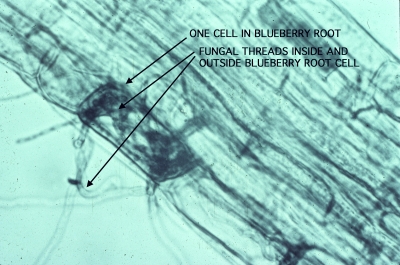
Now let’s take the word apart to see what it means. “Myco” comes from the Greek word meaning “fungus” and “rhiza” from the word meaning “root.” Mycorrhiza, then, is a “fungus-root,” an association between a plant root and a fungus so intimate that the pair has been given a name as if it was a single organism.

Mycorrhizal blueberry root

Mycorrhizal blueberry root

Win-Win

The association is symbiotic, beneficial to both parties. One end of the fungus infects a plant root, while the rest of the long, threadlike body of the fungus ramifies through the soil. Nutrients are absorbed from the soil by those fine fungal threads and pumped back to the plant. The result: mycorrhizal plants can draw nutrients and water from a greater volume of soil than can non-mycorrhizal plants, and plant nutrition is improved. To cite one practical demonstration of this benefit, agricultural scientists in California found that the presence of mycorrhiza was equivalent to the addition of more than one hundred pounds of phosphorus fertilizer per acre on citrus trees.

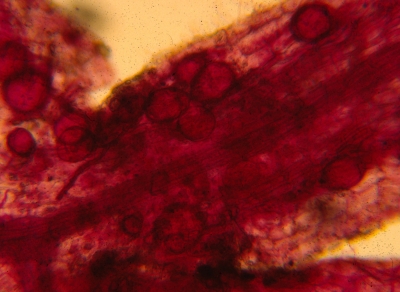
Another kind of mycorrhiza, in apple root

Another kind of mycorrhiza, in apple root

The mycorrhizal association might be termed a balanced parasitism; the fungus does exact payment for its services. Carbohydrates are, literally, the fuel of life, and though mycorrhizal fungi are adept at drawing minerals from the soil, they can’t make their own carbohydrates. So these fungi draw carbohydrates from their host plants, who can make it. Sunlight fuels the photosynthetic reaction of carbon dioxide and water into carbohydrates and oxygen.

Not all fungi are mycorrhizal. Non-mycorrhizal fungi get their carbohydrates either by eating living things without returning the favor, in which case they are called parasites. Others eat once-living organisms such as wood, leaves, and dead animals, in which case the fungi are called saprophytes. Some fungi feed on either or both the living and the dead.

Myco-where?

Mycorrhiza are almost ubiquitous on the earth. Walk through the woods in spring or fall and most of the mushrooms you see on the forest floor are the reproductive structures of mycorrhizal fungi, periodically popping up through the ground to spread spores. Below ground, these mushrooms are connected to nearby tree roots by fine fungal threads.

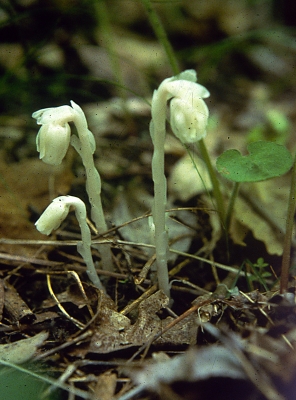
The plant known as Indian Pipes (Monotropa uniflora) offers an eerie signal of the presence of mycorrhizae below ground. This plant, with one nodding flower, is thoroughly white, lacking any chlorophyll with which it could use sunlight to fuel its growth. Instead, its roots tap into a specific mycorrhizal fungus whose underground threads are also tapped into the roots of a nearby tree. Indian pipes is a parasite; it takes from the fungus and the tree, offering nothing in return.

Indian pipes

Indian pipes

Mushrooms are formed only by certain types of mycorrhizal fungi. Most mycorrhizal fungi are not so obvious, working unobtrusively in association with the roots of the vegetables and flowers in your garden, your lawn, shrubs, and trees. The gourmet’s truffle is the underground reproductive structure of one type of mycorrhizal fungus.

Most plants on our planet are infected with mycorrhizal fungi. Mycorrhiza are absent only in special situations such as in the acidic, nutrient-poor spoils left from mining operations, in agricultural soils that have been sterilized to kill pests, and in sterilized potting soil in flower pots. Certain plants never become infected; cabbage, spinach, buckwheat, and their relatives, for example.

The Practical Side

The importance of mycorrhiza is not diminished by their ubiquity. Mycorrhiza is a general term, and not all mycorrhiza are equal. A plant may be mycorrhizal, but perhaps not with the most effective species of mycorrhizal fungus or, perhaps, not enough of them. Mulching, fertilization, irrigation, chemical use and other gardening and agricultural practices alter the types and amounts of mycorrhizal fungi in the soil. Rototilling or turning over the ground, as you might imagine, disrupts those fungal threads. Except for high fertility, what’s good for plants — plenty of soil organic matter, growing plants, good aeration, adequate moisture — is also generally good for mycorrhizae.

Old-time gardeners would throw a handful of soil from an old apple tree into the planting hole for a new apple tree. A crude form of mycorrhizal inoculation? Agricultural researchers have tried to quantify why plants respond to inoculation with mycorrhizal fungi at one site, and not another. Which are the best fungi? What affects them? Recent research has shown that improved nutrition is only the most obvious effect of mycorrhiza. The mycorrhizal association also influences plant response to stresses such as drought, insects, and diseases.

As you might imagine, mycorrhizal fungi have been commercialized, available as inoculants or premixed into packaged potting soils. Under certain conditions, this might be beneficial. In many situations, it’s like “taking coals to Newcastle.” Usually, create conditions conducive to mycorrhizal formation, and a beneficial symbiosis will develop.

For my research as a graduate student, I studied the effect of, among other things, mycorrhizae in blueberry soils. Even my plants grown in sterilized soils in a greenhouse became mycorrhizal, which, while messing up that aspect of my experiment, did highlight how ubiquitous the association can be without the human hand.

If you want to lend your hand to the mycorrhizal association, you could actually extract and grow your own mycorrhizal inoculum. Read how, and learn all about mycorrhizae in Jeff Lowenfels’ excellent book Teaming with Fungi: The Organic Grower’s Guide to Mycorrhizae.

At any rate, mycorrhiza is a fascinating demonstration of ecology, the interrelationship of organisms on the earth.
Teaming with Fungi, cover

MY VINES GET IN ORDER

Pruning vs. Training?

A long time ago, when I first started growing fruit trees and vines, I read a lot about the all-important pruning and training they require. But I couldn’t get clear on my head what exactly the difference was between “pruning” and “training.” I went on to learn that and a whole lot more about pruning (through books, as an ag researcher for Cornell University, and with practical experience), and eventually wrote my own book about pruning, hoping to present the techniques with more clarity and completeness than all the books I had read. Perhaps my book, The Pruning Book, does that.
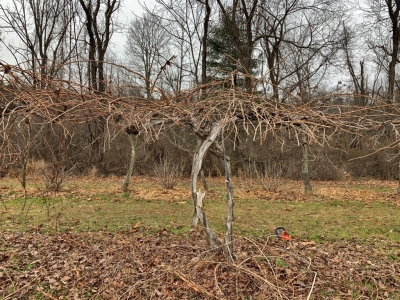
Grape vine in spring
Okay, to answer my question of yore. “Training” is developing the young plant to a permanent framework that is sturdy and will always have its limbs bathed in light and air, and whose fruits hang within easy reach.

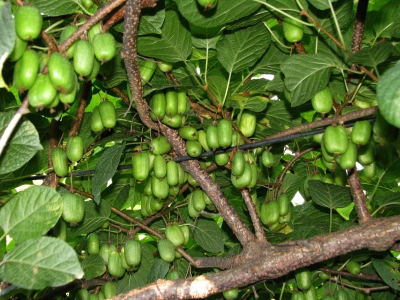
Kiwifruit within easy reach

Kiwifruit within easy reach

Training involves some pruning as well as coaxing stems to grow in certain directions. Once a fruit tree or vine’s training period ends, it generally only needs annual pruning.

Vine-y Training

I thought of all this today as I pruned hardy kiwifruit and grape vines. Both fruiting vines have been trained and are pruned similarly, with one slight variation that I’ll soon mention.

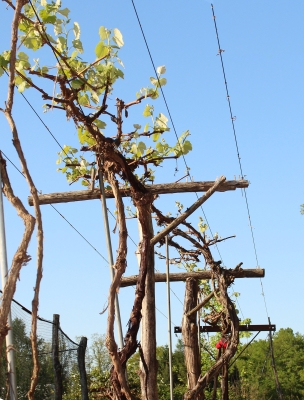
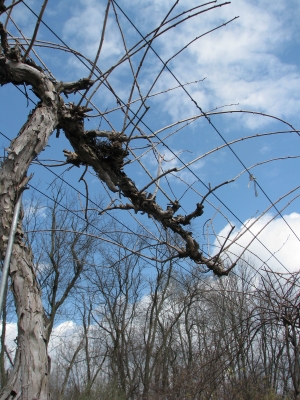
The kiwi and grape vines are trained as “double cordons” which are permanent arms sitting atop a trunk. They run in opposite directions along the middle wire of a 5-wire trellis, the wires parallel and supported about 6 feet of the ground on the cross-arms of T-posts. Each young vine was planted next to a metal or wooden stake to which the plant’s most vigorous stem was tied.

Once that trunk-to-be reached up to the middle wire, I tied it there and cut off all other stems. That trunk-to-be does, of course, keep growing; that new growth gets bent over and tied along the middle wire. Bending coaxes new buds to burst just beneath the bend, one of which is also bent over and trained along the middle wire in opposite direction to the first stem. Both these horizontal stems became the cordons, permanent arms of the plant. Growing off at right angles to the cordons are the fruiting shoots which, weighed down with their weight of fruit, drape onto the other wires.

Vine Maintenance

Today I’m maintenance pruning vines whose training period ended years ago. Maintenance pruning a mature fruiting vine keeps it bearing high quality fruit within easy reach year after year, all accomplished with a renewal method. That is, except for the trunk and the cordon, the vine is completely renewed with each year’s pruning.

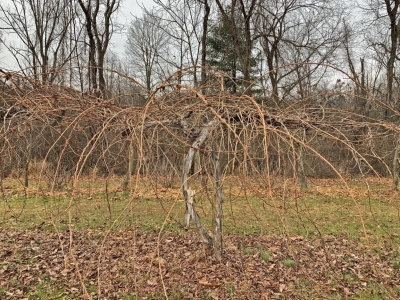
I’ll admit it: A vine looks like a tangled mess before being pruned. But step by step, it  begins to take shape and make sense. Kiwi before pruning

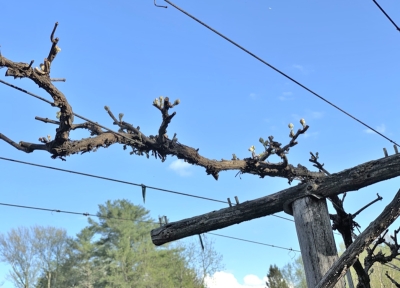
Knowing how a plant bears fruit is important in maintenance pruning. Kiwi and grape vines bear on new shoots growing off one-year-old stems. Kiwis bear best if those one-year-old stems are about 18 inches long. Grape one-year-old stems can be left long or short, but for my method of training, I want each one about two buds long, which is just a few inches.

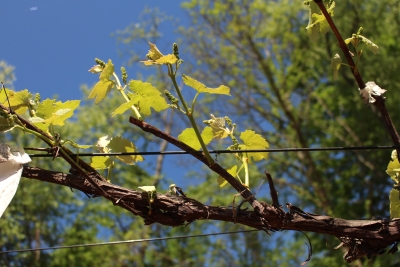
Fruiting grape shoots emerge from 1-yr-old stem

Fruiting grape shoots emerge from 1-yr-old stem

Step one is a no-brainer. The outermost wires are 4 feet apart so I lop all growth back to just beyond those wires. My tool of choice for this is a battery-powered hedge trimmer although pruning shears would also do the trick, except at a snail’s pace.First step in pruning

Step two is to remove excess growth, which does two things. It removes potential fruits so that more of the plant’s flavor-rich goodness gets funneled into those that remain, and it decongests the plant. For this step, I cut back all stems 2 years or older.

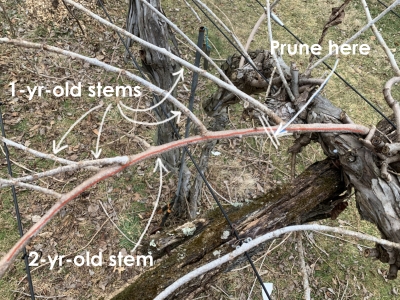
But wait! Two-year-old stems have one-year-old stems, the stems needed for bearing shoots, growing off of them. So rather than cut a two-year-old stem all the way back to its cordon, I cut it back to a one-year-old stem originating near the cordon. Some one-year-old stems also grow right from the cordon. The best one-year-old stems are those that are moderately vigorous and, of course, look healthy. Moderately vigorous stems, for grape or kiwi, are about pencil thick (if you can remember what a pencil looks like; if not, about 1/4” thick).

Kiwi stem and pruning detail

Kiwi stem and pruning detail

There will always be too many one-year-old stems for the plant to make tasty fruit. So I reduce the number of potential fruits by removing some of the one-year-old stems, enough to leave six to ten inches between them on each side of a cordon.

Pruned grapevine

Pruned grape vine

Pruned kiwi

Not finished yet. The final step is to shorten the fruiting shoots. For hardy kiwis, I cut them back to 18 to 24 inches long. For grapes, to about 2 buds or a few inches long.

Oh, one more thing to do: I prune off any new growth rising up from ground level or along the trunk lower than the cordons.

And one more thing: I step back to admire my handiwork. (Here is a video of me pruning a kiwi vine.)  

But What About Bushes?

You might have noticed, early on, that I wrote about pruning and training “fruit trees and vines.” What about blueberries, currants, gooseberries, elderberries, and other FRUITING BUSHES. Yes, they need annual pruning also. No, they do not need training. Although the plants are perennial, their stems are evanescent, all with a limited life. They are pruned by a renewal method — at ground level. All this and much, much more (pruning ornamental plants, houseplants; creating and caring for an espalier; how to scythe; etc) in The Pruning Book, of course.

LOOK BEYOND POINSETTIA GLITZ

A Harem of Males

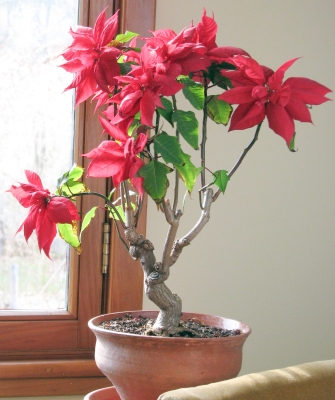
Phew, what a year 2020 was! Well, it’s over and, at least at this writing, things look hopeful for the future, at least from my perspective. Except if you live in a tropical or subtropical climate, there’s not much distraction from anything gardenwise, for now, so let’s take a close look at a plant no doubt sitting on many coffee tables and windowsills. Poinsettia. I’m not a big fan of their appearance, but I do like them as botanical curiosities.

Let’s share some botanical lore of this plant by setting your holiday poinsettia on a table in good light for a close look at its flowers. I say “close  ” because the flowers are not those large, red, leaf-like structures. The large, red, leaf-like structures are just that — leaves, albeit modified leaves called bracts. The bracts attract pollinating insects to the plant.

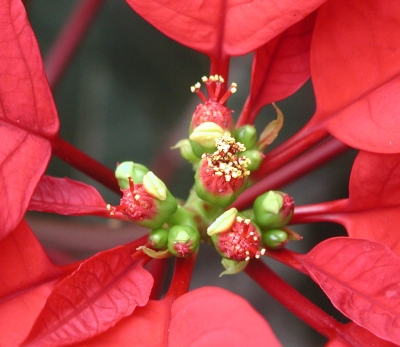
The actual flowers of the poinsettia, which are not very showy at all, originate within the small, greenish, cup-shaped structures you see above the bracts. These cup-shaped structures are “cyathiums.”
poinsettia cyathiums
Each cyathium contains a single female flower surrounded by a harem of males. Pluck a cyathium from the plant, take a sharp knife or razor, and slice it in half from top to bottom. A magnifying glass helps now. You’ll see that the inner wall of the cyathium is lined with numerous tiny flowers which, when the flower is mature, protrude up through the opening of the cup. These are all male flowers.

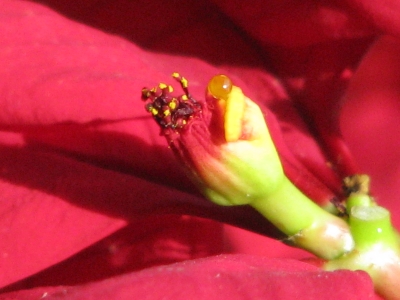
Look very carefully and you’ll also see a stalk attached to the very bottom of the cyathium, protruding up through the cup opening, and capped by what looks like a turban. That is the single, female flower, which, to promote cross- rather than self-pollination, emerges from the cyathium after male flowers begin to shrivel. Cross-pollination promotes genetic diversity for healthier plants. 

In addition to the male and female flowers, on the outside of the cyanthium is a single yellow gland that looks like the mouth of a fish poised to ingest food.
Cyathium close up
Next time a friend comments on the beauty of your poinsettia flower, take out a magnifying glass and closely examine a few cyathiums before looking up and agreeing nonchalantly.

Fool the Plant

Have you ever wondered how stores always manage to have blooming poinsettias for the holiday season? 

Poinsettia, along with chrysanthemums and most strawberry varieties, is a “short-day” plant. Short-days induce “short-day” plants to form flower buds. (In reality, plants are responding to long nights, but the phenomenon was originally thought to be daylength dependent, and the term “short-day” plants has stuck with us.) Poinsettia can be fooled into blooming at any time of the year merely by exposing it to artificially shortened days. 

To secure blooming plants for this past holiday season, poinsettias grown in large commercial greenhouse ranges were covered with a shade cloth so that they experienced 14 hours of darkness each “night” beginning around September. After 8 weeks of this treatment, they formed flower buds which became fully developed just before the holiday season.

You Do It

You can do this at home to make this year’s poinsettias bloom again whenever you want. Your poinsettias first will need a rest period. Loss of leaves and fading flowers indicate that your plants are entering dormancy. (Even tropical plants, such as poinsettia, do take a short, mild annual rest.) When the plants become dormant, move them to where it is cool. Water them infrequently, just enough to keep their stems from shriveling.

About April, the plants will be ready to start growing again. Cut the stems back to a few strong shoots, each about 6 inches long. Give the plants sun, warmth, and water. New shoots will push forth from dormant buds. When warm weather has settled, you can put the plants outside.

As temperatures cool in late summer, bring the plants indoors to a sunny window. Keep them away from cold drafts, which would cause their leaves to drop.

Now for the photoperiod treatment. Beginning three months before you would like the plants to bloom, make sure the plants get 14 hours of darkness each night. Moving them into a dark closet or covering them with a paper bag are convenient ways to do this.

The dark period each night must be uninterrupted. Even peek at them with a flashlight at midnight will have them acting as if they had a short night, instead of the needed long night.

After 8 weeks of the above treatment, move the plants back to their sunny window. Flower buds should be evident, and you should have blooming poinsettias within a month. If you want bloom for the holiday season next year, start the photoperiod treatment about the middle of September.

Poisonous?

Poinsettia, Euphorbia pulcherrima, is a member of the Euphorbiaceae family, commonly called the Spurge family. A common characteristic of plants in this family — which includes Hevea braziliensis, tapped commercially to make rubber — is the milky sap they exude when cut. The sap has often been considered poisonous and was sometimes used medicinally as a purge (hence “spurge,” from the French word espugier, meaning to purge). But, as Philippus Aureolus Theophrastus Bombastus von Hohenheim, more commonly known as Paracelsus, wrote in the 15th century, “All things are poisons, for there is nothing without poisonous qualities. It is only the dose which makes a thing poison.”

In fact, the sap is only mildly poisonous to humans and other animals. It can cause a rash on the skin or mouth, and stomach upset. So go ahead and nick the stem of your poinsettia and see the milky sap exude. No need to touch it.

ALMOST LIKE SUMMER

Fresh Veggies

When I was a child, it seemed that winter vegetables were mostly peas and diced carrots, conveniently poured frozen out of plastic bags into pots of boiling water. Yuk! Winter notwithstanding, my backyard garden still offers plenty of fresh winter vegetables. Let’s have a look. Kale, of course, looks unfazed by snow and plummeting temperatures. Not only does it look unfazed; it also tastes very delicious.

More surprising is the endive that I planted back in August, then covered beneath a “tunnel” of clear plastic and slightly insulating row cover held aloft by metal hoops in late October. Temperatures about a week ago went as low as -8° Fahrenheit! Thanks to the additional insulation from almost a foot of snow, now melted, the endive is still lush and tasty.

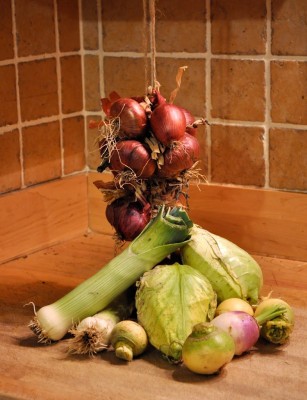
The rest of winter’s fresh garden vegetables are not in the garden. Most are in plywood boxes in cold storage, first in my mudroom, then moved out to my cooler. vegetables of winter(The cooler is an insulated room cooled with an air conditioner that has been tricked, with a device called CoolBot, into bringing the temperature down just below 40° F.) One box houses Hakurei turnips, Watermelon radishes, and Daikon radishes picked around the middle of December.
The same day I pulled the turnips and radishes, I also dug up leeks, now nestled into another box. With snow cover, both leeks and turnips probably would survive winter out in the garden, but reaching into a box is easier than chopping through ice and snow out in the garden to get at these vegetables.

Yet another box has a few heads of cabbage, also harvested that day in December. Lopping off the outer leaves, which anyway were looking ragged and slug-eaten, cuts water loss from the tight heads and keeps them fresh. One more box is packed full of napa type Chinese cabbages, good for “Asian slaw” or stir fry.

Most years I would have braids of onions also. Not this year. Crop failure. All the onions, both direct-seeded and grown from my transplants, didn’t grow large enough to bother storing. The problem was a clog, too long undetected, in the water line to the seasonal irrigation pump at, evidently, a critical time in onion bulb development.

(I also have a 400 square foot greenhouse packed full of fresh, growing lettuce, mustard greens, arugula, celery, claytonia, kale, chard, and mâche, with a little fresh dill, cilantro, and parsley. But that’s a whole other story.)

Summer Berries

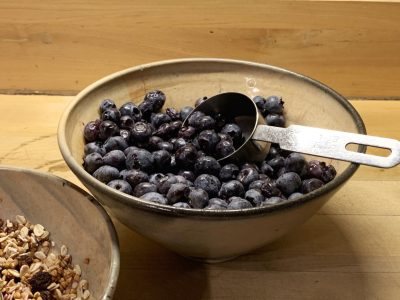
I may be addicted to blueberries. I now eat them pretty much every morning year ‘round. That’s fresh blueberries beginning at the end of June, and frozen ones from mid-September on. I pace myself. The frozen blueberry season opens with about 70 bags (each bag about 5 cups) in the freezer, enough to keep us “berry happy” on into June.
Blueberries, frozen and defrosted
I highly recommend planting blueberries. They are easy to grow organically, the plants are beautiful, and the berries are very healthful and taste great. They’re also easy to freeze: Just spread them on a tray until frozen, then pack them into bags. Their two main requirements are suitable soil, easily made so, and protection from birds, with netting. Each bush will net you 8 pounds, or more, of berries.

Thawed in the refrigerator, the berries taste as good as fresh ones. Or maybe I believe that only because in late December it’s been so long since I’ve had a fresh blueberry.

Olfactory Romance

Man cannot, of course, live by bread alone. I could use some fragrance, some olfactory hint of spring — or summer, or fall. Years ago, I grew “many-flowered jasmine” (Jasminium polyantha). A misnomer for my plant. Its fragrance was heavenly but it only coughed up a few blossoms each winter, despite my subjecting it to a period of temperatures below 60 degrees F. and some drought to give it a rest before it (was supposed to) burst  into flowering abundance.

Gardenia was another one of my plants for winter fragrance. It did bloom in winter, late winter, and its fragrance was heavenly. But it proved to be a magnet for scale insects, one of the most difficult house plant pests to control organically. Both plants have long ago been composted.

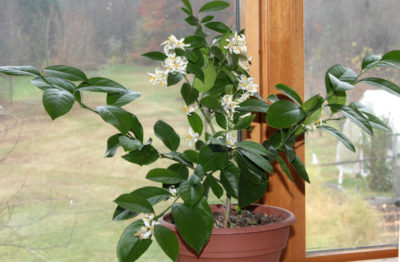
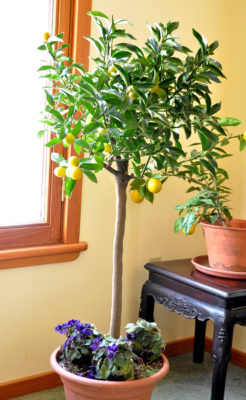
I’m now eagerly awaiting blossoms on my Meyer lemon plant. The plant is easy to bring into bloom, and there’s the added bonus of delicious lemons. Being a hybrid of lemon and sweet orange, Meyer lemon has a slightly different flavor from that of lemons.
Meyer lemon tree in pot
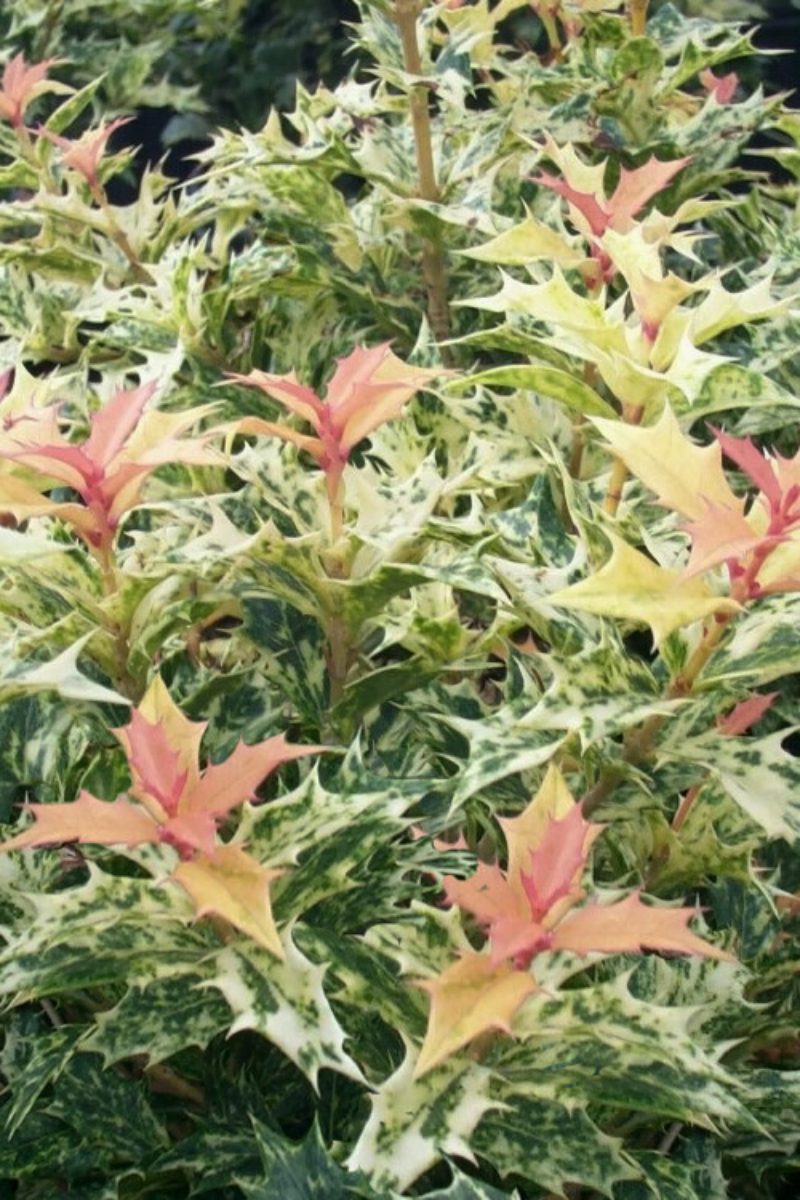
The other plant to — reliably, I hope — blossom now, in early winter is sweet osmanthus (Osmanthus fragrans), specifically the variety Goshiki. Why Goshiki? Because it has variegated leaves, green and white with splashes of pink, spiny like those of holly. Sweet osmanthusIt’s cold-hardy to Zone 6. My plan is to grow it in a pot to bring indoors to a cool sunny window in late fall to spend the winter.

This is all a pipe dream so far because all I have is a spindly stem I cut to root from a plant beckoning me from a sidewalk near Philadelphia. The cutting doesn’t look hopeful. The quest begins.

SNOW’S COME AND SO HAS FRUIT

Free and Attractive Mulch

  Beautiful. Floating down from the sky. A white blanket of “poor man’s manure.” That’s what gardeners and farmers have called snow.
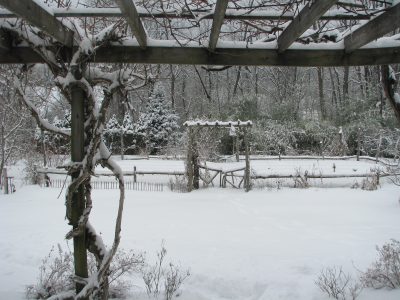
Garden under snow
In fact, snow does take some nitrogen from the air and bring it down to ground level for plant use in spring. Not that much, though. Just a few shovelfuls of real manure could supply the same amount of nitrogen as a blanket of snow.

  Mostly, what I like about the 15 inch deep fluffy whiteness now on the ground is the way it insulates what’s beneath it. Fluctuating winter temperatures wreak havoc on plants, coaxing them awake and asleep and awake and asleep as air temperatures go up and down and up and down. Each time plants are awakened, they become more susceptible to subsequent cold, the whole problem exacerbated with borderline hardy plants.

Anticipating cold weather and snow, last fall I cut back a cardoon plant and two artichoke plants, covered each with a large, upturned plastic planter, and then smothered everything in autumn leaves. Cardoon and artichoke, in fall with leafy coverBoth kinds of plants are probably cold-hardy to about zero degrees Fahrenheit, but here winter temperatures, except last winter, typically drop to about minus 20 decrees Fahrenheit. That snowy blanket provides extra protection that the plants might need — especially after last Saturday’s unseasonal low of minus 8 degrees.Cardoon and artichoke, snow covered
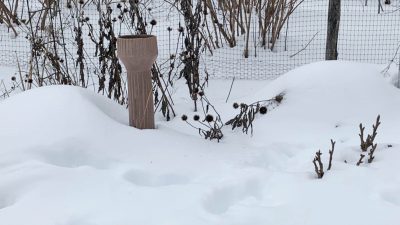
  Hardy orange (Citrus trifoliata) is another plant to benefit from snow cover. It’s a Citrus that’s allegedly cold-hardy into zone 5 (-20°F minimum temperature). I planted some seeds outdoors a few years ago and, while their roots survive winter cold, the tops die back to resprout each spring. I also planted out a more mature hardy orange that was given to me; it also suffered some cold damage.

The deeper this winter’s snow and the longer it stays deep, the more of the hardy oranges’ stems will survive till spring. Perhaps, helped along with global warming, enough of the above ground parts of the plants will survive to reward me one year with sweet-smelling blossoms and, less appealing, their very puckery fruits.

Multiplying Currants and Grapes

  Last fall, I cut stems from my black currants and grapes into 8 inch lengths. In the bare ground between some dwarf apple trees, I scratched some lines and pushed a straight-bladed shovel into the ground on that line. Levering the handle of the shovel opened up just enough space in which to shove one or two of those cut stems, distal ends up, right up to their topmost buds. Then I moved along the scratched line, pushed the shovel in again, shoved in more stems, and so on down each line. If all goes well, each of those stems will grow into a good sized plant that I can dig up and transplant next autumn.
Rooted currant cuttings
  That is, unless alternating freezing and thawing of the soil heaves those stems up and out of the ground. I’ve seen it happen, leaving a row of carefully inserted stems sitting on top of the ground by winter’s end.

  All of which is another reason I’m thankful for the snow. In addition to protecting plants from cold, the blanket modulates soil temperatures, keeping cold soil cold, which is how I’d like it to remain until spring. I could have — should have — thrown some fluffy, organic mulch, such as leaves or straw, over the stems to do the same thing. But I didn’t. I hope the snow stays.

Where One Plus One Does Not Equal Two, Figuratively Speaking

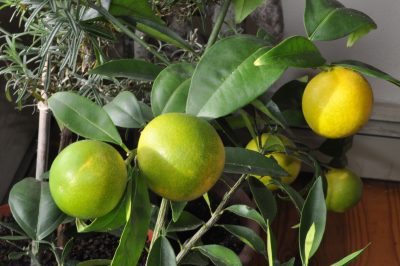
The harvest has begun: I picked the first fruit of the season this week. Not only that, but it was the first fruit I harvested from the particular plant. The fruit was a Sunquat, planted in a pot a year and a half ago. It summers outdoors and winters indoors, basking in sunlight streaming through a south-facing window.
Sunquat
Not many people have heard of Sunquats. I hadn’t. Citrus plants hybridize freely and Sunquat is one of many citrus hybrids, this one a mating of kumquat (Citrus japonica) and Meyer lemon. I happen to be a big fan of the tart flesh and spicy, sweet skins of kumquat fruits. I also happen to be a big fan of Meyer lemon, which is not a true lemon but is probably a hybrid of lemon and sweet orange.

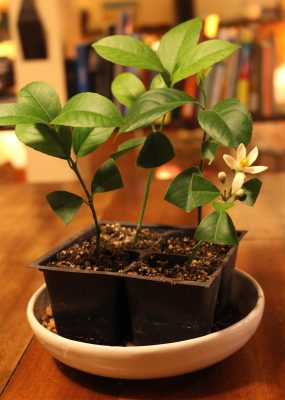
Meyer lemons are juicy and somewhat sweet, with a flowery aroma. They also bear prolifically. As testimonial to their precocity, I once had a cutting that flowered soon after rooting, when it was only a few inches tall.
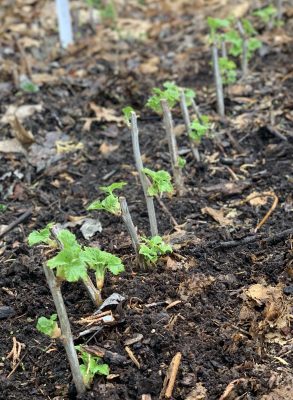
Meyer lemon cuttings rooted

  So what could be bad about combining kumquat and Meyer lemon? A Sunquat! The skin was sour without picking up any of the spicy tang of a kumquat’s skin. The flesh was much less puckery than kumquat or lemon, but was uninteresting, just bland. Perhaps harvesting a bit underripe, before the skins turn full yellow, will put some pizazz in a Sunquat.

If not, I’ll stick to growing Meyer lemons and kumquats, each on their own and with their own delectable flavor.
Meiwa kumquat plant

CLOSING “SHOP”

Chips, Not Hay, In This Case

“Make hay while the sun shines.” Good advice, literally in agriculture and figuratively in life. And I’m following it these days, in agriculture. Not making hay of course, because that sunshine is only effective in summer and fall, partnered with heat.

The “hay that I’m making” is actually mulch that I’m spreading. A few weeks ago I put my “WOOD CHIPS WANTED” sign out along the road in front of my house. In a short time, an arborist was kind enough deposit a truckload of chips. Wood chipsI figured I could spread it on the ground beneath some of my trees and shrubs, especially the youngest ones. There, next summer, the mulch would keep weeds at bay, slow evaporation of water from the ground, and feed soil life, in so doing enriching the soil with nutrients and organic matter.
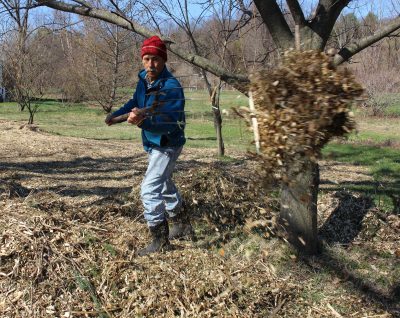
Usually, by this time of year, my piles of wood chips have frozen solid or are white mounds beneath snowy blankets. Not so this year.

So I’ve been loading up garden cart after garden cart with chips to haul over to the garden. (Once the ground disappears beneath a heavy, white layer of snow, moving heavy cartloads becomes nearly impossible.) 

Since the most important trees and shrubs had already been mulched earlier in autumn, I decided it was a good time to add a layer of chips to the paths in the vegetable garden.Mulching chestnut trees Chips there are mostly to suppress weeds which thrived with last season’s unusually abundant rainfall and to soften, by spreading out, the impact of footfall on the paths. I generally “chip the paths” every couple of years at a minimum if for nothing more so that the height of the paths keeps up with the rising height of the vegetable beds which get — and already got, at the end of this season — a one-inch deep blanket of compost annually. (Besides the usual benefits of mulches, the compost provides enough nutrients for the intensively planted vegetables for the whole season. No fertilizer per se is needed.)

After decades of my adding an inch or more of wood chips to the paths and compost to the beds, you might suppose that the whole vegetable garden has risen a few feet above the surrounding area like a giant stage. Nope. The goodness of organic materials, such as the compost and wood chips, comes from soil organisms chewing them up and breaking them down. As decomposition takes place, the bulk of these materials, which are mostly carbon, hydrogen, and oxygen, is released into the air as carbon dioxide and water. The minerals that remain feed the plants.

Pine Berries?

One bed in the vegetable garden is home to strawberries. That bed also needs mulching, for different reasons and with different materials than the other beds, and needs it every year about now.

A strawberry plant is mostly nothing more than a stem, a stem whose distance from leaf to leaf has been telescoped down to create a stubby plant. Drawing of strawberry plantLike the stems of any other plant, a strawberry stem each year grows longer from its tip and also grows side shoots. So a strawberry stem rises ever so slowly higher up out of the soil each year.
Strawberry stems are not super cold-hardy. As a stem slowly rises higher in the ground, it’s exposed to more and more cold, and more apt to dry out.

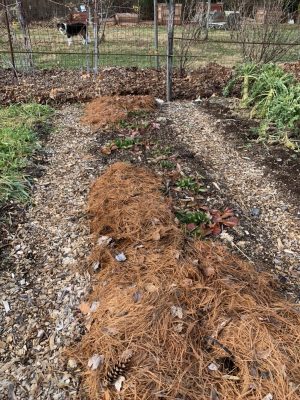
What’s needed is to protect the stems with an insulating blanket of some loose organic material. Straw is traditional — and one possible root of the name “strawberry” — but good straw reliably free of weed seeds is hard to find. Instead of straw, I often use wood shavings, conveniently available in bagged bales. This year I decided that the giant pine tree here could spare a few pine needles, raked up to share with the strawberries.

The goal of mulching strawberries isn’t to keep cold out, just to moderate the bitterest cold. Strawberry bed mulched with pine needlesMulching too early might cause the stems to rot. I typically wait until the ground has frozen about an inch deep which usually occurs towards the end of December here, and then cover the plants with about an inch depth of wood shavings.

Come spring, the mulch needs to be pulled back before the plants start growing. Tucking the mulch in among the plants provides the usual benefits of mulch, especially important for strawberries because of their shallow roots, and provides a nice, clean bed on which the ripening berries can lie.

(More about growing strawberries can be found in my book GROW FRUIT NATURALLY.)

Hey, Good Looking

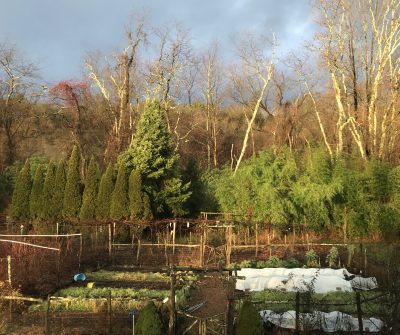
I admire the look of my vegetable gardens this time of year. With the chipped paths and compost lathered beds, some also with a tan cover of winter-killed oat plants, they look very tidy and ready to welcome new seeds and transplants in the months ahead. The look doesn’t compare with the lush greenery and colorful fruits of the summer garden, all of which is nothing more than a memory.
View of garden