SOUTHERN FRANCE, IN SCENT AND SIGHT

Heaven Scent Flower

I trace the origin of my present obsession with growing carnations – big, fat, fragrant carnations (Dianthus caryophyllus) – to the movie, Jean de Florette, that I saw back in 1986. Not that I aspire to labor under the weight of hauling water long distances to care for my plants, as did Ugolin. And not that I’m hoping to get good money selling the cut flowers at a local market.

Actually, my only memories of the film are of the charming countryside of Provence, of Ugolin crouching over the plants and lavishing them with care, and of the pretty pink flowers. Come to think of it, I’m not sure Ugolin’s carnations even got as far as the flowering stage. Anyway, in my mind’s eye I see those pink blossoms and smell their spicy perfume.
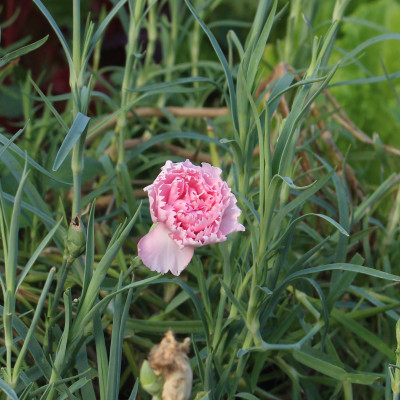
Carnation, fragrant and pretty
With good soil and ample water, my carnations have an easier time of it that did Ugolin’s. Too easy, perhaps. Carnations don’t need or like overly rich or wet soil. When it came time to plant out my seedlings, I recalled those scenes in Jean de Florette. The ledge of soil held up by a stone retaining wall along the south side of my house provide the good soil drainage and sunlight that suits carnations. Lavender, another Mediterranean plant growing on a wall nearby, will help make the carnations feel right at home.

  The biggest threat to my carnations is winter cold and wetness. And even then, these carnations, although technically perennials, are typically short-live perennials that peter out after a couple of years. Luckily, they are easy to grow from seed or root from cuttings.

Like Ugolin, I’ll soon be carefully nurturing some new seedlings. Whether planting, picking, taking cuttings, or preparing them for winter, I’ll also be hunched over my carnations and lavishing them with care, in the months ahead. It’s worth it, for the pastel flowers, and especially for the flowers’ heavenly scent.

And Some Things for the Other Senses

What’s the attraction of southern Europe? The climate there is so different from here in the Wallkill River valley, yet I am attracted to and keep trying to grow Mediterranean plants such as carnations, figs, pomegranates, lavender, black mulberry, and rosemary. All these plants thrive in dry summers and cool, not frigid, winters; minus 20°F is not an uncommon low winter temperature here.
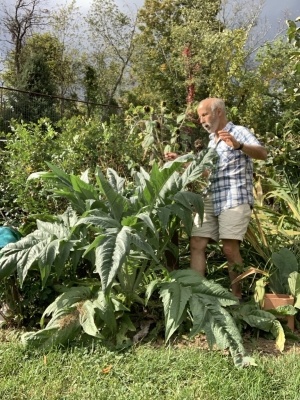
Large cardoon plant

Cardoon, last year

Add to the roster here artichoke and cardoon, two more Mediterranean plants that I set out last spring, for the artichoke, the spring before for the cardoon. (The very mild temperatures of the previous winter let the cardoons survive their first winter outdoors.) That was after sowing each plant in later summer and having it winter in the very cool temperatures of my greenhouse, which provided the vernalization the plants need to flower their first season outdoors.

Both cardoon and artichoke grow as a whorl of spiny leaves from the center of which rises a main flower stalk with smaller flower stalks branching off lower down. Like carnations, they are short-lived perennials. Like carnations, they are easily propagated, in this case by seed or by offshoots that grow at the base of the plant
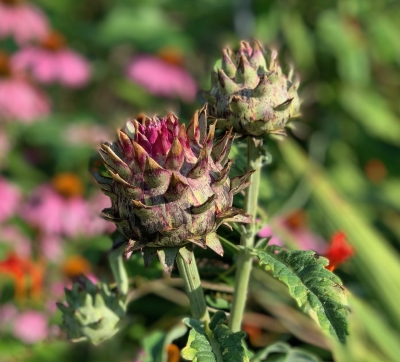
Cardoon in bud

Cardoon in bud

Like carnations, the biggest threat to artichokes and cardoons around here is winter wetness and, especially, cold. Winter cold will assuredly kill them unless they are protected in some way. To that end, late last fall, I cut down the plants and covered each with a large, inverted flowerpot in which and on which piled leaves for insulation. 
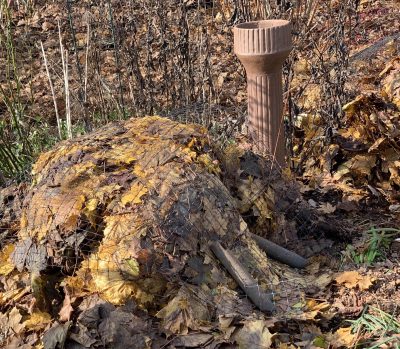
Cardoon  & artichoke protected for winter

Cardoon & artichoke protected for winter

During the warm spell a week or so ago, I pulled back the leaves and uncovered the plants. Cardoon leaves had sprouted more than a foot high within their winter home! Without light, the leafy stalks were ghostly white.
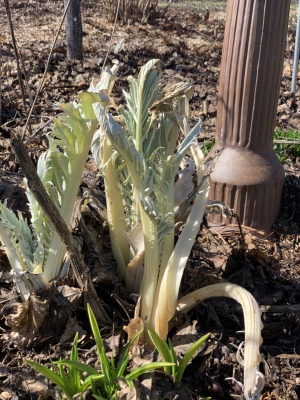
 

Cardoon, after winter

Cardoon, after winter

That’s okay; cardoon is sometimes purposely blanched to make its flavor more mild. A few days of light will green them up. That’s okay too; I’m growing cardoon for its bold visual presence — last year the plants leaves formed a 3-foot-high, blue-green, mound of spiny leaves up the center of which rose flower stalks at the top of which opened blue flowers resembling enormous thistles.
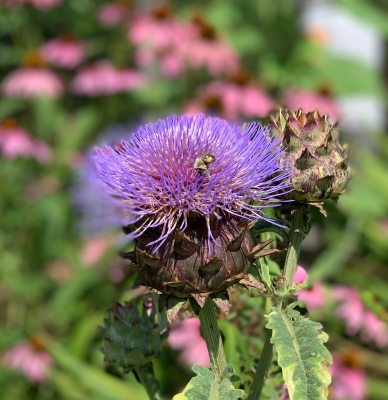
Cardoon flower

Cardoon flower

As for the artichokes: Not a sign of life. Perhaps winter cold or moisture did them in. Perhaps mice lunched on the roots. Perhaps there’s life beneath the ground, still to awaken. I’ll keep my fingers crossed.
BEE GLORY, GONE (FOR NOW)

Arnold’s Promise?

I miss the bees. No, they’re not gone from here because of Colony Collapse Disorder (CCD), widely responsible for the loss of bees. Most years, they would have been here and perhaps gone on to greener pastures by now.
Honeybee on witchhazel
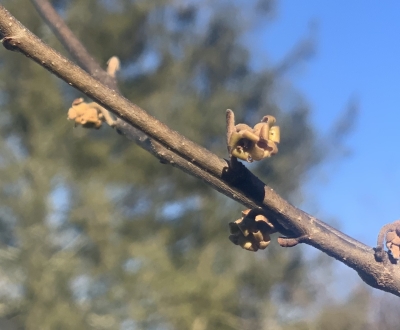
The bees come for my witchhazel, and the reason for their absence this year is because my witchhazel didn’t bloom. It usually blooms in late winter or very early spring. And it won’t bloom this season at all. The reason is because it bloomed last fall.

It’s not uncommon for an early spring bloomer such as witchhazel to jump the gun and bloom in fall. And the cause for this behavior is growing conditions through summer that send the plant into a kind of sleep, then fall conditions that all of a sudden shake the plant awake. My guess is that the plant considered the very dry weather last summer an ersatz winter, and cooler and moister conditions in fall were an ersatz spring.

Witchhazel, spent bloom from August

Witchhazel, spent blooms from past autumn

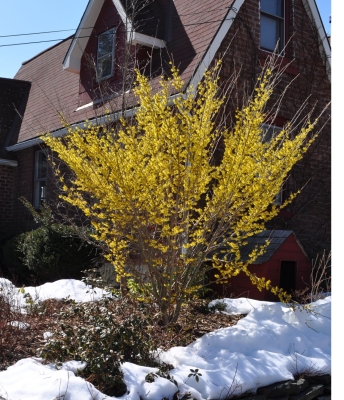
I’d prefer, and the bees also might prefer, for the plant — Arnold’s Promise variety of witchhazel — to bloom on its usual, this side, of the calendar. We’re all much hungrier now for all that visual and aromatic glory. The bees seem happiest with the spring blooms, making the bush all a-buzz with their frenzied flitting moving from flower to flower. These early blossoms provide the nectar and the pollen they need to get going in spring.

Witchhazel in full bloom in past years

Witchhazel in full bloom in past years

What’s So Good About Honeybees?

Honeybees are much more valuable for their pollination services than for the honey and beeswax we sneak from them. Many crops – almost all those with showy flowers – need the pollination services of bees in order to set seeds or make fruits.

I once kept bees, so can attest to the fact that they make very interesting pets. Their social organization rivals that of any other creature. (Humans are not even in this running.) Each bee knows and does his or her job. The hive’s sole queen leaves the hive but once in her life to get fertilized by males, after which the latter, their genitals ripped from their bodies, die. Guard bees protect the entrance from interlopers. 

On calm, balmy days, workers spend their days seeking out and gathering nectar and pollen from flowers. A worker, upon finding a good source of nectar and pollen, returns to the hive and does a dance that communicates to other workers the location of that bounty. This bee “language” is so evolved that different varieties of bees have different “dialects.”

For a fascinating description of the experiments that led to the discovery of those “bee dances,” take a look at the book The Dancing Bees by Karl Von Frisch, who, in 1973, received the Nobel Prize for his work with bees.

Luckily, There are Other Bees

Looking at those ecstatic bees on my witch hazel bush years ago, it struck me that perhaps what I was looking at were not, in fact, honeybees. My personal observations here on the farmden notwithstanding, honeybees are, in fact, on the decline. But they’re not the only bees on the block. Honeybees weren’t even “on the block” a few hundred years ago because they’re not native to North America.

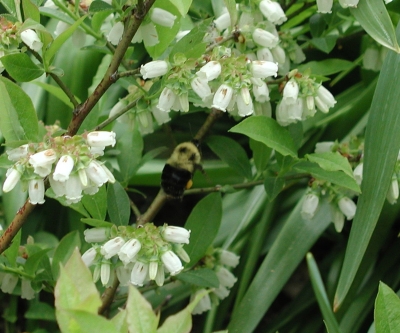
North America has plenty of wild bees, though, almost 4000 species of them! Our wild bees – including, for example, carpenter bees, bumblebees, orchard mason bees, and hornfaced bees — are very efficient pollinators, going outside to work during weather in which honeybees remain huddled in their hives. These native bees get up earlier in spring and earlier each day, and don’t need the calm weather (wind less than 15 mph) and warm temperatures (greater than 55 degrees F) demanded by honeybees. Native bees also are more gentle than honeybees, rarely stinging. They don’t, however, make honey or beeswax.

Bumblebee on blueberry plant

Bumblebee on blueberry plant

Unfortunately, native bee populations are also on the decline these days, due mostly to habitat destruction and pesticide poisoning. Some people build special nestboxes for these helpful insects, which require nothing more than tubes in which to lay eggs, anything from bundles of straws to wooden blocks into which holes have been drilled.

Whatever I’m doing that has kept those bees on my witchhazel happy will have similar effect whether the bees are honeybees or native bees. Because some native bees nest in the ground, our gardening practices can influence their well-being. The website of the Xerces Society details the effects of a number of gardening practices on native bees. Tillage, for example, can be detrimental, as are the pesticides copper sulfate, sulfur, and rotenone. Maintaining wild habitats is also important to their survival.

I’m hoping next winter or spring to see my Arnold’s Promise awash in fragrant, yellow blossoms and all abuzz with bees, whether honeybees or native bees.

SWEET POSSIBILITIES

It’s time to prune, and to help you, I’ll be holding a PRUNING WEBINAR on March 29, 7-8:30 EST. Learn the tools of the trade, how plants respond to pruning, details for pruning various plants, and enjoy a fun finale on an easy espalier. There’ll be time for questions also. Cost is $35 and you can register with Paypal or credit card here.

Choice Syrups

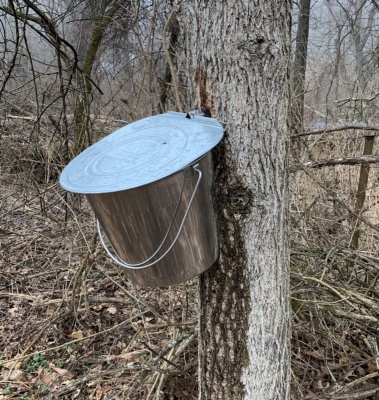
I’ve given up on maple syrup this year. The tree I tapped was too small to yield anything significant. 

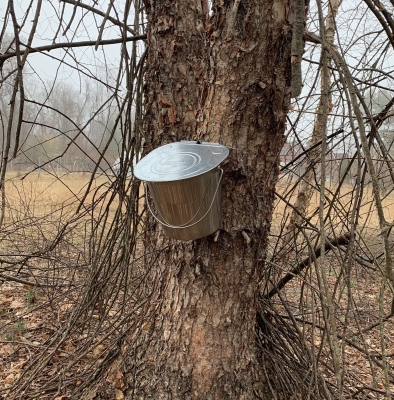
I’d almost given up on river birch syrup. I thought perhaps it was the timing — and, have since learned, that it is! Sap from any one of a number of birch species doesn’t begin to flow until temperatures are consistently 50°F or higher, which arrives near the end of the maple tapping season and continues until about the time the trees leaf out.

River birch, tapped

River birch, tapped

Black walnut was another possibility for tapping. I previously had pooh-poohed it because, much as I love this tree’s nuts, I imagined the aroma of the leaves or the hulls oozing its way into the sap. Ugh!

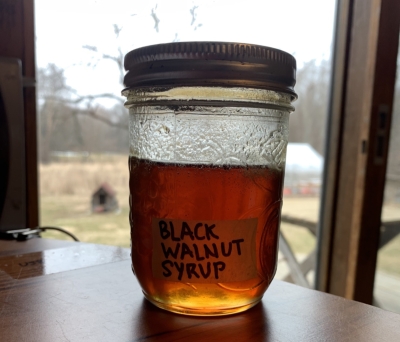
Another reader reported that walnut syrup is delicious and I should try it, so I did. Sap started dripping as soon as I drilled the holes. The first batch is boiled down, and it is delicious. Not that different from maple syrup, with just a slightly different, smoother flavor. Nothing reminiscent of the nuts, leaves, or husks, though.

Black walnut tree, tapped

Black walnut tree, tapped

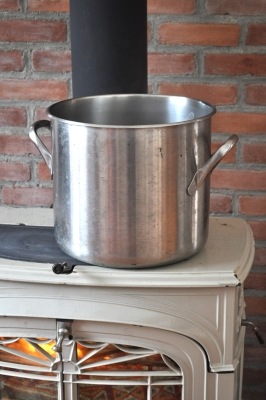
Processing was via the same low-tech approach I’ve used for maple syrup, merely adding each day’s “catch” to a big stock pot sitting on the wood stove. The woodstove is stoked pretty much continuously this time of year, so the sap is always evaporating, with the added bonus of humidifying the house.

I see a few eyebrows going up. Sticky walls and ceiling are what comes to some minds upon the mention of cooking down maple sap indoors. Well, that’s usually myth. Sticky walls and ceiling only result when the sap is in an active boil and bubbles bursting on the surface of the liquid send little droplets of sugar water into the air and onto walls and ceilings.

Until the final stage of my sap-making, the sap is just slowly evaporating. The vapor given off by slowly evaporating, simmering, or boiling a solution of any sugar and water is nothing more than water vapor. That’s why the maple (or black walnut) sugars become concentrated in the remaining liquid. They stay in the pot.

In those final stages of concentration, with much reduced liquid volume, the liquid can indeed reach an active boil. The pot of liquid announces that it’s nearing that stage by starting to gurgle like a baby, at which point it needs to be watched closely, mostly so that the syrup doesn’t get too concentrated or burn. The finish point is when the temperature of the liquid reaches about 219 degrees F. 
Boiling sap
I discovered a big difference from maple syruping when I attempted to strain off schmutz in the boiled down black walnut sap. The schmutz was a jelly that quickly clogged up the strainer. The amount of schmutz can vary from tree to tree, with time of year, and who knows what else. Turns out that black walnut sap is high in pectin, aka schmutz. Perhaps calling it “black walnut jelly” would make it more appetizing. Black walnut syrup

Too Late to Prune, Say the Squirrels?

Someone wrote me that squirrels were chewing on a Norway maple last week and the sap was seen dripping down, then went on to ask if that meant it was too late to prune. Perhaps the squirrels were enjoying some of the sweet sap.

Yes, you can tap and boil into syrup the sap of all kinds of maples; I’ve tapped and made syrup from silver maple, red maple, boxelder, and, of course, sugar maple. And each tastes slightly different from the other.

Getting back the pruning… It’s not at all too late. It’s fine to “dormant” prune any plants up until the time when they unfurl their leaves in spring. Actually, peach trees are best pruned when they are blooming.

Another good question might be: Why not just cut the Norway maple down to the ground? The trees are invasive and displacing our sugar maples, they have poor fall color, and they create lugubrious shade beneath which grass and much else can’t grow. Mostly, people keep these trees because they are already in place and full grown.

PEST PLANS

My Sweet, Corn

Spring is here this week, weatherwise, at least. Not to bring back bad memories, but with real spring just around the corner, now is a good time to revisit two or three of last year’s worst pest problems, and plan some sort of counteraction. Not that those memories are really that bad; the interaction of pests, plants, the environment, and my hopefully green thumb is always interesting.

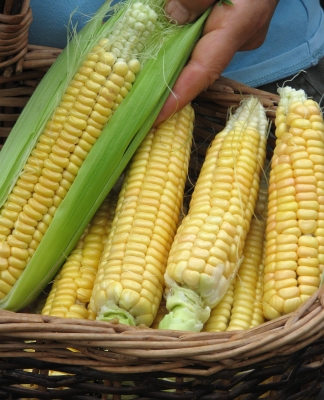
Golden Bantam sweet corn, non-hybridThe most serious pest problem last year, most serious because it affected one of my favorite vegetables, was a disease that devastated my later plantings of corn. Looking at the symptoms —  yellow streaks on leaves that turned to tan, dead areas — my diagnosis was the bacterial disease, Stewart’s wilt. Some plant pathologists pointed out that Stewart’s wilt is very rare around here, and that the problem was probably the fungal disease, northern corn leaf blight.
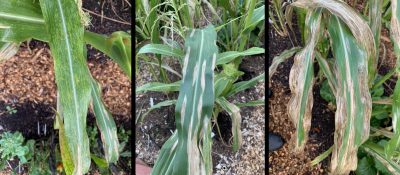
Disease development

Disease development on leaves

I’m not 100% convinced it’s the blight but, more important is what to do in either case. I like my sweet corn. (Popcorn and polenta corn were unaffected.) Stewart’s wilt can be avoided by growing resistant varieties. But not only do I like my sweet corn; I like specifically Golden Bantam sweet corn.

A hundred years ago, Golden Bantam corn was bred into a number of hybrid varieties, some of which are resistant to Stewart’s wilt. Golden Cross Bantam, for example. As I said, though, I like my Golden Bantam. I’ve grown Golden Cross Bantam and its flavor fell short of Golden Bantam.

Northern Corn Leaf Blight

Northern Corn Leaf Blight

As a nonhybrid variety, Golden Bantam turns up in a number of strains. My seed came from a few sources, and it’s possible that some strains are more resistant than others. My two earlier ripening beds had no disease. Last year I didn’t keep records of which beds got seed from which sources. This year I’ll record it.


Northern corn leaf blight can also be controlled with resistant varieties. As I wrote, though, Golden Bantam is the variety for me, so other varieties are not an option, for now at least.

Plus, there are other options for dealing with northern corn leaf blight. Thorough cleanup at season’s end removes spores that would overwinter. Done. Not planting corn in the same bed for one to two years to starve out the disease. Done. Good air circulation and humidity control by keeping weeds in check. Not so done each year. Colder, damper air descends readily into the Wallkilll River Valley here and, while weeds are under control, I do a lot of interplanting, which has the same effect, humidity-wise, as weeds.

Who knows? Another season, different conditions. The problem, whichever it is, never showed up before; perhaps it won’t ever again.

An Unwelcome Newcomer

The other significant pest problems last year were with my onions and leeks. As usual, I started onions from seed indoors in February and planted them out in early May. Another batch got direct seeded right out in the garden in April. Both plantings — I’m ashamed to admit — yielded stunted bulbs, many no bigger than a nickel. Leeks likewise were stunted, or deformed.

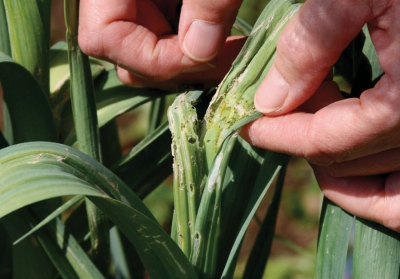
Also embarrassing is that I didn’t take the trouble to examine the plants closely for clues. This would have been relatively easy since the probable culprits were leek moth or thrips, both now common, around here, at least.  Plus, I’ve previously had a problem with leek moth.

Leek moth, a European native, is a relative newcomer on this side of the Atlantic, first showing up in northern New York state in 2009. Temperatures above 50°F in late winter awaken papae or adults overwintering in debris, and Ms. Leek Moth soon starts laying eggs, lots of them. In less than a month, new adults start feeding on leaves. Subsequent generations follow suit, feeding on leaves, weakening the plant, and also the parts — stalks and bulbs — that we want to eat.
Leek moth damage
Early signs of impending damage are the eggs, tiny and transluscent and laid on the undersides of the leaves. Or, later, the caterpillars, slender, yellow and also small, less than one-half inch long. The important thing is to take action at the first signs of damage — holes in leaves and caterpillars. To see the caterpillars, leaves of garlic and leeks need to be unfolded; hollow leaves of onions need to be opened for an inside look.

Leek moth damage, later

Leek moth damage, later

Preemptive action would be to use a lightweight floating row cover beginning early in the season to keep Ms. Leek Moth from laying eggs on plants. 

Once damage or caterpillars is found, spraying, my least favorite garden activity, is needed. Organic sprays include Pyganic, which is effective for a couple of days, or, more lasting, Entrust, a natural substance made by a soil bacterium. In either case sprays need to be applied strictly according to label directions, both for effectiveness and for legality

Thrip, Thrip, Thrip – No, Not a Frog

Thrips, the other possible, or additional, culprits are very small, but their damage is telling: silver lines and/or small white patches on leaves and tip dieback. To see the culprits themselves, you’ve got to look closely between the leaf folds, zeroing in on the youngest leaves, for light yellow nymphs and darker adults. Hot, dry weather suits them best, which were the conditions here last summer.

Thrip damage

Thrip damage

Because thrips overwinter in debris, thorough cleanup helps. Straw mulch has potential, although one study showed that while it reduced the number of thrips, it didn’t affect yield. It did increase the number of jumbo onions, though. Go figure. 

Certain kinds of onions are more resistant to thrips than others. In general, red onions (which I anyway don’t grow) are very susceptible, yellow ones (which I do grow) less so, and Sweet Spanish onions (which I have grown in the past) are relatively resistant.  I’ll no longer grow the variety Candy, which is listed as susceptible.

Certain plants, on which thrips do little damage, can draw thrips away from the onions. Carrots, tomatoes, cabbage and its kin, carnations, and chrysanthemums, as examples.

And, of course, there are organic sprays, a last resort for me. Beauvaria, a naturally-occuring insect killer, for one. Also the relatively benign insecticidal soap paired with Neem. And again, Entrust.

As I said, I’m not bemoaning these insect and disease pests. It’s reassuring for me to stop and think how few or no pest problems vegetables typically affect my kale, tomatoes, peppers, okra, and most other vegetables grow. They all grow well with little more than yearly additions of compost to the beds, and timely planting and watering.

Prune Fearlessly

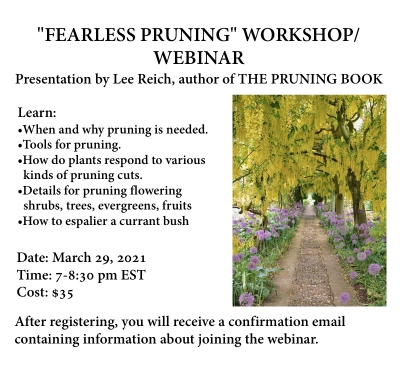
A reminder that I’ll be holding a FEARLESS PRUNING webinar on March 29, 2021 from 7-8:30pm EST. This webinar will take the mystery out of pruning, so that you can prune your lilac and rose bushes, apple trees,  blueberry shrubs — all trees and shrubs, in fact — to look their best and be in vibrant health. Fearlessly. For more information and to register, go to www.leereich.com/workshops.

FEARLESS PRUNING

FEARLESS PRUNING WORKSHOP/WEBINAR

A workshop/webinar to take the mystery out of pruning, so that lilac and rose bushes, apple trees,  blueberry shrubs — all trees and shrubs, in fact — can be pruned to look their best and be in vibrant health. Fearlessly.

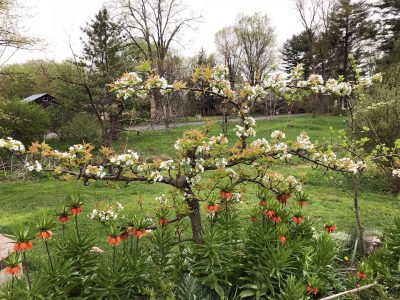
Asian pear espalier floweringTopics will include:
•Why prune?
•Tools for pruning.
•How plants respond to various kinds and timing of pruning.
•Details for pruning flowering shrubs, trees, evergreens, and fruit plants.
•And a fun finale on creating an easy fruiting espalier. (Don’t know what espalier is? You’ll learn it at the webinar.)

And, of course, there will be time for your questions.

Date: March 29, 2021 
Time: 7-8:30 pm EST
Cost: $35

Registration Link
https://us02web.zoom.us/webinar/register/WN_RfkO-_nJT8S-LximcfG24Q

After registering, you will receive a confirmation email containing information about joining the webinar.

HOW ABOUT THOSE OLD SEED PACKETS?

It’s wasted effort to sprinkle dead seeds into furrows either in the garden or seed flats. Seeds are living, albeit dormant, embryonic plants which do not live forever.
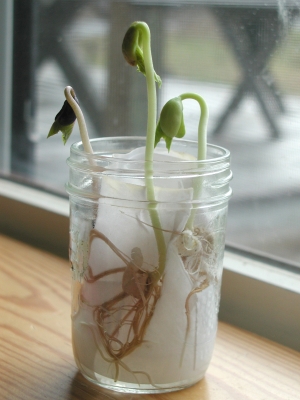
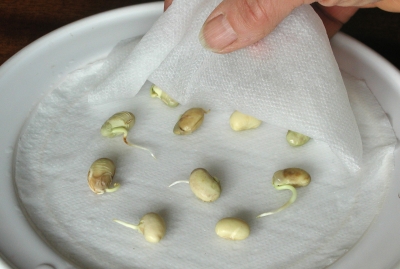
Sprouting bean seeds
When you buy a packet of seeds, you’re assured of their viability. Government standards set the minimum percentage of seeds that must germinate for each type of seed. The packing date and the germination percentage often are stamped on the packet. (The germination percentage must be indicated only if it is below standard.) I write the year on any seed packets on which the date is not stamped.

Your old, dog-eared seed packets may or may not be worth using this season. It depends on where the packets were kept and the types of seeds they contain. Last year I got tired of trying to decide how well my seeds were stored and which were still worth sowing; I took action.

Anti-Aging Treatments

Conditions that slow biological and chemical reactions also slow aging of seeds, i.e. low temperature, low humidity, and low oxygen. In years past, I’ve stored seeds in canning jars in my freezer, then moved the jars to the refrigerator as the freezer filled in fall. Powdered milk sprinkled into the bottom of the jars maintained low humidity. (Or so I assumed.) But all those jars took up lots of space, especially as my seed collections grew, and seed packets don’t pack well into canning jars.

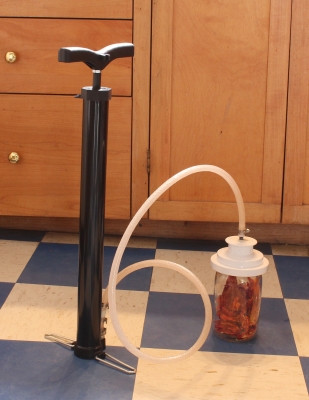
As far as low oxygen storage, it’s not practical for most of us. I did try, one year, to create low oxygen seed storage by reversing gaskets and putting a one way valve on a bicycle pump. Bicycle vacuum pumpThis allowed me to draw some of the air out of the jars with a tube connecting the pump to a ‘FoodSaver Wide-Mouth Jar Sealer.’ It did (usually) create somewhat of a vacuum but it was too much trouble to get at the seeds and re-seal a jar each time. And, again, seed packets don’t pack well into canning jars.
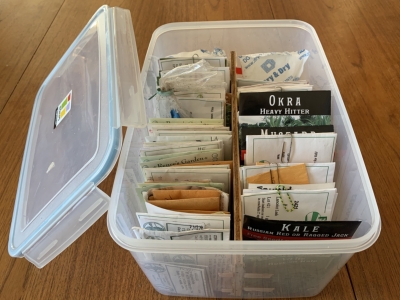
So last year I came up with a figurative “better mousetrap.” After much searching for a plastic, freezer-safe, air-tight, leak-proof, reasonably-sized tub for the bulk of my seeds — a stout order, all this — I came upon the ‘Komax Biokips 35-Cup Large Food Storage Container.’ Perfect!

I measured, cut, and hot-glued a piece of 1/4-inch plywood to run up the center of the tub to allow for two rows of seed packet. A couple of 100 gram silica gel packets in the tub at the end of each row keeps humidity low. The packets are easily rejuvenated in a warm oven for 20 minutes. I just measured the humidity in the tub (I like to measure); it’s a dry 17%.
Seed storage, in tub
Moving the tub into the relative coolness of my basement in summer should maintain conditions in line with the guideline for seed storage that Fahrenheit temperature plus relative humidity should total less than 100. Come cooler weather in fall and then cold weather in winter, back the the tub goes to a shelf in my unheated workshop.

Worth Saving?

Seeds differ in how long they remain viable. Even with the best storage conditions, it’s not worth the risk to sow parsnip or salsify seeds after they are more than one year old. Two years of sowings can be expected from packets of carrot, onion, and sweet corn seed; three years from peas and beans, peppers, radishes, and beets; and four or five years from cabbage, broccoli, brussels sprouts, cucumbers, melons, and lettuce.

Among flower seeds, the shortest-lived are delphiniums, aster, candytuft, and phlox. Packets of alyssum, Shasta daisy, calendula, sweet peas, poppies, and marigold can be re-used for five or ten years before their seeds get too old.

In a frugal mood, I might do a germination test to definitively measure whether an old seed packet is worth saving. Counting out at least 20 seeds from each packet to be tested, I spread the seeds between two moist paper towels on a plate. Inverting another plate over the first plate seals in moisture and then the whole setup goes where the temperature is warm, around 75 degrees. After one to two weeks, I peel apart the paper towels and count the number of seeds with little white root “tails”.
Seed germination test
I figure the percentage, and if it’s low, the seed packet gets tossed into the compost pile (not given away!). Or, I might use the seed and adjust my sowing rate accordingly. 

And the Record Is . . .

Among the shortest-lived seeds are those of alpine plants; their viability might plummet after only a couple of weeks. 

As far as longest-lived seeds, there’s the story of the 10,000 year old lupine seed that germinated after being taken out of a lemming burrow in the Yukon permafrost. Alas, it’s only a story, one debunked by radiocarbon dating.

The true record for seed longevity was, until recently, 2,000 years, and was held by a date palm grown from seed recovered from an ancient fortress in Israel.

No one knows exactly what happens within a seed to make it lose its viability. Besides lack of germination, old seeds undergo a slight change of color, lose their lustre, and show decreased resistance to fungal infections. There’s more leakage of substances from dead seeds than from young, fresh seeds, so perhaps aging influences the integrity of the cell membranes.  Or, since old seeds are less metabolically active than young seeds, the old seeds leak metabolites that they cannot use.

(The above was adapted from my book The Ever Curious Gardener: Using a Little Natural Science for a Much Better Garden available from the usual sources and, signed, from me.)

OUTDOOR MAPLES AND INDOOR KUMQUATS

Sap Season

Get your taps in. It’s syrup weather. Maple syrup. At least here in New York’s Hudson Valley, the sunny days in the 40s with nights in the 20s that are predicted should get the sap flowing.

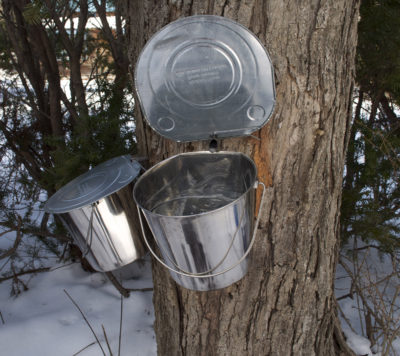
  I say “should” because I haven’t yet checked sap buckets that I hung out on the trees a few weeks ago when winter temperatures suddenly turned warm; it was sap weather back then. That day was hopeful: I drilled holes an inch and a half deep, lightly hammered in the spiles, hung buckets, and attached covers over the buckets. Frigid days and nights that descended soon after that kept sap flow in abeyance.

  My “sugar bush” amounts to only three sugar maple trees. I used to have four, but a large tree that was a truly magnificent representative of its species began an irreversible path to its death. My older sugar mapel“Maple decline” is a disease complex brought on by some combination of drought, soil compaction, road salt, root damage, and air pollution. Upper branches are usually the first to go, and once decline begins, secondary fungi and insects speed the process along.
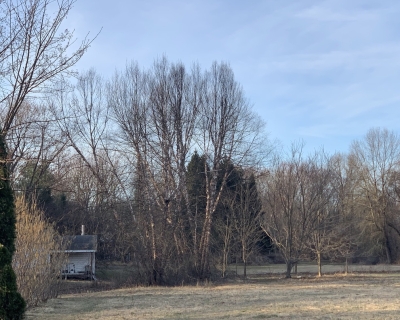
  I’m not sure about my tree, though, because its lower branches were the first to go. Also, the tree grows along the back edge of my property, where it’s been shielded from those usual causes for decline.

  One more contributor to decline is overtapping. I plead not guilty. My fading tree was larger than the 8 or10 inch minimum diameter for tapping, and I only tapped it once, when the tree, it turned out, was already going downhill. The lack of sap flow was what prompted me to see all this. And then I noticed many rows of sapsucker holes in the bark.

Long story short: The tree became firewood.
Maple syrup buckets
My three other, healthy maples might yield me only a quart of finished syrup. The reasons? One quart is enough for me, so I’m tapping only one of them. Also, they’re relatively young. I planted those three trees about 25 years ago, and they’re now only about 8 inches in diameter.

I highly recommend planting trees, for their beauty, for what food they might offer, and for the mere satisfaction of watching the plants grow. Especially if they are small when planted. Small trees also establish quickly to require less aftercare, often soon outgrowing their initially larger compatriots. Those three maple trees? From one perspective, it seems like a long time ago that I dug holes and set the saplings in the ground; from another perspective, it seems like I planted them, walked away, then turned right around to find that these young ‘uns have grown into bona fide trees!

Birch Sap

I may end up with more sap than planned, but not maple sap. Along with the three sugar maples I planted way back when, I also planted three river birches (Betula nigra). They grow, appropriate to their name, in a wet area just out of a swale through which water runs in spring, each a clump of a half dozen or so sturdy trunks reaching skyward to about 35 feet.

Maple might be the heaviest sap producing tree, but it’s not the only kid on the block. Many people tap their black walnut trees. Call me provincial, but black walnut syrup, much as I love the nuts themselves, has no appeal me even though I’ve never tasted it.

Birch syrup though . . . mmm. Never tasted that one either, but it sounds good. Three birch taps should offer an ample amount for tasting.River birches

What a Funny Name

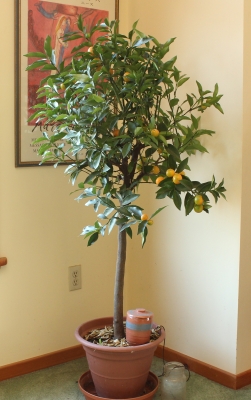
  I don’t need to see the small, pebbly-skinned, orange orbs on grocers’ shelves to know that it’s kumquat season. My own Meiwa kumquat is looking very pretty, with a good crop of fruit staring out from their backdrop of glossy, forest-green leaves. I’ve trained the plant as a “standard,” that is, as a miniature tree with a crown of branches perched atop a four foot trunk.
Kumquat houseplant
 The present crop is my best ever, and traces its success back to last spring. In previous years, I was too timid with pruning. And pruning is necessary, every year. Pruning keeps the plant from growing disproportionately large for its pot -– or my house — and coaxes growth of new, fruiting wood.

The roots also get pruned each year to make space for new potting soil for root growth and nutrients. I laid down the plant and pot to easily slide out the root ball. After slicing an inch or two of roots and potting soil from all around the outside of the root ball, back into the pot the plant went, with new potting soil packed in the space between the shaven root ball and the inside edge of the pot. The seemingly brutal treatment took place last year just as the garden awoke in yellow blossoms from daffodils.
Repotting kumquat
As soon as weather warmed, new sprouts began to grow. By midsummer, the plant was fragrant with blossoms. By late summer, little, green fruits were forming which, with careful watering, survived the environment change as the plant moved indoors in October. The plant stood at attention in a sunny window in the cool bedroom for weeks, and a couple of months ago, the fruits started turning orange. They are now ripe and delicious!

WEED-LESSNESS FOR 2021

WEEDLESS GARDENING WORKSHOP/WEBINAR
 with Lee Reich, PhD, writer, scientist, and farmdener*

Introducing a novel way of caring for the soil, a 4-part system that minimizes weed problems and  maintains healthy plants and soil. Learn how to apply this system to establish new plantings as well as to maintain existing plantings. The principles and practices are rooted in the latest agricultural research and are also applicable to sustainable, small farm systems. 

This system works because it emulates, rather than fights, Mother Nature who, as C. D. Warner wrote (My Summer in the Garden, 1887), “is at it early and late, and all night; never tiring, nor showing the least sign of exhaustion.”

Date: February 22, 2021 
Time: 7-8:30 pm EST
Cost: $35

Register for this webinar at:
https://us02web.zoom.us/webinar/register/WN_WqSCBtOGTqqjGgbOHOuxfg 

After registering, you will receive a confirmation email containing information about joining the webinar.

*A farmdener is more than a gardener and less than a farmer.
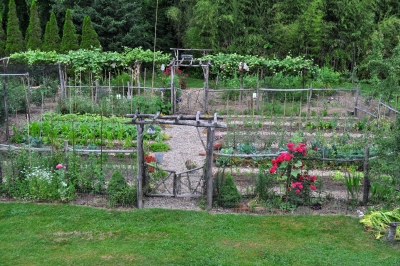
garden view

THANKS

I’d like to highlight, today, what makes this blog possible. 

First of all, it’s you, readers. The positive feedback I get is very rewarding. I’ve had great opportunities — academically and “in the field” — to learn about growing plants and caring for the soil, and have put all this into practice for decades. My hope is that in entertaining you with all this, your tomatoes, apples, zinnias, and all the rest grow healthier and tastier or prettier. I appreciate the positive (even the sometimes negative) comments from you all.

Second, if you’ll look at the bottom right corner of my blog posts (or scroll way down near the end on a mobile device), you’ll see some banner ads. Nothing flashy or moving or obnoxious in any other way. Just simple links to a few advertisers.

These seven advertisers are special; these are companies whose products I stand behind. I’ve used them and can attest to their quality.

Fruit Plants Galore

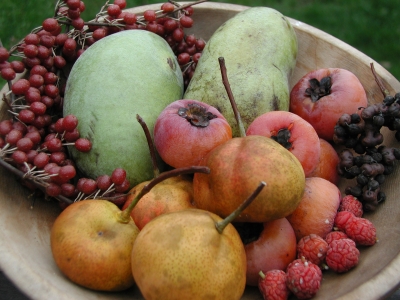
Uncommon Fruits of Fall

Uncommon Fruits of Fall

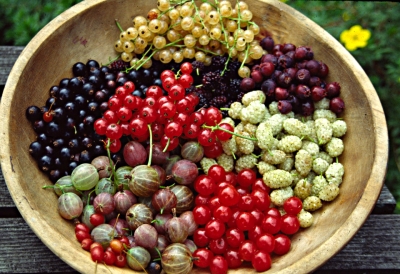
Uncommon fruits of summer

Uncommon fruits of summer


Take, for instance, Raintree Nursery and Cummins Nursery. I’m a “fruit nut” (and a “nut nut”) and, except when I propagate my own plants, these two nurseries are my go-to nurseries for fruiting trees and shrubs.

Raintree Nursery stands out for the wide variety of common and uncommon fruits they offer, everything from apples to jujubes to musk strawberries to wintergreen to hardy passionfruits. All top quality plants.

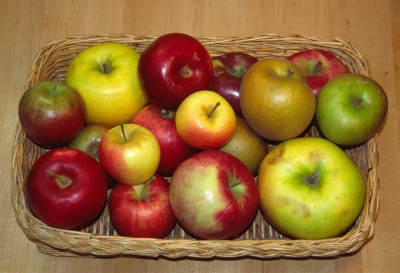
Heirloom apples

Heirloom apples

Cummins Nursery also offers top quality plants, trees in this case. Steve Cummins, the present owner, started the nursery with his dad, Jim, and other family members. Back in the 20th century, when I worked in research for Cornell University, Dr. Jim Cummins also worked there. For many years, he was the rootstock breeder. (A rootstock, on which a Honeycrisp, Mutsu, or other variety of fruit is grafted in order to propagate it, can impart special qualities to the resultant tree, such as early production, eventual tree size, pest resistance, and tolerance to poor soil conditions.)

So I turn to Cummins Nursery if I’m interested in a common (vs. uncommon) fruit tree on a special rootstock, with many, many varieties of fruit to pick from. Or if I want to purchase a rootstock to graft myself. Or if I want a scion of any one of the many, many different varieties of fruits grown at Indian Creek Farm, the pick-your-own farm they run adjacent to the nursery.

You’ll note that Raintree Nursery is in Washington state and Cummins Nursery is in New York state. No matter. These nurseries are selling named varieties of fruit plants. A McIntosh apple grown in Washington state is genetically identical to that variety grown in New York state, so will have the same cold-hardiness, pest resistance, and other characteristics. Of course, a particular season’s weather, wherever the tree is planted, could influence flavor and texture.

Essential, Quality Tools

If you grow fruit plants — or vegetables or ornamentals or houseplants — you’re going to need certain tools. Glance down, then, to my next three advertisers: OESCO (“Oesco” is the acronym for “orchard equipment supply company)”, ARS (the exclusive agent for ARS pruning tools), and Scythe Supply Co.

Whether it’s pole pruners, pruning saws, or most other pruning tools, ARS are among my favorites, and especially for hand shears. The ARS website shows the complete line of ARS tools, as well as where you can purchase them.
ARS web page
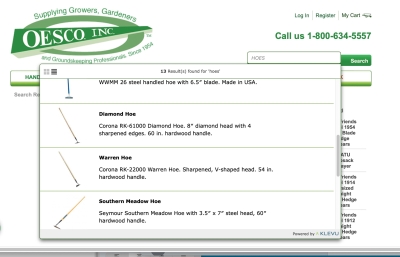
One place for many of those pruning tools, ARS or otherwise, is OESCO. And much more. Trowels, all sorts of shovels, hedgers, sharpeners, grafting knives and sealants, stuff for making trellises, and, of course, many kinds of hand pruning shears.
OESCO web page
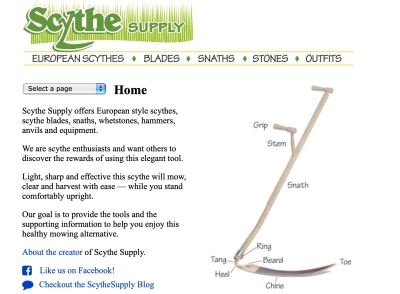
Scythe Supply Co is where I purchase all my scythe blades, sharpening stones, peening tools, and, originally, my snath and grips (I’ve since made these last two parts myself, when needed). You might think a scythe to be an archaic tools. Not so; it works even early mornings without waking the neighbors and in ground too wet or grass too high for a mower. Swinging a scythe is a meditative, first-class exercise.
Scythe Supply Co, webpage
My property was originally a mere 3/4 of an acre. Besides my home, vegetable garden, and fruit trees, I was able to dedicate a portion of that property to a mini-hay field, where I let the grass grow high and then periodically scythed it as food for my compost pile. It was decorative and functional. (Okay I did encroach on the actual hayfield bordering my 3/4 of an acre; I eventually bought it and now have a bona fide hayfield, portions of which I scythe.)

Two More Essentials

You might wonder, “What’s with Bobbex and Sensorpush?”, the last two ads on these blog pages?”

Bobbex webpage

In the past couple of winters as Daisy and, especially Sammy, matured beyond their super energetic puppy stages, 


deer have taken note and become bolder. My initial testing of Bobbex, a deer repellent, seemed promising. I’ve since become amazed at its effectiveness. Deer are here, but not feeding on any of my sprayed plants. And spraying is only needed once a month.

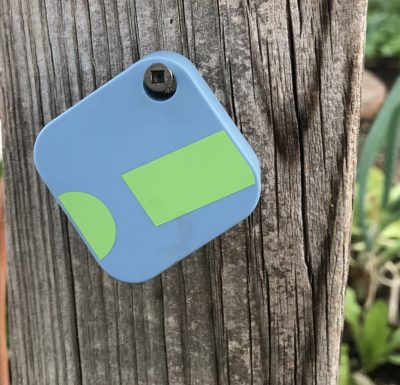
I’ve waxed enthusiastic about Sensorpush many times here on this blog. Basically, it’s a one inch square by 1/2 inch device that you place wherever you want to know the current and historical temperature, relative humidity, barometric pressure, dewpoint, and vapor pressure deficit. There’s one in my greenhouse, and it can alert me if the temperature goes above or below whatever temperature specified. SensorpushThe one on my garden gate is especially useful in spring and fall, when frosts threaten. As soon as the snow melts, my third Sensorpush will go beneath the pile of leaves protecting a fig tree I planted outdoors to monitor winter temperatures there. (Much more about this at a later date.)
So there you have it: seven companies whose products, in my opinion, make for better gardening or farming.

Get Ready for Spring

Are you interested in having a weedless garden this season? Learn how, at my upcoming WEEDLESS GARDENING webinar. The system I’ll talk about also makes more efficient use of water, conserves valuable soil organic matter, allows earlier planting in spring, and doesn’t disrupt beneficial fungi and other friendly soil organisms. Starting a new garden? Here’s the fastest way to get the soil prepared and plants growing.

I’ll cover all this, and more, in the webinar, and allow plenty of time for questions. The webinar costs $35 and runs from 7-8:30 pm on Monday, February 22, 2021.

Space is limited so registration is necess ary.Register at https://us02web.zoom.us/webinar/register/WN_WqSCBtOGTqqjGgbOHOuxfg.
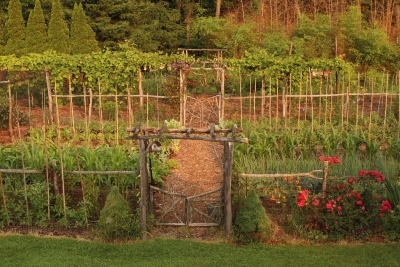
Garden view