GIFT IDEAS

Great Gift Ideas! Gardening books, of course. All available from the usual sources as well as, signed, right from me, here.

Weedless GardeningNot only weedlessness; also lots of information on drip irrigation, making or buying compost, cover crops, timing and details for individual vegetables, tree planting, fertilization, and soil testing. Weedless Gardening, coverI’ve used this weed-less system for over 25 years! $10.95


Growing Figs in Cold ClimatesFive methods for growing figs in cold climates, pruning techniques, best varieties, harvesting, and Fig book coverways to hasten ripening. $24.99


The Pruning Book: Reasons to prune, tools of the trade, how plants respond to being pruned, and details on just pruning just about every plant you can imagine,The Pruning Book from ornamental trees and bushes, to fruit and nut trees, to houseplants and perennials. A final section delves into specialized techniques such as topiary, bonsai, and espalier. $29.95

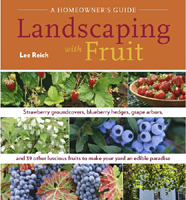
Landscaping with Fruit: How to choose what to grow depending on your region and particular pest or climate problems, and details for individual plants Landscaping With Fruit(the ornamental value, how easy they are to grow, what they taste like, varieties). Also a chapter on landscape design basics. $19.95


A Northeast Gardener’s Year
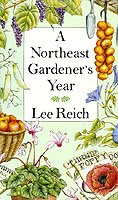
: Month by month, chapter by chapter, in the garden. Each chapter begins with a snippet of borrowed poetry to set the tone, followed by a A Northeast Gardener's Year covershort description of what is going on plantwise. From there we are left to the whims and vagaries of the weather and the weeds, the unfolding of blossoms and ripening of fruits, perhaps the cry of a plant begging to be repotted — any and all topics gardenwise. $17.00


The Ever Curious Gardener
: Using a Little Natural Science for a Lot Better Garden:
An irreverent romp through the natural science of plants and soil, ideal for The Ever Curious Gardenereveryone from newbies to experienced gardeners whose curiosity at the wonders of cultivation grows deeper and stronger with each season. How to maximize flavor and nutrition; how to help plants outwit drought; making the best sse of compost; etc, etc. $18.99


Grow Fruit Naturally
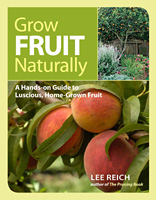
: How to successfully grow fruits that are delicious and nutritious without toxic chemicals. Covers planning, propagation, pruning,Grow Fruit Naturally pest control, storing your bounty, and growing fruit plants in containers. Details on over 30 fruits and how to reap their bounty. $24.95

FILBERT NUTS OR HAZELNUTS?

Species Matter; Varieties Matter

You say “tomayto,” I say “tomahto.” You say “filbert,” I say “hazelnut.” (“Filbert” is from St. Philibert, to whom August 22nd, is dedicated and which is the day of first ripening of hazelnuts in England.) Although hazelnuts originally referred to native American filberts, hazelnut and filbert are now equivalent.

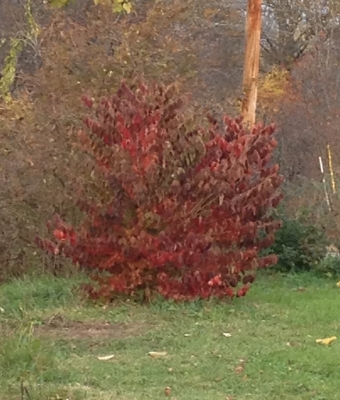
It’s been over twenty years since I planted my first hazelnuts. Fortunately, hazels bear quickly, often within 3 or 4 years. Unfortunately, a disease called eastern filbert blight can decimate the trees, and not begin to do so for about a decade. Our native hazels (Corylus americana), having evolved with the blight, are resistant. Not so for European hazels, which are the hazelnuts of commerce.Native hazel

My first planting was of our native hazel, which I planted for beauty and for nuts. It did turn out to be an attractive, suckering shrub that lit up fall with its boldly colored leaves. The nuts themselves were less notable: small and not very good tasting.

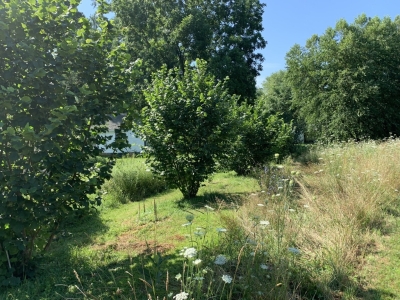
Next I planted a few old varieties of hybrid hazels, Graham, Gellatly, and Halls Giant, followed, a few years later by Tonda di Giffoni, Lewis, and Clark. All were billed as blight resistant and did quite well. In the 1960s eastern filbert blight made its way to the Pacific Northwest, the hotbed of commercial hazelnut production in the U.S. (providing 99 percent of domestic hazelnuts), which prompted breeding of resistant varieties. Lewis and Clark are two such varieties. Two more such varieties, Santiam and Yamhill, were added to my collection 11 years ago.MY hazel plantings

Right on schedule after about ten years, black pustules of blight began to show up on branches, which start to die, then finish. But the varieties I planted were blight resistant, you say. Resistance is a matter of degree (“immune” means no disease), and the varieties I planted evidently were not sufficiently resistant. 

Blight pustules on stems

This doesn’t at all reflect poorly on breeders of these not-quite-resistant-enough hybrids. The blight fungus is capricious, changing with location and, perhaps, over time. I dug up and out all the nonproductive, diseased plants.

But I like filberts. Enter a few breeders breeding filberts right here in the northeast. One is Dr. Tom Molnar of Rutgers University, from whom I got a few selections (with nonluscious, early selection names like CR X R03P26 and CR X R11P07), which I planted back in 2014. And Jeff Zarnowski, of Z’s Nutty Ridge Nursery. And others. So now I grow Geneva (aka Gene, from Grimo Nut Nursery), Truxton, Dorris (another selection from Oregon), Raritan (a more advanced selection from Rutgers), as well as my original Rutgers plants.

I’m ready to cull again any varieties that catch blight or whose nuts are too small. For wherever plants are culled, I have potted plants of Monmouth, Hunterdon, and Somerset — all advanced Rutgers selections — waiting in the wings. 

Streamlining Processing (On a Very Small Scale)

As with fruits in general, this year was also the best ever for nuts that I grow. Even the English walnuts (Juglans regia) bore a crop this year, their first substantial crop, all from 6 walnuts I planted back in 2006. I didn’t have high hopes for walnuts because they are susceptible to anthracnose disease, late frosts, and squirrels, which could conveniently harvest the nuts from the overhead squirrel highway along the road.

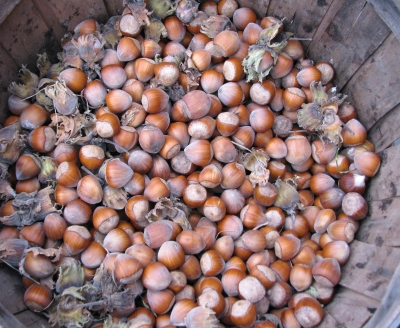
And the filberts — oodles of them. Mostly, we just shell and eat them. That’s fine. But for cooking with them or concocting a delicacy such as, say, fig-hazelnut jam, shelling nuts one at a time is too slow.Basket of filberts

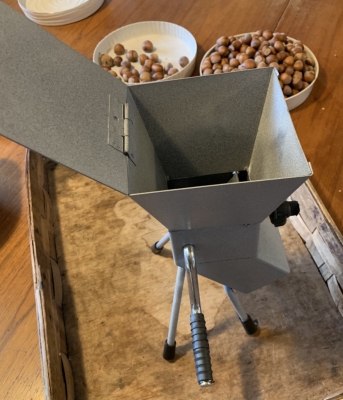
A quick web search turned up a couple of very elegant, home made shellers that work reasonably well. Luckily, before I delved too deeply in how I was going to fabricate one of these out of metal, I did a web search and found one available for about $30.

(These kitchen counter hazelnut sheller are manufactured in Turkey, which grows 70 percent of the world’s hazelnuts. Want another fun fact? Twenty-five percent of the world’s production goes into making Nutella and Ferrero Rocher, both hazelnut and chocolate confections made by the Luxemburger company Ferraro.)Turkish nut sheller

One problem with the sheller is that it needs adjustment for nut size, so it is recommended to do some sorting into size ranges before running nuts through the sheller. This I could make myself, easily. Basically, it is an open wooden box whose bottom has 3/8 inch square, wooden dowels spaced 5/8 inch apart, which is pretty much the size of my largest hazelnuts in the shell. The corners of the box are joined by hinges so that the sides can be moved to deform the shape. As the box deforms increasingly to a parallelogram, the distance between the dowels decreases. A pegged slat from one side of the box to n adjacent side holds the box to the desired shape and dowel spacing.

So I just adjust the box to the smallest dowel spacing needed, about 3/8 inch apart, dump on a bunch of nuts, and shake. Then I move the spacing up to about 1/2 inch, then shake again. And finally, move spacing to 5/8 inch, and . . .  well, you know.

Hazelnut size selector

I could be on my way to hazelnut butter, chopped hazelnuts sprinkled on everything, that fig-hazelnut jam, perhaps even home made Nutella. No rush. Once sufficiently dried (to 6 percent moisture, which takes a couple of weeks), hazelnuts store well in their shells for over year. Shelled and refrigerated, they keep for for about six months

STUFFED

Breadcrumb Seeds?

Who’s getting stuffed for Thanksgiving this year, you or your turkey, or your tofurkey? A good stuffing (of the real or faux bird) is good enough to eat sans bird. And, for best quality, you can grow it yourself. Not by dropping seeds of a “stuffing plant” in the soil, but by planting all the ingredients you need.

The bread and butter of any stuffing is some starchy food, often bread and butter itself, the bread usually as crumbs. There’s no breadcrumb plant, so forget about growing breadcrumbs. Not that you couldn’t buy some wheat berries, plant them next spring, harvest the grain when the plants dry down, thresh and winnow out the berries, grind them into flour, make the flour into bread, then let the bread go stale and pound it into bread crumbs. Whew! Most of us are not going to do this. 

“The Bread Tree”

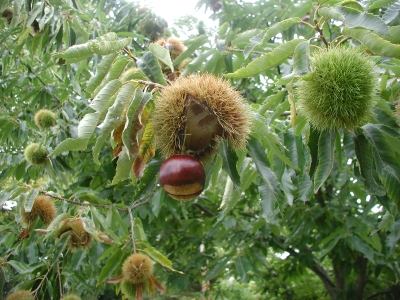
As an alternative to bread crumbs, might I suggest chestnuts (Castanea spp.)? Chestnut falling from its burrThey’re often billed as the “bread tree” because in contrast to other nuts, which are high in fats and protein, chestnuts are high in starch. Obviously, you’re not going to be eating home-grown chestnut stuffing this year, or next, or the next; it takes awhile for a chestnut tree to start bearing. Not that long though. I’ve had plants grown from seed begin to bear within six years, and a grafted tree from a nursery should bear even sooner than that.

(Although their nuts look similar, chestnuts should not be confused with horse chestnuts, Hippocastanum spp.. The latter are toxic. Horse chestnuts have compound leaves, very showy flowers, and their nuts are encased in a spiky capsule. Edible chestnuts have simple leaves, nonshowy flowers, and the nuts are encased in a cupule riddled with very sharp spines.)

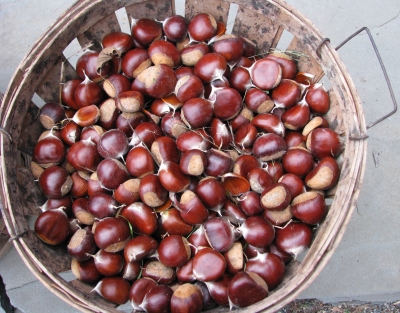
The North American, native and majestic American chestnut (C. dentata) has been decimated by chestnut blight but there are, fortunately other species that resist the blight. A good choice for nut production would be species or hybrids of Chinese chestnut (C. mollisima). Two different varieties are needed for cross-pollination.Chestnuts in a basket

The only caution in planting chestnut trees is to avoid planting them near where people frequently walk. Each fall the ground beneath the trees is littered with the opened, spiny cupules.
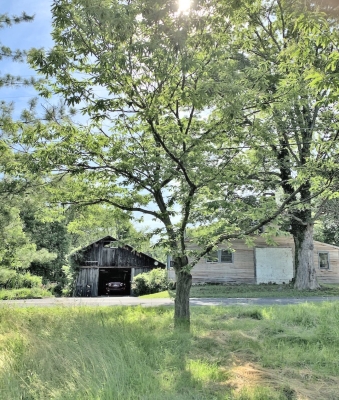
Chestnut tree in summer
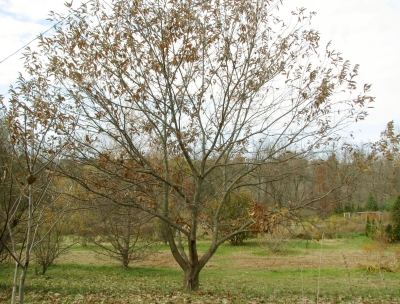
Chestnut tree in autumn

More Crumby Alternatives

While you are waiting to harvest chestnuts, make stuffing based on one of the more quickly grown starchy vegetables. Potatoes, for instance. The best potatoes for making stuffing will be those that are dry and mealy, russet varieties such as Goldrush, Burbank, and Idaho. 

“Dry and mealy” is also the mantra to use when choosing a winter squash variety to grow as a base for stuffing. The phrase “squash stuffing” has a nice ring to it, doesn’t it? My recommendation for a dry, mealy squash is a buttercup type called Chestnut or Sweet Mama. 

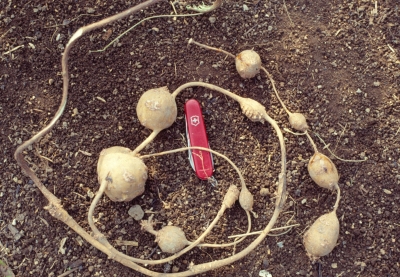
If you really want a truly authentic starchy base for stuffing, the plant to grow is nu nu, a golfball-sized, starchy tuber also called makoosit or groundnut (Apios americana). Groundnut tubersNative Americans harvested and ate nu nu, and this was one of the foods crucial in helping the Pilgrims survive their first winters in Massachusetts.

Be careful planting nu nu because it can spread like a weed to give you more stuff for stuffing than you would ever need. I planted it in a perennial flower bed decades ago. That was the wrong place for it, and I’ve spent decades trying to weed it out, unsuccessfully.

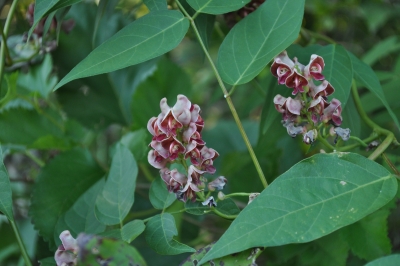
On the plus side, the plants do sport decorative and sweetly fragrant, lilac colored flowers, so it is worth growing where it can be regimented. Nu nu tubers grow attached a few inches apart along underground stems.Groundnut flowers

Seasonal Seasonings

Stuffing isn’t only about the bread-y ingredient. It also needs some seasoning. Parsley, sage, rosemary, and thyme, summer savory, sweet marjoram — they’re all very easy to grow. Sage and thyme are perennials, each also available in designer flavors. Pineapple sage, caraway thyme, and lemon thyme, for instance.

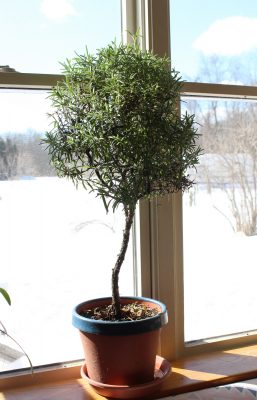
Potted rosemary tree in winter

Rosemary is also a perennial, cold hardy to zone 7, possibly even zone 6. It’s is not hardy here but I grow it as a “standard” (trained as a small tree) in a pot that summers outdoors and lives indoors at a sunny kitchen window in winter to provide pretty greenery, piney fragrance, and savory snippings.

Some vegetables from the garden round out and make more interesting a stuffing. Onion, celery, and carrots are mainstays, but vegetables such as parsnips and garlic can make special — and powerful — flavor contributions. 

Have a happy and healthy Thanksgiving!

PREPARING FIGS FOR A COLD WINTER

They’re Not Tropical

Too many people think fig trees are tropical plants. They’re not. They’re subtropical plants and that’s one reason those of us living in cold winter climates can harvest fresh, ripe figs. In fact, fig trees like that little rest that cold weather offers them.Fig fruits in plate

Here in Zone 5 (average winter lows of minus 10 to minus 20° F), I grow figs a number of ways. Figs are cold hardy to the low ‘teens, too cold for even subtropical plants to grow outdoors in the ground, their stems splayed to cold winter air like my apples and pears. Their roots, especially if mulched, generally will survive winters here in the relatively warmer temperatures underground. But then new shoot growth must originate at ground level, and the growing season isn’t long enough for figs that develop on those shoots to ripen.

Potted

  Some of my figs, like many of yours, are in pots.

With nighttime temperatures now often below freezing, there’s an urge to grab the potted fig and carry it indoors. Don’t! As I wrote, fig trees like a little cold weather. Experiencing some cold weather also toughens them to be more able to withstand even colder weather. My goal is to get these potted plants into a deep sleep, and to maintain that state as long as possible through winter, ideally until they’re ready to be carried outdoors again in spring.

My friend Sara's fig

My friend Sara’s fig last summer

If temperatures are going to be super cold, below the low ‘teens, move the plant to a temporary, but cool, location such as an unheated garage or mudroom, or garden shed.

Plants might still sport some leaves this time of year. Perhaps some of those leaves have been frosted. Not to worry.


Eventually, a potted fig needs to be moved to a winter home. Around here, at least, not yet. Typically, I leave my potted fig trees outside — in a slightly sheltered spot near a wall of my home where temperatures are modulated — until sometime in December. A fully dormant fig tree sheds its leaves so won’t need light in winter. If any of my plants are still holding onto their leaves, I just pull them off before the plants move to their winter home.

The winter home should be cold, but not frigid, ideally 30 to 45°F. That previously mentioned unheated garage or mudroom, or garden shed might be suitable. A minimum-maximum thermometer is an inexpensive way to know just how cold a site gets during winter even when you’re not in there or looking — at 2 AM, for example. 

Some of my potted figs retire to my basement for winter, where winter temperatures are usually 40 to 45°F.

Fig trees stored in cold basement

Kadota fig stored in cold basement

More recently, I’ve set up an insulated, walk-in cooler, mostly for storing fruits and vegetables. There’s also plenty of space for some potted fig trees. The cooler, which needs a little heat in the dead of winter, maintains a pretty consistent temperature of 39° F.

To help the plants remain asleep, I keep them on the dry side, perhaps watering them once or twice during this period.

To a point, the more stem growth on a fig tree, the more fruit it bears. So a potted fig can only bear so much fruit. I want more figs from some of my trees.

Innovations for Greater Yields

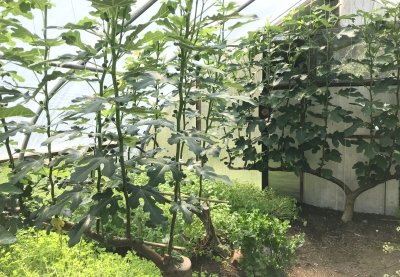
Years ago, I built a greenhouse in which to grow cool-weather-loving salad stuff and greens such as lettuce, celery, kale, chard, arugula, mustard, mâche, and claytonia through winter. I soon realized that the hot summers and the cool (never below about 35°F) winters in the greenhouse mimicked the Mediterranean climate that figs call home. So I planted four fig trees right in the ground in the greenhouse. The vegetables don’t mind their figgy neighbors because they’re leafless in winter.

Those fig trees are more than just leafless in winter; they’re also pretty much stemless. Each tree is trained to have a short trunk off which grows one or two permanent, horizontal arms. (This method of training is called espalier.) Espalier fig tree

Fig trees in greenhouse

Fig fruits on branchesFruits are borne on shoots that grow vertically from these arms. Tomorrow I’ll lop all those vertical shoots back to the arms. Next year, new shoots will bear fruits and be cut back next fall, and the year after that, new shoots . . . and so on.Pruned greenhouse fig
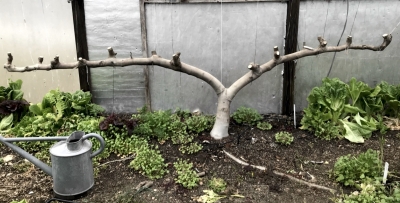
I’ve even used this method, this time with the horizontal arm trained just a few inches above ground level, for a fig tree I have growing outside. That low-growing arm is easily covered with a blanket of leaves, straw, or some other insulating material, how much depends on the depth of wither cold expected.Espalier fig outdoors
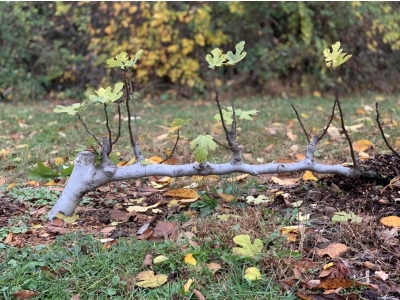
Once again, I’ll delay covering the plant until colder temperatures arrive so that the plant is hardened more against cold and goes into winter as dormant as possible.

Over the years, other figs of mine have weathered cold winters also by such methods as being bent over and covered to keep them warm and outdoors, by being grown in pots sunk into the ground then lifted, before the arrival of frigid weather. etc., etc. You want to harvest fresh figs in summer? There are many paths to this mountaintop.

The takeaway today is: Don’t protect your fig tree from too much cold too soon. Let the plant experience and benefit from the sleep-inducing and hardiness that some exposure brings.

And if you want to know more about growing figs in cold climate — varieties, method details, pruning,  accelerating ripening, potting mixes, and more — see my book with the eponymous title GROWING FIGS IN COLD CLIMATES (available from the usual sources as well as, signed, from my website).Here’s a very short video I made back in October about some methods of growing figs in cold climates and my new book: Fig video

BEAUTY AND FLAVOR

The Good, the Bad, and the Ugly (in my opinion)

For better or worse, every year nurseries and seed companies send me a few plants or seeds to try out and perhaps write about. The “for better” part is that I get to grow a lot of worthwhile plants. The “for worse part” is that I have to grow some garden “dogs.” (I use the word “dogs” disparagingly, with apologies to Sammy and Daisy, my good and true canines.) Before my memory fades, let me jot down impressions of a quartet of low, mounded annuals that I trialed this year.

Calibrachoa Superbells Blackberry Punch was billed as heat and drought tolerant, which it was. As billed, it also was smothered in flowers all summer long. It’s a petunia relative and look-alike. Still, I give it thumbs down. But that’s just me; I don’t particularly like purple flowers, and especially those that are purple with dark purple centers.

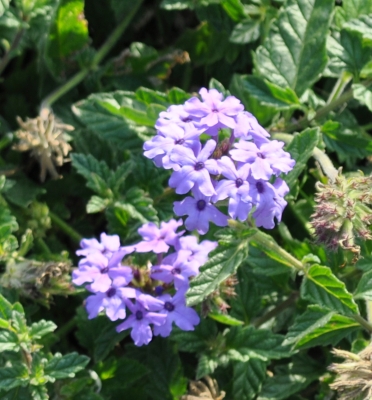
I’ll have to give Verbena Superbena Royale Chambray a similar thumbs down. superbena royale chambrayIt’s that purple again, light purple in this case. Also, the plants weren’t exactly smothered with flowers and most prominent, then, were the leaves which were not particularly attractive.
Golddust (Mecardonia hybrid) made tight mounds of small yellow flowers nestled among small yellow leaves. I give this one a partial thumbs up. The flowers were too small and there weren’t enough of them even if the leaves alone did make pleasant, lime green mounds.

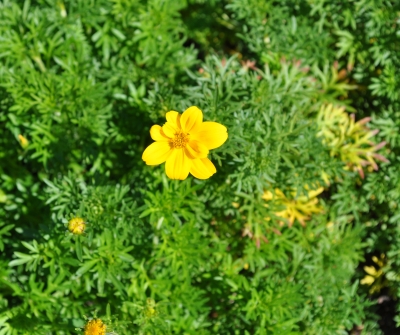
And finally, a rousing thumbs up for Goldilocks Rocks (Bidens ferulifolia). This plant also was a low mound of tiny leaves, needle-shaped this time. Sprinkled generously on top of the leaves all summer long were sunny yellow blooms, each about an inch across and resembling single marigolds. Flowering was nonstop, even up through the many recent frosts here, right down to 24° F.
Goldilocks Rocks
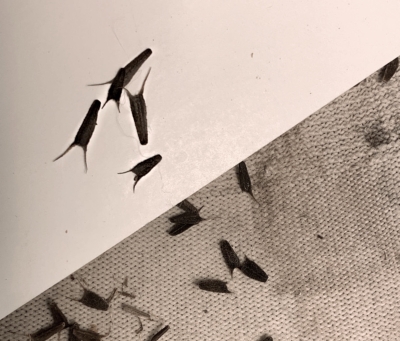
Bidens in its botanical name caused me slight pause when I planted Goldilocks, not because of any displeasure with our president, but because the common name for this genus is sticktight, or beggartick. You know those half-inch, flat, 2-pronged burrs that attach to animals — and, inconveniently, your socks — when you walk through wild meadows? Bidens, sticktightsThose are Bidens, trying to spread. (Not to be confused with the round, marble-size burs of burdock.)
No problem with Goldilocks Rocks that lined my vegetable garden paths. The flowers were too low to reach any higher than my shoes.

Ugly, Beautiful, and Tasty

Despite the recent spate of cold temperatures, there’s still fruit out in the garden, hanging on and ready for picking at my leisure.

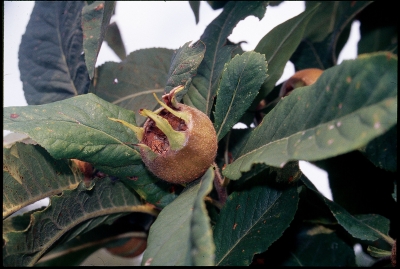
The first is medlar (Mespilus germanica), a fruit that was popular in the Middle Ages, but not now. Its unpopularity now is due mostly to its appearance. One writer described it as “a crabby-looking, brownish-green, truncated, little spheroid of unsympathetic appearance.” The fruits resemble small, russeted apples, tinged dull yellow or red, with their calyx ends (across from the stems) flared open. I happen to find that look attractive. Medlar fruit  in summer

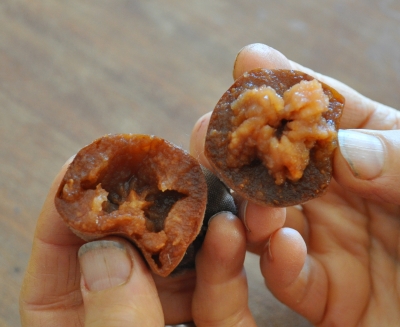
The harvested fruit needs to sit on a counter a few days, like pears, before it’s ready to eat. Worse, from a commercial standpoint these days, when ready to eat the firm, white flesh turns to brown mush. Yechhh! Except that it’s delicious, with a refreshing briskness and winy overtones, like old-fashioned applesauce laced with cinnamon.Medlar ready to eat

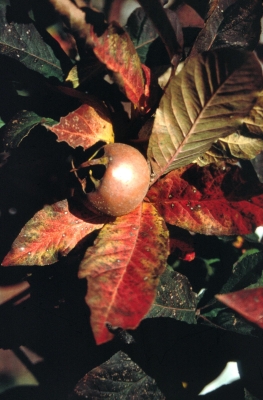
The plant itself is quite beautiful, a small rustic-looking tree with elbowed limbs. In late spring individual white blossoms resembling wild roses festoon the branches. In autumn, medlar leaves turn warm, rich shades of yellow, orange, and russet. Medlar in fall

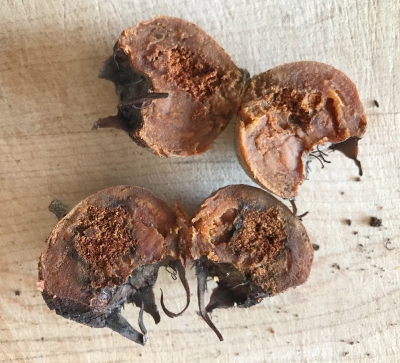
I would bill medlar as very easy to grow, except here on the farmden. A few years ago, a pest started attacking my fruits, turning the flesh dry, rust-colored, and inedible. I have yet to identify this pest (rust?) which is absent just about everywhere else. Do any other of you few medlar growers have anything to say about this pest, if you’ve seen it?Medlar pest

Beautiful and Tasty

Walking around my home to the bed supported by a low, stone wall along my front walkway, we come to lingonberry (Vaccinium vitis-idaea). This fruit never fails to stir a smile, a dreamy look, perhaps even a tear in the eye of Scandinavians away from their native land. Nonetheless, it’s actually is native throughout the colder zones of the northern hemisphere.

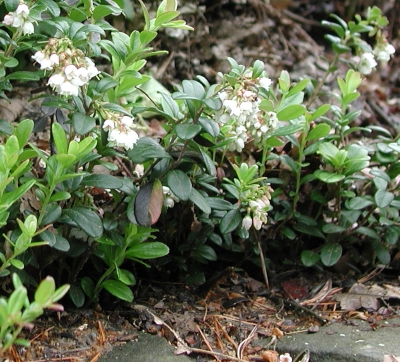
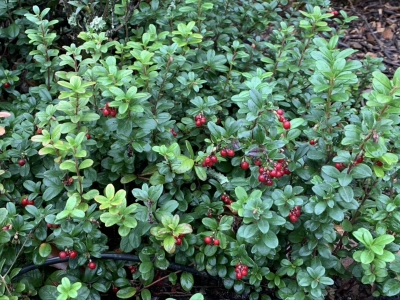
Lingonberry is an evergreen groundcover growing only a few inches high; I grow it both for its beauty and its fruit. In spring the cutest little white, urn-shaped blossoms dangle upside down (upside down for an urn, that is) singly or in clusters near the ends of thin, semi-woody stems. Lingonberry floweringThe bright red berries hang on the plants for a long time, well into winter, with their backdrop of holly-green, glossy leaves making a perfect holiday decoration in situ.Lingonberry fruiting
The key to success with lingonberries is suitable soil. Like blueberries, a close relative, they enjoy, they demand, a soil rich in organic matter, well aerated, consistently moist, and very acidic. I created these conditions with some peat moss in each planting hole, a year ‘round mulch of wood chips, leaves or sawdust, topped up annually, and sulfur applied to bring soil pH to between 4 and 5.5.

Lingonberries have been put to lots of culinary uses besides the usual lingonberry jam. I like to eat them straight from the plants. They’re not sweet, but they are delicious.

(I considered the two above-mentioned fruits so worthwhile that each warranted a chapter in my book Uncommon Fruits for Every Garden. This book’s out of print now, but is due to be revised and re-issued again in a couple of years. Some of the information in that book can be found in my currently available books Grow Fruit Naturally and Landscaping with Fruit.)


CATS ON A COOL, GREEN ROOF

Why and How to Build

I’ve got to learn to look up more, you know, the way tourists do; natives generally fix their gazes straight ahead to a destination or downwards, in thought. I am reminded of this when a visitor (a “tourist” in this context) walks up my front path, smiles, and tells me, “I like your green roof.” So then I (the “native” in this context) look up and join in the appreciation.Two cats on my green roof

My green roof was born about twenty years ago. After fumbling too many times with packages or keys in the rain at the front door, the time had come build protection from the elements. Rather than cover just the area around the door, this cover would extend over a small patio. And rather than just shingle the roof, why not make it a planted roof, a “green roof?”

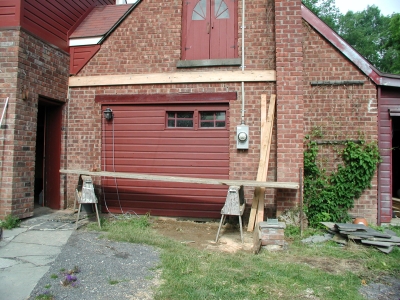
So my friend Bill and I built a sturdy, shallowly sloped roof supported on three corners by the walls of my house, and by an 8 x 8 white oak post in its fourth corner.Roof, ledger up The roof had enough slope so plants could be seen from the path, yet not so steep that a hard rain would wash the soil away.Roof completed

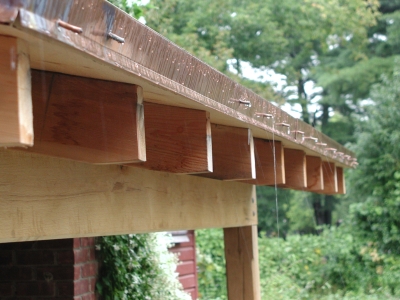
To keep the wooden structure dry, it was covered with EPDM roofing material and flashed with copper. A two-inch high lip of copper flashing along the low edge keeps plants and soil from sliding down off the roof. To prevent water from puddling at this lower end, I drilled holes and soldered short lengths of copper tubing at intervals into the lip, figuring that excess water would stream decoratively from each tube during rains. Roof drains(It streamed, but not so decoratively, because some tubes kept getting clogged and the bottom edge of the roof was not exactly horizontal so the flow burden was taken up by only a few tubes.)
How and What to Plant

Next was the gardening part of the roof. To keep the weight down, for low fertility to suppress weeds, and for good moisture retention I made a planting mix of equal parts peat moss and calcined montmorillonite clay (often sold as kitty litter).

The root environment on the roof was going to be harsh for plants. Only a two-inch depth of root run. And, in contrast to the moderated temperatures within soil out in open ground, roots on this shallow roof would experience mad swings in temperature that would closely mirror that of the air. And even though peat moss sucks up and holds moisture, there’s not much peat moss moisture to draw from in 2 inches of rooting.

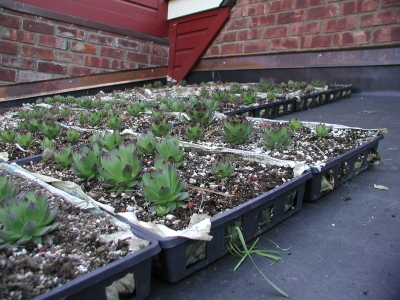
The plant choice, given the conditions, became obvious: some kind of hardy, succulent plant. I chose hens-and-chicks. After filling enough 24 x 10 inch planting trays with the planting mix, I plugged in hens-and-chicks plants every 4 inches in each direction. Hens-and-chicks in traysAll this planting took place almost a year before the roof was readied for the plants, important so the hen-and-chicks could make enough “chicks” to spread and pretty much cover the planting trays, which otherwise would have left too much planting mix exposed to washing from rainfall.
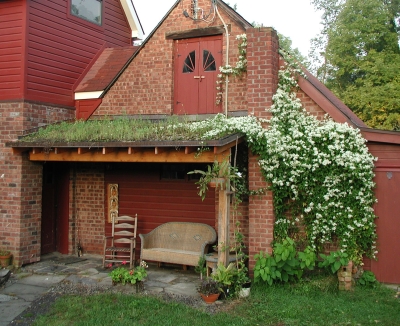

Up the trays eventually went on sloping roof, laid down like tiles on a tile floor. Everything looked very neat and trim.Green roof, early on

Nature Collaborates

Despite very little intervention from me, the years have brought some changes to that green roof. This was not a garden area that I ever planned to weed, and I stuck to my plan. I figured that a green roof with a weed-free planting mix, sheltered on two sides by walls, and eight to ten feet off the ground would not harbor weeds.

I was wrong. Some weeds have moved in. Well, not weeds per se, because a “weed” is plant in the wrong place, and the roof is welcome to pretty much any plant.

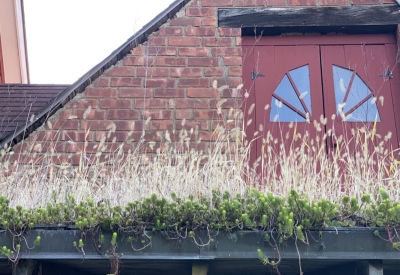
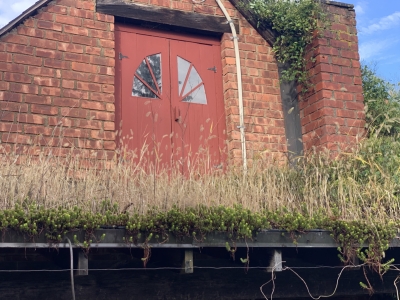
Gazing up on my roof now, I see, in addition to the original hens-and-chicks, plenty of foxtail grass, quite decorative through the year with green shoots in spring and tawny, fuzzy foxtails in fall and winter. Also a single cedar tree about two feet high.Roof with weeds
More weeds on roof

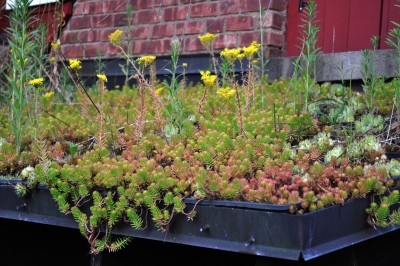
I had a hand in introducing another sedum, Angelina. This sedum has borne small, yellow flowers and, just as decorative, its fleshy leaves turn a deep red color in winter. Angelina started out as a single plant I set in a nearby stone wall; over time a few plants of it appeared up on the roof. Angelina on roof

Angelina floweringShe looked good up there, especially when draped over the front lip. She also multiplied rapidly both on the wall and on the roof. To further encourage her, I grab bunches wherever in excess on the wall and toss them up on the roof to root.
One year I also planted oats left over from cover cropping in the vegetable garden. Oats’ extensive roots would be good to further knit together the rooting mix and lessen chances of rain washing it down. Planting involved nothing more than grabbing handfuls of oat seed, tossing them up on the roof, then waiting for rain.

Writing about my green roof has encouraged me to more frequently look up at it. It does bring a smile. Is that because there’s something anomalous about an aerial garden?

Brooklyn Grange

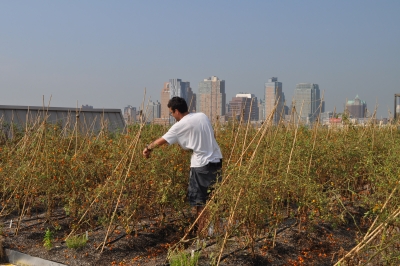
Urban farm high in the sky at Brooklyn Grange

OF MAPLES AND REDS

Where’d the Red Go?

Sugar maples (Acer saccharum) are now doing just what I expected of them. But not exactly what I want them to do. Here in New York’s mid-Hudson Valley, at least, this autumn’s leaf show is not quite up to snuff. And it’s also later than in the past. It used to peak here in the middle of October; nowadays, with climate change, the peak has been pushed forward to about now.Autmn view of the 'Gunks mountains

Back to the color: This year the local sugar maples are mostly only yellow, lacking the oranges and the reds that, along with some yellow, really ramp up the blaze of landscapes and forests. Let’s blame that more subdued show on the weather. To know why, let’s backtrack to summer when, quoting from a section in my recent book The Ever Curious Gardener, Using a Little Natural Science for a Much Better Garden:

Green is from chlorophyll, most welcome in spring and through summer, but not what interests me in fall. Chlorophyll must be continually synthesized for a leaf to stay green. The shorter days and lowering sun of waning summer are what trigger leaves to stop producing it, unmasking other pigments lurking there.

Leaves’ yellow and orange colors are aways present, thanks to carotenoid pigments, which help chlorophyll do its job of harvesting sunlight to convert into plant energy. I offer thanks to carotenoids for the warm, yellow glow they give to gingko, aspen, hickory, and birch leaves.

Sugar maple

Sugar maple (not this year)

Tannins are another pigment, actually metabolic wastes, that, all summer, are hidden by chlorophyll. Their contribution to the fall palette are the season’s subdued browns, notable in some oaks and enriching the yellow of beeches.

Because leaves harbor carotenoids and tannins all summer long, nothing particular about autumn weather should either intensify or subdue their autumn show. The only glitch could be an early, hard freeze that occurs while leaves are still chock full of chlorophyll. In that case, cell workings come abruptly to a halt and all we’re left with is frozen, green leaves that eventually drop without any fanfare.

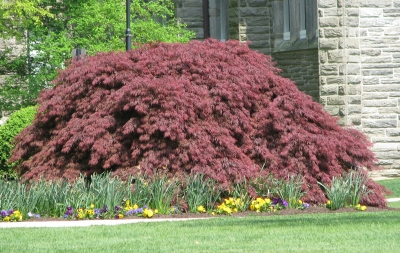
Autumn color also spills out reds and purples, most evident in red maples and some sugar maples, scarlet oak, sourwood, blueberry, and winged euonymous. Those reds and purples come from yet another pigment, anthocyanins. Except for trees like ‘Purple Fountain’ beech and ‘Royal Purple’ smokebush, whose leaves unfold dusky red right from the get go in spring, and remain so all season long, in most leaves anthocyanins do not begin to develop until autumn.Japanese maple

Anthocyanin formation requires sugars so anything that I or the weather does to promote sugar accumulation in autumn will increase anthocyanin levels in leaves. The weather’s role is to offer warm, sunny days to maximize photosynthesis, and cool, but not frigid, nights to minimize nighttime burning up of accumulated sugars. A cloudy, rainy autumn means less red because less anthocyanin is formed, and any that does form is diluted.

As I write this, it’s cloudy and rainy, as it has been so many days this autumn.

Other Reds

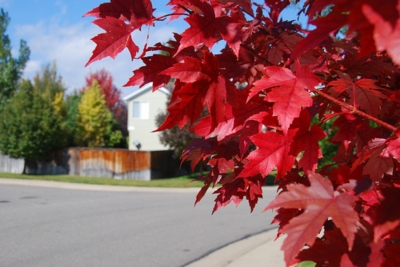
I was recently visiting my daughter in Pennsylvania. As we looked around her neighborhood I admired the rich, red, autumn color of the trees lining the streets. Red?! How can that be? What about what I wrote about this autumn’s weather and anthocyanin and red leaves in autumn?

Ah, but science takes care of that, too. Those trees in the Pennsylvania landscape weren’t sugar maples; they were a variety of Freeman maple (Acer × freemanii). Freeman maples are natural and deliberate hybrids of silver maples (Acer saccharinum) and red maples (Acer rubrum), the silver maple contributing fast growth to the hybrids and the red maples contributing strong branches and red leaf color in autumn. Freeman maple

Trees vary, both as to species and locations, in the amounts of pigments found at various times in their leaves. Red maples, as the name implies, have significant amounts of anthocyanins. In these trees, this anthocyanin is present not only in autumn as the chlorophyll fades, but throughout the growing season. Depending on the amount and kind of anthocyanin, its redness would be more or less masked by chlorophyll during the growing season. Some varieties of red maple, and many varieties of Japanese maple, are red or purplish all summer long.

The million dollar question is why a tree would have anthocyanin in its leaves all season long. Various theories have been floated. Anthocyanins do offer protection against excess sunlight, which is why young leaves emerge reddish on some plants.

Seedling red maples

Seedling red maples

(This characteristic does not correlate with the degree of red in leaves in autumn.) It’s also possible that anthocyanins could ward off pests.

Whatever the reason, red or orange or yellow leaves, I’m not complaining. Autumn is still a beautiful season here in the Hudson Valley. 


HARDWOOD CUTTINGS: NOT HARD (TO DO SUCCESSFULLY)

Pros for Hardwood Cuttings

Years ago, I had just one plant of Belaruskaja black currant. Now I have about a dozen plants of this delicious variety, and plenty of black currants for eating. Do you have a favorite tree, shrub, or vine that you would like more of. 

Hardwood cuttings are a simple way to multiply plants. This type of cutting is nothing more than a woody shoot that is cut from a plant and stuck into the soil some time after the shoot has dropped its leaves in the fall, but before it grows a new set of leaves in the spring. In the weeks that follow planting, if all goes well, some roots may develop and, come spring, this apparently lifeless piece of stem grows shoots and more roots, and is well on its way to bona fide plantdom.

(Be very careful, though. Multiplying plants can become an addiction. I speak from experience.)

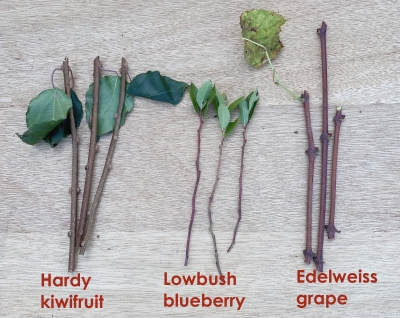
Hardwood cuttings, kiwi, blueberry, grape

Easy to root

Success with hardwood cuttings depends on both your skills and the plant chosen. Not every woody plant is amenable to increase by hardwood cuttings. You can expect close to one hundred percent “take” with plants such as grape, currant, gooseberry, privet, spiraea, mulberry, honeysuckle, and willow. But this method generally is unsuccessful in making new apple, pear, maple, or oak trees. 

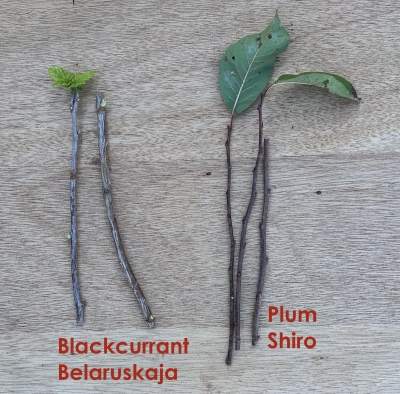
Because they lack leaves, hardwood cuttings are less perishable than “softwood cuttings,” the leafy stem cuttings that are taken while plants are in active growth.Blackcurrant and plum cuttings

If you’re a novice and want to make your thumbs feel greener early on, try your hand with hardwood cuttings of willow, a plant I have seen take root from branches inadvertently left on top of the ground through the winter. Most other plants demand a little more finesse to ensure success with hardwood cuttings.

Gathering Wood

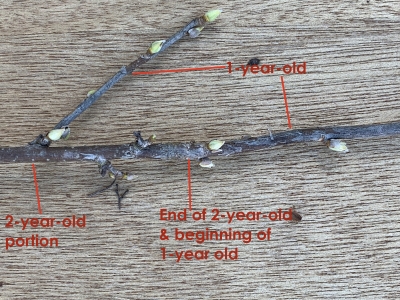
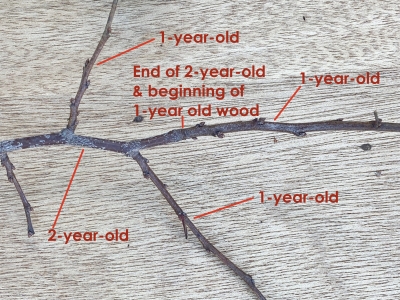
All right, so you have a woody plant you want to multiply by hardwood cuttings. Step back and look at the plant before you take wood for cuttings. Look for some young shoots, those  that grew this past season; snip them off for cuttings. The shoots most likely to root are those of moderate vigor, not too fat and not too thin for the particular species.

Black currant, 1 and 2-year old stems

Black currant, 1 and 2-year old stems

Plum, 2 and 1-year old wood

Plum, 2 and 1-year old wood

Once you have one or more shoots “of moderate vigor” in hand, cut them down to a manageable length of eight inches or so. Look for the nodes on each branch; these are the points where leaves were attached. Make the cut for the top of each cutting just above a node, and the cut for the bottom of each cutting just below a different node. 

Make sure the upper end of the cutting, which is the point that was furthest from the root, is planted pointing upwards. The plant “remembers” this orientation and responds accordingly, growing roots from the bottom and shoots from the top of each cutting. (Although it’s not impossible to root upside down cuttings, there’s just less chance of success.) Professional propagators cut the bottoms off squarely and the tops at an angle so that the ends don’t get mixed up during planting.

Success Comes With . . . 

Plant the cuttings in your garden where the soil is not sodden. Without good drainage the cuttings will rot, rather than root.  Make a slit with your shovel, slide in a cutting until only the top bud is exposed, then firm the soil. The rooted plants should be ready for transplanting to their permanent homes by next fall.

Cuttings can be set in the ground for rooting either immediately or stored through the winter for setting out in early spring. I’ve had better success with fall, rather than spring, planting. In the spring, the cuttings often are overanxious to begin growth and the top growth is well underway before the roots have begun. The shoots soon realize that there are no roots to sustain them, then flop over and die. 

With cuttings planted in the fall, roots have the opportunity to develop from now until the soil freezes. In the fall, soil temperatures drop more slowly than air temperatures so there’s still some time, depending on your location, before the soil freezes solid. New shoots, on the other hand, won’t grow until next spring, after they feel they have been exposed to a winter’s worth of cold. (This is a natural protection mechanism that prevents plants from resuming growth during a warm spell in January.) Come spring, the shoots that grow from the tops of the cuttings will already have at least the beginnings of roots to bring sustenance.

Blackcurrant cuttings in spring

Blackcurrant cuttings in spring

Mulch fall-planted cutting so that alternate freezing and thawing of the soil doesn’t heave them out of the ground.

Cuttings could even be planted in pots with a well-drained potting soil, as long as the pots are kept cool (30-45°F) long enough for the shoots to “feel” winter, so they can grow shoots in spring.

If you’d rather plant in the spring, the cuttings need to be kept cool and moist through the winter. The traditional method of storage is to bundle the cuttings together and bury them upside down in a well drained soil. Why upside down? Because the bottoms of the cuttings then will be first to feel the warming effects of spring sunlight beating upon the ground, while the shoot buds are held in check buried deeper in cold ground.

A refrigerator can substitute for the traditional burying. Seal the cuttings in a plastic bag, wrap the bag in a wet paper towel, and then seal the whole thing in yet another plastic bag. Plant as early in spring as soil conditions permit.

Pay attention to what works and what doesn’t, figure out why, and you’re on your way to propagation addiction. Next worry is what to do with all your plants.

WHAT I LEARNED ABOUT BRUSSELS SPROUTS

Sprout Success

Years ago, a friend referred to Brussels sprouts as “little green balls of death;” that never exactly increased the gustatory appeal of this vegetable for me. The same could be said for “a little boiled to death,” a too common way of preparing the vegetable, and perhaps that’s what the friend had actually said.

Still, I’m always up for a horticultural challenge, even if I had never had success with Brussels sprouts. What does “lack of success” mean with Brussels sprouts? Dime-size sprouts.

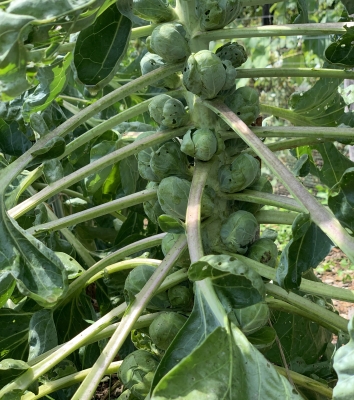
Sit tight. This season my Brussels sprouts are a roaring success, and I’m going to impart to you what I learned about growing this sometimes maligned vegetable. Or, at least, what I did differently this year, which was a few things, so I’m not sure whether one or more of them was responsible for my achievement. It could even have been the weather, which I had no hand in.Brussels sprouts on plant

Brussels sprouts is a very long season vegetable, so seeds need to be sown in spring for a fall harvest. Check. I planted mine back indoors in March for transplanting in May. They could have been sown a little later, at some sacrifice of yield.

A big difference in what I did this year was that the seeds that I sowed were those of a new variety, Catskill. Although a new variety for me, Catskill is actually an old variety, first introduced in 1941 by Arthur White, of Arkport, New York. It’s billed as yielding especially large sprouts (yes) on compact stalks (nope). In previous years I grew Gustus, Hestia, and Prince Marvel, and all were duds for me.

The Catskill mountains are only an hour’s drive away from my farmden, which perhaps explains my success with the same-named variety. But, as they often say (quietly) in advertising, “your results may differ.” My suggestion is to try a few varieties until you find one that does well wherever you garden or farmden.

Brussels sprouts requires a rich, near neutral soil high in organic matter. Check. My Brussels sprouts beds have always received, as do my other vegetable beds, an annual dressing of a one-inch depth of compost. Decomposition of compost enriches the soil with a variety of nutrients, including nitrogen.

Still, another big difference in what I did this year was to give my plants an extra oomph with, in addition to the compost, a sprinkling (1 pound per 100 square feet) of soybean meal, an organic source of nitrogen.

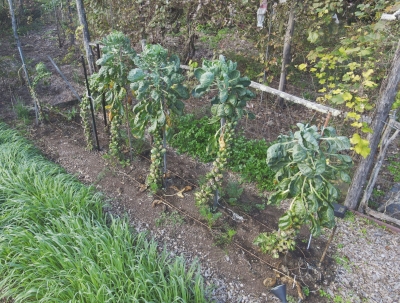
In anticipation or hope of large plants, each Brussels sprouts plant was afforded plenty of elbow room this year, with plants two-and-a-half feet apart down the middle of the three-foot-wide bed. They were flanked on each side by a single row of early carrots which, I figured, would be harvested and out of the way by the time the Brussels sprouts plants were spreading their wings (leaves).View of bed of Brussels sprouts

My previous efforts with Brussels sprouts always resulted in three-foot-high plants that, early in their youth, flopped to the ground. Only after a plant’s supine stem had created a firm base would the end of its growing stem curve more or less upward, according to original plan. That youthful waywardness wasted and muddied lowermost sprouts, with the sprawling plant demanding even more space, which was a problem in my intensively-planted garden.

This year each plant had the companionship of a sturdy metal pole right from the get-go. Loops of string around the stalks and the stakes kept up with the plants’ upward mobility.

Pest Alert

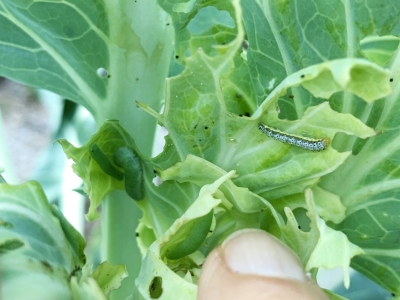
Finally, and very important, is pest control, specifically of any one of the few leaf-eating caterpillars, colloquially called cabbage worms, which are the offspring of of those cheery, white moths that flutter among the plants on sunny days. The caterpillars also attack broccoli, cabbage, and cauliflower, all relatives in the cabbage family (Brassicaceae).Cabbageworms

A very effective and nontoxic to most creatures (including to you and to me) control is spraying with Bacillus thuringienses, a naturally-occurring bacterium extracted from the soil. This material is more easily remembered under the name Bt, packaged up under such commercial names as Thuricide, Dipel, and Monterey B.t.

I checked the plants frequently through the growing season, at first just crushing any caterpillars I found and, only when the damage was getting severe, resorting to the spray. Cabbageworms, like any pest, can develop resistance to most pesticides, more likely the more that is used. 

GMO. No

As an aside, that potential resistance of a pest to Bt is a problem with crops developed as genetically modified organisms wit Bt toxins. Almost all commercial corn and cotton have been genetically engineered in this way; the genetic material has also been incorporated into cotton, potato, rice, eggplant, canola, tomato, broccoli, collards, chickpea, spinach, soybean, tobacco, and cauliflower.

The problem arises because a field of plants expressing the Bt toxins is akin to that whole field being sprayed with Bt all season long. There is evidence of the development of resistance to Bt by insect pests of the genetically modified crop plants.

FERTILIZING 101

Feed Sooner, Not later

Although shoot growth of woody plants ground to a halt weeks ago, root growth will continue until soil temperatures drop below about 40 degrees Fahrenheit. Root and shoot growth of woody plants and lawn grass are asynchronous, with root growth at a maximum in early spring and fall, and shoot growth at a maximum in summer. So roots aren’t just barely growing this time of year; they’re growing more vigorously than in midsummer. 

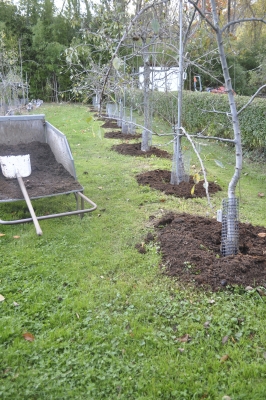
Compost mulch on pearsRemember the song lyrics: “House built on a weak foundation will not stand, no, no”? Well, the same goes for plants. (Plant with a weak root system will not be healthy, no, no.) Fertilization in the fall, rather than in winter, spring, or summer, promotes strong root systems in plants.
By the time a fertilizer applied in late winter or early spring gets into a plant, shoots are building up steam and need to be fed. Fertilization in summer forces succulent shoot growth late in the season, and this type of growth is susceptible to damage from ensuing cold.

They Hunger For . . . 

The nutrient plants are most hungry for is nitrogen. But nitrogen is also the most evanescent of nutrients in the soil, subject to leaching down through the soil by rainwater or floating off into the air as a gas. The goal is to apply nitrogen so that it can be taken up by plants in the fall, with some left over to remain in the soil through winter and be in place for plant use next spring. 

Two conditions foster nitrogen loss as gas. The first is a waterlogged soil. If you’re growing most cultivated plants — yellow flag iris, marsh marigold, rice, and cranberry are some exceptions — your soil should not be waterlogged, aside from considerations about nitrogen. (Roots need to breathe in order to function.) Nitrogen also evaporates from manure that is left exposed to sun and wind on top of the soil. Manure either should be dug into the soil right after spreading, or composted, after which it can be spread on top of the soil, or dug in.

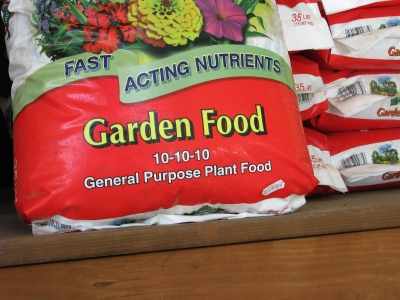
Leaching of nitrogen fertilizer is a more common and serious problem, especially on sandy soils. The way to prevent leaching is to apply a form of nitrogen that either is not readily soluble, or that clings to the soil particles. Most chemical fertilizers — whether from a bag of 10-10-10, 5-10-10, or any other formulation — are soluble, although a few are specially formulated to release nitrogen slowly.

Fertilizer labelThe two major forms of soluble nitrogen that plants can “eat” are nitrate nitrogen and ammonium nitrogen. Nitrate nitrogen will wash right through the soil; ammonium nitrogen, because it has a positive charge, can be grabbed and held onto negatively charged soil particles. Therefore, if you’re going to purchase a chemical fertilizer to apply in the fall, always buy a type that is high in ammonium nitrogen. The forms of nitrogen in a fertilizer bag are spelled out right on its label.
Go Organic

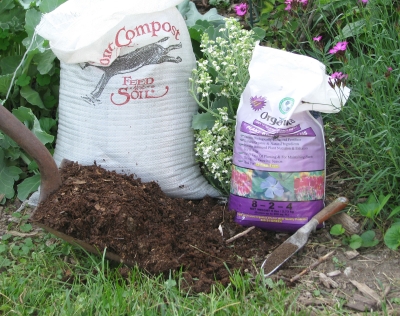
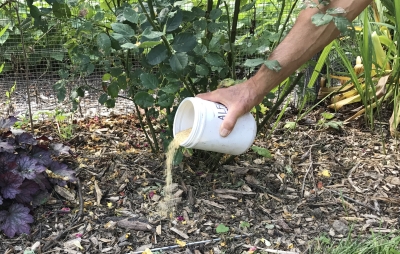
Rather than wade through the chemical jargon, nitrogen loss through the winter can be averted by using an organic nitrogen fertilizer. Nitrogen in such fertilizers, with the exception of blood meal, is locked up and held in an insoluble form. As soil microbes solubilize the nitrogen locked up in organic fertilizers, it is released first as ammonium nitrogen. So by using an organic nitrogen source, the nitrogen is not soluble to begin with, and when it becomes soluble through the action of microbes, it’s in a form that clings to the soil particles and not wash out of the soil.Organic fertilizers

(Except in very acidic soils, other soil microbes then go on to convert ammonium nitrogen to nitrate nitrogen. This reaction screeches almost to a standstill at temperatures below 50 degrees Fahrenheit, so the ammonium nitrogen can just sit there, clinging to soil particles, until roots reawaken in late winter or early spring.)

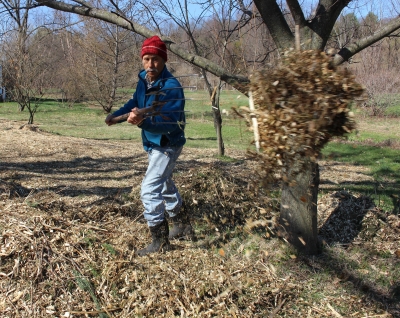
Common sources of organic nitrogen include soybean meal, cottonseed meal, fish meal, and manure. Hoof and horn meal, leather dust, feather dust, and hair are esoteric sources, though plants will make use of them as if they were just ordinary, organic fertilizers. Even organic mulches, such as wood chips, straw, and leaves, will nourish the ground as they decompose over time.Fertilizer application Woor chip mulching

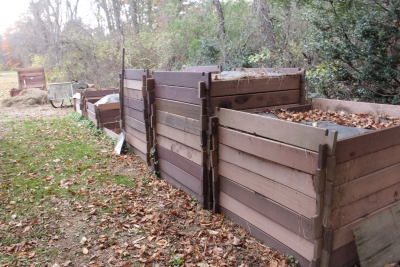
The Cadillac of fertilizers is compost. Compost offers a slew of nutrients, in addition to nitrogen, released slowly into the soil as microbes work away on it. Compost — most organic fertilizers, in fact — are not the ticket for a starving plant that needs a quick fix of food.Compost bins

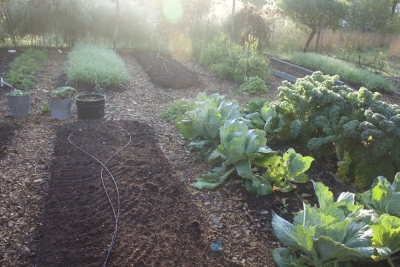
Every year I spread compost an inch deep beneath especially hungry plants like vegetables and young trees and shrubs to keep them well fed. Less hungry plants get one of the above-mentioned organic mulches. The benefits of these applications continue, trailing off, for a few years, so annual applications build up continual reserves of soil nutrients, doled out by soil microbes, that translate to healthy plants and soil.Composted garden beds
(More details about fertilization can be found in my book Weedless Gardening.)