
ESPALIER, A TASTY FUSION OF ART AND SCIENCE
Let’s Revive an Ancient Technique
Let’s go back in time, say, four hundred years. You’re puttering around your garden, your walled garden — walled to keep out animals and unfriendly neighbors. Hmmmm, you think, why not plant a fruit tree in that strip of earth against that wall, perhaps a fruit that will also benefit from the extra warmth over there? May as well make the plant look nice and orderly, too.
And so originated espalier (ES-pal-yay): a plant, usually a fruit plant, usually trained to an orderly and two-dimensional form. The word is derived from the Old French aspau, meaning a prop, and most espaliers must, in fact, be propped up with stakes or wires.
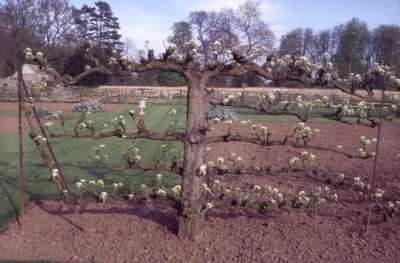
Although today we rarely build walls to fend off unfriendly animals or neighbors, an espalier still might warrant a place in the garden. Grow an espalier where you want a formal effect, especially where space is limited, or grow a row of espaliers side by side so they meld together as a living fence. Nowadays, no need to back an espalier up against a wall and no need to restrict espalier only to fruiting plants.
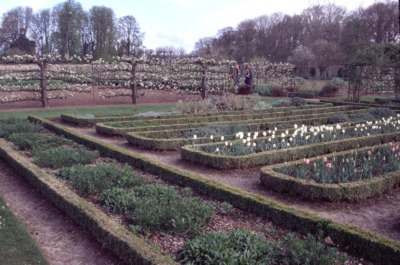
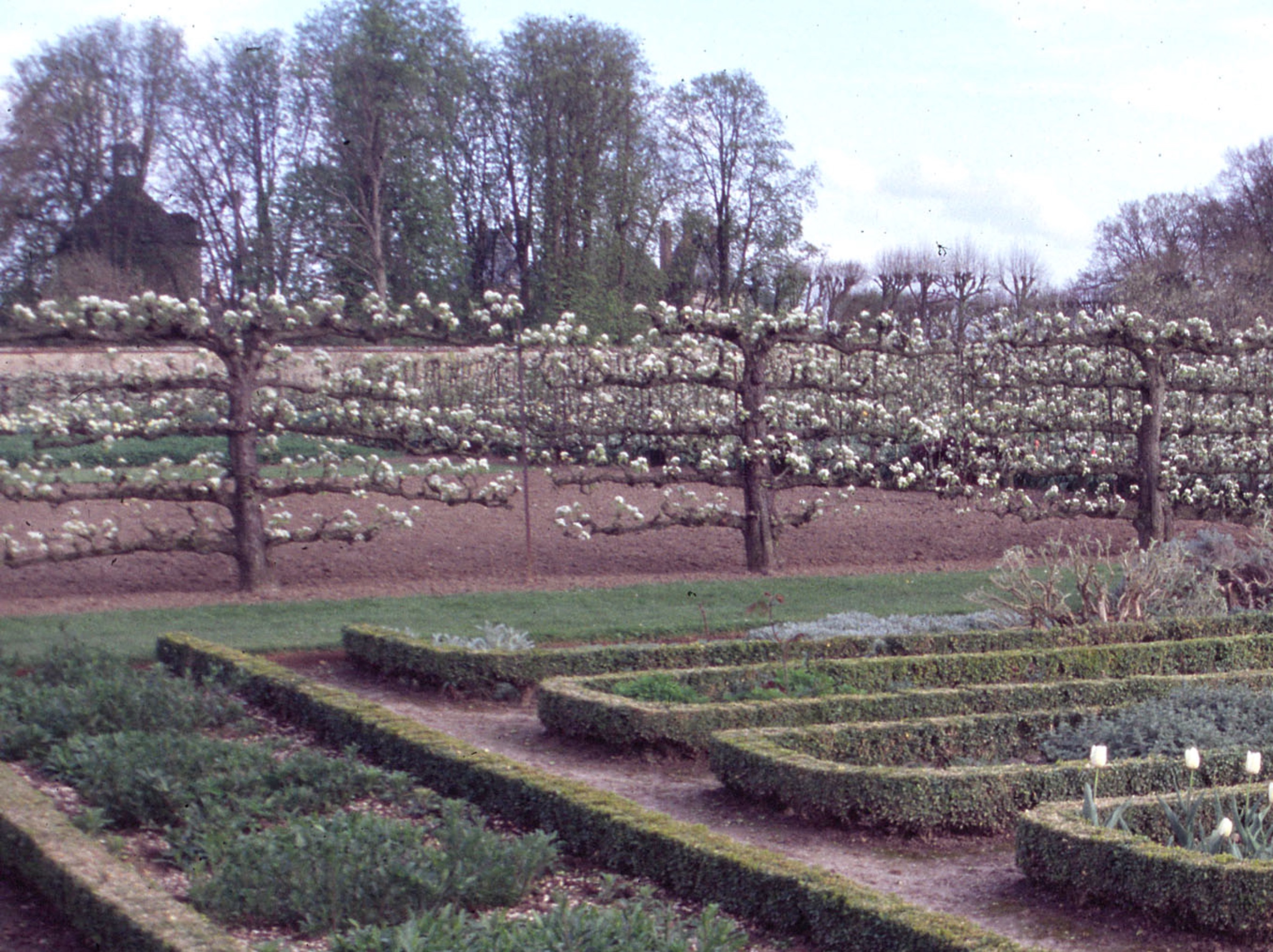
Pear espaliers at St. Jean de Beauregard
Most espaliers need a wood, wire, or rigid metal framework for support and to make sure their stems are straight and at the desired angles. For an espalier growing against a wall, erect the framework about a foot away from the wall so that air can circulate behind stems. Rather than tie a stem directly to the framework, it may be more convenient to lash it to a bamboo cane that follows the desired direction of growth, then tie the cane to the framework. This lets you keep the stem straight, but growing a whatever angle you wish no matter what the layout of the frame.
A Perk: Delicious Fruit Also
Espalier is not a low-maintenance way to grow plants. It usually demands repeated pruning through the growing season, perhaps in winter also, to keep the plant within bounds and to maintain that orderly appearance.
Is it worth all this trouble, having to erect a trellis and then so frequently pinch and snip to keep the plant in shape? Well, besides the ornamental effect, the actual growing of the espalier is fun. A well-grown, fruiting espalier represents a happy commingling of art and science.
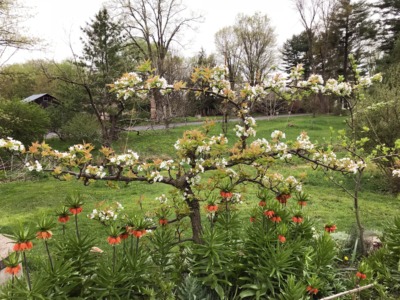
Asian pear espalier trained self-supporting en arcure
You apply this science artfully (or your art scientifically) by, for instance, maintaining a congenial balance between stem growth and fruiting, pulling stems upward for more stem growth, or downward for more fruiting. Cut notches where stems threaten to remain bare. Shortening branches in summer to keep growth neat and fruitful.
Where you want branching, shorten a young stem. How much you shorten influences the number and vigor of shoots that regrow, with more severe cuts leading to fewer, but more vigorous, shoots. Where a stem is growing in the wrong place, just cut it away completely.
Done well every branch on a well-grown espalier is clothed throughout its length with leaves and, for the edible espalier, fruits. Those fruits, bathed in sunlight and air, grow especially luscious, large, and full-colored.
Many Variations
An espalier consists of one or more main stems, “leaders,” off which grow “branches” and, in some cases, “ribs.” Branches are temporary, and on the solely ornamental espalier, you just cut them back as frequently as is necessary to keep the plant orderly and handsome. Growing a fruiting espalier is trickier, though, because then you have to be careful that your repeated pruning doesn’t cause flowering and fruiting to suffer.
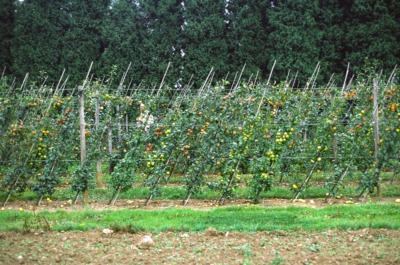
Oblique cordon espaliers in Great Britain
The simplest form of espalier is just a single stem, a “cordon.” Set eighteen inches apart in a row, vertical cordons are a way to cram many varieties of apple into a small area. A horizontal cordon can be a decorative and luscious border for a path or garden. The fruiting cordon is best suited to plants that bear fruits on short growths, called spurs, so that the cordon can be kept looking like a cordon, rather than like a porcupine.
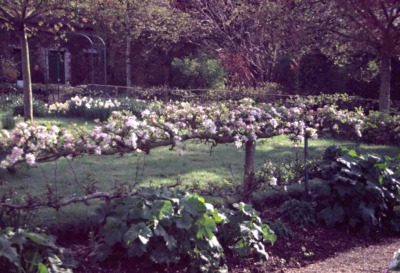
Apple espalier at Giverny
To see how other forms might develop from a vertical cordon, imagine terminating that single stem to split it into two stems, which turn away from each other before growing vertically again. You now have a “U palmette.” Split those two vertical leaders of the U again and you have a “double-U palmette.”
All these forms have an inherent shortcoming: They are threatened by apical dominance, which is the tendency, on any plant, for strongest growth from buds and shoots that are spatially highest.
Various forms of espalier have been devised to be artistic even as they sidestep apical dominance. One popular form is the “fan,” in which the central stem terminates to split into two stems that angle upwards and outwards. Other designs purposely weaken the central leader by bending it around in a decorative curve, rather than allowing it to grow straight upward.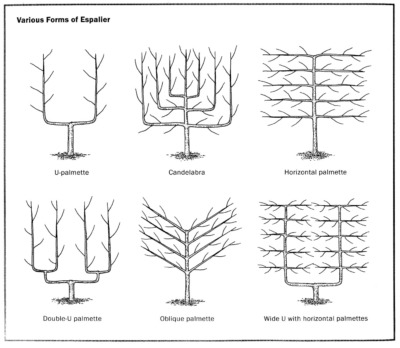
An Especially Easy Espalier
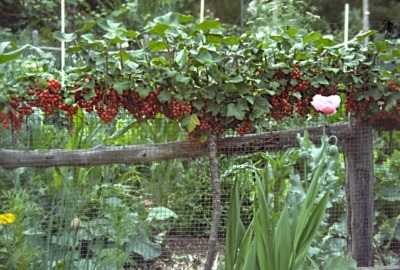
Red currant is easy to espalier as a simple T; I grew one to adorn the fence around my vegetable garden.
I began by cutting away all stems except a single upright one, which would become the trunk. I tied it to a stake as it grew to keep it straight. Once the stem grew a bit higher than the fence, I cut it back to that point and selected two side shoots to become horizontal leaders — the “arms” — growing in opposite directions.
I had two goals with the developing leader: To keep it growing from its tip, and to keep lower buds active. Toying with a leader’s orientation is the way I achieved these goals.
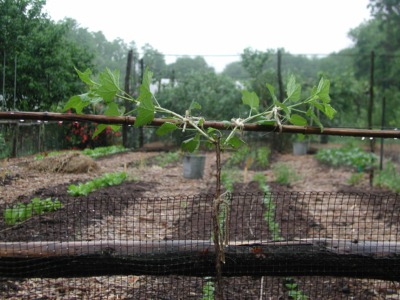
Currant trunk with 2 developing arms
I initially trained the two horizontal arms at an upward angle to keep growth stimulated — the more upward pointing, the more tip growth and the less branching. As the arms approach full length, I gradually lowered them to slow tip growth.
The basic procedure for training the red currant espalier can be adapted to other forms and plants with a few additional wrinkles.
Once the leader was full length, I shortened it each year, when dormant, to just about where growth began the previous season. But even before it was full-grown, its older parts needed strict pruning to control branch growth and so maintain the neat shape of the plant — all without any sacrifice of fruit yield or quality.
In the case of red currant, this pruning is straightforward. I just shortened all branches to about five inches just as the fruit is starting to color. In winter, I cut those shortened branches back further, to about two inches. Thisbuilds up short, fruiting growths right near the leaders.
How pruning accomplishes this goal with other fruit plants depends on a plant’s fruiting habit. More on that after your espalier has finished its training period . . .
If you want to dive deeper into espalier, see my book, THE PRUNING BOOK https://www.leereich.com/books, in which I devote a whole chapter to the techniques.



Leave a Reply
Want to join the discussion?Feel free to contribute!