
THE POWER OF TOUCH
Too Tall and Too Thin
I hope that I’ve caught you in time, before your seedlings have stretched out too long and too thin. That’s a problem this time of year. Tomato, zinnia, and broccoli plants — they’re all growing up on sunny windowsills. It’s the combination of a bit too much warmth and a bit too little light that causes that stretching.
The easiest way around this problem would be to just wait until the weather warmed up enough to sow seeds directly outside. There, abundant sunlight, cooler temperatures, and buffeting by wind would make sturdy, stocky seedlings. Of course, do this and you won’t eat your first broccoli bud until the end of June, and you’ll have to wait until early September to admire your first zinnia flower or bite into your first tomato.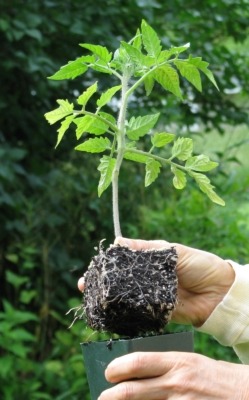
So we’re back indoors. Turning down the heat, pulling window curtains way back, cutting down any trees that block light in a south-facing window — all this helps. But still, you can draw just so much light into a window of your house, and it doesn’t compare with outdoor light. And the more sun you let stream in, the hotter it gets.
A Brush With . . .
There is another way to make your indoor seedlings sturdier and that is to merely touch or shake them. No need to make this a full time job, because brushing them back and forth ten times each day is sufficient, doing all ten at once or spreading the brushing throughout the day. That’s for this time of year; there’s some evidence that twenty brushings a day may be needed in June.
That brush that you and I use in winter to whisk snow off our windshields can find meaningful existence during the growing season brushing seedlings. 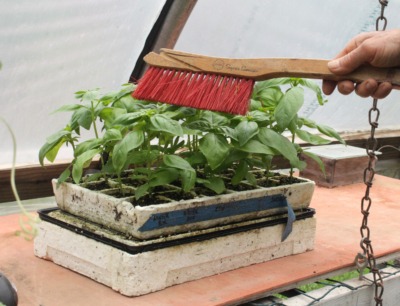 Run it lightly over the tops of your seedlings. Or use a horizontally held broom handle. Or the palm of your hand.
For something different, shake the seedling flat instead of brushing the seedlings. Or blow air on them with a fan for, perhaps, thirty seconds each day.
Although stocky and sturdy growth helps seedlings better survive transplanting and adapt to outdoor conditions, we don’t necessarily want our plants to remain dwarfed once planted outside. Fortunately, the dwarfing effect of shaking, touching, or wind wears off within days after transplanting.
While brushing plants to make them stockier might seem woo-woo, there Is science to back it up. The movement causes a slight stress which, in turn, causes release of ethylene gas, Ethylene is a plant growth regulator which can slow stem growth. After all, other plants are more familiar in such responses. Buffeting by wind is partly responsible for the stockiness of trees growing on windswept cliffs.
The emphasis is, as I wrote in the previous paragraph, on “slight stress.” You don’t want to break stems. Brushing and time will make those once-fragile stems more resistant to damage. Give seedlings a few days of growth before they are able to tolerate any stress.
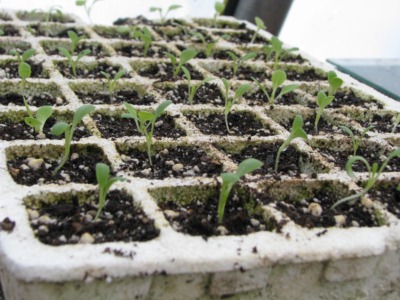
Too young to brush
Everybody’s Doing It
Touch response isn’t rare among plants. What do you think makes a pole bean or morning glory stem twine around a pole? They are responding to touching the poles. The same thing makes tendrils of peas and cucumbers cling to a chicken wire fence. 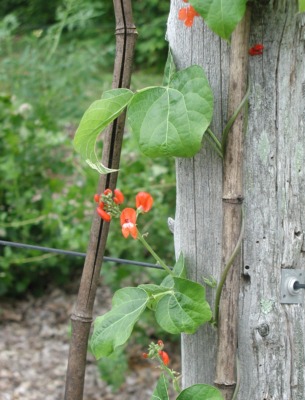 A scientist who stroked a pea tendril for 5 minutes found that it remained curled for days, as if pining for a twig or piece of wire to hug.
Venus fly trap is another plant that responds to touch, in this case with the sensitive hairs within its trap. The trap clamps shut, but remains so only if those hairs continue to be touched for a few minutes after the trap closes, indicating a live catch.
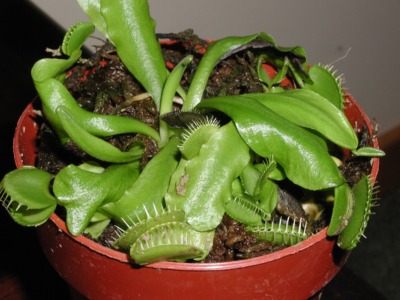
Venus flytrap
The so-called sensitive plant (Mimosa pudica) has an equally dramatic, but less intimidating, response to touch. Touch makes its leaves collapse all of a sudden. The response can be as quick as a tenth of a second, with the signal, an electrical one, coursing through the stems as fast as 2 feet per second.
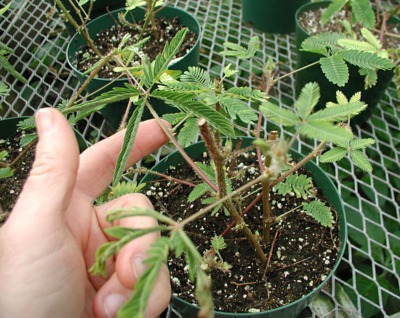
Mimosa collapsing
Shaking and touching plants doesn’t only or always dwarf them. Caressed cucumbers or melons bear a greater proportion of female flowers than do plants that have not been caressed.
And shaking a plant for long periods each day can lead to increased growth, a technique that has been applied in Japanese greenhouses using vibration — even music! I wonder if this means that talking to plants would also affect their growth. If so, don’t talk too much to your seedlings until you know how they’ll react.
(For more about thigmotropism, as touch sensitivity is called, and other sensitivities of plants, see my book The Ever Curious Gardener: Using a Little Natural Science for a Much Better Garden.)



Your suggestions for strengthening the stems of plants sounds so right! I’ve been to many plant give-a-ways where the stems of the vegetables in pots are so thin that I doubt they’d last for a few days. I assume the same suggestions apply to touching nut tree seedlings. Have you ever experimented with touching give them a strong start in their perennial lives?
Hi Jerry, I’m pretty sure that the principles apply to all plants.