
PLANT SMALL, THINK BIG
Chillax
If delayed gratification sometimes seems to be too much a part of gardening, it does teach us to appreciate the means to an end as much as the end itself. Especially with planting trees. Your vision might call for a towering maple or spreading beech in a corner of your front yard, but you can do no more than plant one, care for it, and wait.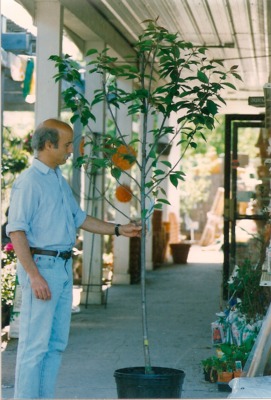
Not that full-sized trees cannot be — and sometimes are — moved for instant effect. Take enough earth along, keep it intact around the roots, and even a large tree hardly knows it’s been relocated. Such moves demand heavy, specialized equipment and plenty of money. Even then, though, a number of these trees die within a year of their move, or just sulk for many years.
Size Does Matter
We mortals are better off planting smaller trees — much, much smaller ones. In fact, if you’re talking about trees that you ordinarily buy from a nursery, smaller is usually better than larger. Financial considerations aside, research has shown that if the same species of large and small tree are planted under similar conditions, growth of the smaller tree often outstrips that of the larger one after a few years.
One reason for the better growth of smaller trees is because they suffer proportionately less loss of roots in transplanting. A larger tree needs a lot more water to recover from its move, and because it takes longer to reestablish itself, watering must be continued longer, often for a few years.
Nursery trees are commonly sold balled-and-burlapped (B & B), in pots, or bare root. B & B trees are dug from fields in spring, their roots and attached ball of soil then swathed in burlap. Although such trees typically lose well over 50 percent of their roots during digging, these trees survive transplanting well as long as their root balls remain intact, they are planted soon, preferably before growth begins, and their tops are not too large in proportion to the size of the roots.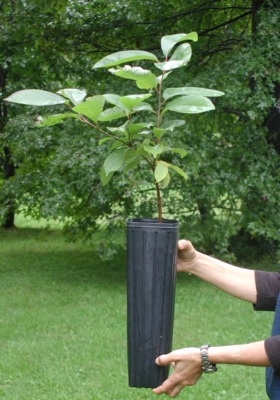
Potted trees spend their whole youth in pots — at least they should. Advantages of potted trees are that they can be transplanted almost any time of year and with no loss of roots. Potting soils are porous and watered frequently at the nursery, so after being transplanted a potted tree needs diligent and regular watering until roots start to spread out into surrounding soil.
Nix any benefits a potted tree gets from having its whole root system moved intact if the tree is to big for its pot. Then the roots grow around and around inside the pot, and sometime after being planted out, the tree begins a slow decline as it strangles itself.
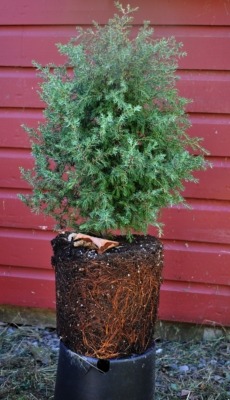
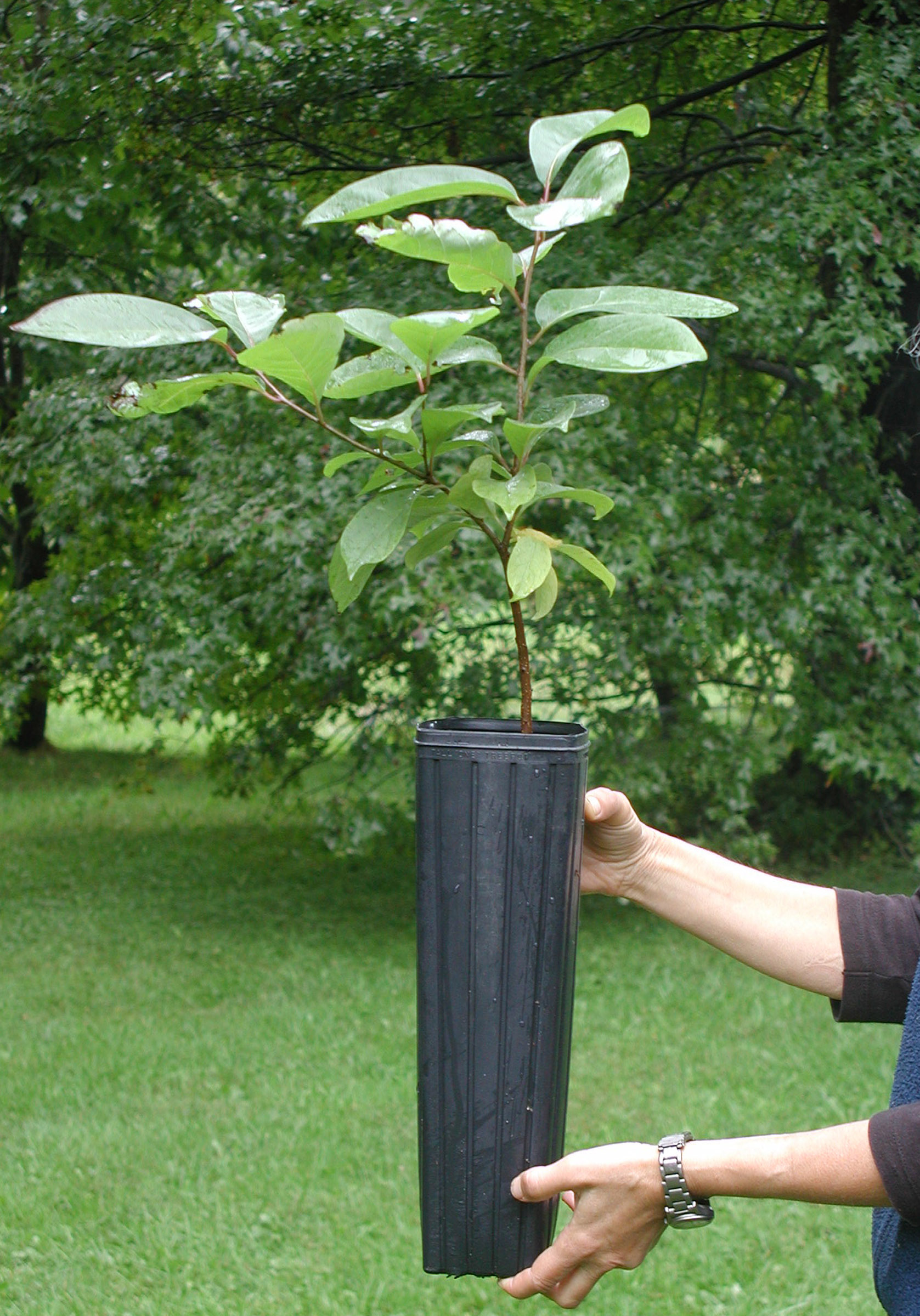
Height and healthy roots indicate that this tree is just the right size for its pot
Bare root trees are those that are dug up from the field while they are dormant, then have some water absorbent material such as wet sawdust packed around their roots. These plants can remain in storage as long as they remain dormant (leafless and not transpiring water), and can be shipped in good condition when needed. Because they can be easily and successfully shipped, they are often available in greater variety than potted or B & B trees.
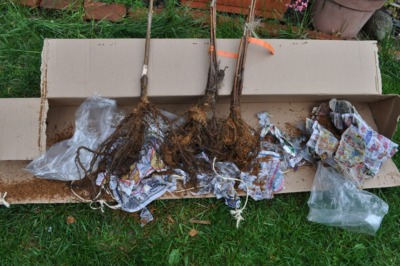
Unpacking a shipment of bare root trees
Some nurseries buy in bare root trees and pot them up to be sold as such. You’ll know this is the case when almost all the soil falls away from the roots as you tip it out of the pot. No problem with this as long as you’re being charged a price for a bare root tree and as long as the tree is still leafless.
But How Small, or How Big?
You’re now ready to shop for a small tree, or at least one whose top is not too big for its roots. But how big is too big? You could just eyeball the plant and use your judgement.
Specific standards for B & B trees have been spelled out by the American National Standards Institute (ANSI). Those ANSI standards are quite detailed, but a few examples can give you a feel for what to look for. Three measures help judge the quality of a nursery tree: trunk diameter 6 to 12 inches above the soil line, tree height, and root ball diameter. According to the standards, a tree whose root ball is 12” across should be no taller than 4’ or have a trunk caliper of no more than 3/4 of an inch. Corresponding measures for root balls 18 inches across are 7 feet and 1.5 inches.
With potted trees, look for a tree whose height is no more than 2 or 3 times the depth of its pot. Even better is to tip the plant out of its pot. What you should see is plenty of soil, with young white, pink, or tan root tips growing at the outer edge. Thick roots circling the bottom of the root ball are a no-no.
My choice in buying a tree is a bare root plant that is 4 to 5 feet tall. Planted carefully, mulched, and watered religiously for their first season (one gallon per square approximated spread of the roots), the tree will take off and grow with minimal care from then on.
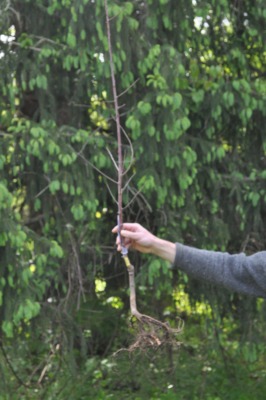
A good bare root tree, nice roots and height
So rather than shopping for a tree with the tallest trunk, plant small and enjoy caring for your plant, watering it, pruning it, and watching it grow. As your little tree grows, frost, rain, and sun will lend a patina to the trunk and limbs; near the ground, creeping plants will lend a gentle embrace. There’s no way around it — time is needed to bring character to any tree.



Love your blog. Thank you. When are you having a sale
Thanks. Not sure about the sale but contact me in late May.
Thank you for this wonderful blog.