
THE TOP OF THE SOIL
Where Roots Like to Roam
“Topsoil” is one of the haziest terms used by gardeners — and by those who sell the stuff. After all, topsoil is nothing more than the top layer of soil.
And what’s so special about this layer of soil? Under natural conditions, topsoil is the most fertile portion of soil. In the forest each autumn, leaves fall on the surface of the ground, where they are digested by soil life to release nutrients and create soil organic matter. In meadows, including prairies, the topsoil each year is similarly enriched by the remains of old roots, leaves, and stems of flowers and grasses.
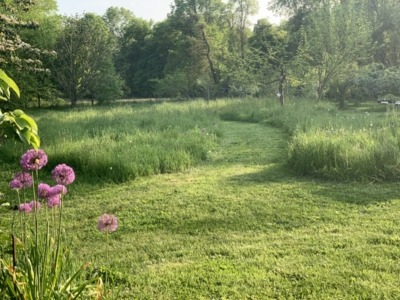
Lush meadow above ground, rich soil below ground
It’s no wonder that the feeder roots of plants — from magnificent maples to midget marigolds — choose to live and work in the topsoil! Here is where roots find a soft bed and a congenial mix of food, water, and air. Much of that congenial mix is the result of the diversity of friendly bacteria, fungi, and other micro- and macroorganisms that make their home there. The diversity of life in that layer of ground helps plants fight pests. It’s rich in nutrients, especially nitrogen.
But What is Topsoil?
Topsoil develops naturally, but it takes centuries, even millennia, to develop.
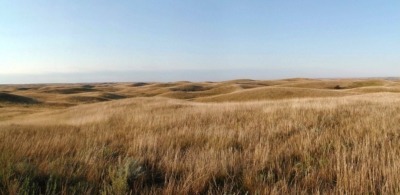
Native prairie in N. Dakota. (Rick-Bohn-USFWS-wiki-CC.)
Because natural topsoil is a limited resource, it is not what you necessarily get when you purchase “topsoil.”
When you purchase topsoil, you might get whatever soil happens to be in the upper layer of any piece of ground. That top layer may turn out to be what was left after the real topsoil was eroded or stripped away some time ago.
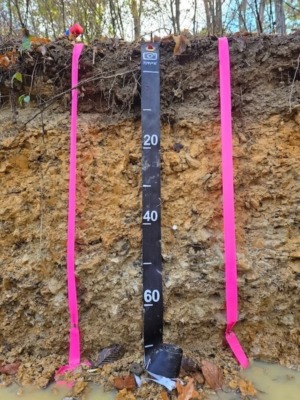
Soil profile showing real topsoil
Or, purchased topsoil might be a manufactured product. Not that there’s anything wrong with manufactured topsoil, which is made by mixing almost any soil with some organic material such as compost or leaf mold. It can be a good substitute for the real thing.
Because “topsoil” is so ill-defined, it pays to ask some questions before you have a mountain of it slid off a truck bed into your yard. Ask the seller whether the topsoil was mined or made. Ask how much organic matter the topsoil contains. For comparison, a rich natural topsoil has about 6 percent organic matter.
Ask whether the mineral fraction, i.e. ground up rock particles, of the topsoil is a clay, sand, or loam. For most purposes, loams, which are equitable mixes of sand, silt, and clay, are ideal. (Sand, silt, and clay are designations of the size ranges of minerals in the soil, the ranges being 2 to 0.05 mm, .05 to .002 mm, and less than .002 mm according to the USDA system.)
The very small particles of clay soils have very small spaces between the particles which cling to lots of capillary water. The result: clay soils hold plenty of water but not enough air, which roots need to breathe. Sandy soils have the opposite problem, the large particles have commensurately large spaces between them; these soils cling to little water but have plenty of air spaces. However, a clay soil that is aggregated, with its small, clay particles clumped to form larger units, provides the best of both worlds: Air between the aggregates and water clinging to the clay size particles within aggregates. Air and water, just what plants need to thrive. Organic matter, besides its other virtues, helps aggregate clay soils.
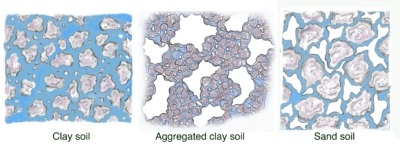
Water, air, and mineral particles in clay, aggregated clay, and sandy soil
Another question worth asking before you get a load of topsoil delivered is whether or not it has rocks in it. You might already have a rocky soil. What you want is soil, not rocks.
How about chemical residues. Especially topsoil that has been scraped from the surface of farmland might contain pesticide residues. The effects of some pesticides can linger for years.
Do You Really Need It?
Also ask yourself a question: Why are you buying topsoil? If you’re buying it to enrich very poor soil in your vegetable or flower garden, don’t. Use pure compost instead, either home made or purchased, spread right on top of existing ground.
Perhaps you have a low area in your yard that you want to fill, then plant to lawn, vegetables, trees — anything, in fact. No need to fill that whole depression with topsoil. Instead, first fill the bulk of the space with some cheap dirt, preferably a loam or sand. Then top the whole area with a layer of topsoil a few inches deep.
Perhaps you need soil to build raised beds for your vegetables. Buy compost in this case? No! Compost is mostly organic matter which is mostly compounds of carbon, hydrogen, and oxygen, which decomposes to carbon dioxide and water. The compost will sink dramatically in its bed, requiring more of the same.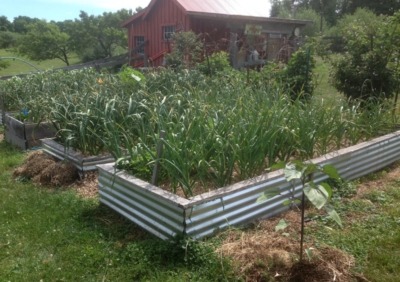
For a raised bed, I’d recommend any well-drained — that is, sandy or loamy soil — to fill the bed leaving enough head room for a topping of 2 or 3 inches of pure compost . Each year the bed will require just another inch or two of compost for fertility and all compost’s attendant physical and biological benefits.
Perhaps you’re thinking of buying topsoil for a new lawn. Here’s a perfect use for topsoil. Lawn grasses thrive in rich soils, making topsoil an ideal covering for the poor dirt left at most construction sites or where topsoil has been stripped away or is otherwise lacking. Any excavator worth his or her salt will strip off and pile up topsoil to spread back out after excavation is finished.
No matter where you use topsoil, always spread it on top of the ground, where it can do most good. Good topsoil is alive and breathing, but not if it’s buried within the bowels of the earth. And besides, some of the benefits of topsoil, such as helping rainfall and air percolate into the ground, come specifically from its being on the surface.



When left unused for a season, I am covering those raws in my garden with plastic, to avoid weeds growth. At end of the season I remove the plastic and add a couple inches of compost in preparation for next season.
By covering the raws for 6 months with plastic am I doing anything wrong?
Probably not. I assume the raws are broken down by the time you uncover the ground.