
MOLES, THE FURRY KIND
A Nice, Springy Lawn
One year my lawn felt particularly soft and springy. It felt pleasant at first, then that feeling gave way to panic once I looked down and saw tunnels pushing up just beneath the surface. A mole invasion!
Before contemplating turning a herd of these velvety, furred creatures into a mole fur garment, I consider why they were there and just what they were doing.
First of all, the “they” probably was an “it.” Moles are very territorial animals, so even if a lawn or garden is riddled with tunnels, it may be the work of just a single interloper.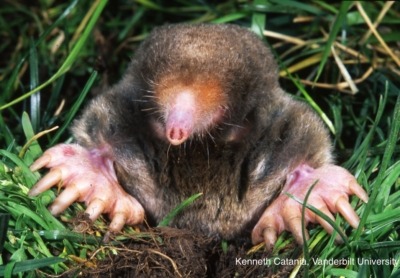
And, while all those tunnels I saw were, in fact, feeding tunnels, moles might be considered garden and lawn allies, rather than pests. Only rarely will they enjoy a bit of vegetarian fare, perhaps a softened seed or a bit of root. Moles eat mostly insects, and among their favorite foods are earthworms and fat, juicy grubs. (Import moles to your garden to rid it of invasive, jumping worms?)
Earthworms generally are beneficial to the soil, but those grubs: the reason they are so fat is because they are dining on the roots of your plants, mostly lawn grass. After a year of feeding, grubs pupate to become the Japanese beetles that will dine on your roses, grapevines, and zinnias, as well as over 200 other plants.
No Food, No Moles
I’m not suggesting welcoming moles to your backyard as grub killers. Even though moles don’t eat roots, the tunnels do admittedly disrupt roots enough to kill seedling plants. Those tunnels also are sometimes used by mice and voles — who do eat plant roots. The tunnels also ruin the smooth look of the lawn.
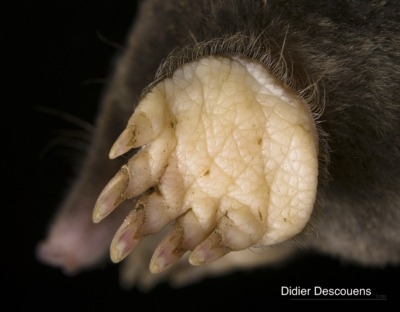
Mole paw, good for digging
The most obvious way to dissuade a mole from living in your backyard is to get rid of its food, specifically the grubs. Milky spore disease or predatory nematodes are commercially available preparations that attack grubs, yet are nontoxic to just about everything else.
A quicker way to kill grubs is to strap to the bottom of your shoes special spiky soles that aerate the soil and spear the grubs as you walk around your lawn. Incidentally, watering the lawn all summer long to keep it green and lush also keeps the grubs happier — and makes for more mowing.
Draw the Line
Another way to thwart moles is with some sort of barrier. The barrier could be small mesh fencing buried 18 to 24 inches deep in the soil, or — even better — bent into an L-shape to extend outward 6 inches at that 18 to 24 inch depth. Moles are not climbers, so the fence need not be more than a few inches high.
Some gardeners report success using certain plants as barriers. One plant used for this purpose is even called mole plant (Euphorbia lathyrus). Like other euphorbias, this one emits a caustic white juice when injured, and perhaps really does keep moles at bay.
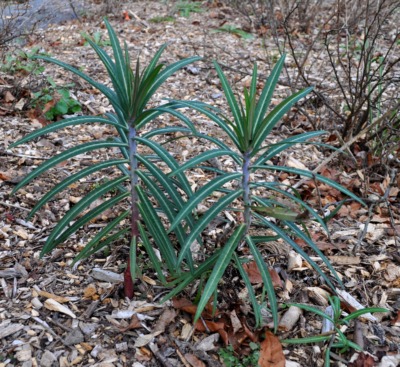
Mole plant
I’ve grown this plant occasionally, and I no longer have moles here. (Possible correlation, not cause and effect.) I like the plant for its architectural structure, often a single upright stem with four thin, strappy leaves radiating outward at each node from the top of the plant to the bottom. Be aware that the plant is invasive in certain areas. Even here in New York’s Hudson Valley, plants were showing up in increasing numbers year after year. I got scared and removed all of them, and haven’t seen any since — until, after perhaps a decade now, a few small ones have showed up here and there.
Castor bean is another plant that moles purportedly find offensive. The plant grows rapidly lush, so its effect on moles could be secondary, as it dries out the soil to reduce the number of insects — the mole’s food — present. Maybe it’s the plant itself, though, because some gardeners report that moles will not cross a strip of ground that has been watered with a mixture of castor oil and soap, and that a mole will avoid a tunnel into which has been dropped a castor bean seed.
More Innovative Controls
A contraption that might keep moles away are those little lawn windmills whose turning vanes make a wooden man chop wood. Moles have very soft skulls, soft enough so that they are stunned, or even killed, just from the shock wave when the surface of the ground is hit with the flat of a shovel blade. Perhaps a mole would naturally avoid ground that was thumped. Pinwheels might also work, and electronic versions of that mechanical wood chopper are now available.
Those were the gentler controls; there are quicker-acting and more surefire ones. For instance, you could flood the nest in spring. First you must locate one of the permanent tunnels, which are different from the feeding tunnels in being straight, deeper, and repaired within a day or so if disrupted. Once you find the tunnel, flood it with water for about 15 minutes. The adult will escape, but not the young.
Various traps are available that kill moles. Because the shallow, feeding tunnels are often used only once, there is more chance of a mole happening upon the trap if it is placed in a permanent tunnel.
And then there is the mole skin garment. Quick side note: Moles have been such a pest in Great Britain that Queen Alexandra, wife of Edward VII, ordered a mole-fur garment, starting a fashion trend that created a lucrative industry while helping get rid of moles. Single coats require hundreds of moles.
One final, quirky cure that I have come across for mole problems is baiting a tunnel with JuicyFruit gum. Unwrap the gum in such away that it does not touch your fingers, then drop it in a tunnel. Moles presumably like the taste, but after they eat it, their innards are gummed up. I’m not sure I would wish such a fate upon a grub killer.
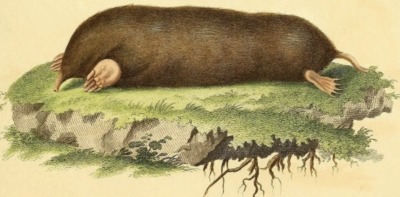
Mole, Johann Andreas Wagner 1855



Leave a Reply
Want to join the discussion?Feel free to contribute!