
A MAYAPPLE IN SEPTEMBER
An Eerie Plant
September does not seem a likely time for seeking out things called “mayapples,” but this when they are ripe. Obviously, mayapple is no ordinary apple. In fact, it’s not an apple at all. But you can eat it, I guess.
Mayapple (Podophyllum peltatum) is a native plant that blankets forest floors throughout eastern North America. Each spring, as soon as winter chill is out of the air, the perennial rootstocks send up new stalks. Each stalk grows about 18 inches high, then is capped by just one or two leaves. The leaves are like large shields, deeply lobed and held parallel to the ground.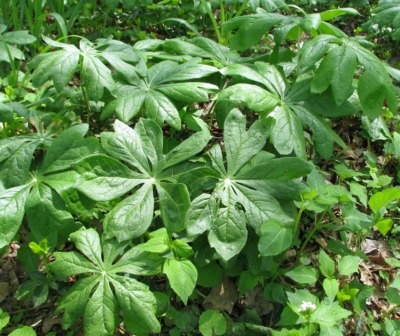
The perennial rootstock spreads underground, so plants grow in ever expanding colonies. These colonies add another layer to the forest, one of green shields hovering above the earthen floor. Contrasting growth habits and leaf shapes make mayapple a nice companion to ferns in a woodland garden. Contain the wandering roots — in a bottomless pot, for example — if your woodland garden is small.
If you happen upon a colony of mayapples during a spring stroll through the woods, peek under the leaves. Right where the stem divides to make two leaves, you might just find a mayapple flower, a single waxy, white bloom about 2 inches across. Single leaved plants do not have flowers.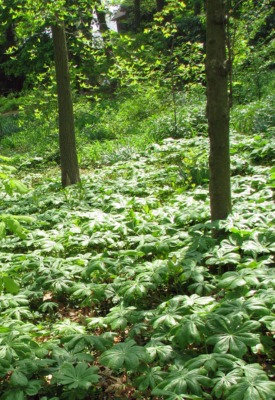
And Fruit, Now
Fruits are supposed to follow flowers, but in my experience, you will not find nearly as many mayapple fruits as you found mayapple flowers. Most plants have flopped down and begun to dissolve away soon after midsummer, so part of the reason might be that animals have gobbled up fruits lying on the ground.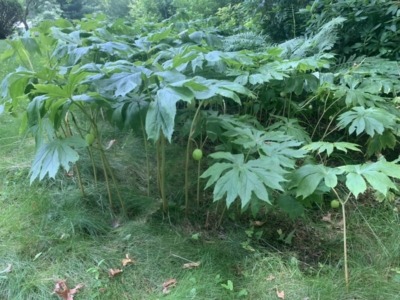
Before you take a bite out of a mayapple, let me tell you something more about the fruit. Another name for mayapple is American mandrake, “mandrake” because this plant, like the true mandrake, has a root whose shape can be likened to a human figure. The shape of the true mandrake root supposedly imbued it with all sorts of medicinal and magical properties.
Mayapple does, in fact, have some medicinal properties. The roots, for example, contain podophyllin a compound that has been used as a cathartic, emetic, or purgative. It also has been used for topical treatment against warts. Other compounds in mayapple inhibit cell division, and a modified extract of the plant is used to make etoposide, an anti-cancer drug.
This plant is strong medicine, too easily taken in toxic doses by those not thoroughly familiar with its use. All parts of the plant are toxic — except the ripe fruit, mentioned earlier on. It contains some very toxic compounds. Native Americans used the plant medicinally, and for committing suicide.
Beware!!!
Ripe mayapple fruits look more like lemons than apples. They are yellow, and about the size and shape of eggs. The flavor also is more like that of a tropical fruit. It reputedly tastes something like passionfruit, citrus, quince, and/or strawberry. But bland. No one raves about the flavor, but some people like them well enough to eat raw, or at least to use for flavoring -ades or cooking into a sauce or marmalade.
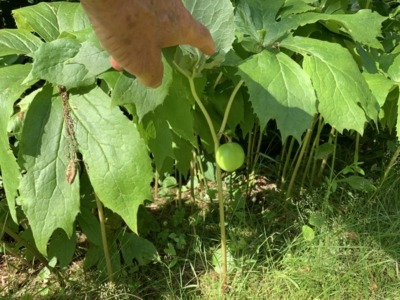
Mayapple fruit in July
I have never tasted a mayapple, and do not intend to do so. My first opportunity to taste the fruits came when a friend in Pennsylvania mailed me a box full of ripe ones. I thanked him, but later admitted that the fruits — steeped in all that magic and medicine, and cradled in tissue paper in the box — seemed too ominous to eat.
Perhaps you are bolder than I am. If you do eat the fruit, make sure it is ripe, because unripe fruits are toxic. And don’t chew the seeds; they also are toxic. And don’t eat too many, which would be one for me.



Thanks for the info, I have always wondered about this since I had both the domestic (peltatum) and an Asian variety S. hexandrum which while similar varies slightly in growth habit.
You have listed the Asian one a in a defferent genus. Is that correct?
Dino Podophyllum hexandrum family Berberidacae (only species). Given to me ~10 years ago. Let me know if you want some. Doesn’t spread as aggressively as the domestic variant.
Interesting!
Fascinating post and beautiful photos! Thank you so much for sharing this!
Thanks!