
HOW TO EAT A PEAR
Don’t Pick When Ripe!
Bite into a tree-ripened pear. Yecchh! It’s brown and mushy on the inside.
Pear is one of the few fruits that tastes best picked underripe, then ripened indoors — and there is as much art to picking and ripening a pear as to growing it. Perhaps more, because pears are relatively easy to grow as compared with other tree fruits.
Although the fruit has to be picked before it is ripe, you can’t pick just any unripe pear and then expect it to ripen into a juicy, sweet, buttery fruit, with the subtle flavor individual to the particular variety. The spicy flavor of Seckel or the hint of vanilla of Concorde pears, for example.
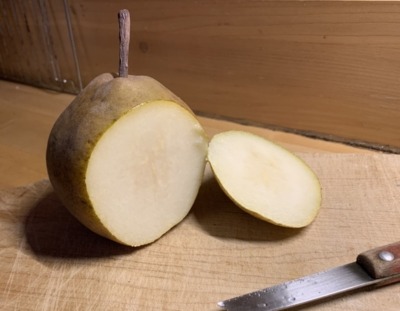
Passe Crasanne pear, ripe and ready for eating
To ripen well, a pear must have attained a certain degree of maturity before harvest. Otherwise, it merely shrivels without ever developing any sweetness or flavor. Of course, if you wait too long, you get that brown mush.
One way to tell when to pick a pear is by looking at it. The skin becomes paler, but only slightly so. Even better would be to look at the raised bumps, called lenticels, on the skin: they change from white to brown as harvest approaches.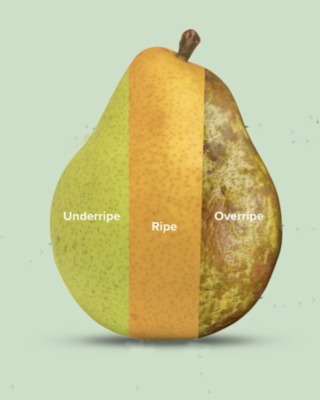
A more direct way to tell when to harvest is to lift a fruit upward, with a slight twist. If the fruit is ready to be picked, it will pop off the branch. This operation has to be done gently, though, or else the fruit will be coaxed off the branch before it really wants to.
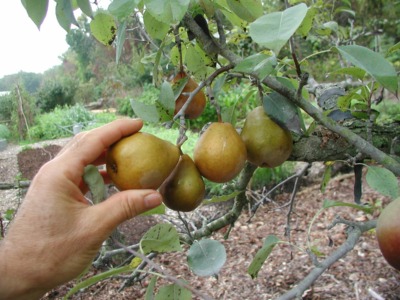
Harvesting Seckel pear
I’ve grown pears for many years and many varieties but have to admit to not thoroughly having yet mastered the art of picking the fruit of some of the varieties I have most recently planted. Seeing a few fruits that have jumped ship and are lying on the ground, barring some dramatic winds, is a good indicator for me. Then, quick gathering of the rest is needed.
Storage and Ripening
Harvested fruit can go into storage, or else can be ripened for eating. The refrigerator is a good place to store pears, as long as you maintain high humidity. I put my pears into white delicatessen bags, although plastic bags are also suitable if you punch a few holes in them so that gases given off by the living — yes living — fruits do not build up inside.
The closer to freezing the storage temperature, the better. In fact, some pear varieties, such as Anjou, Bosc, Comice, Eldorado, and Packham’s Triumph, will not ripen unless they’ve been first exposed to several weeks of cold temperatures.
Pay as much attention to ripening a pear as to picking it. Pears need more warmth for ripening than for storage, ideally a cool room with temperatures between 60 and 70 degrees. Drafts should be avoided, to keep the ripening fruit from drying out, but don’t put the fruit in a bag or it will ripen too quickly because of a buildup of the ripening gases (ethylene).
The moment for eating now approaches. Check the ripening fruit almost daily by gently pressing your finger against the flesh near the stem.
Passe Crasanne pear, ripe and ready for eating
I have found that when the flesh near the stem gives just a wee bit when pressed with a finger, the time has come. Get out the silver knife, light some candles, and experience the Queen of Fruits at her best. The window of perfection for a ripe pear is fleeting. Ralph Waldo Emerson knew pears when he wrote “There are only ten minutes in the life of a pear when it is perfect to eat.” Another writer whose name escapes me wrote something to the effect that if pears are not fully ripened, the flavor is grassy, if overripe, well, you’ve got browning mush.
If you get inundated with too many ripe fruits at once, dry them, marinate them in wine, or half, then bake, them topped with a slice of cheddar cheese.
No Brainer
If the above harvesting and ripening instructions seems too complicated or not worth the hassle, there are other options. The pear variety Seckel, for instance. It can be harvested fully ripe so you can just taste one to see if the others on the tree are ripe.
Also, Asian pears, all of which reach their peak flavor only when allowed to fully ripen on the tree. You’ll know that day has arrived by the slight change in skin color, the ease with which the fruit stem separates from the branch, and the flavor.
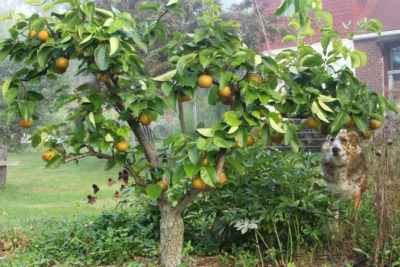
Chojuro Asian pear
Another exception is the hybrid Kieffer pear which is a 100 plus year old hybrid of European and Asian pears. This variety is reliably decked with flowers and the loaded with fruit year after year. You commonly see old Kieffer trees loaded down with large, yellow fruits; unfortunately, they are hardly eating no matter what you do to them. Some people can them.
(Pears decorative, hardy fruit trees that I included in my book Landscaping with Fruit.)



What are good sources for affordable asian pear trees for the mid-atlantic/mountains climate?
Thanks for details determining ripeness.
raintreenursery.com, cumminsnursery.com
thank you
I did much better harvesting one variety of my two trees this year. This early success got me overexcited for the later-maturing variety. The fruits also got sooty blotch, which made it so I was eating them alone. I canned some, at least! i think I’ll bag them again next year for the blotch, and prime more aggressively.
Good to hear of your success, which increases with experience. By the way, you can usually wash off sooty blotch.