
ENOUGH WATER?
Delusion
Although you water your plants with the best of intentions, whether by drowsily spritzing your tomato leaves with spray from a hose or by sloshing buckets of water beneath your roses, your efforts might be ineffective. One way to judge this is to scratch the surface of the ground right after you water. Don’t be surprised if the ground bone dry an eighth of an inch deep.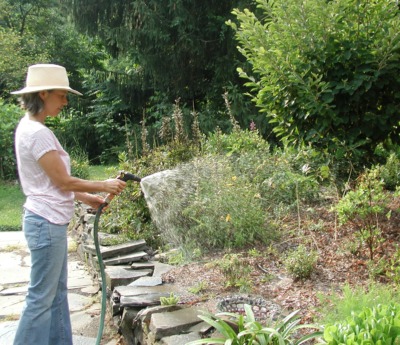
Because feeder roots of plants are mostly in the top foot of soil, that is the depth of soil to be moist. And that’s deeper than you are going to be able to scratch with your finger.
Instead of Your Finger
So the next technological leap, after use of your finger, in determining whether you should water or have watered enough, is the use of a trowel. With your trowel, you can dig down a foot or so to see and feel how moist the soil is.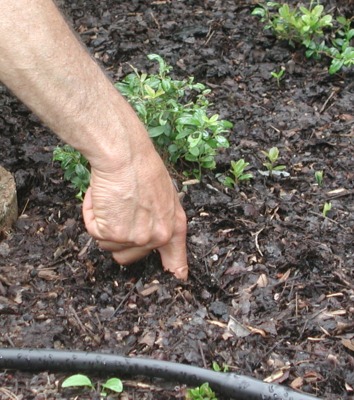
Of course, you can’t expect to pock your garden with holes, disturbing roots, every time you water or want to know if you need to water. Fortunately, other methods are at our disposal.
An easy method to determine soil wetness is with an electronic moisture meter, available through many local and mail order garden supply stores. You merely push the metal probe of this device into the ground, then read “dry,” “moist,” or “wet” on the gauge atop the probe.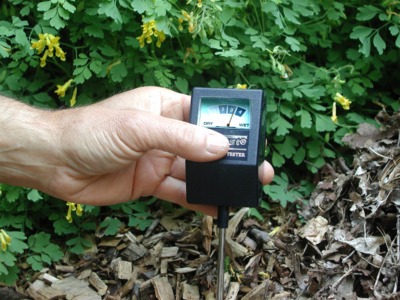
You have to be careful putting your faith in these electronic devices. Water conducts electricity, and the probe determines soil moisture by how well the soil conducts electricity. The problem is that any soluble fertilizer increases the electrical conductivity of water, and this can throw off readings. You also must be careful not to break the probe pushing it into rocky or rock-hard soil, and you cannot leave the device in place. Remove and clean it after each reading.
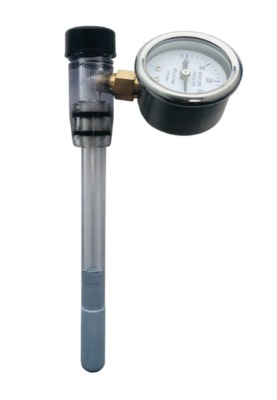
A tensiometer is another device that lets you conveniently read soil wetness off a gauge. It is a long, sealed tube that is filled with water and has a ceramic cup at its bottom. As soil outside the tube dries, it tries to suck water out of the tube, and this suction is displayed on a gauge.
A tensiometer provides an accurate measure of soil wetness irrespective of fertilizer, and you can — and should — leave it in place all summer. You can even hook it up to some irrigation device, to automatically turn on the water when the soil reaches a certain level of dryness. The only disadvantages of tensiometers are that they are pricey and are of limited use in very sandy soils.
Higher and Lower Tech Options
A totally different approach to knowing when and how much to water is the indirect approach, by estimation. Do this with a pan of water, from which water evaporates about as fast as it is lost from the soil through evaporation and plant uptake. A gallon paint can makes a good “pan evaporameter,” but any large, straight-sided container will do. Fill it to within two inches of its top with water and place it in the sun. Then measure the water depth in the can with a ruler, and repeat the measurement on a daily or weekly basis.
When measurements show a loss of water, make up the difference by watering. If the depth drops a half-inch, for example, turn on you sprinkler until it brings the level back up in the can. If you are using the measurement in your can to tell you when to dribble water on the ground from the end of your hose or watering can, count each one inch depth of water lost as equivalent to a three-quarters of a gallon of water per square foot of area to be watered.
You could carry your estimating one step further, and just assume that your plants need one inch of water per week through the growing season. This is a very rough estimate, but religiously provide that much water and your plants will be pretty happy. Do occasionally check the soil itself, though, so your plants never have to tell you by their flagging leaves that they are thirsty.
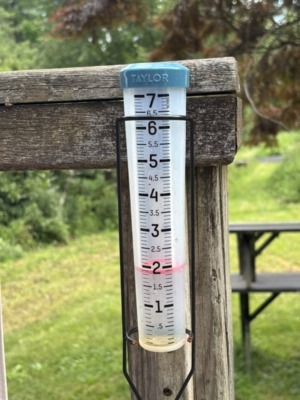
A rain gauge can tell the amount of moisture falling from the sky whether from rain or your sprinkling



I gardened in the south for 20 years. I used a sturdy aluminum tube called a soil probe. It has an open side to see the soil at depth and check moisture. Invaluable! I don’t know if it’s available in MI
I have a similar soil probe that I bought years ago.