
WITH GOOD REASON, FAMILIES MIGRATE AROUND MY GARDEN
(Excerpt from The Ever Curious Gardener: Using a Little Natural Science for a Much Better Garden, available directly from this website, signed, or from the usual sources.)
Who is Coming?
How many families am I having over to the vegetable garden this summer? I have to plan their seating arrangements.
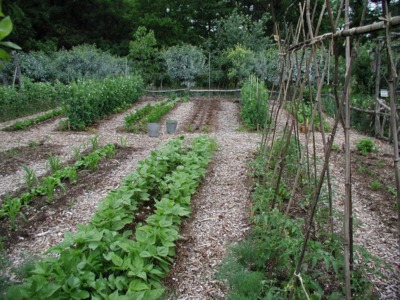
I’m talking about plant families. An example of a plant family is the Mustard Family, known botanically as the Cruciferae, and including among its members cabbage, broccoli, collards, and Brussels sprouts. Their similarly pungent flavors and waxy, bluish leaves might also have earmarked them as being in the same family. Then again, the different parts eaten—the swollen stalks of kohlrabi, the leaves of cabbage, and the flower buds of broccoli— might indicate otherwise.
Most important in uniting this family, and the primary characteristic that botanically unites members of any plant family, is the similarity of their flowers. All members of the Mustard Family have flowers with four equal petals in the shape of a cross. Hence, the name: crux is Latin for “cross,” as in “Cruciferae” and “crucifixion.”
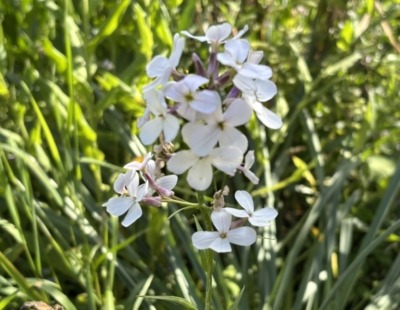
Not usually eaten but a pretty flower, Dame’s rocket is a Crucifer
Another prominent family that I’ll undoubtedly have over this summer is the Leguminosae, better known as the Pea Family. This family also includes beans, and if I step out of my vegetable garden into my flower garden, lupines. On the way, walking across the lawn, I’ll no doubt be stepping on another member, clover. Leaves of the Pea Family are usually made up of more than one leaf et, hence the 3- or, rarely, 4-leafed clover.
But here, again, the characteristic that most distinguishes all these plants as a family is their flowers. In this case, the flowers are irregular, having three different kinds of petals—two wing petals flanking an upper standard, and two lower keel petals.
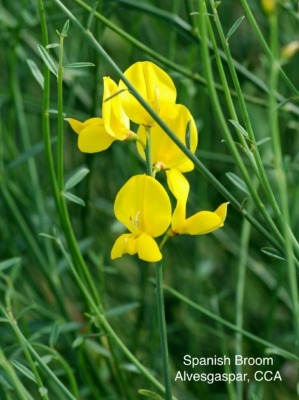
Spanish broom, an ornamental Pea Family relative.
The flowers of another family, the Carrot Family, are described by their botanical name, Umbelliferae. An umbel is a group of flowers, all of whose stalks radiate out from a common point atop a thicker stalk, resulting in a flat-topped or rounded cluster. Like an umbrella. Except for dill, which I grow for seeds and leaves, I rarely see the flowers of carrot, parsley, celery, parsnip, and other members of this family because I grow them only for their roots or leaves.
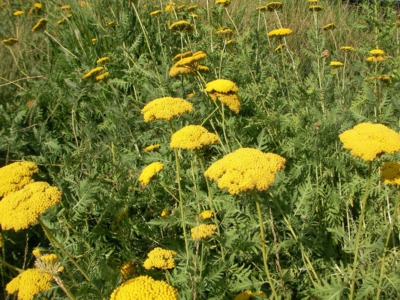
Tansy flower heads
Five equal flower petals characterize one of the most-loved families in my garden, the Nightshade Family, botanically the Solanaceae. World famous members of this family include potato, tomato, eggplant, and pepper.
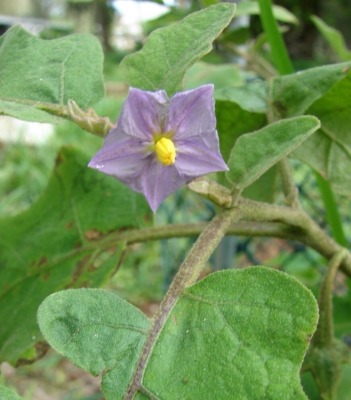
Eggplant flower
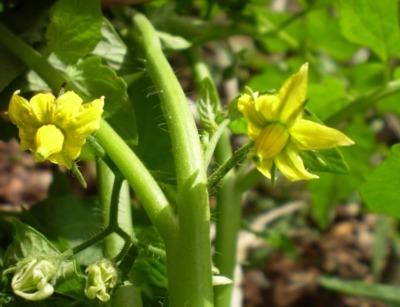
Tomato flower
A plant family is characterized by more than just the number and shape of its flower petals. Taking a look at the flowers of cucumber, squash, melons, and pumpkins, I see that their flowers also have five equal petals. But the flowers of this family—the Gourd Family or, botanically, the Cucurbitaceae—are either male or female, and the central stalk of the female flower is capped by three stigmas to receive pollen. (Nightshade flowers all have both male and female parts, and female flowers have a single stigma.)
Why the Fuss?
You may wonder: why all this fuss about plant families? Surely, the different families must be able mingle freely in the garden and get along. (After all, they’re not human!) Yes, plant families can pretty much mingle freely.
The need for fussiness arises because members of a plant family usually share common pest problems. As examples, clubroot disease attacks the Mustard Family, blight attacks the Nightshades, and parsleyworms chew on leaves of the Carrot Family.
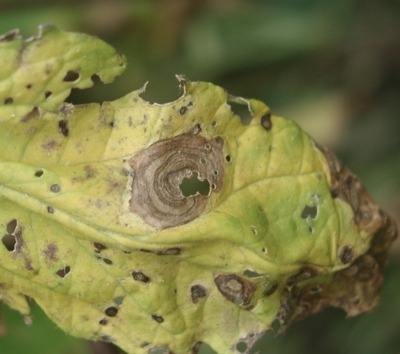
Characteristic leaf damage from tomato early blight
Except where it is sufficiently mobile or has an appetite for a wide range of families, a pest can usually be starved out by not planting members of a susceptible plant family in the same location more often than every three years. This is one of the rationales for “crop rotation.”
My vegetable garden is laid out in beds, with eight beds on each side of the main path running through the garden. One year a bed might be devoted only to tomatoes. Tomatoes are a no-no in that bed the next year, and the same goes for peppers or eggplants. That bed could be home to corn (Grass Family, Poaceae) or broccoli, cabbage, and kale. That year, the tomatoes get planted two beds away, as does the corn or Mustard Family the next year. And so on, year after year, different vegetables march like slow soldiers around the garden, two steps each year counterclockwise around the garden from bed to bed, with no family returning to where it previously grew for three years. 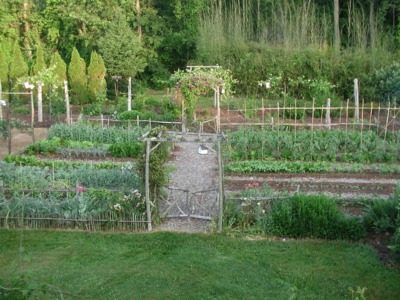
Some Fun with Families
Crop rotation need not always be about pragmatism. Just for the fun of it, I’ve imagined creating a small, ornamental plot (but haven’t yet) to a single family, perhaps the Pea Family. Perhaps plantings of lupines and vining sweet peas three dimensional color to the dappled shade beneath a honeylocust.
I planted the honeylocust back in 2006. Thus far lupines still inhabit the heath bed in front of my house. This heath bed, incidentally, includes many members of the Heath Family, Ericaceae, grouped for their affinity to very acidic, organically rich soil I’ve created in front of my home. Lupine also demands such soil conditions.
And the sweet peas, which are NOT edible but are valued for their pastel flowers and delicious scents, still climb the garden fence on the outside of my vegetable garden.



Hey Lee, would consider doing a blog post about the construction of your great rustic fencing and gates? I’d love to see how you build all the great structures around your garden that are practical and aesthetically charming
Thanks
Stay tuned
Grouping and rotating plant families like the Cruciferae is such smart, natural science-based gardening. I saved your crop rotation tips to my online clipboard for this spring.
Glad it was useful for you.