OF MAPLES AND REDS
Where’d the Red Go?
Sugar maples (Acer saccharum) are now doing just what I expected of them. But not exactly what I want them to do. Here in New York’s mid-Hudson Valley, at least, this autumn’s leaf show is not quite up to snuff. And it’s also later than in the past. It used to peak here in the middle of October; nowadays, with climate change, the peak has been pushed forward to about now.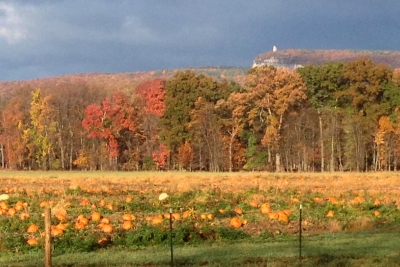
Back to the color: This year the local sugar maples are mostly only yellow, lacking the oranges and the reds that, along with some yellow, really ramp up the blaze of landscapes and forests. Let’s blame that more subdued show on the weather. To know why, let’s backtrack to summer when, quoting from a section in my recent book The Ever Curious Gardener, Using a Little Natural Science for a Much Better Garden:
Green is from chlorophyll, most welcome in spring and through summer, but not what interests me in fall. Chlorophyll must be continually synthesized for a leaf to stay green. The shorter days and lowering sun of waning summer are what trigger leaves to stop producing it, unmasking other pigments lurking there.
Leaves’ yellow and orange colors are aways present, thanks to carotenoid pigments, which help chlorophyll do its job of harvesting sunlight to convert into plant energy. I offer thanks to carotenoids for the warm, yellow glow they give to gingko, aspen, hickory, and birch leaves.
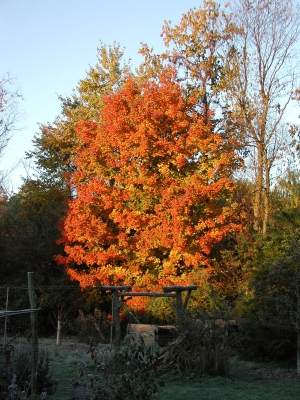
Sugar maple (not this year)
Tannins are another pigment, actually metabolic wastes, that, all summer, are hidden by chlorophyll. Their contribution to the fall palette are the season’s subdued browns, notable in some oaks and enriching the yellow of beeches.
Because leaves harbor carotenoids and tannins all summer long, nothing particular about autumn weather should either intensify or subdue their autumn show. The only glitch could be an early, hard freeze that occurs while leaves are still chock full of chlorophyll. In that case, cell workings come abruptly to a halt and all we’re left with is frozen, green leaves that eventually drop without any fanfare.
Autumn color also spills out reds and purples, most evident in red maples and some sugar maples, scarlet oak, sourwood, blueberry, and winged euonymous. Those reds and purples come from yet another pigment, anthocyanins. Except for trees like ‘Purple Fountain’ beech and ‘Royal Purple’ smokebush, whose leaves unfold dusky red right from the get go in spring, and remain so all season long, in most leaves anthocyanins do not begin to develop until autumn.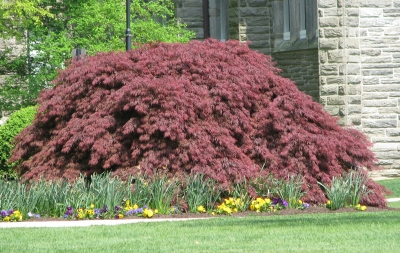
Anthocyanin formation requires sugars so anything that I or the weather does to promote sugar accumulation in autumn will increase anthocyanin levels in leaves. The weather’s role is to offer warm, sunny days to maximize photosynthesis, and cool, but not frigid, nights to minimize nighttime burning up of accumulated sugars. A cloudy, rainy autumn means less red because less anthocyanin is formed, and any that does form is diluted.
As I write this, it’s cloudy and rainy, as it has been so many days this autumn.
Other Reds
I was recently visiting my daughter in Pennsylvania. As we looked around her neighborhood I admired the rich, red, autumn color of the trees lining the streets. Red?! How can that be? What about what I wrote about this autumn’s weather and anthocyanin and red leaves in autumn?
Ah, but science takes care of that, too. Those trees in the Pennsylvania landscape weren’t sugar maples; they were a variety of Freeman maple (Acer × freemanii). Freeman maples are natural and deliberate hybrids of silver maples (Acer saccharinum) and red maples (Acer rubrum), the silver maple contributing fast growth to the hybrids and the red maples contributing strong branches and red leaf color in autumn. 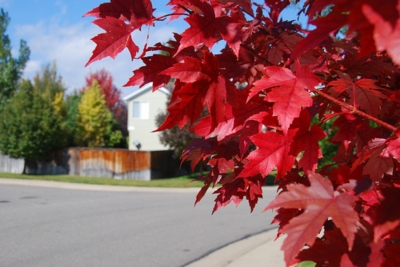
Trees vary, both as to species and locations, in the amounts of pigments found at various times in their leaves. Red maples, as the name implies, have significant amounts of anthocyanins. In these trees, this anthocyanin is present not only in autumn as the chlorophyll fades, but throughout the growing season. Depending on the amount and kind of anthocyanin, its redness would be more or less masked by chlorophyll during the growing season. Some varieties of red maple, and many varieties of Japanese maple, are red or purplish all summer long.
The million dollar question is why a tree would have anthocyanin in its leaves all season long. Various theories have been floated. Anthocyanins do offer protection against excess sunlight, which is why young leaves emerge reddish on some plants.

Seedling red maples
(This characteristic does not correlate with the degree of red in leaves in autumn.) It’s also possible that anthocyanins could ward off pests.
Whatever the reason, red or orange or yellow leaves, I’m not complaining. Autumn is still a beautiful season here in the Hudson Valley.
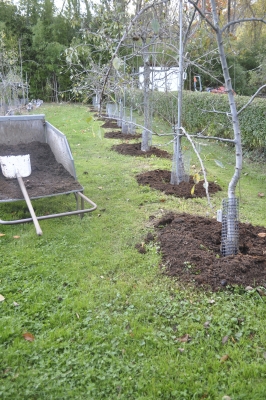 Remember the song lyrics: “House built on a weak foundation will not stand, no, no”? Well, the same goes for plants. (Plant with a weak root system will not be healthy, no, no.) Fertilization in the fall, rather than in winter, spring, or summer, promotes strong root systems in plants.
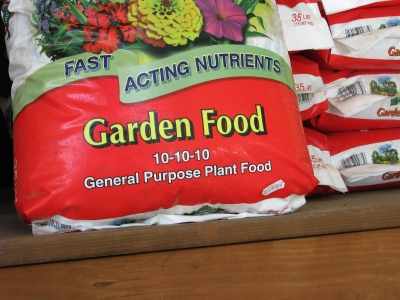 The two major forms of soluble nitrogen that plants can “eat” are nitrate nitrogen and ammonium nitrogen. Nitrate nitrogen will wash right through the soil; ammonium nitrogen, because it has a positive charge, can be grabbed and held onto negatively charged soil particles. Therefore, if you’re going to purchase a chemical fertilizer to apply in the fall, always buy a type that is high in ammonium nitrogen. The forms of nitrogen in a fertilizer bag are spelled out right on its label.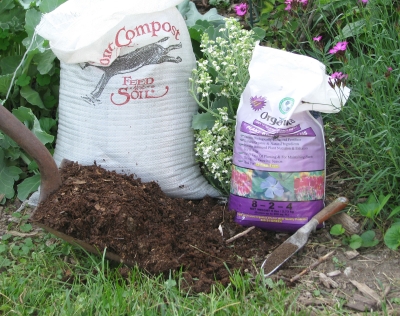
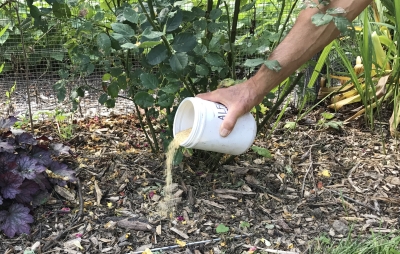
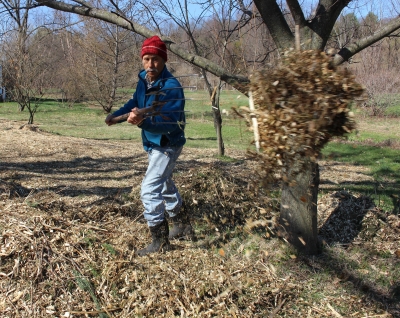
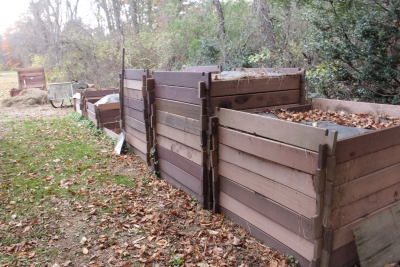
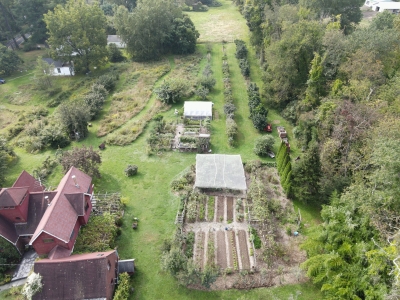
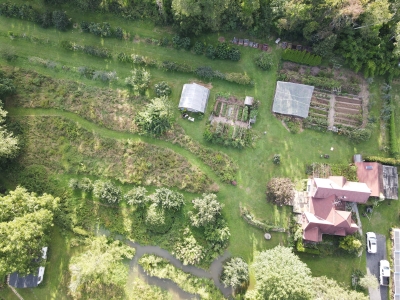
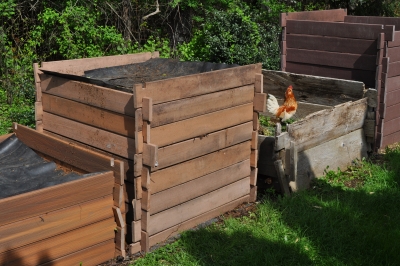 I like to think of my compost pile as a pet (really, many pets, the population of which changes over time as the compost ripens) that needs, as do our ducks, dogs and cat, food, water, and air. Today I’ll feeding my pet — my compost pet — corn stalks, lettuce plants that have gone to seed, rotten tomatoes and peppers, and other garden refuse. Plenty of organic materials are available to feed compost piles this time of year.
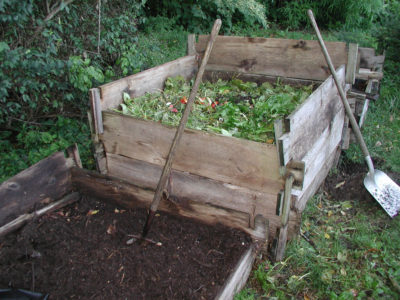 Joseph Jenkins, in his excellent (and fun-to-read) book, The Humanure Handbook, quotes research showing complete destruction of human pathogens in humanure composts that reach 145°F for one hour, 122°F for one day, or 109° F for one week. The same should be true for plant pathogens and pests. For decades, I’ve tossed everything and anything into my compost piles and never noticed any carry over of pest or disease problems.
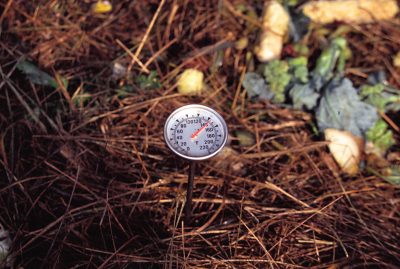 This time of year, my compost piles dial the heat up to around 140°F, and hold that temperature for a couple of weeks, or more, before slowly cooling down.
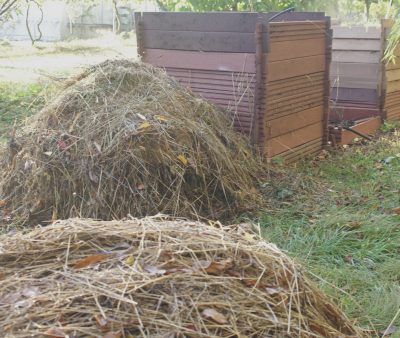 Also on the menu is some horse manure from a nearby stable, which I like mostly for the wood shavings that provide bedding for the horses. The manure itself furnishes nitrogen, which compost pets need for a balanced diet — 20 parts carbon to 1 part nitrogen but no need to be overly exacting because it all balances out in the finished compost. Lacking manure, soybean meal is another nitrogen-rich feed, as are grass clippings and kitchen waste.
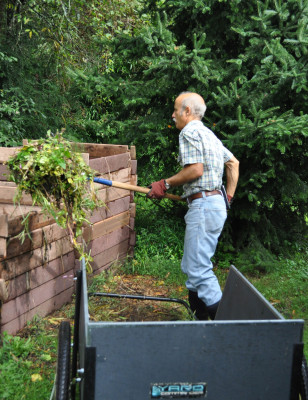 Feeding a variety of compost foods provides a smorgasbord of macro- and micronutrients to the composting organisms and, hence, to my plants. Every few inches I also sprinkle on some soil, to help absorb nutrients and odors, and some ground limestone, to lower acidity of our naturally increasingly acidic soils, and to improve the texture of the finished compost.
 It was too late to plant a late vegetable crop in the bed I just cleared of old corn stalks, so I blanketed that bed an inch deep in compost. The same goes for a bed in which grew an early planting of zucchini.