
UGLY WORD, NICE PLANTS
What’s a Variety
Mmmmm, how I like to bite into a cultivar. And look at the beautiful petals of a cultivar. And admire the autumn foliage of a cultivar.
A “cultivar?” What an ugly word for a plant with so many qualities.
Actually, a cultivar is any cultivated variety of plant. Get it? “Cultivated variety” contracts to “cultivar,” a word that was originally conjured about 100 yers ago, then codified in the International Code of Nomenclature for Cultivated Plants (ICNCP) in 1959. Some horticulturalists, myself included, avoid the word. As I wrote, the word is just too ugly.
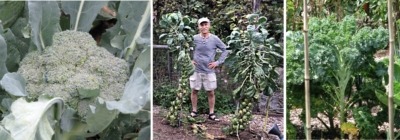
Brassica oleraceae var. botrytis, B. oleraceae var. gemmifera (with Homo sapiens), and B. oleraceae var. acephala.
Before the word “cultivar” was invented, gardeners used the word “variety,” but some people objected that this confused a “cultivated variety” with a “botanical variety.” The latter is merely a way to split up a plant species, warranted when a population of plants within a species is sufficiently different from the remaining members — but not so different as to warrant its being a separate species. A good example of botanical varieties is found among cabbage and its relatives. They all are Brassica oleraceae, oleraceae being the species name, but all cabbages are Brassica oleraceae var. capitata, all Brussels sprouts are Brassica oleraceae var. gemmifera, and all broccolis are
Botanical Splitting Hairs
Actually, species sometimes are pared apart to a level different from botanical variety. If a group of plants within a species is different from the rest, but not quite different enough to warrant variety status, they may be placed within a “subspecies.” An example would be the grandifolius subspecies of the ionanthus species of African violet, the whole name written as Streptocarpus ionanthus subsp. grandifolius. From the subspecies name, you probably guessed that this group is notable for having larger leaves (“grandifolius” means “large leaf”).
At least two subspecies must exist if it’s going to be separated in subspecies. (If there was only one, it would be elevated to be a species.) Subspecies are distinguishable, geographically separate population. If they weren’t they would interbreed, erasing the differences between them.
A botanical variety, exemplified above by cabbage and its close relatives, is a finer distinction than subspecies. In the cabbage example, there are no subspecies of Brassica oleraceae, just botanical varieties.
Had enough? Hold on, there’s yet another, even finer differentiation. Sometimes. That’s “botanical form,” denoted by “f.”. It could be at the level of species, subspecies, or botanical variety. The botanical form is only a slight difference, often the result of the local environmental conditions. A familiar example would be the spineless forms of honeylocust tree, Gliditsia triacanthos f. inermis. If you’ve ever seen or been poked by the three-branched thorns of honeylocust, G. triacanthos, you’d be pleased with the botanical form inermis, inermis meaning “unarmored” or “toothless.”
To sum up levels of differentiation: species, subspecies, cultivar, botanical variety.
So What is Cultivar Anyway
A cultivar (ughhh!) can be a botanical variety, subspecies, or form, or even an individual plant that is repeatedly cloned to make a whole population of identical, new plants. What distinguishes a cultivar is this: The group of plants has certain similarities, and the plants are intentionally cultivated. You might notice their similarities merely by sight, or the differences might be more subtle, in the plant’s physiology or chemistry.
The reason that you would intentionally cultivate a group of similar plants is because they have some desirable quality. Which is why I like to bite into a cultivar — of ‘Spitzenburg’ apple, for example.
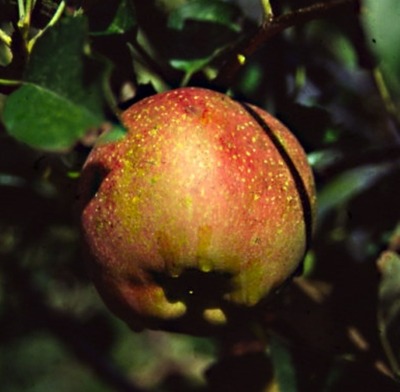
Homegrown Spitzenberg apple
A wild apple tree growing along the roadside is not a cultivar, unless you happen to like the fruit and start making the tree into new plants. (The chances of a wild apple tasting as good as some cultivar is less than one in 10,000, though.) Similarly, ‘October Glory’ red maple has better autumn color than its wild siblings. And you won’t find a wild begonia with flowers as flamboyant as ‘Rosebud Double Giant’ begonia.
The way that any cultivar is reproduced depends on the particular plant. Cloning, which I mentioned previously, is just one method. Some old varieties, errr . . . cultivars, of tomato, such as ‘Belgian Giant’ and ‘Bonny Best’, are self-pollinating, and reproduce true from seed now that they have been inbred for so many generations. (Plant, not human, generations.) Cabbages readily cross-pollinate, but an old cultivar like ‘Early Jersey Wakefield’ is maintained by growing it for seed in isolation. And then there are cultivars such as ‘Big Boy’ and ‘Big Girl’ tomato, which are hybrids, the result of a deliberate mating of two specific parents.
Before closing, I’ll give you some full names. Reach for a packet of Early Jersey Wakefield cabbage and what you’re getting is Brassica oleraceae var. capitata ‘Early Jersey Wakefield’. And I am very proud of the red-leafed, thornless honeylocust I planted 20 years ago. But what a name: Gliditsia triacanthos f. inermis ‘Ruby Lace’! Just asking for Ruby Lace honeylocust at a nursery would get you one there also.
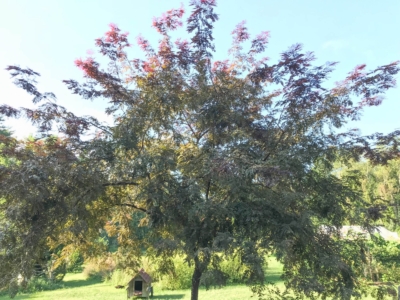
Gliditsia triacanthos f. inermis ‘Ruby Lace’
Now, don’t get the idea that all cultivated plants are cultivars. In some cases, a whole species is outstanding and worth growing, with no distinctive groups within the species. You rarely find any cultivars of such garden plants as arugula, climbing hydrangea, four o’clocks, burnet rose, or beauty berry. The run-of-the-mill species do just fine.



Thanks for the detailed breakdown. I was always confused as to the difference between cultivar and a variety. Just to be clear, a species can have a variety but not necessarily a cultivar attached to it?
Yes, it can have either a variety or a cultivar attached to it, or both. But you have to be clear when you write “variety” for this question whether you’re referring to a botanical variety or a cultivated variety, the latter being a cultivar. Just saying the word variety can mean your referring either to a botanical variety or a cultivated variety.
Really confusing for me. But still fun. Vidalia. Onion is considered a cultivar. Even though a few different varieties of onion could be grown in Vidalia and be allowed to carry the name Vidalia. Maui Onions are also a cultivar. Near as I can tell all Maui Onions are the same variety. And most Vidalia Onions and Maui Onions are the same variety. But Kula(Maui) Strawberries would not be considered a cultivar. Then there’s San Marzano Tomatoes. San Marzano is a specific variety. And all San Marzano tomatoes are the same variety. At least the DOP ones. Thinking about this could make a person go giddy. Maybe I got all that wrong.
Vidalia is a brand name for a number of onion varieties that might be grown in the region of Vidalia, Georgia. “Varieties include the hybrid Yellow Granex, varieties of Granex parentage, and similar varieties as recommended by the Vidalia Onion Committee and approved by the U.S. Secretary of Agriculture” (wikipedia). As far as I can tell, Vidalia and Maui differ because they can be labelled as such because of where they’re officially grown. They could be the same or similar varieties (Granex, e.g.)