
A WELCOME TOUCH OF GREENERY
Beauty, Beer, and Aroma
What more hopeful way to go into winter than with a plant named wintergreen? Wintergreen. The word conjures up an image of lush greenery against lily white snow, a congenial juxtaposition of the living and the nonliving, both pristine.
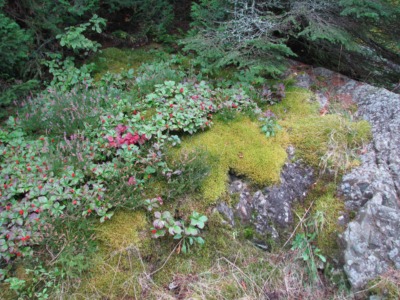
Wild wintergreen in Maine
If the word wintergreen brings to mind, instead, a refreshing aroma or flavor — yes — that’s the same plant. Oil of wintergreen has been used as flavoring for teas and beers, both alcoholic and nonalcoholic, as well as straight up, as a leafy nibble. The plant’s berries also provide a nibble, one that might make you start moving your feet. Wintergreen is also known as teaberry, the flavoring in a chewing gum that was featured in popular TV advertisements in the late 1960s that showed the gum inducing a jiglike dance, the “teaberry shuffle,” to a catchy tune.
As if two common names were not enough, wintergreen, botanically Gaultheria procumbens, also has been called checkerberry and partridgeberry (Mitchella repens). Checkerberry comes from the resemblance of the fruit to that of the checker tree (Torminalis glaberrima), a kind of wild mountain ash of Europe, whose fruit has been used to flavor beer. And partridgeberry because, of course, partridges are so fond of the berries.
Besides being used as a flavoring, oil of wintergreen has been used to soothe fevers and ease the pain of arthritis and rheumatism. Native Americans used wintergreen leaves for this purpose either as a tea or poultice. The active ingredient is closely related to aspirin, so oil of wintergreen, like other natural or synthetic drugs, should be used with discretion.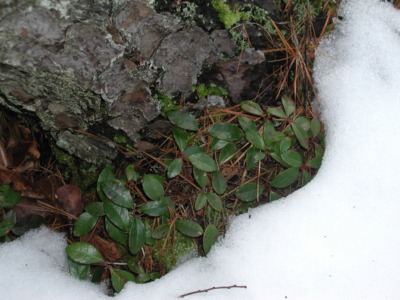
Looks and Care
Wintergreen does live up to its name, doing its part to help keep a snow bare winter from looking like a wasteland of gray and brown, or peeking through the snow to break the achromatic monotony of a snowy winter. The plant grows only about six inches high, creeping along the ground by means of underground stems. New leaves are yellowish green, soon turning glossy green, then taking on a bronze tinge through winter, the colder the weather the bronzer the color.
Leaves are only part of the display. All summer, they are accompanied by solitary, pinkish white flowers.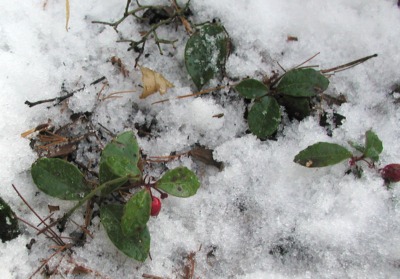 And then red berries, ripening in late summer, add to the show and carry it on through fall and winter. A variety called Macrocarpa is known for its prolific berry production.
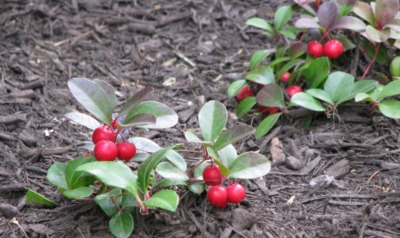
Macrocarpa wintergreen planted as ornamental, Bryn Mawr
All these qualities meld together to recommend wintergreen as an evergreen groundcover plant. In its native haunts, which cover much of the eastern half of the country, the plant grows in moist, acidic soils in the shade of evergreens. Why not do the same in the garden, letting the glossy greenery spread over soil beneath, for example, a shrubbery of rhododendrons and mountain laurels, or beneath a group of hemlocks? The taller plants will appreciate the protection wintergreen affords their roots, keeping the soil from washing and insulating it against summer’s heat and winter’s cold. Wintergreen will actually grow over a wide range of light conditions, tolerating deep shade at some expense to growth and fruiting, and sun, if the soil stays sufficiently moist.
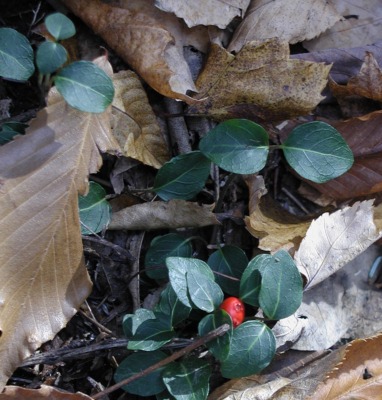
Wintergreen in fall
Do pay careful attention to the soil before you plant wintergreen. Add plenty of acidic peat moss or well-ripened compost, as well as sulfur if the pH still goes above about 5.5. Use little or no fertilizer, though, because fertilizer can damage the plant’s fine roots, and because the plant just doesn’t need it. With soil prepared, plant seeds or potted plants.
If you buy wintergreen from a nursery, order by botanical name because a number of other plants also go under that common name. Species of Chimophila and Pyrola, for example. Of course, if all you want is the smell of wintergreen, any these “wintergreens” would do.
Then again, so would sweet birch (also know as black birch or, botanically, as Betula lent), which was the commercial source of oil of wintergreen until it was superseded by synthetic, but identical, methyl salicylate. My firewood pile once included sweet birch from which a heady aroma of wintergreen wafted for months every time I went near it.



Great post. Love teaberry.flavor!
On a hike in Western PA (zone 6a) , was once shown how the Teaberry’s berry has just the one dimple (dark spot) on it, whereas partridgeberry has (in addition to the “meh” , ho hum, not-so-minty flavor) two dimples on the berry.
Good to know. Thanks. Makes it easy to distinguish them if you have a stuffed nose.