
THIS CITRUS HAS IT ALL
Botanical Mumbo Jumbo, but it’s Still a Kumquat
Cold and snowy winters agree with me just fine. Still, as a gardener, my mouth waters and my hands itch to be able to pluck ripe citrus from a home-grown tree in winter. It can be done, as attested to by all the potted calamondin orange trees now basking in sunny windows.
As pretty as calamondin trees are, their fruit is barely edible, if that. What I want is a citrus plant that also bears edible fruit. Oranges and grapefruits are possibilities, but let’s admit it: a four-foot high citrus tree festooned with a few large, colorful fruits thoroughly lacks grace. Lemon and lime fruits are better proportioned to an indoor plant, and have the advantage that a single fruit of either goes far in the kitchen.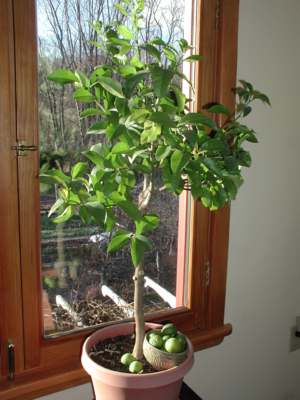
The citrus that offers the most mileage as a potted plant is kumquat. Kumquat was originally classified as Citrus japonica in 1784. In 1915 it was moved to its own genus and became Fortunella japonica. In 2008, kumquat went back to its original classification, becoming a bona fide citrus species again, back to Citrus japonica. And then genomic analysis in the 2020s showed that different kumquat varieties represent different species. Now, Nagami is officially C. margarita, Meiwa is C. crassifolia, Morani and Marmumi kumquats are C. japonica, etc. Whew!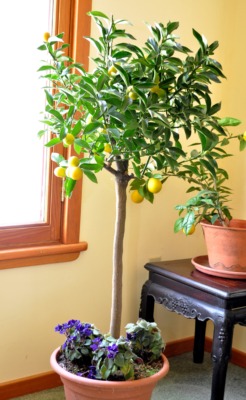
Gertrude Stein wrote that “A rose is a rose is a rose is . . . Botanical classifications aside, Like other citrus, kumquat is a pretty sight all year ‘round, sporting glossy, evergreen leaves that provide a perfect backdrop for the waxy white flowers. And that same, sweet fragrance of other citrus plants wafts also from those of kumquat.
The fruit is what makes kumquat stand out from the rest of the citrus crowd. While you eat only the pulp of oranges and grapefruits, and use only the juice of a lemon or lime, you can eat a whole kumquat, skin and all. The skin has a sweet, spicy flavor that mixes well with that of the pulp, which, depending on variety, varies from sweet to tart. The golden orange fruits are about the size of a quarter, so look perfectly proportioned to a potted plant and can be popped whole into your mouth.
Pretty Easy to Grow
Kumquat is among the most cold-hardy — to about 15° F — of citrus, and part of that hardiness is due to the long winter rest into which it settles. Color change of the now-ripening fruits is my plants’ only sign of life right now. The fruits are almost too pretty to eat. Fortunately, ripe kumquats hang in good condition on the plant for many weeks.
With just a few wrinkles, grow kumquat just as you would any other houseplant. Fruiting takes energy, which comes from sunlight, so my kumquat trees spend summers outdoors in almost full sun and winters at a south facing window.
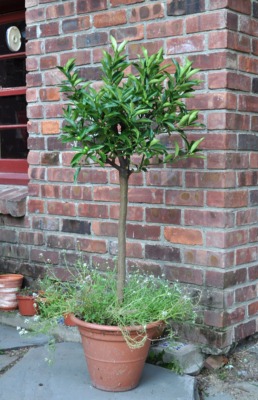
Kumquat outside on summer “vacation”
A cool room is best in winter, with cool temperatures compensating to some degree for reduced indoor, winter light. I use the same potting mix that I use for other potted plants, consisting of equal parts compost, garden soil, perlite, and peat moss. Although this mix offers nutrients, I occasionally supplement them with more or less regular applications of some soluble fertilizer except in midwinter, when the plant is resting.
The kumquat in markets is usually the oval-fruited Nagami, whose thick skin encloses a tart pulp. I once grew the variety Meiwa, which differs in having fruits that are larger and round, with a thin skin enclosing a pulp that was billed as a sweeter pulp. It wasn’t sweeter, just less tart and, to me, ho-hum. So I no longer grow Meiwa.
Less well known are the varieties Marumi and Changshou (Fukushu in Japan), both with round fruits and, allegedly, a sweetish pulp. I haven’t grown either.
Citrus breeders have incorporated the cold-hardy genes of kumquat into a number of hybrids whose names are fun to speak.
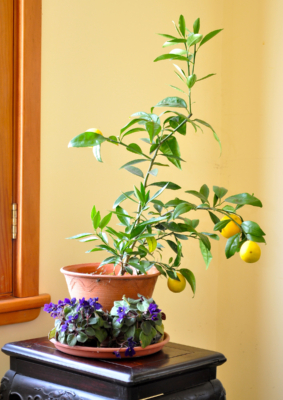
Sunquat, hybrid of kumquat and orange
Limequats are hardy lime substitutes, and include such varieties as Eustis and Tavares. Orangequat fruits are larger and sweeter than kumquats, and quite cold hardy.
Hardiest of all are citrangequats, hybrids of kumquat and citrange, the latter itself a hybrid of orange and poncirus. Poncirus is an inedible relative (previously Poncirus trifoliata, and more recently joining the clan as Citrus trifoliata) that grows and fruits here on my farmden in Zone 5. Well, I previously thought it was inedible but this year fruits ripened to the point of dropping, and made a very good lemon juice substitute. But I don’t think anyone would consider the pulp or the skin edible straight up.
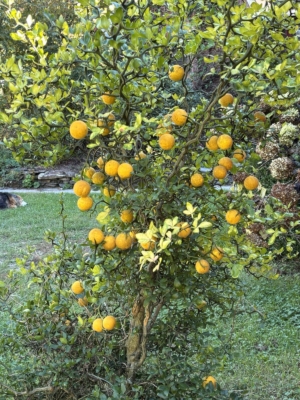
Poncirus crop this year
Ongoing Care
Just as soon as I harvest the last of my kumquats, I prepare the plants for next year’s crop. Because the plant is as large as I can manage, it gets get root pruned to make way for fresh soil and so that they can go right back into their present ten inch diameter pots. I slide each plant out of its pot, then slice one-inch of roots and soil from the sides and bottom of the rootball with a knife. Teasing the outermost roots on the rootball with a fork or stick gets them ready to grow out into new potting soil. I pack the soil into the space between the root ball and the edge of the pot after setting the root ball in the pot on a new bed of soil.
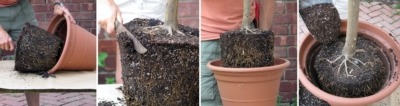
Steps in repotting kumquat
After root pruning, the stems need pruning to encourage fresh growth, avoid congestion, and keep the plants a manageable size. The plant is trained as a standard with a clear trunk capped by stems. My first cuts remove some stems right to their origin. Next, I shorten some of the remaining stems, wherever increased branching is needed. Finally, I remove twiggy or crowded stems. As I prune, I step back and look at the plant with an artist’s eye, clipping stems here and there to put them visually in balance with each other and with the size of the pot.
You could start a kumquat tree from seeds you spit out of store bought fruit. Unlike most other fruits, whose seed-grown progeny can be very different from the parent tree (for the same reason that human children differ from their parents), citrus seedlings commonly are identical to their parents. The reason is because such seedlings are nucellar, derived not from the union of pollen and egg cells, but from the same cells that make up the stems and leaves. Still, a seed-grown kumquat could take ten years to bear fruit.
A friend with a kumquat plant could perhaps give you some stems for grafting or for rooting cuttings. Now would be a good time of year for either operation. For grafting, you need a rootstock, which could be a kumquat or poncirus that you raise from seed.
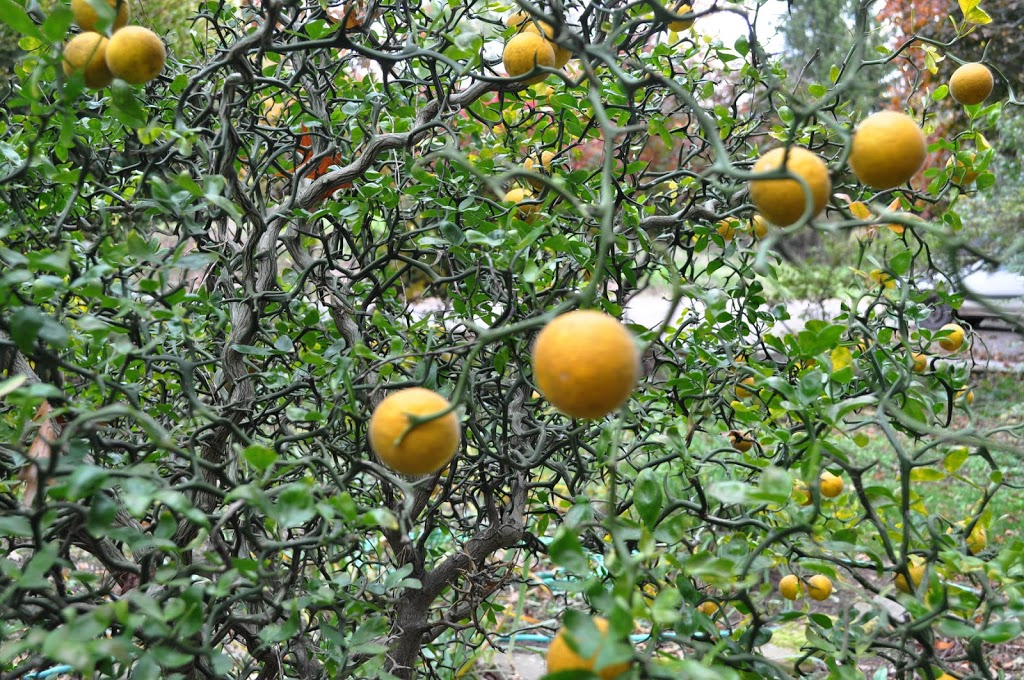



Do kumquats have thorns?
If there are thorns on your kumquat plant, is that a sign the rootstock is taking over?
Are the flowers of kumquat fragrant?
Thanks!
Kumquats should not have thorns. Yes, it’s probably rootstock sprouts that have the thorns. Yes, flowers are fragrant.
What kumquat variety is yours that you have pictured against the brick wall—and how old is it, please?
I think it is Meiwa, but it could be Nagami. Nowadays I only grow Nagami. Age? Good question but I can’t recall.
You mention that seed-grown kumquat typically takes about 10 years to fruit. Will it take that long to bloom as well?
Yes, it’s the blossoms that house the makings of the fruits.
Where did you buy your tree?
Logee’s Greenhouses in Connecticut
Thank you! I’ve had a Fukushu kumquat for several years, but knew nothing about caring for it. Your information was very timely, especially the thoroughly detailed instructions on repotting. It’s much appreciated!