
OTHER CREATURES ALSO LOVE APPLES
With more forethought, Adam might not have bitten the apple and I might not have planted apple trees. For my part, I hadn’t realized that apple trees had so many pest problems.
But Adam did bite the apple, and I did plant apple trees and we each have dealt with the consequences. I could have resorted to the season-long drench of pesticides recommended to kill every pest. Instead, I decided to research potential pest problems, then see how little, if any, pesticide I could use and still harvest an acceptable crop of high quality apples.
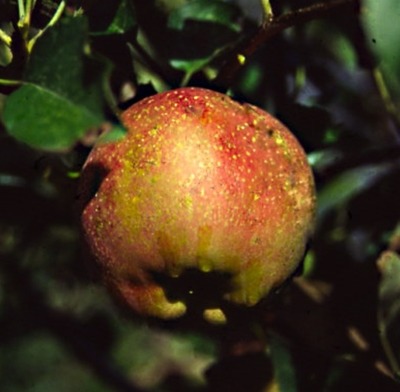
Home grown Esopus Spitzenberg apple
I should say at the outset that I no longer grow apples. For three reasons. First, my site, with cold, dank air in a valley, is a poor one for growing apples. Second, especially in a poor site, some spraying is needed; I grew tired of that. And third, I found a local orchard where I can buy excellent Macoun, Ashmead’s Kernel, and Esopus Spitzenberg apples, along with other favorites of mine.
With that said, I would definitely grow apples if I had a higher site with sloping ground, full sunlight, and acres and acres of forest not so close. Or if I lived out West or nearer one of the coasts.
Insect Culprits
The three major insect pests of apples are apple maggot, plum curculio, and codling moth. Here on the farmden, apple maggots are the worst of the lot, dimpling fruits and riddling them with brown trails of burrowing larvae. Given free rein, apple maggots damage almost every fruit beyond offering even one good bite.
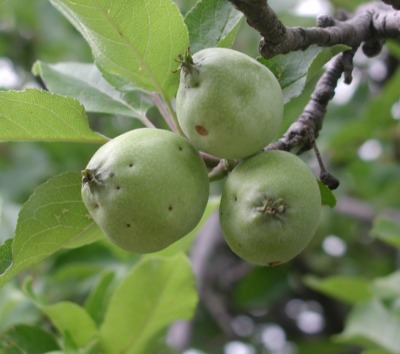
Dimpled fruit from apple maggot
Thankfully, the apple maggot has its Achilles heel. When the fly stage of this insect emerges in the latter half of June, the females search around for the biggest, reddest apples in which to lay eggs. I used to hoodwink Ms. Maggot with ersatz apples, which were red, plastic spheres that I coated with a very sticky material called Tangletrap — one trap per dwarf tree, two or three for larger trees, hung at head height in clear view.
After a few years of dealing with the messy business of cleaning Tangletrap off each sphere for use the next season, I came up with a better idea. Why not buy and use some real apples, very firm and very red Red Delicious apples. They do look and smell like apples even if their flavor leaves much to be desired. And they do keep for a very long time. I coated these apples with Tangletrap and pushed a wire through each for hanging in the branches. By winter, they shriveled to nothing and, with wire removed, can be composted.
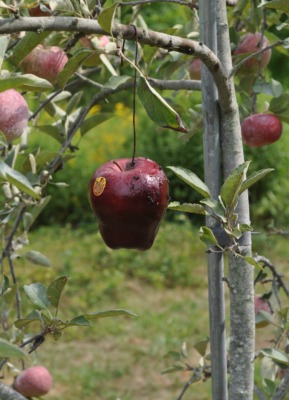
Maggot trap, with real apple
Unfortunately, no good alternative to spraying exists for plum curculio. This insect can cause fruit drop early in the season.
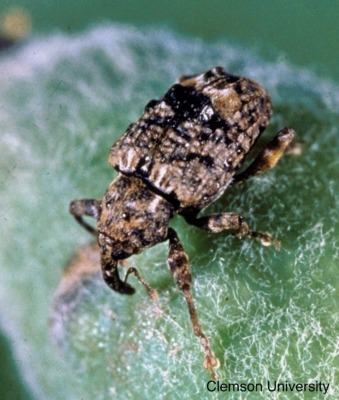
Plum curculio, cute but a real pest in eastern US
Instead of the usual chemical pesticide sprays used against this pest for the six weeks that it is active, this pest can also be controlled with a spray derived from kaolin clay. It’s a special formulation of kaolin — marketed under the name Surround — that coats everything to disguise the fruit and clog insects’ eyes, ears and reproductive organs. All in all, the coating makes Ms. Curculio think twice about landing, feeding, or laying eggs.
Sprays of Surround also keep Ms. Codling Moth at bay. This pest is active for much of the season, but even unchecked, results in only 25 percent fruits with the signature big, fat worm. This is the half a worm (actually a caterpillar) you see after taking a big bite out of apple.
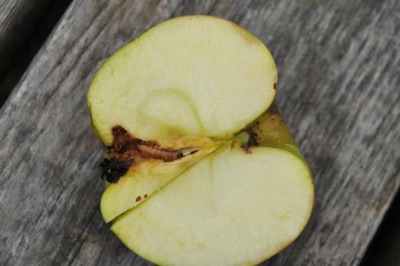
Codling moth in apple
The problem with Surround is that the tree needs a heavy coating (3 sprays, even before bloom), and then the spray needs replenishing to keep it dusty every couple of weeks or after just a quarter of an inch of rain.
Sprayed trees will have a white cast to them — a very Mediterranean look, commented one visitor to my garden.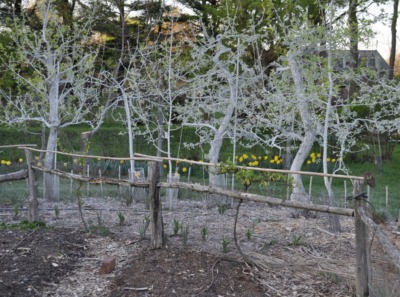
All Creatures Great and Small
Turning to diseases, the three most common ones are fire blight, cedar-apple rust, and scab. A combination of strategies keeps disease damage within reasonable bounds. I’ve always kept a careful eye out for fire blight, so that I could prune out any infections as soon as they show. Fire blight, which causes leaves or whole branches to blacken as if they have been singed by fire, thankfully never reared its frightful head in my backyard. The ends of infected branches curl over like a shepherd’s crook.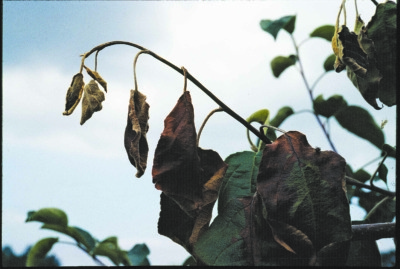
Cedar-apple rust shows up wherever wild cedars (especially eastern red cedar, Juniperus virginiana) abound, defacing leaves, and sometimes fruits, with rusty lesions. The cedars are alternate hosts for the disease, without which the disease cannot complete its life cycle. This disease is difficult to control with sprays organically, so I chose to accept a certain amount of damage rather than suit up for an additional spray session. And forget about removing nearby cedar trees because the fungal spores from cedars can travel as far as two miles!
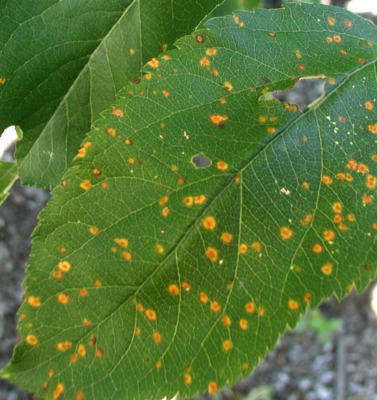
Cedar apple rust on apple leaf
Apple scab results in corky brown lesions on fruits and leaves. Defense against scab always began in fall, when I would smother fallen apple leaves — the source of next year’s infections — beneath a thick mulch of wood chips. Leaves that fell on nearby lawn were defused by mowing thoroughly. Chopped, the leaves decompose quickly and are rendered harmless.
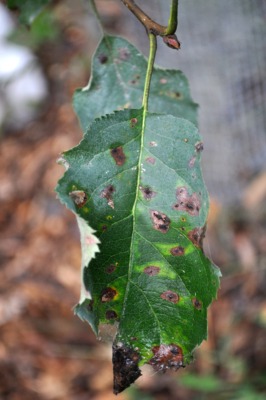
Apple scab on leaf
Although apple insects have cosmopolitan tastes, disease organisms are finicky. So another way to control diseases is with resistant varieties. One variety that I grow, Liberty, is resistant to all the major apple diseases. Other varieties have varying degrees of resistance to one or more diseases.
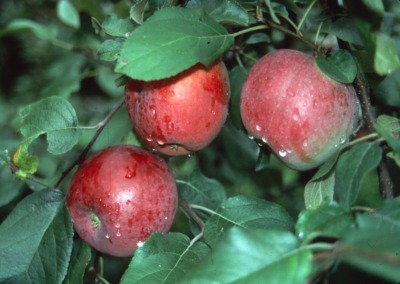
Liberty apple, home grown
Even without paying particular attention to planting only disease resistant varieties, I was able to harvest reasonably good yields of reasonably clean fruit using my combination of cleanup, limited spraying, and traps.
Cosmetically, my fruits put on a poor show compared with the perfect apples you see in markets. But my fruits were pesticide-free, and the Macoun, Jonagold, Spitzenberg, and other select apple varieties that I grew were simply scrumptious picked at their peaks of perfection. I hope Adam’s apple was as good.
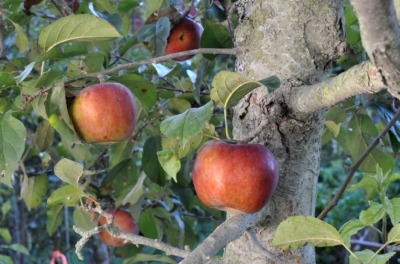
Home grown Macoun apples



If a master gardener says Apples are hardly worth the battle for fruit, I’m relieved to hear it. I won’t feel too badly about giving up on mine, Thanks for your good info and insight. With apologies to the deer for ruining their fun, the apples will be cut down.
Regards,
Lizzy