
BORING TROUBLES NO MORE
First Evidence: Limp Leaves
Complaints. Complaints. I’ve been hearing so many complaints about squash plants, how they looked healthy, then all of a sudden flagged and took a turn on the road towards death. I can help you deal with the problem — but mostly for next year. The best time for action was earlier this season.
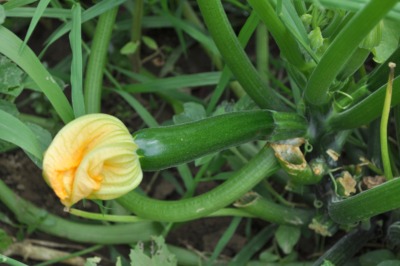
Young zucchini, early in season
An insect called the “squash vine borer,” lodged in the stem, is responsible for your squash’s wilting. The saga of how that insect got there began in early summer, when a pretty insect with an orange and black body crept out of the soil, stretched its coppery-green and clear wings, then looked around for a mate. She evidently found one, and soon after sought out your squash plants. Instead of squash, she also might have settled for a gourd, cucumber, or melon plant, in that decreasing order of preference.
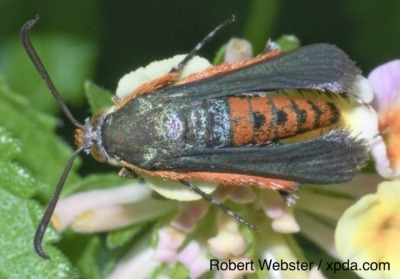
Adult squash borer
Upon finding a suitable plant, she proceeded to lay her fertilized eggs on the stems or leaf stalks near the base of the plant, eggs which within a week hatched into larvae. The larvae bored into the stems, and ate so much that there eventually was not enough stem tissue to conduct water to the leaves. Voila! The leaves went limp, and that’s what grabbed your attention. Take a look at the base of the stem now, and you will see a hole out of which has poured some sawdust-like frass.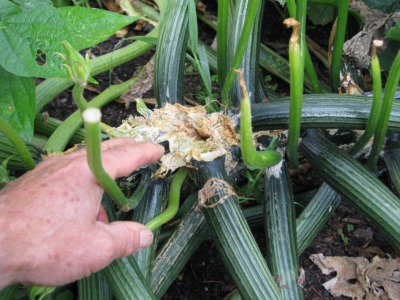
Fighting Ms. Melititia
We can fight this pest in a few ways. Because the moth only lays eggs early in the season, late plantings never pick up larvae. Thoroughly composting infested stems also helps if it gets the larvae before they leave the stem to return to the soil, which they do after about 6 weeks of feeding.
Another approach is to turn the moth away before she ever lays an egg on a squash plant. A floating row cover — or any other lightweight mesh material — allows water, light, and air to pass, but not Melittia cucurbitae (that’s the moth’s real name). The covering is only needed early in the season, during egg-laying, and, anyway, needs to be removed later so that bees can pollinate the blossoms. Covering merely the base of the plant with straw, nylon mesh, even aluminum foil, can prevent egg laying.
A physical barrier is 100 percent effective, but you could, instead, try repellents. Some gardeners claim that Ms. Melittia will avoid plants that reek of camphor, black pepper, or turpentine.
Another line of defense is to kill the larvae. You can kill them before they even get into the stem if you repeatedly dowse the base of the plant with Bacillus thuringiensis (Bt) aizawai, a readily available “organic” insecticide. Once the larvae are within a stem, get at them with any of the above pesticides — or parasitic nematodes — by injecting the material into the stem near where you see the telltale hole oozing frass (their sawdust-like poop).
If you are the kind of gardener who prefers hand-to-hand combat with pests, rather than pesticidal or biological warfare, then make a lengthwise slit in the stem just big enough to find the larvae, and stab it.
My second to favorite method for dealing with Ms. Melittia is to keep the plant happily growing in spite of her presence. I merely place bricks at intervals over portions of my squash’s trailing stems, inducing new roots to grow at those points. Larvae only lodge in the portion of stem right near where the seedling originally emerged, so new roots growing further along the stem can support the plant even if this oldest portion dies.
Problem Solved . . . Easily
My favorite method for averting damage from Ms. Melittia is to choose with care what squash to grow. The ideal squash would, of course, taste good, yield well, and be resistant to the borer. Those squashes exist!
The word “squash” — or “pumpkin” — brings in a number of Cucurbita species. C. Pepo includes zucchini, acorn, crookneck, and spaghetti squashes, as well as a number of “pumpkins.” They’re all very susceptible to squash vine borer.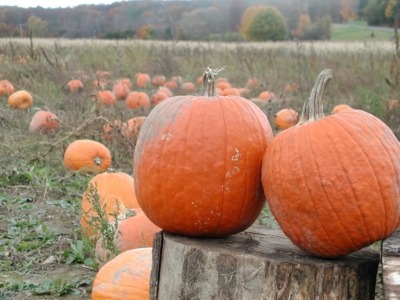
Slightly less susceptible are C. maxima, which includes blue Hubbard, butternut (turban shaped), banana, Kabocha squashes, as well as — again a number of “pumpkins,” typically the larger ones.
The species C. moschata are very resistant to borers because of their thicker, solid stems. They are the ones I grow: butternut (pear shaped) as a winter squash and so-called Korean squash as a summer squash.
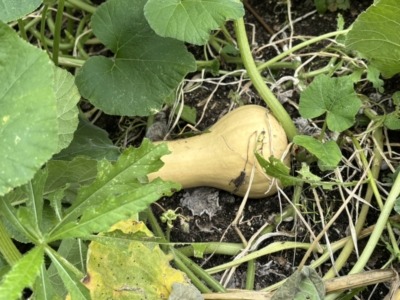
Squash, Butternut
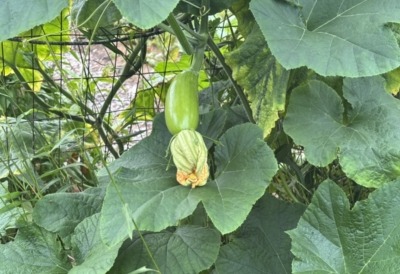
Squash, Korean fruit forming
If they have one flaw it’s their rampant vines; these vines are now flowing up over and through my fence out of the garden and into the outside area. Plants bear fruits in keeping with the vines’ vigor. The butternuts bear and store well enough to keep appearing on our plates through winter, on into March.
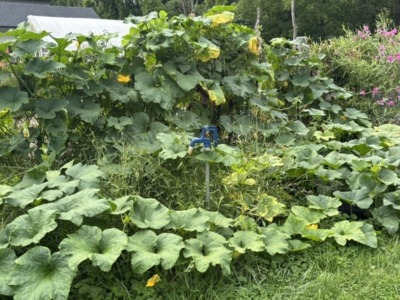
Squash, Korean escaping fence
If you like very sweet squashes, the variety Honeynut, a hybrid of butternut and buttercup, is very borer resistant.
For years I grew zucchini squash. And every year it would get attacked by borers. The vines didn’t stretch out enough to allow new roots to form along their length. No matter, though. By the time my summer squash plants slumped, I was always relieved. After all, how much zucchini can anyone eat?
I’m still harvesting plenty of Korean squash — and giving plenty away.



Could you show a pic. Of the way you put bricks on your plants
I don’t have any pix but do nothing more than lay a brick across some stems so that the stems are lightly pressed against the soil. Rooting the occurs in few days.
What is the botanical name for the Korean squash and where can one find seeds?
As I wrote, Cucurbita moschata genus includes various varieties of summer and winter squashes including, besides Korean squash, also Butternut squash. You can find Korean squash on the web as “Korean squash” or aehobak.
The idea of encouraging new roots along trailing squash stems is clever, but switching to borer-resistant varieties sounds even more appealing. I had no idea Korean squash could be so productive. Your final comment about having too much zucchini made me laugh!