
WOULD THE REAL (BEST) OREGANO PLEASE STAND UP
What’s in a Name
Ripe tomatoes bring to mind tomato sauce; tomato sauce brings to mind oregano. You would think that all that you needed to do to get oregano would be to mosey on down to the local seed store to pick up a plant or a packet of seeds, or send away to your favorite mail order nursery, right? Wrong!

Pizza
Oregano is, botanically, Origanum vulgare, a hardy perennial that sometimes parades under the names perennial marjoram, wild marjoram, or pot marjoram. As you can see, confusion is already creeping in. Marjoram is also the name of another herb. (Pronounce “marjoram,” with the accent on the first syllable, so the word sounds much like “margarine.”)
Margarine…whoops, marjoram…is an annual herb, that was once botanically Majorana hortensis and then became Origanum Majorana. The botanical names tell you that marjoram and oregano are kin, and they do, in fact, taste quite similar to each other, with marjoram being the sweeter and less strongly flavored of the two. Although marjoram is a perennial, it is a cold-tender perennial, so is usually grown as an annual. Because of its flavor, this marjoram is more specifically referred to an sweet marjoram. Because of its lack of hardiness, it’s also sometimes called annual marjoram.
But we can’t yet untangle ourselves from marjoram — sweet marjoram, that is — to stay with oregano, which is what we are after for our tomato sauce. A flavoring oil called “origanum oil” is extracted from either oregano or sweet marjoram, and occasionally, to further the confusion, from thyme or calamint. And sometimes this oil is called “marjoram oil.”
Now back to oregano, O. vulgare. Oregano is a very variable plant. That variable growth habit has given rise to some very ornamental forms, such as Kent Beauty, with trailing stems and hoplike blossoms, and Aureum, which forms a creeping mat of golden leaves. To me, those yellow leaves make the plant appear malnourished.
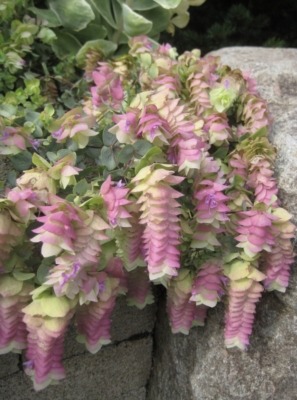
Kent Beauty oregano
Flavor Is What Really Matters
Oreganos also are variable in flavor — that most important attribute for our sauce. Some oreganos are virtually tasteless, such as one that I planted years ago. Perhaps you have had a similar experience. Recognizing the plight of us gardeners, some seed companies have started commenting, in their catalogs, on the flavor of the oreganos they sell.
True Greek Oregano is a name that has a flavorful ring to it, and this is the oregano now being promoted for strong flavor by some seed companies. The catalogs and websites list the botanical name for this True Greek Oregano as O. heracleoticum, whose common name is not really True Greek Oregano (a marketing ploy). It has also paraded under the common names of winter sweet marjoram or pot marjoram. At any rate, O. heracleoticum is, obviously a different species from O. vulgare, oregano, even though you would have to be a botanist to distinguish them. O. heracleoticum is considered by some to be O. vulgare subsp. hirtum, a subspecies of oregano.
If you’re not thoroughly confused by now, let me help you along in that direction. At least one seed company sells seeds of both plain oregano and True Greek Oregano, and they claim that plain oregano has the stronger flavor of the two.
Finally, Oregano Nirvana
I ripped that insipid oregano out of my garden long ago, and, finally, planted a deliciously, strongly one I needed for my sauce. To get this plant, I didnt resort to sorting through botanical names or sifting through seed catalogs. A friend had a large plant growing in her garden; I smelled it, liked it, and we divided it up into a few new plants. With its pungent flavor, small white flowers, and compact growth, this plant may very well be ‘True Greek Oregano.
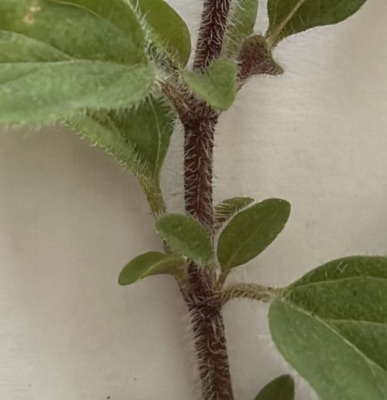
My oregano’s hairy stems and leaves
Putting together all the information I gleaned from the web, the flavor has led me to the conclusion that what I’m growing is, in fact, O. vulgare subsp. hirtum, that is, True Greek Oregano. For further confirmation, I looked at the leaves and stems under magnification and noted their dense coverings of glandular hairs, another characteristic of True Greek Oregano.
Of course, all this is academic. What I wanted is good-tasting oregano. I have it.



Years ago I had some kind of oregano that was tall with pinkish flowers. It was kind of invasive. I dried a bunch but the flavor was hardly present when dried. I identified it years ago but don’t remember it now. Do you have any ideas?
I guess it could have been the variety Kent Beauty that I mentioned in the post. It doesn’t have much flavor or aroma.
It was definitely not that! Once I realized how worthless it was I rooted it out.