
MYTHOLOGY COMES ALIVE!
[The following is excerpted from my book The Ever Curious Gardener: Using a Little Natural Science for a Much Better Garden, available from the usual sources or, signed, directly from me at leereich.com/books.
Chimeras That Are Not Frightening
The chimera of Greek mythology was a scary, fire-breathing creature that was part lion, part goat, and part dragon, and feasted on humans. Although Bellerophon killed that chimera, some still exist today. Perhaps there’s one in your backyard, even in your house!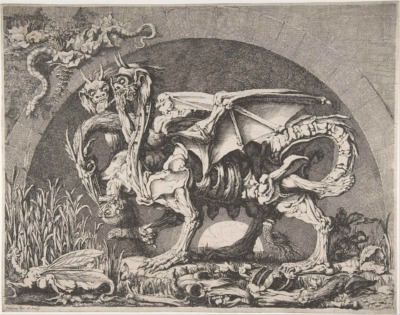
A chimera is a composite creature, a genetic mosaic, and such creatures exist in the plant world. Don’t expect to find red apples dangling from marigold stems or gardenia blooms unfolding against backdrops of poinsettia leaves. Plant chimeras never are as genetically diverse as that lion, goat, and dragon combo. Nor are they as physically diverse, a plant usually broadcasting that it is a chimera only with splotches or lines of color different from the surrounding color of the leaves, flowers, or fruits.
A chimera might originate by design, more usually by chance. To picture the beginnings of such a creature requires a step back to thinking how any plant grows.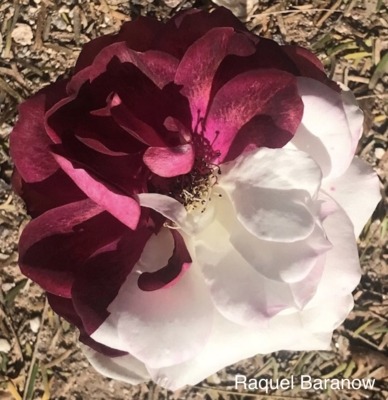
How These Freaks Come About
All plants elongate by division of cells at the tips of their stems. Zoom in to one of those stem tips, down to the cellular level and you’ll see that it has two or three well-defined layers which, as they divide, give rise to distinctive parts of the plant. For instance, the outermost layer of the tip becomes, logically enough, the outermost layer of a leaf. In most plants all the cells in their tips are genetically identical to each other and to those in the rest of the plant, with the exception of the pollen and egg cells.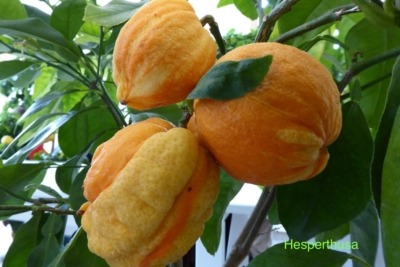
Now just suppose that a portion of that stem tip — even just a single cell — was genetically a bit different from the others. Perhaps that cell and its offspring were colorless. Then whatever parts of stems, leaves, flowers, or fruits derive from that particular cell would also be colorless.
That oddball cell or cells could be the result of a natural mutation. Or, a stem tip with more than one kind of cell could be made by tissue culture, a laboratory procedure for multiplying plant cells and, hence, plants in test tubes before growing them large enough to pot up or plant outdoors.
Out in the Garden
Historically, gardeners have occasionally created chimeras when grafting if, by chance, a new growing point arose that incorporated dividing cells from the two parts of the graft.
Some of these so-called graft hybrids aspire to that chimera of mythology, not in fierceness but in creating a creature representing more that one species or even genus. The camellia Daisy Eagleson is a graft hybrid of two different camellia species. Graft hybrids have also resulted from grafting laburnum and broom plants together, which are in different genera although the same family. The resulting plant’s branches are usually draped in yellow flowers characteristic of laburnums, but occasional branches are covered with purple blooms of broom.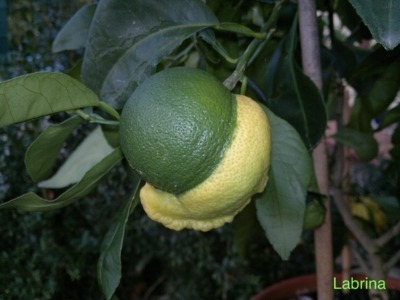
The plant chimeras that we gardeners are most familiar with are those that are visually obvious and look pretty — how else would we so easily identify them, and why else would we be so ready to propagate them? Thus we have the vinca varieties Elegantissima and Oxoniensis, the former with white margins bordering a dark leaf and the latter with dark margins bordering a pale green leaf. Another plant chimera is the sansevieria variety Hahnii Solid Gold. Chimeras are relatively common among geraniums.
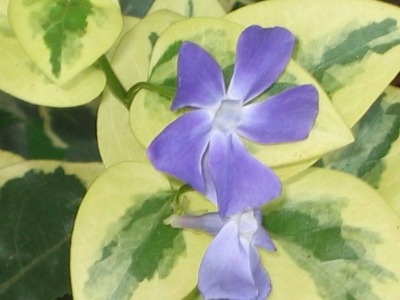
Vinca major ‘Variegata’
Don’t assume that any plant with streaks or splotches of color is a chimera. A virus is often the cause as are nutritional or environmental problems. And sometimes — in lungwort or zebra plant, for example — certain cells naturally grow differently or take on a different color in certain areas of plant even though the whole plant remains genetically homogeneous. Perhaps such plants just want to look like fierce beasts.



I love your blog. I'[ve visited you for a tour. I have read your book and list it in the bibliographjy of my book.
I want you to know that I am featured in a new 8-episode PBS TV series, The Home-Scale Forest Garden Show, available for national distribution this spring. The series offers practical advice on creating a perennial food forest for any size plot and maintaining it through the seasons. If you would like your local PBS station to air The Home-Scale Forest Garden Show at no cost to them, please call them and make that request. And if you are willing I would love you to spread the word.
Good idea. Thanks.