
AND THE REAL SPLIT-LEAF PHILODENDRON IS. . .
Doppelgangers
Ask for the real philodendron to stand up and you might be surprised at what plant does not rise. The still-seated plant I’m talking about is Swiss cheese plant (Monstera deliciosa), often called split-leaf philodendron.
Swiss cheese plant is sometimes called split-leaf philodendron, a common name it shares with a true philodendron (Philodendron bipinnatifidum) because both have similar looking, large glossy, incised leaves and aerial roots. Like the real philodendron, Swiss cheese plant also has a hardy disposition within the limitation of being tropical, and tolerates low light, dry air, and neglectful watering as well as do other good houseplants.
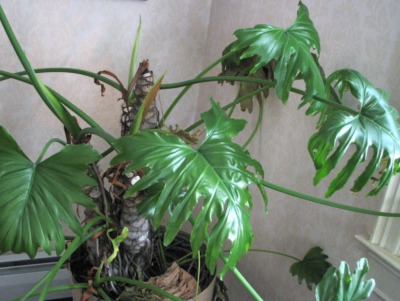
Philodendron bipinnatifidum
Where the cousins part ways visually is in the “Swiss cheese” aspect of the plants. While both plants have split or deeply cut leaves, only the Swiss cheese philodendron also has, as might be expected from its common name, holes in its leaves.
There are also other differences: Swiss cheese plants is a climber while split-leaf philodendron is more shrubby, although it can climb some if placed right up against a tree.
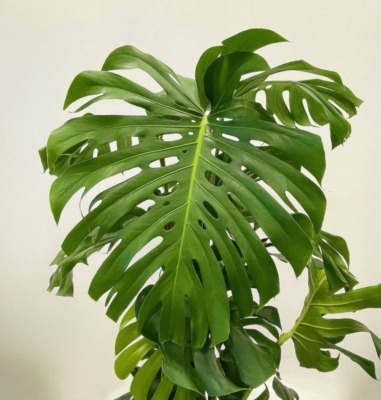
Swiss cheese plant
Pretty much the only response of Swiss cheese philodendron to poor growing conditions will be for new leaves to be undersized and lack the deep cuts and holes found on leaves developing under ideal conditions. The philodendron called split-leaf philodendron, on the other hand, is more consistently split-leaved under poor growing conditions and even when young.
Spectacular flowers
The genus name of Swiss cheese plant, Monstera, does not signify Monstera in a frightening sense. Instead of monster, think instead “monstrous,” because the plant’s leaves grow so large — even two or three feet across. Monstera is a close relative of philodendron, sharing the same family along with plants such as Jack-in-the-pulpit and calla lily.
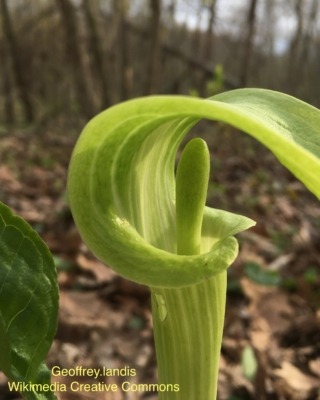
Jack in the Pulpit
What unites all these plants into a common family are their unique flowers. Individual flowers are themselves inconsequential. What makes them striking is the way they are packed tightly along an upright, fleshy spike, the whole spike rising just above one or two broad, brightly colored bracts. (A bract is a modified leaf at the base of a flower, and is often more showy than the flower itself — the red bracts of poinsettias are another example.)
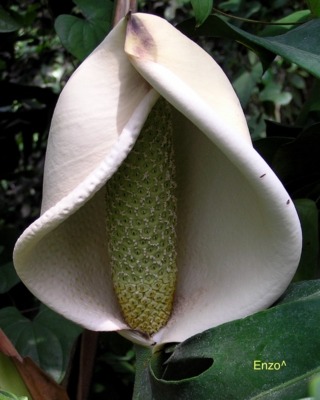
Monstera flower
You’ve probably come upon Jack-in-the-pulpit or calla lily flowers in the woods, a garden, or florist’s shop, but you may not ever have come upon flowers on a Swiss cheese plant. The reason is because Swiss cheese plant’s flowers develop only under nearly ideal growing conditions, which for this plant means high heat, high humidity, and high light. These are conditions found in either the tropics or a warm greenhouse. There, a young plant might flower as soon as two years after it has been propagated as a — incidentally very easy-to-root — stem cutting. The ten inch spike surround by a boat shaped, white bract is quite spectacular.
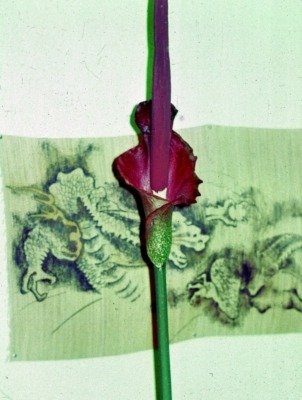
Another relative, this one called Amorphophallus
And fruits…
Fruits that follow such flowers make Swiss cheese plant even more interesting, and give rise to the species part of its botanical name: deliciosa. You’ll occasionally find this fruit offered in tropical markets, sometimes under the name ceriman. As the fruit develops, the spike looks like a long pine cone or an ear of corn covered with small, hexagonal plates of green rind covering individual edible kernels.
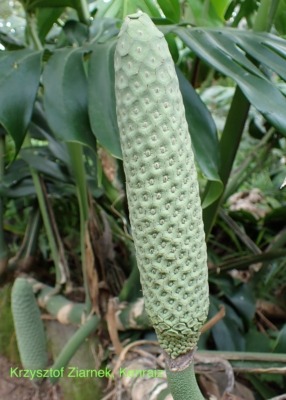
Monstera deliciosa, unripe fruits
Those kernels turn yellow as they sequentially ripen. You wouldn’t want to taste any kernels while they are still green. At that stage they are still high in oxalic which can cause a burning sensation in your throat. People vary in their sensitivity, at the extreme experiencing skin rash or anaphylaxis.
The fruit signals that it’s ripening by turning a lighter color, almost yellow, and by shedding bits of its rind. All the kernels do not ripen at once, but the fruit can be clipped from the plant when ripening begins, then wrapped in plastic and held at room temperature to finish ripening completely without falling apart. Bite into the individual, pale, juicy kernels, and what you would taste would be a combination of pineapple and banana, with a slight hint of apple.
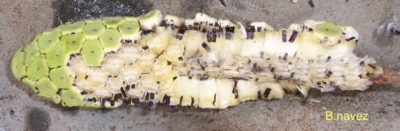
Monstera deliciousa fruit, ceriman



Leave a Reply
Want to join the discussion?Feel free to contribute!