
BUSH RESCUE
Let the Plant Express Itself
“I brake for butchered plants.” Perhaps that’s what the bumper sticker on my car should read, because I did almost slam on my brakes last week to try and save a forsythia bush — a whole row of them, in fact — from being butchered. An obviously well-intentioned guy was attacking the bushes on his front lawn with loppers.
A few things were wrong with this scene. Loppers are the main tool to use in pruning forsythia, but this guy, unfortunately, was standing upright and using them at chest height. Cutting a myriad of stems individually is tedious.
More important, lopping all branches to this height creates a bush that rises up from the ground aspiring to become a graceful fountain, then loses that nascent grace in a wild burst of growth originating — you guessed it — at chest height.
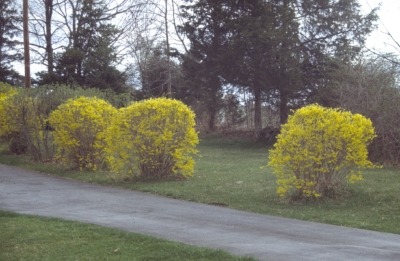
Forsythia hedged globes
The response is the same as when you shorten a stem on any plant, from a ‘mum to an apple to an indoor avocado: buds just behind the cut are awakened to grow out into vigorous shoots.
Why not let a forsythia bush be the graceful fountain of growth that it’s trying to be? The plant does need pruning, of course, to periodically rid it of decrepit, old stems and make way for young, flowering ones. The way to prune and maintain that graceful, arching form is by using the lopper at ground level, cutting away the decrepit, old stems there.
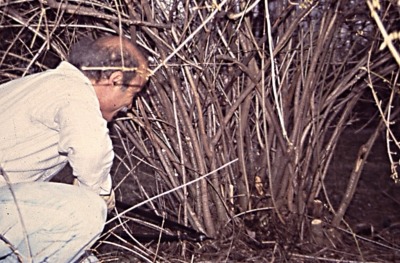
Pruning out decrepit and congested stems at base of forsythia
A few of the youngest stems can also be cut to ground level, with a hand shears (aka “pruning shears” or, in Britain, “secateurs) so that the stems don’t crowd each other with age.
And finally — don’t put the hand shears away yet — but complete the job using them to shorten any stems that are too lanky. For good looks, that is.
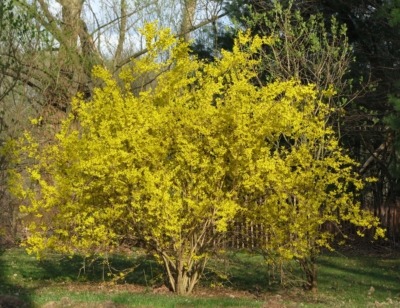
A fountain of yellow forsythia flowers
Unnecessary Flower Sacrifice
A second problem with this pruning/butchering job that I came across was timing. Forsythia blooms first thing in the spring, not on shoots that start growing early in the season, but on stems that grew last season. So anything cut off now translates to just that many fewer flowers this coming spring.
For the most abundant flower show from forsythia or any other early spring flowering shrub, wait to prune until next spring, right after the burst of colorful blossoms subsides. Summer blooming shrubs, such as butterfly bush and rose-of-sharon, blossom on new shoots so nothing is sacrificed by cutting off old ones in winter or anytime before growth begins.
Consider Plant Health
Fall is also not the best time to prune forsythia or any other plant in terms of plant health. Plants respond to being cut with a certain amount of activity right at the wound. This time of year, the response is nowhere near as obvious as the quick healing of wounds or new shoot growth that occurs in spring and early summer, but something, perhaps only on a cellular level, does nonetheless happen.
Plants are best able to face winter with their “machinery” shut down. Any part of a plant where there is activity, whether it’s the cut edge of a stem or awakening stem or flower bud, is susceptible to damage from frigid weather.
For this reason, it’s generally best to wait to prune any plant until after the coldest part of winter has passed. And for plants that are particularly tender to cold, wait even longer, until just before or after growth has begun for the season, which one — before or after — depending on when the plant flowers.
It wasn’t really critical for me to come screeching to a stop in front of those forsythia bushes I saw being butchered last week. Forsythia is a tough plant, not particularly susceptible cold damage here in Zone 5.
Butchering ruined their appearance (in my opinion) and will sacrifice part of the spring show, but won’t kill or otherwise harm the plants.
The same cannot be said for pruning or butchering other plants this time of year.
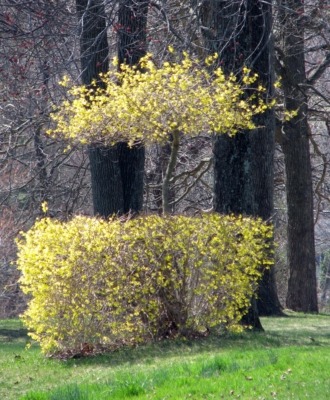
Interesting and unique pruning of forsythia



When would I prune witch hazel, as it flowers in late fall or early winter?
Prune anytime after flowering until before growth begins in spring.