FINAL HARVESTS

Compressed Gardening Experience

People are so ready to sit at the feet of any long-time gardener to glean words of wisdom. I roll my eyes. Someone who has gardened for ten, twenty, even more years might make the same mistakes every year for that number of years. I, for instance, swung a scythe wrong for 20 years; I may have it right now. Even a wizened gardener who has evaluated and corrected their mistakes has garnered experience only on their own plot of land; these experience may not apply to the differing soils, climates, and resources of other sites.
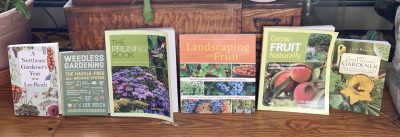
Lineup of my books
When I began gardening, my agricultural knowledge and experience was nil, zip, niets, rien, nada. But — and this is important — I had easy access to a whole university library devoted solely to agriculture. Hungry to learn, I read a lot. (I also was taking classes in agriculture.) In one year I was able to garner years of, if not actual experience, much of the knowledge that comes with that experience. And my garden showed it.

I’ve now gardened many decades and still gobble up the written word.

All of which is to say that reading reputable sources about gardening can make anyone a much better gardener and do so quicker than by gardening alone. “Reputable” is a key word in the previous sentence. So here’s the, to use the phrase of Magliozzi brothers on the radio show Cartalk, Shameless Commerce Division of this blog: a plug for my books. I stand firmly by anything I’ve written and am open to criticism.

Here’s the book list, all available from the usual sources or, signed, from me through this website (good gift idea, also):

A Northeast Gardener’s Year: A month by month romp through all things garden-wise, what to do, how to do it, and when to do it.
The Pruning Book: Plant responses, pruning tools, how to prune just about every plant (indoor, outdoor), and final sections on specialized pruning techniques, such as scything and espalier.
Weedless Gardening: A four-part system, emulating Mother Nature and based on current agricultural research, that makes for less weeds and healthier plants, along with other benefits such as more efficient use of water and conservation of humus.
Landscaping with Fruit: Following introductory chapters about designing your landscape is a listing of the best fruits to use for “luscious landscaping” in various regions and how to grow each of these fruiting trees, shrubs, vines, and groundcovers.
Grow Fruit Naturally: Describes multi-faceted approaches to growing fruits without resorting to toxic sprays, starting with selecting kinds of fruits and varieties and moving on to encouraging natural predators, beefing up the soil, and more.
The Ever Curious Gardener: Using a Little Natural Science for a Much Better Garden: Knowing some of the science behind what’s going on in the garden can make you an even better gardener; here’s how.

Vegetable Finale

And now, on to some gardening . . .

I’ve said it before and Yogi Berra said it before me, “It ain’t over till it’s over.” Last night’s temperature plummeting to 18°F was still not enough to put the brakes on the vegetable garden. Beneath their covered “tunnels,” arugula, mustard, endive, and napa Chinese cabbage still thrive. Along with mâche and kale, which aren’t under cover, all these greens are looking as perky as ever and, most important, taste better than ever.

Interestingly, temperatures I’ve measured within the tunnels are not that different — actually, not different at all — from temperatures I’ve measured outdoors. But something’s different. The increased humidity under the tunnels is probably at least partially responsible for the fresh tastes and appearances.
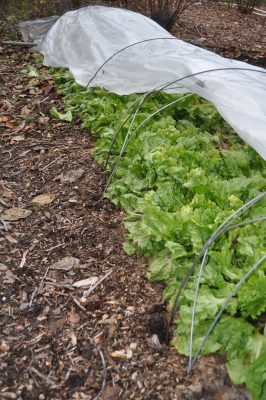
Endive in tunnel
It’s a wonder that these tender, succulent leaves tolerate such temperatures. You’d think the liquid in their cells would freeze and burst the contents to smithereens. That would have been the case if the 18°F had come on suddenly, without any precedents. 

Plants aren’t passive players in the garden. Increasingly cold weather and shortening days acclimated these plants to cold. (A month ago, temperatures dropped one night to 16°F.) Plants move water in and out of their cells, as needed, to avoid freezing injury. And increasing concentrations of dissolved minerals and sugars in the cells make the water freeze at lower temperatures. Perhaps that’s one reason why these vegetables taste so good. The tunnels also slow down swings in temperature, giving plants time to move water in and out of their cells and whatever else they do preparing for and recovering from cold.

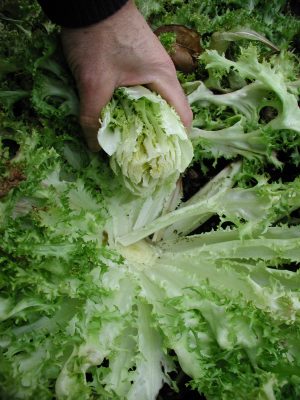
Too many people, even gardeners(!), consider endive as nothing more than a bitter, green leaf best used as garnish. Reconsider. Given close spacing so that inner leaves of each head blanche from low light along with cool and cold temperatures, and endive takes on a wonderful, rich flavor. Blanched interior of endiveOnly the slightest hint of bitterness remains, enough to make the taste more lively — delicious in salads, soups, and sandwiches.
Fruit Finale

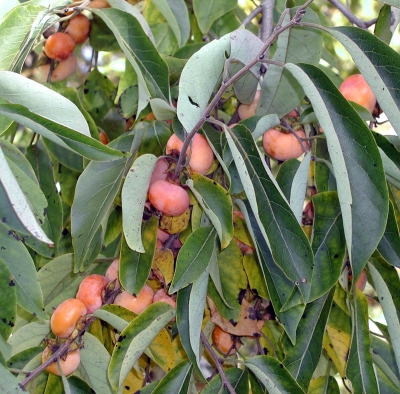
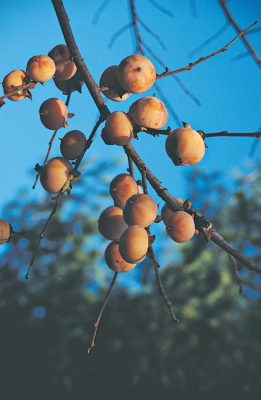
The last fruits of the season, Szukis American persimmon, were harvested last week after over a month of eating them. Definitely the easiest fruit I grow. No pruning, no pest control. And definitely one of the tastiest: imagine a dried apricot soaked in water, dipped in honey, then given a dash of spice.
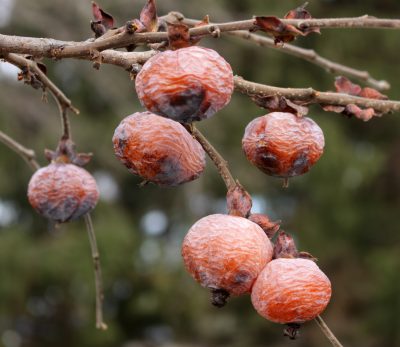
Persimmons on tree in December
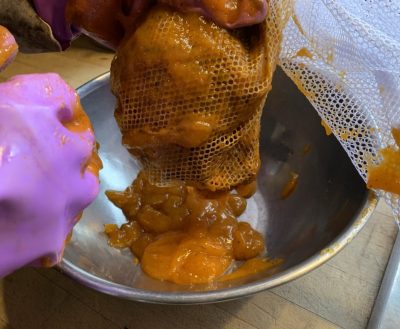
Fruits were very mushy for the final harvests — perfect for a jam. Squeezing a bunch of the fruits in a mesh bag (such as used for women’s “delicates” in a washing machine) pushed out Making persimmon jamthe pulp without seeds. No sweetener needed. Just jar it up and refrigerate (keeps about 2 weeks) or freeze. Delicious.
 

GARDEN ESSENTIALS, FOR PEGGY

Compost, of Course, and More

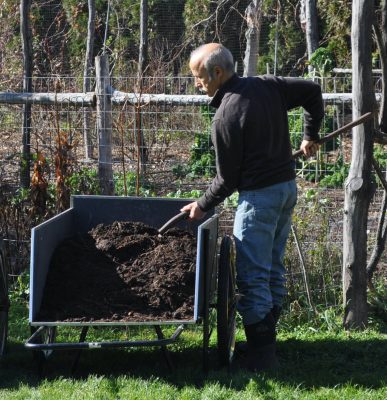
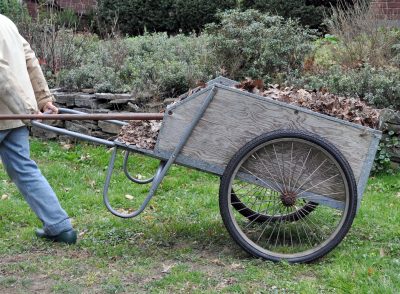
Very soon I plan to drive a truckload of compost to my sister Peggy’s house. Like many people, she’s caught the gardening bug, and this compost, along with a wheelbarrow I fished out of my town’s metal recycling, is a gift. It includes my help spreading it.
Compost in garden cart
What else would be a good gift for any beginning gardener? (Okay, Peggy has been dipping her toes in the gardening waters for years, but only recently got more serious about growing vegetables.)

For starters, indispensable, would be a trowel or a hori-hori knife, the latter being something of a hybrid of a garden knife and a trowel, not as good as either parent but great for all-around use. No need to labor over the worth of a high-end, stainless steel, oak-handled trowel; either will work well and last long if stored out of the elements.

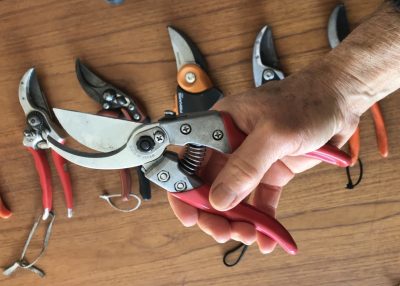
A pair of hand shears would come in handy for clipping tomato suckers or cutting down pepper or eggplant plants at season’s end. They’e admittedly not indispensable for vegetable gardening but very useful if any shrubs or trees are also in the picture. ARS pruning shearsFor a hand shears, quality counts. Blades of the best hand shears, as in their name, shear past each other like those of scissors. They’re called “bypass pruners.” My favorite is the ARS hand shears. Shears with anvil blades — “anvil pruners” — sport a sharp blade that comes down on a narrow, flat surface; the flat surface limits how close you can make a cut and the shear works poorly if any nick or waviness develops on the sharp blade.
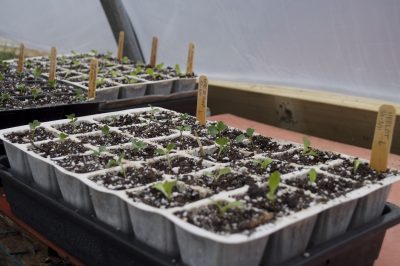
For anyone venturing into growing their own seedlings, which greatly widens the choices of varieties to grow, I recommend one of the many “self watering seed starters.” Cells housing plants sit on a capillary mat that dips into a water reservoir just below. Seed propagatorSoil in the cells sucks up moisture from below through capillary action to remain consistently moist, and the reservoir requires replenishment infrequently.
And finally, gloves, although these are very personal and it’s hard to pick out a pair suited to anyone else besides yourself. How about money for gloves? And some people like to get their hands in the dirt. As a professional pianist and piano teacher, probably not Peggy (check her out at www.peggyreich.com).

Reading Can Substitute for Years of Gardening

Okay, moving on to a most important “tool” for beginning, even intermediate and advanced, gardeners alike: books and the web. That is, if the information offered is sound — not always the case. One way to get solid information off the web is to follow any search term(s) with “site:edu” or “site:gov”, which brings you to university or government sites, respectively.

Not that those are the only reputable sites, but then judge whether other sites are reputable based on the author(s), possible agendas for financial gain, and comparing other information on the site with that you know for sure is either correct or false. 

As an example, someone recently told me that black walnut plants are high in iodine, as evidenced by the brown stain from the hulls and the first of many hits if you enter “iodine” and “black walnut” into a search engine. This didn’t ring true to me so I looked up analyses of iodine concentrations in black walnut on a number of reputable sites. No, black walnut plants do not contain iodine, despite all the sites touting the myth that they do.

(Everything you read on my site is, of course, reputable. Ha, ha.)

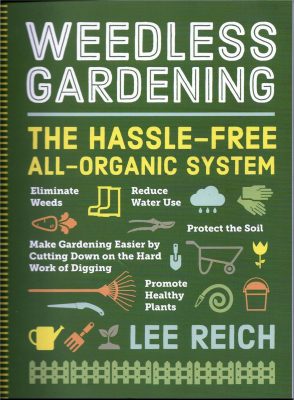
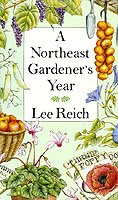
On to books . . . if I may be so bold as to begin by recommending my own. Weedless Gardening Weedless Gardening, covertells how to prepare and manage the soil, when to sow and transplant vegetables, what to use for mulch, how to make compost, the ins and outs of drip irrigation, and more. A Northeast Gardener’s Year A Northeast Gardener's Year covertakes you on a timely jog through the year with all things gardening: soil, flowers, houseplants, naming plants, etc., depending on what needs doing gardenwise indoors and out. I’ve written more books (all are listed on this site), but these two are more essential.
Plenty of other reputable gardening books are around if you seek them out. For an all around gardening book, check out Barbara Damrosch’s The Garden Primer. Specifically, for vegetables, there’s E. C. Smith’s The Vegetable Gardener’s Bible or some oldies, or, if you can get them, A. C. Burrage’s Burrage on Vegetables or Gardening: The Complete Guide to Growing America’s Favorite Fruits & Vegetables from the National Gardening Association.

Quality Compost?

Back to that truckload of compost for Peggy. A truckload of compost is more than I can spare of my own black gold, so I’m purchasing it in bulk.

I picked up the phone, dialed some numbers, and asked some prospective compost merchants about their products to make sure the compost would be of good quality. What went into the compost, for instance? A greater the variety of raw materials results in a better variety of nutrients in the end product as long as those raw materials don’t include industrial wastes that might contain heavy metals, or, in dry regions, feedlot manures, because of excess salts.

What about the acidity or pH? Ideally the pH lies between 6 and 7. 

How rocky or stony is the compost? No need to pay for rocks rather than compost. Similarly, is the material pure compost (desired), or compost diluted with a large portion of soil?

How about weeds or weed seeds? Time, temperature, and pile turning all have bearing on the number of viable weed seeds in a finished compost. A carefully built compost pile easily reaches a high enough temperatures to kill most weed seeds. But even when weed-free initially, composts that sit around too long (especially if uncovered) will pick up weed seeds carried in by wind and animals.

Good gardening, and especially organic gardening, involves moving bulky organic materials such as hay, straw, wood chips, wood shavings, leaf mold, and compost. These organic materials are what feed the friendly soil microbes which, in turn, feed the plants, as well as beef up the soil ecosystem in many biological and physical ways.

So two other items that come to mind, after the trowel, pruning shears, seed starting flats, and books, are a wheelbarrow or garden cart, and pitchfork or shovel. As I wrote, I’ll leave the wheelbarrow with her and can also leave of the many pitchforks I’ve accumulated over the years. Have I forgotten to mention any other gardening essentials?Garden cart

ONE OF THANKSGIVING’S UNSUNG HEROES

Years ago I wrote about one of the unsung heroes of Thanksgiving, the groundnut (Apios americanum). This plant, which helped nourish the Pilgrims through their first winters, never achieved the reknown of corn, pumpkins, cranberries, and other foods of the season.
Groundnut
When I first wrote about groundnuts, I had just planted them. I pointed out that there was renewed interest in the plant, though specifics as to how to grow it were wanting and selection of superior clones was just beginning. Now that I have grown groundnut for a few (thirty plus!) years, I am ready to share my experiences.

It Looks Like . . . And Acts Like . . .

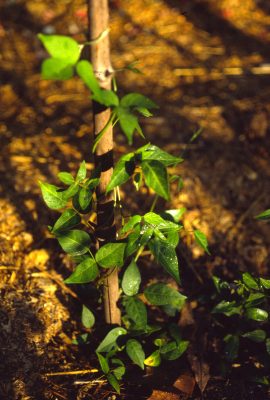
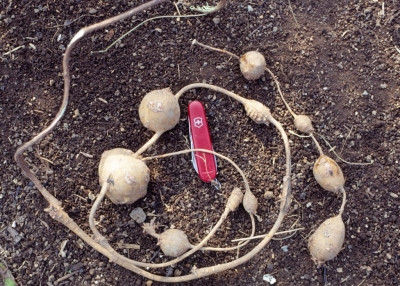
As you might guess from the name, the plant makes edible tubers, usually the size of golfballs and strung together on a thinner, ropelike root. The swollen roots on one of my plants are more the size of tennis balls than golf balls. Not as obvious, below ground, at least, is that the plant is a legume; as such, it can “fix” atmospheric nitrogen, that is, put it in a plant-available form.

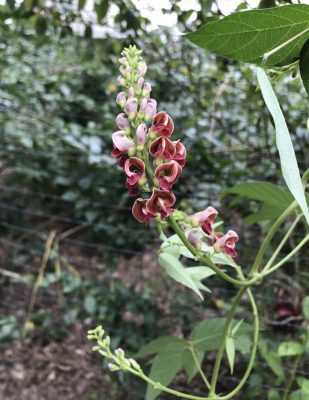
The plant also has shown some virtues aboveground. Chocolatey brown flowers dangle like jewelry from the twining stems. The flowers are pretty enough to have accorded groundnut a place in flower gardens in France a hundred years ago. On some plants, the flowers also have a strong and delicious aroma – vanilla, instead of chocolate, though.
Groundnut flower
I started some of my plants from seed; others I purchased growing in pots. I trained each vine up and down and around a tomato cage. The plants were and still are in full sun and rich soil, with a thick mulch of wood chips. The ground is so fluffy that I can harvest by just grabbing one end of a root, then pulling it up and out of the soil.

Soon after I planted groundnut, I discovered that it is weedy. I was soon finding plants, first sneaking across the ground a couple of feet from mother plants, and then further and further.

Aboveground, the twining stems reached around and insinuated themselves amongst the branches of a nearby bush cherries and other plants.
Groundut vine
To further unsettle me, I was startled at the reappearance, with vigor, of one young plant which I thought I had destroyed as I dug looking for edible roots. (I since learned that harvest must be delayed until the second season.) I hope groundnut will not prove to be as unruly and as hard to remove as the horseradish I once foolishly planted in the garden!

Is It Good To Eat?

Now for the important question: What does groundnut taste like? Thomas Hariot, in A briefe and true report of the new found land of Virginia (1590) may have been the first to write of groundnut, and his opinion was “boiled or sodden they are very good meate.” In 1602, a correspondent from New England wrote to Sir Walter Raleigh that groundnuts were “as good as potatoes.”

Dr. E. Lewis Sturtevant (Sturtevant’s Notes on Edible Plants, 1919) reported an eighteenth century horticulturalist writing that the “Swedes ate them for want of bread, and that in 1749 some of the English ate them instead of potatoes.” He also quotes a nineteenth century writer, who wrote that the Pilgrims “were enforced to live on ground nuts.”

Moving up to the twentieth century, wild food forager Euell Gibbons, who enjoyed everything from cattails to milkweed pods, was reserved in his praise of groundnuts.

I have harvested groundnuts and, because they should not be consumed raw, boiled some and baked some. They taste almost as good as potatoes, though less distinctive. The texture was dry and mealy. Like Euell, I am reserved in my praise of the roots, though other groundnut plants might have better or worse roots. (After all, not all potatoes taste the same.)

I do think that groundnut, even in its present primitive state, is a native, perennial, permaculture friendly vegetable (I have been accused by some of being a permaculturalist)  good enough to deserve a place at the Thanksgiving table. That is, it deserves a place in the garden and on the Thanksgiving table as long as it’s planted where its growth and spread can be reined in.

How about calling it one of its Indian names – nu nu, perhaps – and making nu nu stuffing standard Thanksgiving fare? Happy Thanksgiving!

GHOST OF A NOVEMBER PAST

A Vine or a Bush?

Here’s a blast from the past, from my November 20, 2009 blog post, with current commentaries  on how things have changed — and not changed — over the past 11 years.

Dateline: New Paltz, NY, November 20, 2009, 5:30 am. New models of plants, like cars, are deemed necessary to keep consumers interested and spending money. My cars (actually trucks . . . you know, manure and all that) stay with me for as long as they keep rolling along, so it was with equal skepticism I looked upon a new “model” of mandevilla, called Crimson, that arrived at my doorstep early last summer.

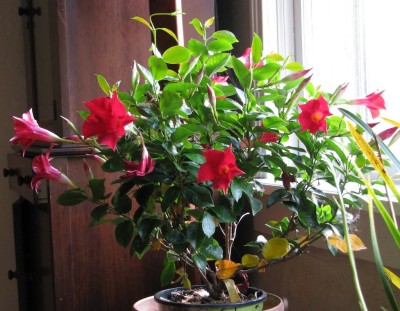
I was first attracted and introduced to mandevilla about 20 years ago. The glossy leaves and the bright red, funnel shaped flowers, were part of the attraction. The Crimson Mandevillavining habit was also a big part of the draw, making the plant a stand-in for morning glory, but with prettier leaves and brighter flowers. Mandevilla is a perennial, tropical vine, so must winter indoors rather than be seeded outdoors each spring like morning glory. My vine’s leaves yellowed so much in winter that I tired of looking at it; one winter day I walked it over to the compost pile.
The variety Crimson is a new kind of mandevilla whose main selling point is its bushy growth habit. So yes, it is different and new, but wasn’t that vining habit one of the things I always liked about mandevilla?

Still, I have grown very fond of Crimson. It flowered continuously all summer and, since coming indoors in September, continues to do so, with new buds on the way (at every third leaf bud, according to the “manufacturer.”) I’m going to think of Crimson mandevilla as a very pretty, long blooming, bushy plant. Yes, it’s a worthy new model.

Dateline: New Paltz, NY, November 19, 2020: Well, Crimson evidently was not that worthy; it’s no longer with me. As I remember, that sickly look that eventually came on in winter didn’t justify its tenancy here.

With that said, someday I may still grow mandevilla again. But not Crimson or any other bushy variety. As I wrote 11 years ago, that vining habit was one of its main attractions. If I do grow it again, I’ll put it in the basement or somewhere where I’ll hardly see it, for it to sit out winter.

Are They Really Sickly?

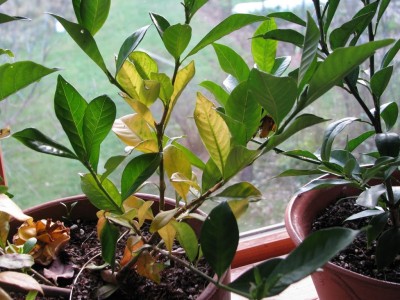
(2009) Sickly-looking leaves of houseplants – such as my mandevilla of yore – can be traced to a number of causes. Already I’m seeing this yellow transformation creeping up on my gardenia, which just finished one of its many fragrant shows.
Yellowing leaves of gardenia
Both mandevilla and gardenia need soils that are quite acidic (pH 4-5.5) in order to thrive. Not enough acidity makes it hard for the plant to imbibe iron, resulting in iron deficiency and yellow leaves.

But wait! It’s not time yet for the “iron pills.” Looking more closely at my gardenia, I see that it is the OLDEST leaves that are yellowing. Hunger for iron causes the YOUNGEST leaves to yellow (and for their veins to remain green). Yellowing of older leaves most commonly means that the plant isn’t getting enough nitrogen. The nitrogen is being robbed from older leaves (which turn yellow because nitrogen is an important component of green chlorophyll) to feed the younger leaves.

The prescription? Add some soluble nitrogen fertilizer and pay more attention to watering. Too much water drives air out of the soil, and roots gasping for air have trouble doing their work to take up sufficient nutrients.

(2020) I mostly agree with my past diagnosis of and cure for yellowing leaves. But two other considerations are worthy of attention. 

First, temperatures in my home are on the cool side and roots are less functional as temperatures cool, especially the roots of warm climate plants. So roots might not be able to make efficient use of nitrogen even if it’s added to the soil.

And second, even evergreen plants go through periods of shedding their oldest leaves. Before these leaves drop, they lose their chlorophyll and turn yellow.

So under natural and under less than perfect conditions, mandevilla and gardenia are unavoidably going to look sickly in late fall and early winter.

Oh, the gardenia is also no longer a resident here. Too prone to scale insects.

Asparagus’ Leaves, Their Work Finished

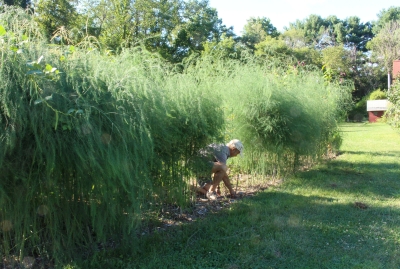
(2009) Yellowing leaves are not always a bad thing. (Think of birch leaves a few weeks ago, or aspen leaves.) I’m happy that my asparagus’ leaves have yellowed. The plants have been growing vigorously all season, feeding their roots to fuel next year’s growth of the delicious young spears that I’ll be snapping off at ground level from late April to early July.

With this year’s work finished, the shoots and leaves, left to grow unfettered since early July, are yellowing and dying back. My short-bladed brush scythe was the perfect tool to make quick work of the plants, a fluffy addition to the compost pile.

With the asparagus shoots and leaves cleared away, I could get into that bed and weed it. The bed was pretty much weed-free until July, but then wet summer weather kept Weeding asparagus in past yearsweeds germinating and growing, and hard to reach among the 6-foot-high forest of feathery stalks. The bed is now weeded and soon to be fertilized (2#/100 square feet of soybean meal) and mulched (wood chips 2 inches deep).
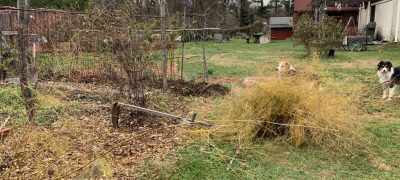
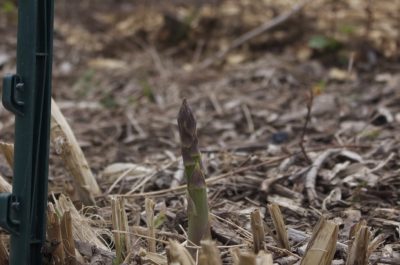
(2020) Wow! Right on schedule, on the same date as 11 years ago, asparagus leaves have yellowed. They’ve pumped nutrients and fuel down to their roots to provide for next spring’s growth, and are no longer functional and could harbor pests. So, like 11 years ago, I’m going to cut them down and add them to the compost pile.
Asparagus cut with scythe
This year I did treat the ground differently from the past 11+ years. Right after this year’s harvest, at the end of June, when the whole bed was cut to the ground, I did a little weeding. And then, instead of soybean meal as a fertilizer, I spread an inch of compost. Compost adds organic matter to the soil, and supplies a wider slew of nutrients and is more sustainable than soybean meal, among other benefits. The compost would also smother some weeds that would try to emerge.

Then, just to further smother weeds, I topped the compost with a one inch layer of wood chips.

I’m proud to report that the asparagus bed has never been so weed-free. No doubt, the very dry summer weather also played a part in keeping weeds at bay. 
Asparagus, growing thru compost + chips
At any rate, I’m getting out the scythe now to cut down the stalks. And I look forward to a good crop of asparagus beginning at the end of April. I highly recommend growing asparagus: it’s perennial and is one of those vegetable whose flavor is markedly different, and much, much better, when eaten fresh-picked.
Asparagus spear

FROM PAST TO PRESENT

Br-r-r-r-r-r

This post originally appeared November 7, 2009. Here’s an update with commentaries  on how things have changed — and not changed — over the past 11 years.

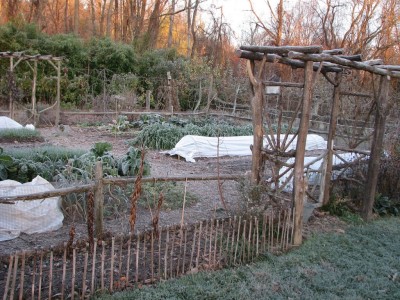
Dateline: New Paltz, NY, October 19, 2009, 5:30 am. I bet my garden is colder than your garden. I was startled this morning to see the thermometer reading 23 degrees F. Not much I could do at that point about protecting “cold weather” vegetables still in the garden, some covered with floating row covers and some in “plein aire.” The thing to do under these circumstances was wait for the sun to slowly warm everything up and then assess the damage.

Frost in vegetable garden

2009

I ventured out to the garden for a survey in the sunny midafternoon. Joy of joys. None of the cold-hardy vegetables was damaged by the cold. Romaine lettuces stood upright and crisp, arugula was dark green and tender, radishes were unfazed, and the bed of endive, escarole, and radicchio looked ready to face whatever cold the weeks ahead might offer.

That 23 degree temperature reading came from my digital thermometer, read indoors from a remote sensor out in the garden. Most surprising was the reading from the old-fashioned minimum/maximum registering mercury thermometer out in the garden. This thermometer remembered the night’s lowest temperature as 20 degrees F. Brrrrrrrr.

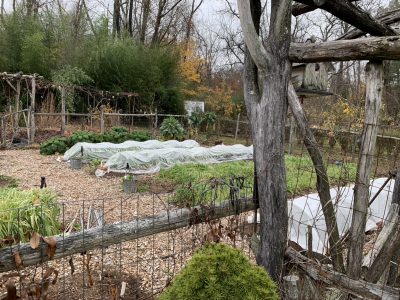
Garden view in early November

2020

Dateline: New Paltz, NY, November 11, 2020. This fall has likewise had a few frigid dips in the thermometer, down a couple of times to 24°F, and cold temperature vegetables have likewise fared well. Nowadays I check temperatures with a high-tech, but reasonably-priced, Sensorpush, a small sensor strategically hung in the garden. It beams current temperature and humidity back to my smartphone, and keeps a record of them throughout the day, week, month, and year. Its reporting jives with that of my “old-fashioned minimum/maximum registering mercury thermometer”.

What has changed is the weather over the past couple of weeks, with sunny days and temperatures hovering around 70°F. A fitting closing for a stellar year in the garden: best harvest, best fall color, congenial weather.

The effect of microclimate has been startling. I live about 4 miles out of town, on a road that follows the valley along the Wallkill River. On clear nights, radiation frosts spill cold air downhill to bring the temperature at the farmden about 5° colder than in town. A couple of evenings ago, temperature in town, as displayed on the local bank building and on my car thermometer as I drove through town, was 55°. Arriving at the farmden, the car thermometer, Sensorpush, and the “old-fashioned minimum/maximum registering mercury thermometer” registered 42° — quite a dramatic difference for a 40 foot elevation difference.

Mediterranean Fancies

(2009) Moving, figuratively, to warmer climes: the Mediterranean. I’m taking the Mediterranean diet one step further by trying to grow some of the delectable woody plants of that that region.

Figs are a big success, and not an unfamiliar sight well beyond their natural range. I’ve tried all the usual methods of growing them in cold climates. I’ve grown them in pots brought indoors for winter; I’ve bent over and covered or buried the stems to protect them from cold; I’ve swaddled the upright stems in leaves, straw, wood shavings, or other insulating materials. All yielded some fruit, but none of these methods beats having a small greenhouse with the trees planted right in the ground. Handfuls of soft figs, so ripe that each has a little tear in its “eye,” follow each sunny day and should do so for a few more weeks.

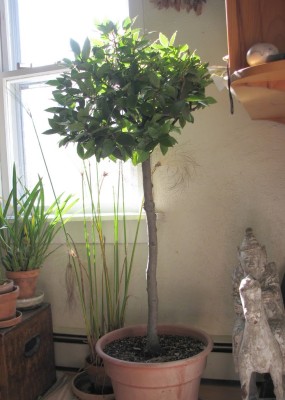
Bay (as in “bay leaf”) also does well, this one potted. After 20 years, my bay laurel is a

Bay laurel tree

Bay laurel, 2009

handsome little tree, trained to a ball of leaves atop a single, four-foot trunk. The fresh leaves are much more flavorful, almost oily, than dried leaves, especially the old, dried leaves typically offered for sale.

(2020) Yes, figs have been abundant in the greenhouse over the past 11 years. But diminishing sunlight and cooler temperatures, even in the greenhouse (37° minimum temperature), have drained the flavor from the few ripe, remaining figs.

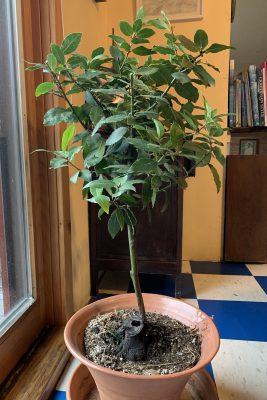
After 30 years, the bay is still thriving, valued as much for its beauty as for the flavor of its fresh leaves. It’s still trained as a small tree, smaller than in the past. I lopped the whole plant to the ground a few years ago to give it a fresh start, trained as round-headed tree only thirty inches tall.

Bay Laurel 2020

Bay Laurel 2020

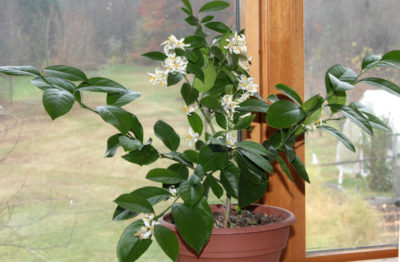
(2009) Three hopeful Mediterranean transplants are my olive, feijoa, and lemons. I purchased the olive tree in spring, whereupon it flowered and has actually set a single fruit! The feijoa, also known as pineapple guava, has two fruits on it, which might not seem like a big thing except that those two fruits represent the culmination of about 15 years of effort. (More on that some other time.) True, feijoa is native to South America, but it thrives and is often planted in Mediterranean climates. The same goes for lemon, except that it is native to Asia. My Meyer lemon hybrid, like the olive, was potted up this past spring and sports a single fruit.

The long shots among my Mediterreans are pomegranates. My two plants – the varieties Kazake and Salavastki – are cold-hardy, early ripening, sweet varieties from central Asia, so should do well here in a pot. (They are cold-hardy for pomegranates, down to a few degrees below zero degrees F.) They have yet to flower and fruit.

In a few weeks I’ll move all the potted fruits to the sunny window in my very cool basement, where winter weather is very Mediterranean-esque.

(2020) All three trees are still residents here, although the feijoa tenuously so. It’s a pretty plant but what I really want from it is fruit. Yields have been paltry. I’ve repeatedly threatened it with the compost pile, but repeatedly reneged. Besides its beauty, it often flowers, and the flower petals, fleshy, pinapple-y, and minty, are delicious.

One year, in an effort to downsize plant-wise, I was also going to walk the olive to the compost pile. And then someone reminded me that the olive is a symbol of peace, so I kept it. It’s a pretty plant, an easy to care for houseplant, and occasionally bears tasty olives.

The Meyer lemon offers so much everything: deliciously fragrant flowers, verdant leaves year ‘round, and tasty lemons. Just not enough of them. Meyer lemon is actually a hybrid of lemon and sweet orange.Meyer lemon tree in pot

Pomegranate is still a long shot. I’m down to one plant, Salavastki. It often flowers and sets a few fruits, but the fruits drop off. I’m still not sure why.

Still Great After All Those Years

Szukis persimmons ripening on leafless stems

2009

(2009) Persimmon is another tree grown in Mediterranean countries, although it’s not native there. Up here, I grow American persimmon, an outdoor tree that is cold hardy to below minus 20 degrees F.. Besides yielding delectable fruits, it’s a tree that requires almost no care, not even pruning. Some of the tree’s branches are deciduous, naturally dropping in autumn.

Heavy winds of a few weeks ago took the persimmon’s self-pruning theme too far and blew the top off my 20 year old tree. Fortunately, my three other persimmon trees remained unscathed. I’ll just trim the break from the decapitated tree and it will be fine.

Szukis persimmon

2020

(2020) Persimmon is still thriving, still care-free, and still delectable, the ripe fruits tasting like dried apricots that have been soaked in water, dipped in honey, and given a dash of spice. My persimmon “herd” has been thinned to my two best-tasting, most reliable varieties: Szukis and Mohler. Both are well-adapted to ripening in the the relatively short season (for a persimmon) this far north. Right now, the leafless tree is leafless and still loaded with fruit for the picking, much more than I can eat.

THE SHOW GOES ON

Lesser Known

A whole slew of clear, sunny days and cool nights caused sugar maples to put on a particularly fiery show of yellow and orange leaves this fall. That’s mostly over now around here — but a number of other trees and shrubs, many not well known, are keeping my farmden and beyond colorful longer.

Little known, for instance is Persian ironwood (Parrotia persica). I planted it years ago as a shade tree. Big mistake! For shade, that is. It doesn’t grow very large and is more of a large, multistemmed shrub. I’m glad I planted it, though. The smooth, gray stems grow thick and often horizontally, then downward a little before heading skyward, sort of like a miniature beech.

Parrotia leavesBut I’m writing about color, and Persian ironwood has it, the leaves emerging purplish in spring, turning a lustrous green in summer, then morphing into variable shades of yellow, orange and red in autumn.
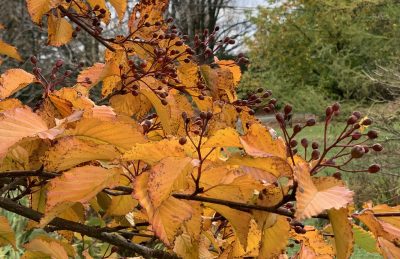
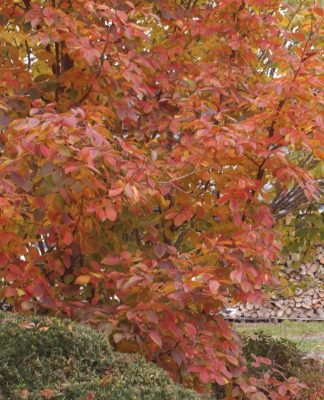
Also not well known is Korean mountainash (also called Korean whitebeam, Sorbus alnifolia). It’s closely related to more familiar mountainashes except in a different subgenus, Aria, with simple, rather than compound, leaves. I first saw this tree one fall at the Scott Arboretum in Pennsylvania and, knowing the tiny fruits make a good nibble, ate some. And knowing a whole tree can be grown from a tiny seed, I saved some seeds for planting.

That was in 2006, and the tree is now about 20 feet tall and draped in rusty red leaves that are splashed with yellow. As with the sugar maples, the color is particularly good this year — and fruits, which I’ll be nibbling, are also particularly abundant. As an added plus, the tree, each spring, is draped in large clusters of foamy, white flowers.
Korean mountainash
Another rare bird is Japanese stewartia (Stewartia pseudocamellia) which I planted — was it for its bark, for its flowers, or was it for its autumn leaf color? All are outstanding. The bark exfoliates in the same way as does sycamore, leaving silvery gray and charcoal gray patches against a khaki background. Its cup-shaped, white flowers with yellow center are like camellias, a relative. Right now, the leaves are a warm terra cotta color shading, in parts, to yellow.

Stewartia

Stewartia

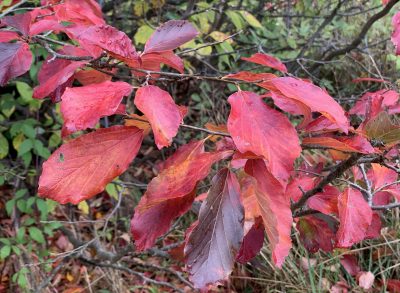
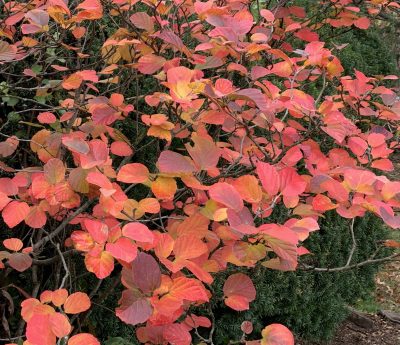
Fothergilla (Fothergilla gardeneii) is one more lesser known plant now aglow here. This small shrub’s leaves’ traffic-stopping, rich red color is heightened by occasional blushes of yellow and dark red. Back in spring, candles of fragrant, creamy white flowers perched atop the ends of stems.
Fothergilla leaves

Known for Their Fruits

Some plants that I grow for their fruits are also more than earning their keep with fall color. 

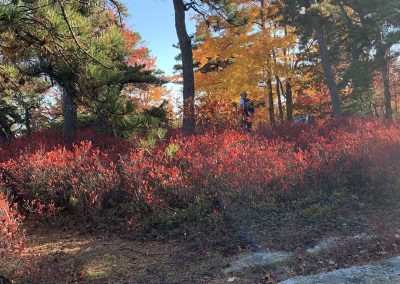
Huckleberry (Gaylussacia baccata) is among the best of these, and the color makes up for its relatively poor yield of fruit. The deep red leaves look pretty highlighted among the evergreen leaves of rhododendron, mountain laurel, and lingonberry in my “heather bed.” (All are in the Heather Family, Ericaceae.) Where the plants are really spectacular is in the Shawangunk Mountains that rise up just west of here. There, whole swaths of plants paint the forest understory red.
Huckleberry leavesPawpaw (Asimina triloba) is another fruit plant here, this one with many tropical aspirations. Tropical aspirations? It’s the northernmost member of the mostly tropical Custard Apple family (Annonaceae); its fruit has taste and texture reminiscent of banana; the fruits hang in clusters like bananas; and its long, drooping leaves would be visually at home in tropical climes. Come fall, the plants shed those tropical aspirations as the leaves turn clear yellow, especially nice when backlit by sunlight.
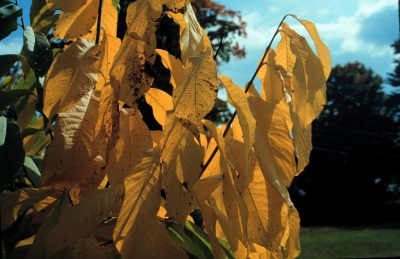
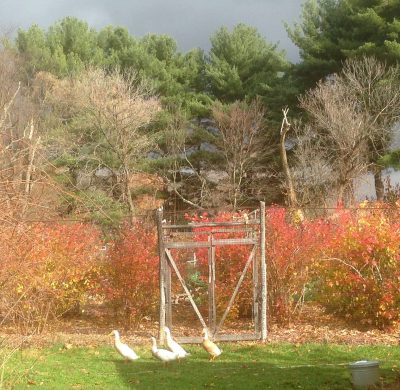
 Pawpaw fall leaf color
I often rave about blueberry for its ease of growth, its pretty, white flowers in spring, its long season of harvest, its health benefits, and of course, its delicious fruits. I’m sure I’ve also mentioned its fall color, to me one of the best of all plants, mostly crimson but depending on the variety and the season, also with some yellow.
Blueberry leaves in fall
(I delve into the planting and use of these and other ornamental fruit plants in my book Landscaping with Fruit.)

Look Down

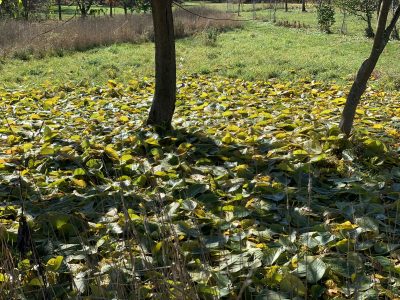
Perhaps it was a couple of particularly cold nights, with temperatures dropping into the low 20s, that caused leaves to all of a sudden drop all at once from certain trees. At any rate, the beautiful carpets blanketing the ground beneath these trees have caught my eye.

Pawpaws, for one, the overlapping, large leaves thoroughly hiding the grass beneath them.

Even at their best, mulberries leaves are nothing to look at in fall (but the trees do have other ornamental attributes, so did make it into Landscaping with Fruit). This year, though, the green leaves that plopped onto the ground following the cold nights did catch my eye. Perhaps it was the low angle of the sun reflecting off them; perhaps it was their shine.
Mulberry leaves on the ground
One tree whose leaves are perhaps at their best on the ground in ginkgo (Ginkgo biloba). This one is edible, allegedly delicious, but did not make it into my book. The edible part is the nut (seed) inside the fruit. The problem, for me, is that the fallen fruit smell like an open sewer. Really! 
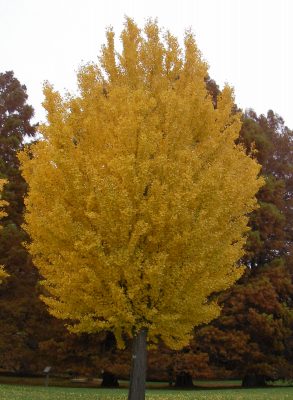
Ginkgo tree in fall
The way around this is to forgo the fruit by planting a male tree. The fan-shaped leaves of this living fossil, whose appearance dates back to the Early Jurassic, turn the clearest yellow imaginable in fall. They’re at their best when they drop, making the ground look as if a sunbeam had fallen from the sky.

I haven’t — yet? — grown ginkgo myself.

ABOUT PEPPERS

Better Late than Never

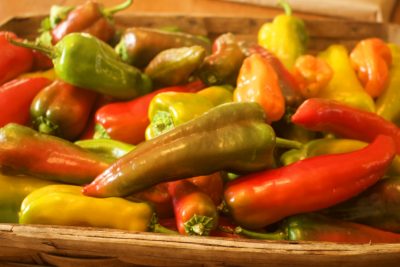
Cold has finally gotten the better of my pepper plants. Two below freezing nights a month ago started their demise, and two more during the last few nights finally finished them off for the season. Not the fruits, though, plenty of which are piled and spread out in trays and baskets in the kitchen.
Peppers in various stages of ripening
Outdoors, fruits weathered the below freezing temperatures well. They’ve been shielded from the full brunt of cold by their canopies of increasingly floppy leaves. Also, fruits of plants are higher in sugars than are the leaves. Thinking back to high school chemistry, I recall that any solute, such as sugar, lowers the freezing point of the solution. So pepper fruit cells can tolerate more cold than pepper leaves.

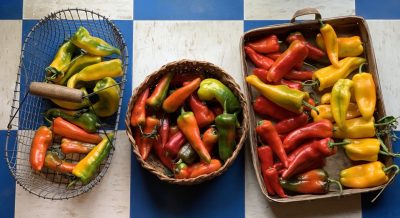
Even with the plants dead outside, the pepper season isn’t over here. The season has been greatly extended by harvesting and bringing indoors sound, green peppers showing any bit of red — or yellow if that’s the pepper’s ripe color. Sitting in trays and baskets in the kitchen, these mostly green peppers have been ripening, depending on when they were harvested and how long they’ve sat, to fully red or yellow color, when they are most flavorful (to me).
Peppers in trays and baskets
For some reason, perhaps the heat interfering with pollination, peppers started ripening later in the season than usual. The present and the past few week’s abundance of them makes up for the late start.

Thank You C2H4

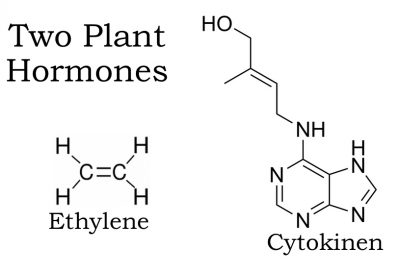
For the peppers’ morphing from green to red or yellow, I have to thank, in large part, a simple gas made up of just two atoms of carbon and four atoms of hydrogen. It’s ethylene, a plant hormone. Most plant and animal hormones are much more complex molecules.
Ethylene diagram
Ethylene is produced naturally in ripening fruits, and its very presence — even at concentrations as low as 0.001 percent — stimulates further ripening. The ethylene given off by ripe apples can be used to hurry along ripening of tomatoes, by placing an apple in a closed bag with the tomatoes.

Banana, apple, tomato, and avocado are among so-called climacteric fruits, which undergo a burst of respiration and ethylene production as ripening begins. These fruits, if picked sufficiently mature, can ripen following harvest.

Peppers, along with “figs, strawberries, and raspberries are examples of non- climacteric fruits, whose ripening proceeds more calmly. Non-climacteric fruits will not ripen after they’ve been harvested. They might soften and sweeten as complex carbohydrates break down into simple sugars, but such changes might be more indicative of incipient rot rather than ripening or flavor enhancement.” Or so they say. And, I admit, I’ve said; that quote is from my book The Ever Curious Gardener. (The rest of the section about ethylene in my book is correct.) They and I were wrong.

So, I’ve learned two things. First of all, pepper do ripen well after harvest, not only to a bright color but also to a delicious flavor. And second, further reading has revealed that hot peppers, but not sweet peppers, are, in fact, climacteric fruits.

What about semi-hot peppers? Or non-hot hot peppers? (Read on.)

Hot and Not

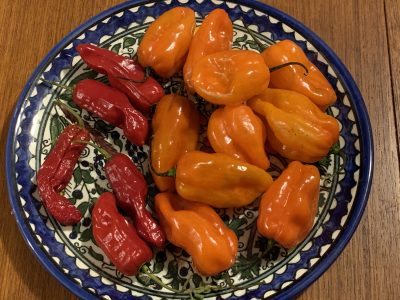
I did also grow some semi-hot peppers this season. Roulette is a variety billed as resembling “a traditional habanero pepper in every way (fruit shape, size and color, and plant type) with one exception – No Heat!” Roulette had an interesting flavor that I both liked and didn’t like (mostly liked), and occasional ones did have some heat to them, but that might have been due to their proximity to . . . 

Red Ember is billed as an early ripening hot pepper with “just enough pungency for interest.” It definitely caught my attention when I bit into one! Call me a wimp, but I thought it was fiery hot.

Peppers, Red Ember and Roulette

Peppers, Red Ember and Roulette

In my previously mentioned book, The Ever Curious Gardener, I also explored flavor in fruits and vegetables and, briefly, hotness in hot peppers. “Studies have been done with peppers, focusing specifically on their hotness, which, to muddy the waters, stems from not one, but from a whole group of compounds, capsaicinoids, mostly capsaicin and dihydrocapsain. Hotness in peppers was found to depend on the variety, the environment, and the interaction between variety and environment, with smaller fruited peppers less influenced by vagaries of the environment. Usually, but not always, a pepper will have more bite if plants are grown with warmer nights, with colder days, with just a little too much or too little water, or with fertility imbalances; increased elevation elicits the fiercest bite. Basically, with any sort of stress.”

Uncommonly hot temperatures this summer may very well have turned up the heat in Red Ember and put some heat in Roulette.

GRAPE and NUTS

Long-term Grapes

About a month ago, I picked a bunch of grapes as I was walking around the farmden with a friend, and handed it to him to taste. “Wow,” he exclaimed, eyes lighting up, “that really has taste.” That was the variety Brianna, one of many I grow that are otherwise not well-known, surely not to anyone who doesn’t grow grapes. My friend and I went on to agree that store-bought grapes are, “at best, nothing more than little sacks of sugary water.”

All that’s history now. Over the past month, most of the remaining grapes have either been harvested, eaten by birds or insects, or rotted, although a few very tasty berries can be salvaged here and there from some ugly bunches still hanging.

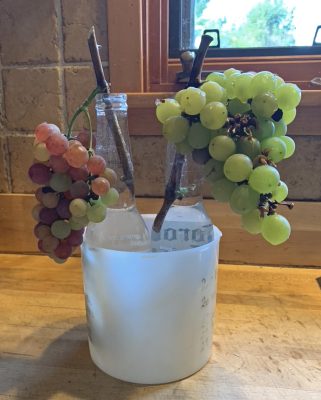
But are those grape-ful days gone yet? Years ago I read about how, over a century ago in France, fresh grapes were sometimes preserved by cutting off bunches along with a length of stem, the bottom of which was slid into a narrow-mouthed, water filled bottle. These bottles were then placed in a rack on shelves in cold storage which, where outdoor temperatures rarely dipped below freezing, was nothing more than a slightly insulated, outdoor room.

Grapes, stems in bottles, fresh picked

Grapes, fresh picked

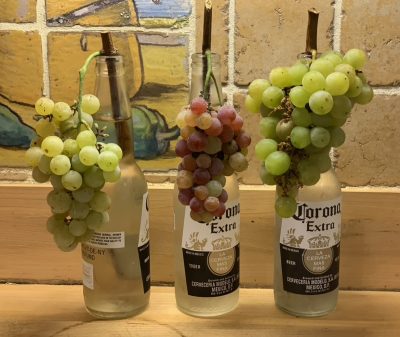
A month ago, I emulated those French grape growers of yore, in this case using Corona beer bottles, three of them, three grape varieties, and my refrigerator — very decorative looking.

Grapes, after 1 month storage

Grapes, after 1 month storage

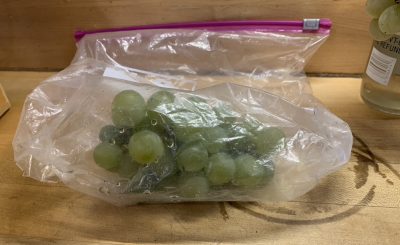
For a modern version, another bunch of grapes went into the refrigerator in a sealed freezer bag. Grapes in freezer bagIf any of this worked out, the plan was to use either the old-fashioned or modern method with a whole bunch of bunches in my walk-in, insulated and with some cooling or heating, as needed, fruit and vegetable storage room.

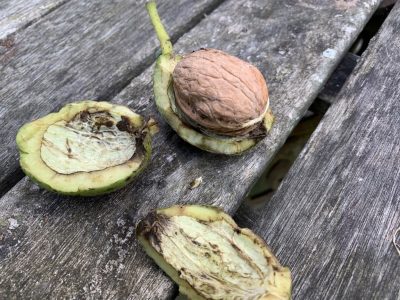
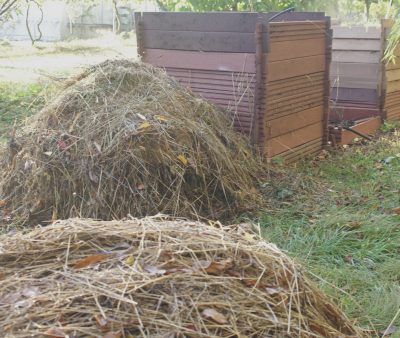
Back in the olden days, storing fresh grapes was not so rare even on this side of the Atlantic. Professor Frank Waugh, in his 1901 book Fruit Harvesting Storing, Marketing, wrote “An acquaintance of mine from the grape-growing district wrote me the other day (March 12th), ‘A neighbor of mine has one hundred tons of Catawbas still in storage.’” Probably not as single bunches on stems in bottles of water!

Anyway . . . drum roll . . . yesterday it was time to taste my stored grapes. One variety, Glenora, didn’t hold up well. The other two, Lorelei and Brianna, were very good. “Bottled” bunches were very slightly shriveled, but tasted quite good. Perhaps they would do better in the more humid atmosphere of the walk-in cold storage room. The bagged bunch, Brianna, was plump and also tasty.

Admittedly, none of the stored bunches had the crisp texture or fresh flavor of the few berries hanging on ugly bunches still outside. But all were better than any fresh grapes I can buy.

Walnuts at the Car Wash

Storage of nuts, also abundant this time of year, is more straightforward. You pick them up from the ground, let them cure in a cool place away from squirrels, then crack and eat them at your leisure.

With black walnuts, the green husks must be removed and the nuts within cleaned up. Leaving the husks to soften and darken a little makes them very easy, although tedious, to remove. Of the many suggested methods, twisting them off with two rubber-gloved hands seems most effective.

As far as cleaning up the hulled nuts, an old fashioned washing machined, earmarked only for this purpose, would work well. I don’t have one, so came up with an effective alternative.

After spreading out all the husked nuts into eight black plastic vegetable harvest boxes, I loaded them in the back of my truck. And then it was off to the car wash. A couple of rounds with the high pressure water spray did the trick. It was a messy job that I was prepared for with rain coat and pants, boots, hat, and face shield. The truck needed a washing anyway.

Spreading out the trays on the deck exposed for a few days to bright sunlight had them all clean and dry. Squirrels would normally be a threat but the deck is also where Sammy and Daisy, my dogs, spend much of their days.

Previous generation watchdogs on deck

Previous generation watchdogs, Leila and Scooter, on deck

Finally, the nuts were put into five half-bushel baskets for cracking beginning towards the end of December, which is about when last year’s nuts will be finished up.

Harvest Tragedy

I was never that hopeful for English walnuts here (also called Persian or White walnuts). This species is not all that cold-hardy, their blossoms are susceptible to late frosts, which are common here on the farmden, their leaves are susceptible to anthracnose disease, and the only place I had for them was near the road, along the squirrel highway (telephone, cable, and electric wires).

Still, I couldn’t resist, back in 2006, an offer of seeds for some “hardy” varieties. I planted two groups of three trees each, planning to cull out any weaker ones in each group.

All the trees grew well, and I eagerly awaited blossoms which, finally, this year, appeared in abundance. That abundance was followed by an abundance of nuts, and everything looked healthy. Then disaster, in the form of squirrels, struck. Every single nut was stripped from the trees.

Well, not every single nut. One nut was left, which I harvested, easily popped out of its husk, and let sit — cure — on the kitchen table for a couple of weeks. Then, with great fanfare, it was cracked open and eaten.

This year's English walnut harvest

This year’s English walnut harvest

As luck would have it, I also had a bag of store-bought English walnuts with which to compare in taste. No contest. Store-bought tasted rancid in comparison.

Next year, in enough time before the nuts start to ripen, I plan to spray all the trees with a hot pepper spray.

Any other suggestions would be most welcome.

COMPOSTING, A DIDACTIC & A PERSONAL VIEW

Start With The Carbs

A bit of chemistry might be good for your compost. Just a bit. Actually, we mostly need to deal with only two familiar elements of the 100 plus known ones. These two elements are carbon and nitrogen, and they are the ones for which the “bugs” that do the work of making compost are most hungry.

“Work” is too strong a word, though, because these composting bugs do nothing more than eat. Nonetheless, a balanced diet — one balanced mostly with respect to carbon and nitrogen — does these bugs, the composting microorganisms, good.

This time of year, the microorganisms’ smorgasbord is set with an especially wide array and abundance of carbon-rich foods. You can identify these foods because they are old plants or plant parts. As such, they are mostly brown and mostly dry. Autumn leaves, for example. Other carbon-rich foods include wood chips, straw, sawdust, hay, and even paper, made — after all — from wood pulp or other old, dry plant material.
Haystacks and compost piles

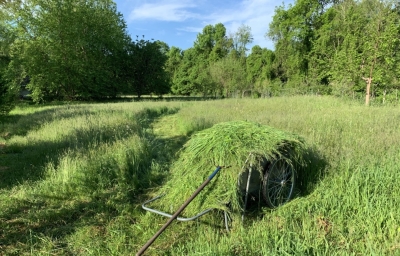
By far the bulk of high carbon — carbohydrate — foods for my compost organisms this time of year is hay that I scythe from odd corners here and there in my meadow. (Most of the meadow gets mowed by tractor once a year.) The hay is a mix of a wide variety of plants, mostly various species of grasses and goldenrods, but also, depending on where I cut, loosestrife, asters, New York ironweed, Joe Pye weed, and others. That varied mix is good for a compost pile; those microorganisms, like us, thrive on a varied diet which provides a slew of macro- and micronutrients which then end up in the finished compost and then my vegetables.

Next, Some Proteins

Just as we humans cannot live on bread and pasta alone (carbon-rich foods), so it is with composting microorganisms. So let’s now peruse the smorgasbord for some nitrogen-rich fare. This would include green stuff: young, succulent plants and plant parts. There’s not a whole lot of this stuff around this time of year, but there is some, including grass clippings, kitchen scraps, and microbial fare such as old, spent tomato, broccoli, pepper and other garden plants.

My scythed hay also provides some nitrogen-rich food — early in the season when its lush and green and only a foot or two high. But it has to be used in moderation because there’s not a whole lot of carbon-rich foods early in the season. Except that is, for the previous autumn’s fallen leaves and arborist wood chips that I stockpile. I also make some haystacks to save late-season hay for use in winter and early in the growing season.

Meadow with cartful of scythed hay

Early season scythings

When there’s insufficient nitrogen foods to balance out all the carbon foods you could now find for your compost, it’s time for dietary supplements. Nitrogen-rich supplements for the compost pile include manures and nitrogen fertilizers. Manures usually also add some carbon food, in the form of the straw, wood shavings, or whatever else the animal was bedded in.

No need to get out the chemistry set to analyze how rich a food is in carbon or nitrogen so that you can get them in exact balance (which, if you must know, is a ratio of 20:1). Just keep in mind that the younger the plant part, the richer it is in nitrogen. Also that rabbit manure is richer in nitrogen than is chicken manure, which is richer than, going down the line, sheep, horse, duck, cow, and, finally, pig manure. Nitrogen fertilizers are very concentrated sources of nitrogen.

If I need to supplement the compost diet with extra nitrogen, from fertilizer, I use something that acts organically in the soil, such as soybean meal, which is readily available from feed stores. Its nitrogen is released as various microorganisms feed on it.

Pile It In, and Monitor

So pile anything and everything that was once or is living into your compost bin, balancing carbon-rich foods with nitrogen-rich ones. After garden and backyard cleanup is finished for the season, the scale tips the other way as vegetable scraps become the most significant additions to your compost pile. Balance the food value of this nitrogen-rich material with an occasional cover of wood chips or hay from a pile you keep handy next to your compost bin.

The most important thing in making compost is a good bin. A “good” bin will keep scavengers at bay, be a barrier to weed seeds that might waft into the finished compost, is convenient to fill and empty, and maintains moisture and warmth within. It also keeps everything neat, looking like a compost pile rather than a garbage pile.

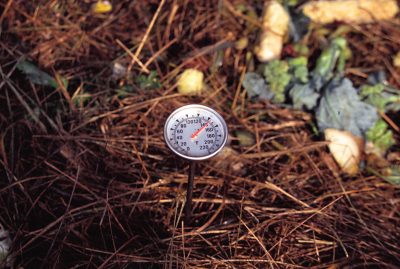
If you want to see how you’re doing as a compost “bug” dietician, monitor the goings on within your pile with a long-probed thermometer and your nose. If the materials are moist and outdoor temperatures not frigid, the well-fed pile will be decidedly warm — 120 degrees F., or more. Lack of heat reflects an excess of carbon-rich foods or insufficient water; odors are the result of excess nitrogen or too much water.
Compost thermometer

I take care of my pile’s water needs in two ways. First, when I build the pile I add materials of various texture so that the mix drains well — but not too well so that it can’t cling to sufficient moisture. A lot of water is needed to really wet the innards of pile. Add a lot of material to a compost pile at one sitting and you’d have to stand there, hose in hand, for a long time to really wet it. I’m not that patient, so the second way I take care of the pile’s watering needs is to hook up a small, static sprinkler to a hose along with a valve for adjusting the width of the spray to only cover the top of the pile. About 20 minutes of watering does the trick. (I periodically check moisture deep within the pile with a long-probed moisture meter.)

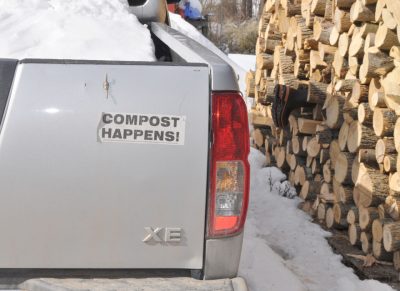
Keeping records of what you add to your compost pile and how it responds helps you remember what you did right and wrong. But “wrong” is too strong a word, because the material you put in your compost bin

Compost happens bumper sticker

will always turn to compost. As my bumper sticker reads, “COMPOST HAPPENS,” even if the process takes longer or becomes “aromatic” along the way.

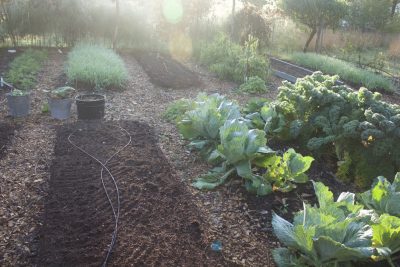
For me, making and spreading compost is as rewarding and enjoyable as is gardening per se.

(For more about making compost, using it most effectively, and buying compost, see my book Weedless Gardening.)
Composted garden beds, S garden

FRUITS UNLAWFUL AND LAWFUL

Interloper, Not Welcome by Everyone

As I was coming down a hill on a recent hike in the woods, I came upon an open area where the path was lined with clumps of shrubs whose leaves shimmered in the early fall sunshine. The leaves — green on their topsides and hoary underneath — were coming alive as breezes made them first show one side, then the other.
Autumn olive along trail
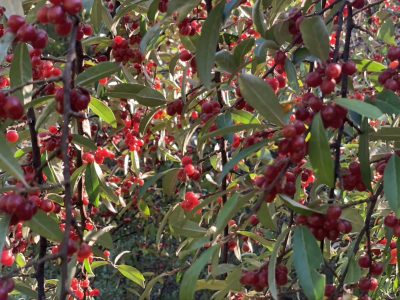
The plants’ beauty was further highlighted by the abundant clusters of pea-size, silver flecked red (rarely, yellow) berries lined up along the stems. I know this plant and, as I always do this time of year, popped some of the berries into my mouth. The timing was right; they were delicious.

Many people hate this plant, which I’m sure a lot of readers recognized from my description as autumn olive (Elaeagnus umbellata). What’s to hate? The plant is considered invasive (and banned) in many states in northeast and midwest U.S. “It threatens native ecosystems by out-competing and displacing native plant species, creating dense shade and interfering with natural plant succession and nutrient cycling.”
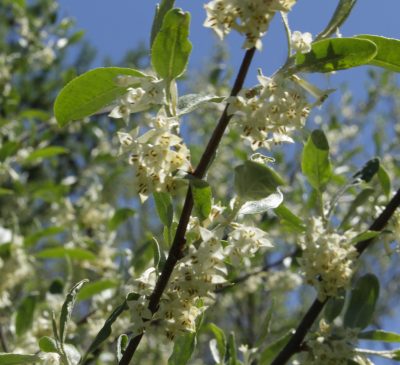
Flowers of autumn olive
But there is a lot to love about this plant, in addition to its beauty. In spring, about the middle of May around here, the plant perfumes the air with a deliciously sweet fragrance. And poor soil is no problem. An actinobacteria (Frankia) at its roots takes nitrogen from the air and converts it into a form that plants can use.

That ability to make its own fertilizer is just one reason this plant was loved before it was hated. Native to Asia (where the plant is not considered invasive), autumn olive was introduced into the U.S. and the U.K. about 200 years

Autumn olive fruit

 ago for their beauty and to provide shelter and food for birds, deer, bees, racoons, and other wildlife. The plant isn’t stingy with its garnered fertility. The soil near plants becomes richer, all to the benefit of nearby other plant species. As such, autumn olive has been planted to, for instance, reclaim soils of mine tailings, and, as interplants, to spur growth of black walnut plantations (by over 100 percent).


But let’s get back to me — and you — eating the berries. The berries are high in lycopene and other goodies so most sources tout the health and healing benefits, after admitting that the berries are astringent and tart.
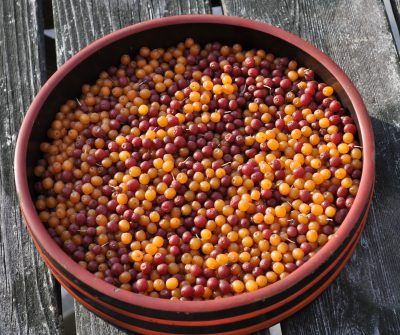
Yellow and red autumn olive fruits

But, for most autumn olive plants, that’s only if they’re eaten underripe. Right now around here, some plants are offering their dead ripe berries that are neither tart nor astringent, but sweet. Don’t mind the single seed inside each berry. Just eat them also; they’re soft. That window of good flavor is fleeting, lasting only a couple of weeks.

And eating the berries, seed and all, will slow the plants’ spread, pleasing invasive plant people.

So Bad(?) Yet So Good

Are invasive plants really bad? Or just bad for us? Planet Earth likes plant growth. Plants take in carbon dioxide and release oxygen, sequestering carbon, blanket the ground to limit soil and water erosion, and help support micro and macro communities of organisms.

Natural landscapes and their associated natural communities aren’t static. They change as they evolve. No doubt, humans have altered many natural successions. That might spell disaster for our aesthetic or economic sensibilities, but is not “better” or “worse” for our planet.

Scandinavian Dreams

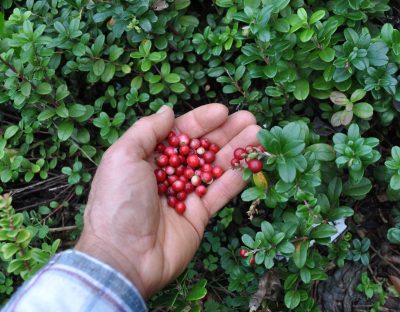
Noncontroversial is another red berry that I am now picking and enjoying. That’s lingonberries (Vaccinium vitis-idaea). If you are Scandinavian, you probably just smiled and a dreamy look came into your eyes.Each year, thousands and thousands of tons of lingonberries are harvested from the wild throughLingonberry fruitsout Scandinavia, destined for sauce, juice, jam, wine, and baked goods. A fair number of these berries are, of course, just popped into appreciative mouths. Most everyone else only knows this fruit as a jam sold by Ikea.
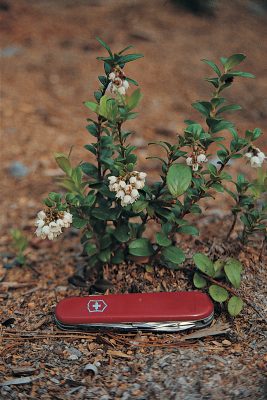
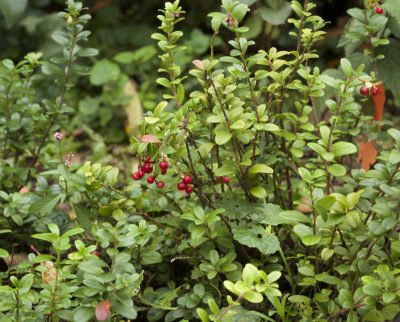

I grow this fruit and am now enjoying the fruits of my labors. I planted it both for its good looks and its good flavor, which got it a chapter in my book Landscaping with Fruit. (Autumn olive also made it in.) Let’s start in spring, when cute, little urn-shaped blossoms dangle singly or in clusters near the ends of the thin, semi-woody stems rising less than a foot high. These urns hang upside down (upside down for an urn, that is) and are white, blushed with pink. They’re not going to stop traffic from the street, but are best appreciated when plants are grown where they can be looked at frequently and up close—such as in the bed at the front of my house.

Lingonberry flowers

4-44-P14

If you miss the spring floral show, you get another chance because lingonberries blossom twice each season. This second show, appearing in mid- to late summer on young stems, bore the fruits I am now enjoying.

Lingonberry sports evergreen leaves, the size of mouse ears and having the same green gloss as those of holly. Like holly, they retain their lush, green color right through winter. New shoots sprout above the spreading roots and stolons to so plants eventually make an attractive and edible groundcover. 

The fruits that follow the flower shows couple just enough sweetness with a rich, unique aroma so they are, if picked dead ripe, delicious plucked right off the plants into your mouth or mixed with, say, your morning cereal. They are pea-sized and somewhat of a show in themselves. The bright red berries hang on the plants for a long time, well into winter, making a perfect Christmas decoration in situ.
Lingonberry fruit on plant
Lingonberry is native to colder regions throughout the northern hemisphere. This fruit is the Preiselbeere of the Germans, the kokemomo of the Japanese, the puolukka of the Finns, the wisakimin of the Cree, the airelle rouge of the French, the keepmingyuk of the Inuit—and the lingon of the Swedes. In English, the plant parades under a number of monikers, including partridgeberry (Newfoundland), cowberry (Britain), foxberry (Nova Scotia), mountain cranberry, and rock cranberry.

If you grow lingonberry, give it the same soil conditions as its relatives, blueberries, mountain laurels, and rhododendrons. To whit: Well-drained soil that is high in organic matter, very acidic, and not too fertile.