
CROCUS THAT ISN’T
Startling Beauty
Autumn’s crocus is worth planting if for nothing more than to startle your neighbors. When they ask how come your crocuses are blooming this time of year, just smile and say it’s an early spring.
A bed of autumn crocus does more than just startle, of course; it also paints the fall landscape in soft, bold swatches of lavender, pink, or white blossoms. And, if you so desired, that paint job, depending on species planted, could have begun as far back as August. Not such a bad idea at that, because many flower gardens temporarily sulk in August, waiting to revive in the moist coolness of autumn.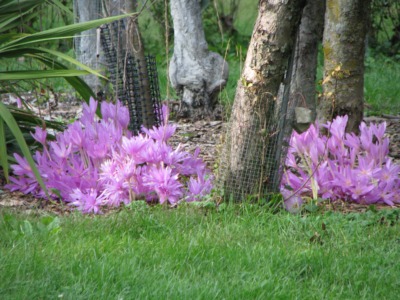
My late summer crocus blooms come from a bulb called colchicum, which is not really a crocus species at all. The plant is called autumn crocus because its blossoms do look like those of crocuses, crocuses on steroids. And that’s the size crocus blossom it might take to catch our eyes after a summer of flowers. The bulbs are pricey, but don’t let that you scare you away; a dozen or so flowers unfold from each corm over the course of a few weeks. Also, with good growing conditions, the corms multiply rapidly.
Depending on the variety and species of autumn crocus that you plant, you could have crocus-y blossoms right through late fall. One of the best autumn crocuses is Colchicum speciosum, a robust plant bearing large, shapely blooms of a soft, rosy pink color. When fully open, each flower is almost a half-foot across. How’s that for a “crocus,” and one that blooms in fall at that?!
Hide Them in Spring
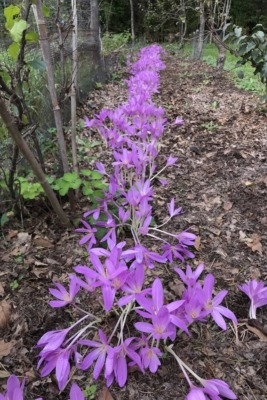
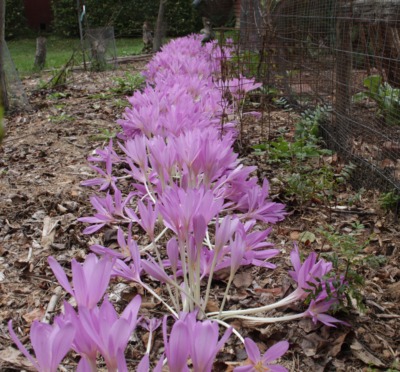
Despite their look-alike flowers, colchicums do not sport the delicate, strappy leaves of true crocuses — and that’s allegedly a problem when the leaves start to brown a few weeks after appearing in spring. As far as myself, I can’t fail to notice and appreciate the flowers in fall, and likewise never notice the browning leaves in spring from the long swathe of bulbs growing in the leafy mulch beneath my row of pear trees.
I’ve read the suggestion to hide the large, aging leaves by planting the bulbs beneath some evergreen groundcover, or distant enough so that although the flowers can be appreciated in autumn, the browning leaves don’t catch you eye before melting into the soil in late spring. I may try one suggestion, letting the plants naturalize in a low grass meadow, which is how they grow in Europe, where they are native.

Colchicine in Kazbegi, Georgia
That would, of course, obviate mowing during the blossoming season in autumn or the few weeks in spring when leaves develop.
(Note that all “autumn crocuses” are not fake crocuses; some real crocuses, that is Crocus species, also blossom in fall. These crocuses, unrelated to the Colchicum species, sport delicate flowers in white or shades of purple, and the bright orange stigmas of their flowering cousins. Again, there are few species, and they differ in bloom time, colors, and size, the most commonly offered being Crocus sativus.)
So Easy
Colchicum crocuses are cold hardy and enjoy the same growing conditions enjoyed by most spring flowering bulbs, that is, moderately rich, well-drained soils in sun or dappled shade. I have found, at least in my rich, well-drained soil, the corms multiply quickly, at which point they can be dug and replanted elsewhere. The recommendation is to do this in spring right after the foliage dies down. I’ve also had good success digging and replanting right after the flowers fade.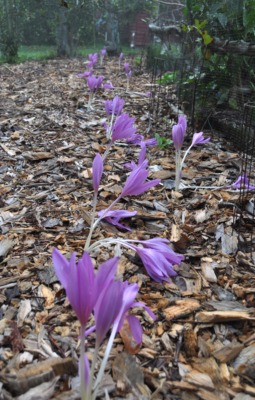
Colchicum crocuses do have a very dark side — all parts of the plant are extremely poisonous. No need to worry about deer or rabbits nibbling these flowers. It comes as no surprise that colchicum has virtually no pest problems.
Despite that dark side, the plant has its practical use. It’s been used medicinally for the treatment of gout. With extreme care, though, because the window between a therapeutic dose and a fatal dose is extremely narrow!
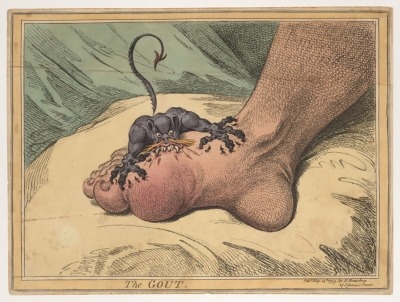
“The Gout,” drawing by James Gillray
Also, plant breeders have used colchicine to create polploidy, that is, to create plants with more than two sets of chromosomes per cell. Such plants are often “more of” for many characteristics. Larger fruit, for instance, in the case of Jonathan apple.
Another problem with autumn crocuses is that they differ from spring flowering bulbs in their need to be planted earlier, preferably in late summer. It’s a marketing rather than a gardening problem. Nurseries hype and sell spring flowering bulbs in autumn, and summer flowering bulbs in spring. It would be hard to drum up fanfare for midsummer sales of the few autumn flowering bulbs needing planting then. If you have trouble finding these bulbs locally, buy from mail-order firms and order in midsummer.
Depending on when you actually get bulbs in hand, you might find autumn crocuses blooming in their packaging. If you want to “plant” autumn crocus for even more startling effect than the outdoor show, albeit on a small scale, just set a bulb that has not yet flowered on a dish or just a countertop and wait for it to bloom there.
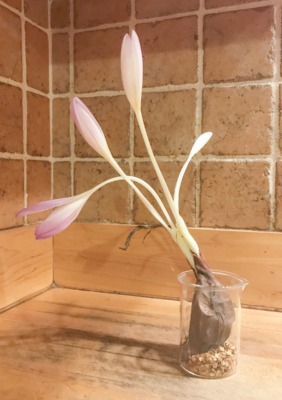
Colchicum blooming without soil
Blooming out of the soil will not hurt the bulb, but do plant it outside as soon as the blossoms fade.


Leave a Reply
Want to join the discussion?Feel free to contribute!