
PLANT A TREE, NOW?
The ending of Joyce Kilmer’s ode to trees, “only God can make a tree,” may be true enough (as was Woody Allen’s addendum “probably because it’s so hard to figure out how to get the bark on”). But for good growth once a tree is made, it is for us mortals to step in and plant correctly.
Fall is usually the best time of year to plant most trees. The ground is soft and moist — perfect for digging. Nurseries have fresh trees. And roots have time to establish themselves before stems begin growing next spring.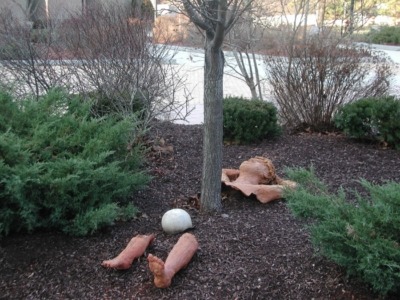
Kinds of Nursery Trees
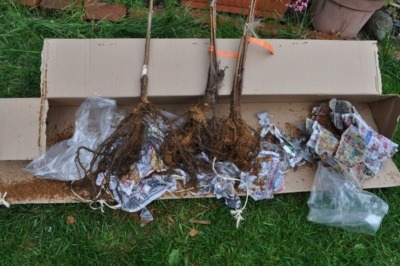
Nurseries offer trees three ways. “Bare root” trees are dug from fields as soon as their leaves drop, then the roots are packed in wet sawdust or other moist material. Transplant shock is minimized if the tree isn’t too big (I consider four or five feet tall to be ideal), spends minimum time out of the ground, and — of course — is planted correctly. Bare root trees are the least expensive kinds of nursery trees, and, because they are easily shipped, are available in greatest variety.
 A nursery may dig a tree while keeping the roots happily entombed in a ball of soil, swaddling that root ball in burlap to give this type of nursery tree the name “balled and burlaped” or, simply, “B&B.” B&B trees are more expensive than bare root trees, less easily transported, and, under ideal conditions, suffer less shock when transplanted.
The third kind of nursery tree is the one that has spent its life growing in a pot. “Potted” trees suffer the least root disturbance, and can be planted any time of year. Ideally, small, new, usually white roots should appear at the edge of the root ball when you slide the plant out of its pot. Because they are more easily shipped than B & B trees, potted trees are available in greater variety.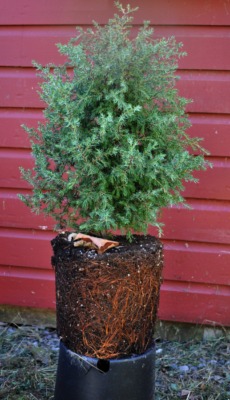
Planting
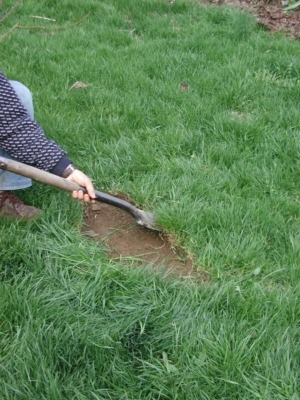
Once you have selected a tree and a site, prepare the ground. With a lawn edger or shovel, cut into the grass along the circumference of a circle twice as wide as the spread of the roots. Then use the shovel to strip off the top inch or two of sod from within the circle.
In the center of the circle, dig a hole slightly wider than the spread of the roots. 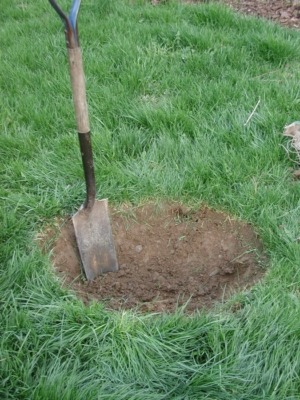 Dig only deep enough so that after planting the tree will be almost as deep in the ground as it was in the nursery. You can tell how deep a bare root tree stood in the nursery by the soil line on the trunk. Loosen up the soil at the bottom and the sides of the hole, and, for a bare root tree, use some of the soil that you excavated to build up a shallow, cone-shaped mound on which to bed the roots.
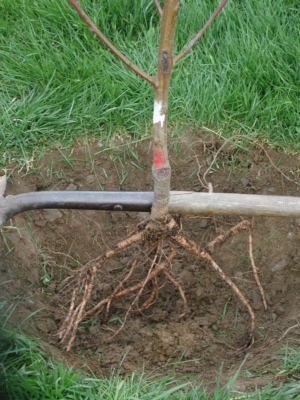
Setting plant height in hole
Take a last look at the roots before you lower your tree into its hole. On a bare root tree, cut back any diseased or broken roots to healthy tissue. Also cut back any especially long roots rather than tucking them into the hole. Tucking those long roots back in the hole could have them circling within the hole getting thick and thicker to the point where the root eventually strangles the tree.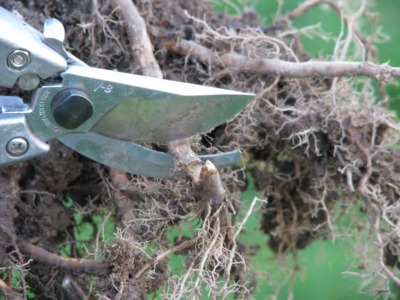
Slide a potted tree out of its pot, unravel any large roots circling the root ball, then tease smaller roots from the outside of the root ball with a pointed stick.
Lower your tree into the planting hole, tucking soil underneath the roots or scraping it away, as needed, until the tree is at the correct depth.
A B&B tree has most of its roots swaddled and intact within the burlap. Keep that root ball intact. No problem if the burlap and the string tying the packaged root ball are biodegradable. Just lower the plant into the planting hole, cut the string around the trunk and leave everything in place. Roots will grow to explore soil beyond the confines of the burlap rope, and the rope and burlap will eventually decompose.
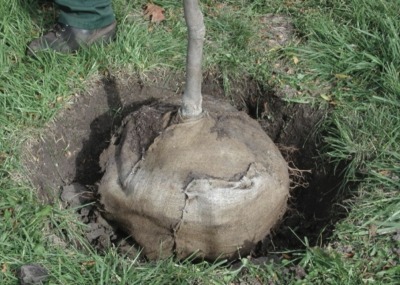
If the burlap and/or string are not biodegradable, cut the string so the burlap can open up beneath the plant to lie flat on the ground. Pull on the burlap to slide the plant into position in the hole without disturbing the root ball. Cut and remove any rope or wire, and cut the burlap into enough pieces to ease most of it out of the ground.
Shovel soil back in amongst the roots, crumbling it, prodding it with a stick, and pressing it with your heel so that no gaping voids remain. Then cover the bare ground with a three inch depth of wood chip or straw mulch, almost to the trunk. Finally, give your tree a thorough but gentle soaking, applying at least one gallon of water for every square foot spread of the roots. Larger trees will require more water.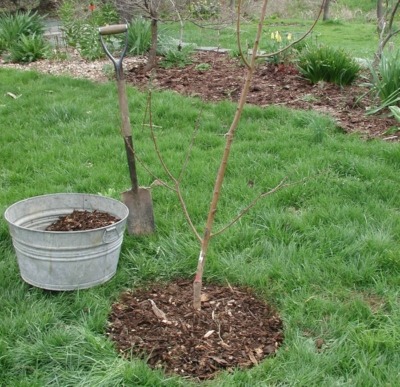
Coddle, then Stop
Now don’t ignore your tree. Water regularly, as long as leaves persist or the soil is not frozen. And during its first season of growth, lavish your tree with a thorough soaking once a week, except following heavy rains. Aim for one gallon per week for each estimated spread of the roots. Rain can make a contribution; figure on almost a gallon of water per square foot for each inch of rain that falls.
Here on my farmden, trees are on their own as far as water after their first year in the ground. Annual care then is pruning and mulching. In drier regions of the West, trees are more dependent on your providing water.
Among the many trees I’ve planted here on the farmden are chestnuts, filberts, hickories, and other nut trees If planting nuts interests you, consider attending the meeting of the New York Nut Growers Association’s fall program on Saturday, October 17, 2026, at the Willow Water Farm in Amsterdam, NY. Besides tours, there will be talks on such topics as top-working hickory trees, off-site successes and failures of permaculture plantings, and incorporating forest trees in nut growing operations. Registration is $20.00 for members and $25.00 for non-members, including breakfast and lunch. Register at http://www.nynga.org.
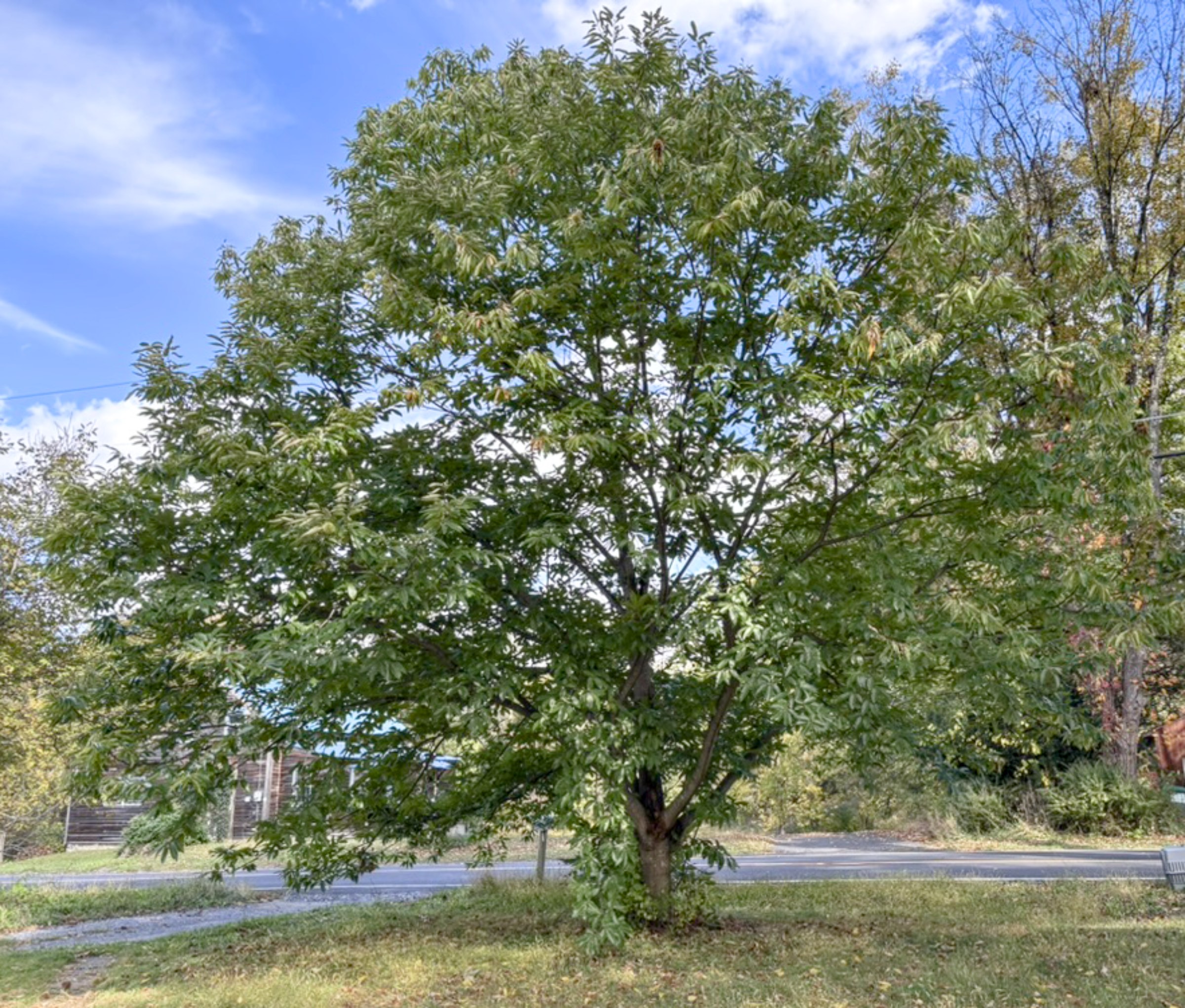
Chestnut, Marigoule in October


Leave a Reply
Want to join the discussion?Feel free to contribute!