
DINNERPLATE DAHLIAS, AND MORE
Flowers are the ephemerals of the garden. The plants vanish without a trace at the end of each season, so you would hardly think them worth pruning during their brief stay. Still, pruning can help make more flowers, as well as either make the plants bushier or increase the size of individual flowers. So grab your hand shears and sharpen your thumbnail and let’s go for a stroll among the flowers.
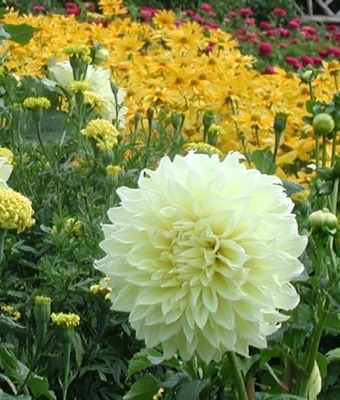
Dahlia, Kelvin Floodlight
A Single Pinch’ll Do It
Pinching out the tips of growing stems stops, at least temporarily, their growth, in so doing coaxing growth of side shoots. The result: bushier plants. Even though plants such as lavatera, marigold, and zinnia are naturally bushy, pinching out the tips of their stems makes them more so.
Early in the growing season, when any and every flower is still to be cherished, you may find that the top bud on, for example, a marigold seedling is a flower bud or even an already opened flower. Grit your teeth and pinch it off! 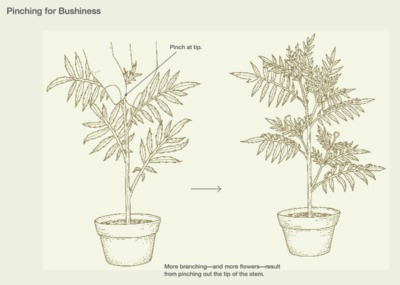
Not only will doing so make the plant bushier; it will also channel energy destined for that flower into the growth of new shoots. Allowing a small seedling to flower prematurely saps its strength, so the plant is likely to remain a runt. Defer your pleasure. (As consolation, read the words that Charles Dudley Warner wrote in 1888 in My Summer in a Garden: “The principal value of a private garden is . . . to teach patience and philosophy, and the higher virtues— hope deferred, and expectations blighted, leading directly to resignation, and sometimes to alienation. The garden thus becomes a moral agent, a test of character, as it was in the beginning.”)
Don’t carry pinching to excess, though, because it does delay flowering. Pinching is something you want to do mostly at the beginning of the growing season. And not that you’d always want large flowers rather than small flowers, but plants with more side shoots have more — but smaller — flowers.
A single pinch is usually sufficient for marigolds and other naturally bushy flowers. Certain chrysanthemums look best with repeated pinching. With snapdragon and some other spiky flowers, you have a choice: Do you want a single large spike, or several smaller ones?
Fewer, But Bigger
Just as pinching the tips of stems makes for bushier plants with more but smaller flowers, limiting the number of stems or flowers has the opposite effect. This is how you grow “football” ‘mums and “dinnerplate” dahlias.
The way to create a plant with fewer but larger flowers is to channel a plant’s energy into fewer growing points. Pinch off side shoots, or pinch off flower buds forming along a stem, or reduce the number of stems sprouting from ground level.
Remove a side shoot or lateral flower bud while either is still young enough to be succulent and pinched off. At that stage, removing the side shoot hardly affects overall plant growth because the side shoot or flower is not yet contributing to the energies of the plant.
New England aster, perennial phlox, and thick-leaf phlox are examples of plants that put on a better show if you reduce the number of shoots they send up from ground level. When shoots are 2 inches high, remove all but three per plant.
Removing spent flowers — called deadheading — is yet another way of pruning to get the best from your flower plants. Deadheading does double duty, keeping plants tidy and preventing seed formation, which can drain enough energy from a plant to slow or stop flowering.
Deadheading is especially effective at keeping annuals energetic because all they live for is to flower enough to set some seeds, then happily die, all in one season. Once that occurs, they are apt to slacken their efforts at making more flowers. Deadheading keeps annuals energetic.
Even some perennials will come back for a repeat performance later in the season if you cut back their flowers after the first show. Try it with delphinium and Canterbury bells.
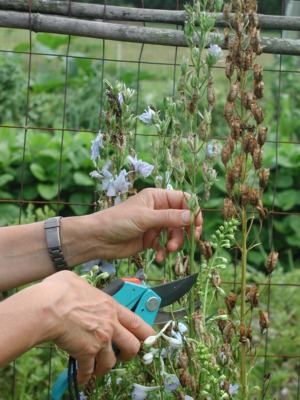
Cutting back spent delphinium flower stalks
Cutting individual, spent flowers from mounded plants bearing small flowers could be tedious. Deadhead alyssum, nasturtium, and petunias by shearing the whole mound back with either grass or hedge shears after a flush of bloom.
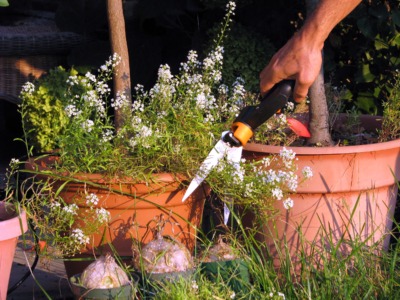
Shearing back alyssum
Give mounded perennials like basket-of-gold, cottage pink, edging candytuft, and spike speedwell similar treatment. All these plants will look ragged for awhile, but good growing conditions soon has them happily lumbering along the ground and, in some cases, flowering again that same season.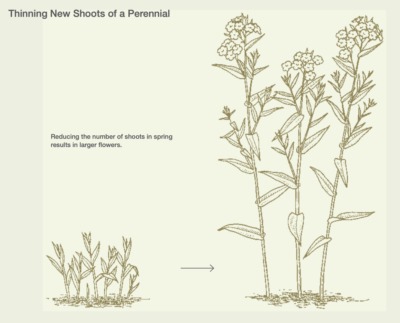
Another way that deadheading keeps plants tidy is by preventing them from self-seeding and growing all over the place. Especially fecund plants include feverfew, perennial phlox, and thick-leaf phlox. Lop off their spent flowers before they make seeds.
For more about pinching and other types of pruning, see my book, THE PRUNING BOOK.



Leave a Reply
Want to join the discussion?Feel free to contribute!