
IF YOU USE ORGANIC FERTILIZERS . . .
Is “Organic” Always the Best?
“Organic” fertilizers are all the rage these days, and with good reason. They can provide plants with a long, slow feed, just as Nature intended, and their manufacture can put less demand on our planet’s natural resources. Many gardeners, though, make the mistake of using organic fertilizers that share the same drawbacks as synthetic, or “chemical,” fertilizers.
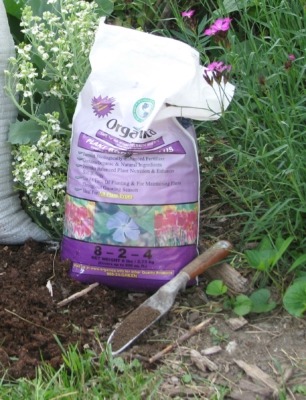
Concentrated organic fertilizer
For instance, the other day a gardening “expert” on the radio was touting the benefits of guano, or bat droppings. He was right about guano being rich in nutrients. It can have almost 20 percent nitrogen in a form that can be taken up quickly by plants. And guano surely is natural: it’s merely scooped up out of caves where bats hang out. It’s bat poop.
The problem is that guano is not much different in its effects on plants and soil from synthetic 20-10-10, or any other quick-acting, synthetic fertilizer.
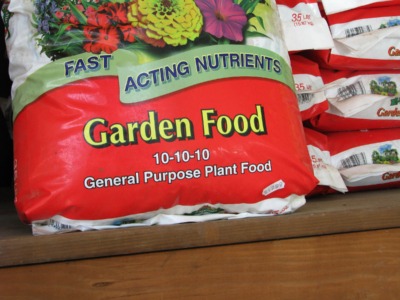
Chemical fertilizer
The same could be said for blood meal, poultry manure, and other concentrated, quick-acting — albeit organic — fertilizers.
Bulk in Your (Plants) Diet
The thing that is missing from all synthetic fertilizers, and from concentrated organic fertilizers, is bulk. Yes, plants benefit from bulk in their diet, just as we do. Like the bulk in our diet, bulk’s benefits to plants are indirect, not purely nutritional. These benefits include getting soils to hold more air and water, making plant foodstuffs already in the soil more accessible, and helping plants fight off certain diseases.
Bulk that is good for plants is familiar stuff. Raw bulk includes such materials as straw, autumn leaves, sawdust, hay, and manures. Stabilized bulky materials become so through decomposition, and include things like compost, peat moss, and old manure. Of course, another name for this bulk is organic matter or, after it has decomposed somewhat, humus.
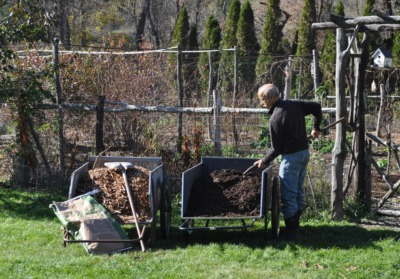
Arborist wood chips, soybean meal, and compost
Note that most of the bulk associated with manures comes from the sawdust, wood shavings, straw, or whatever other material was used for bedding for the animal. What comes out a chicken, for example, contains little organic matter, so much of its benefit to plants comes from the wood shavings or straw that is scooped up along with the poop from the floor of the chicken house. In fact, the more concentrated any organic fertilizer is, the less organic matter it offers.
This is not to say that plant growth can’t suffer from the opposite extreme, that of applying too much bulk to the soil, and not enough actual nutrients. Raw organic materials, such as sawdust, straw, and other usually older, brown (versus green) plant materials, can cause nitrogen starvation in plants if they are mixed into the soil. These materials are low in nitrogen which soil microorganisms need to balance out their digestion of carbon compounds. So they take it from the soil at the expense of plants.
But wait! In the above scenario, plant starvation is temporary, only until enough microbial digestion has occurred so that nitrogen drawn out of the soil is released back into the ground as poop and dead bodies of some of the soil microorganisms.
And more importantly, plant starvation doesn’t occur at all if sawdust, straw, and similar materials are laid on top of the ground where decomposition and release of nitrogen occur slowly, at a similar pace, at the interface of mulch and soil. (Of course, on top of the ground, these mulches also offer moisture retention, temperature modulation, and other benefits.)
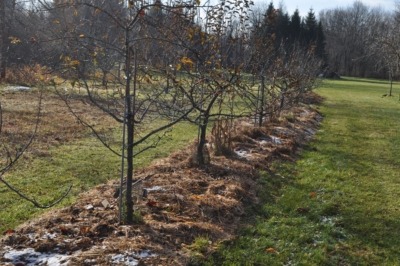
Hay mulch feeds apple trees, suppresses weeds, and conserves water
The Best of Organic
Getting back to fertilizers per se: Don’t necessarily seek out the most concentrated — the “richest” — organic fertilizer. Or, if you do use a concentrated organic or synthetic fertilizer, also add plenty of organic matter along with it, either digging it in (which would be okay, since you added extra nitrogen to soil) or even just laying it on top of the ground.
Even better than hauling in fertilizer is to grow it in place. Set aside a different part of your garden each season for plants such as oats, rye, or buckwheat that you grow specifically to enrich the soil with organic matter. Add a legume such as field peas, cowpeas, woollypod vetch, or subterranean clover to the mix and you’ll also be growing nitrogen in place.
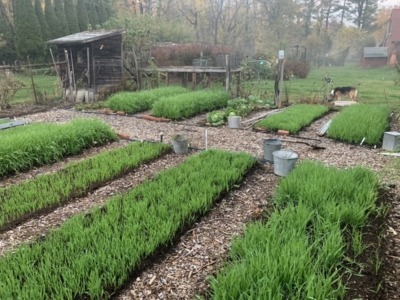
Fall cover crop of oats in the garden
Better still would be give your soil a good feed by blanketing the top of the ground with at least an inch depth, of some bulky material such as compost, rotted leaves, or old manure. No need to dig it in if you have sandy soil or if grow plants in permanent beds.
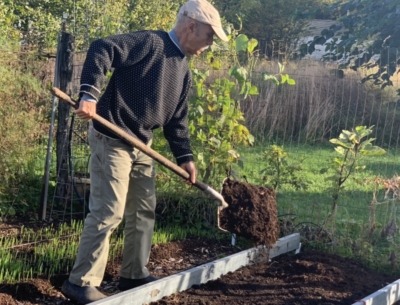
Spreading compost
Fertilizing with your pitchfork rather than your fertilizer spreader is good for your plants, good for your soil, and good for the planet.



Leave a Reply
Want to join the discussion?Feel free to contribute!