
THOSE OTHER PEONIES
I wouldn’t say that tree peonies — those “other peonies” — prepare you for the show of the herbaceous ones soon to come. No, with quivering golden stamens enveloped in dish-sized whorls of silky white, pink, red, lavender, or yellow petals, tree peony blossoms catapult you into peony-dom. Later, catch your breath with the herbaceous ones.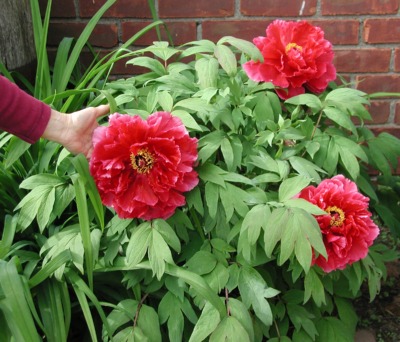
Every third garden, it seems, has herbaceous peonies, but I could go from one end of my town to the other and never see a tree peony. (Wrong. I do know of one other planting, dating back to a hundred years or so.) The scarcity is due at least in part to some myths and prejudices tree peonies have picked up during their thousand plus years of cultivation.
Myth Busting
The first myth is in the name. Tree peonies are not trees. Yes, they are woody, but multi-stemmed and usually no more than a few feet high and wide. Eventually, a tree peony may reach six feet in height, but that could take decades — or more! And that’s hardly a tree; hardly even a large shrub. But it does highlight a possible prejudice against planting tree peonies — they are slow growing.
It’s a fact that tree peonies are pricey. Eighty-five dollars would not be considered expensive for a tree peony a mere foot high. And you don’t have to look hard at all to find plants selling for a few hundred dollars each. One reason for this cost is that tree peonies are usually propagated by being grafted upon roots of herbaceous peonies, and fifty percent success in grafting is considered acceptable. And no matter how a plant is propagated, it takes three or four years before it’s large enough to sell. Spectacular blossoms, of course, also figure into pricing.
Years ago when a local nursery was offering tree peonies in one gallon pots for only ten dollars each, I immediately snatched one up. At this price, slow growth would be tolerable. And I was curious as to just how slow they actually do grow — and how fast I could make one grow.
Rumor also has it that tree peonies are difficult to grow. They hail from the dry mountains of western Asia, so abhor “wet feet.” And whether or not the plants dislike being buffeted by wind, such conditions would surely and quickly fray the splashy blooms. I found an almost perfect location for my plant — the slightly raised bed that borders my terrace and is protected to the north by a brick wall.
Full Bloom Ahead
My plant bore three humongous, red blossoms the first spring after I planted it. And the plant grew. Those blossoms formed at the ends of shoots that were each about eighteen inches long, making me hopeful that slow growth was a myth. But here’s the rub: Those shoots die back to some degree each winter. Still, a foot or so survives. A foot or so of growth each year is not too slow, and the plants allegedly pick up speed with age.
My tree peony is now 25 years old. It blooms reliably each spring — now, in fact. It’s tallest shoots are almost four feet high but it still has a ways to go before I’d call it a full-bodied shrub. I’ll never call it a “tree.”
A few years after purchasing that first tree peony I planted another one, this one white and blossoming a few days after its red compatriot.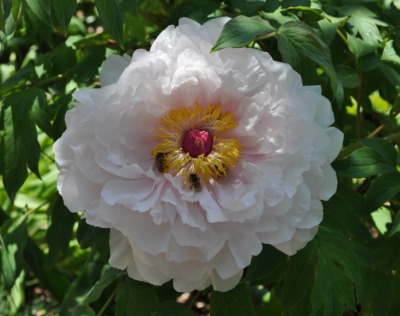
And after that I added yet another peony, this one of the so-called Itoh varieties, which are hybrids of tree and herbaceous peonies. Their stems die back each fall, but are sturdy enough to hold blossoms upright. The blossoms spread open after the show as that from herbaceous peonies is ending and then hold their own for a few weeks.
The particular one I planted is Bartzella, whose blossoms are a half a foot or more across and are crowded with luscious lemon yellow petals highlighted with orange flames at the center. This one also has a sweet scent, which my two early tree peonies do not. Peony scents, good or bad, don’t travel far.
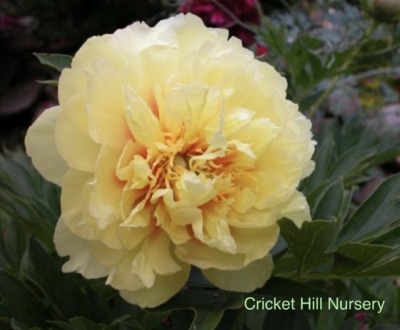
Bartzella tree peony
A Long History
Tree peonies made their way from China to Japan in the 7th century, as medicinal plants, then again in the 17th century, this time as ornamental plants. Japanese breeders developed tree peonies that were quicker growing — initially, at least — than the Chinese hybrids, but lacked their fragrance and fully double blooms. In the last hundred years, American and European breeders got into the act, too, so that now there are hundreds and hundreds of varieties — many of which are available from specialty nurseries (Cricket Hill Garden, www.treepeony.com, for instance).
My bargain plant was evidently a Japanese hybrid. The blossoms lack (good) fragrance and the plant did not come with a name like “Honeydew from Heaven” or “Coiled Dragon in a Mist Grasping Purple Pearl.”
Although tree peonies like to bask in abundant sunlight, the blossoms last longer if shaded. In China, individual plants in bloom are temporarily shaded beneath paper umbrellas, an amenity my tree peony thus far lacks. Despite these deficiencies, each of my tree peonies, and the hybrid, is glorious in bloom, and a first step into the world of those “other peonies.”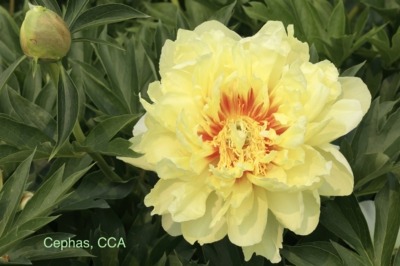



Leave a Reply
Want to join the discussion?Feel free to contribute!