
TRAVELING PLANTS
Yes, Plants Can Travel Successfully
People often stare at me in disbelief if I suggest buying a certain plant from a nursery 2000 or 3000 miles away. Surely no plant could survive such a journey!
Not so. This time of year, UPS trucks and airplane holds are filled with plants on the move.
I prefer to buy my plants at local nurseries. But when I want a specific plant, such as a Hudson’s Golden Gem apple tree on G.11 dwarfing rootstock, I have to turn to mail order. (In this case, it would be from www.cumminsnursery.com.)
If shipped from reputable nurseries, mail-order plants thrive as well as plants purchased locally. That “if” is a big one. As with anything else offered for sale, quality costs. Beware of any nursery offering super-bargains or whose ads gush with horticultural hype.
I remember many years ago seeing a magazine ad for “A Miracle of Nature! Climbing Vine Peaches.” Rather than quote extensively ad bait such as “dazzling golden blooms” and “fruit by the bushel,” suffice it to say that I happen to know that this plant’s fruits might look like peaches, but are, in fact, practically tasteless. They are a kind of melon, nowadays sometimes billed as a vining mango.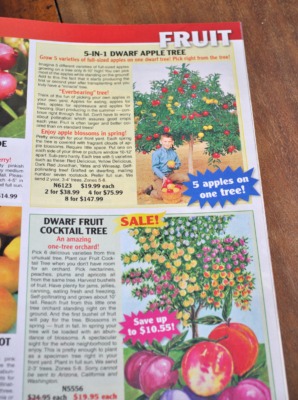
And forget about any “IRON-CLAD GUARANTEE” from such nurseries. The nursery is able to offer and support this guarantee because, like others in its class, it banks on customers’ forgetting about such claims as soon as spring melts into summer.
A few rotten fruits don’t ruin this barrel of apples, though: many mail-order nurseries sell quality plants and also have strong guarantees. Just read between the lines of any nursery ad or catalog to determine if the nursery seems reputable, and do your own research about the plants.
But back to that “vine peach:” I did research some contemporary information on it and to me the descriptions were not sufficiently disparaging. It was said to be very fragrant — in a bowl, not your mouth — and good for pickles or preserves, but not for fresh eating.
Bare Root or Potted
Mail-order plants are shipped either potted or bare root. “Bare root” sounds brutal, but plants do fine shipped this way if handled properly by the nursery and you. The nursery’s job is to dig the plants while they are leafless, except in the case of small evergreens, then keep them cool, with their roots swathed in moist peat, sawdust, shredded newspaper, or some other water-absorbent, spongy material.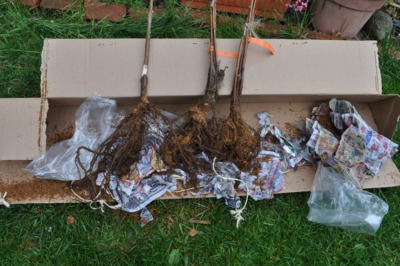
Years ago I ordered and received a small, bare root Nanking cherry plant that arrived looking like a forlorn twig with a few dried roots that had been just tossed into a small, plastic bag. No wonder the plant was so cheap. No wonder it never grew.
When I receive a bare root plant, I unpack it soon after its arrival, checking that the roots are still moist, then plant post haste. If the roots seem at all dry, I’ll soak them in a bucket of water for a few hours before planting.
If I can’t plant immediately because the ground is frozen or too wet, I keep the plant cool and moist by putting it in my refrigerator, if it’s small enough, with its roots wrapped in plastic, or by temporarily planting it in a shallow hole on shady north side of my workshop. Or I could just re-wrap with its roots in the moist (moistened if not sufficiently moist) packing material in which it arrived and keep it somewhere cool, such as in my workshop, which is unheated.
Potted plants can go longer before being planted out in their permanent location — as long as the potting soil is kept moist. The nursery’s job, in this case, is to pack the plants to arrive at your doorstep with their stems undamaged and their soil intact. 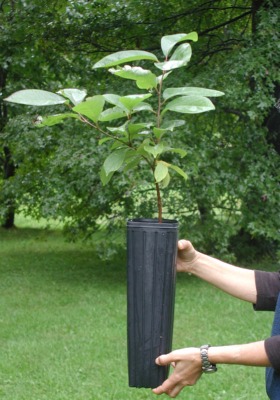 Some nurseries have really mastered the art of packing and shipping live plants. Opening a shipping box of their neatly nestled, happy plants gladdens any plant lover’s eyes.
Bigger Isn’t Necessarily Better
Whether ordering a bare root or potted plant — even if you are buying locally — don’t always opt for the largest plant. Large, bare root plants often suffer more in digging and transit than smaller ones. Large potted plants often have their roots cramped and twisted into undersize pots. I lift the plant out of its pot to check on the roots; I should see some at the outside edge of the root ball, but not ropes of them going around and around.
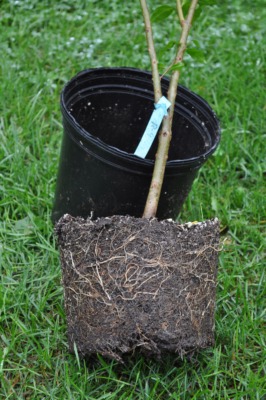
Root ball of good nursery plant
Growth of smaller plants often outstrip growth of larger ones after a few years because they establish more quickly. They also require less aftercare, mostly watering, often just the season of planting for the smaller plant versus years for a larger one. I consider the ideal size for a bare root tree is a trunk-to-be four or five feet high.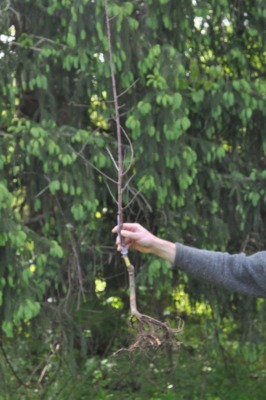
There’s something satisfying about walking into a local nursery on a balmy spring day, drinking in the bright colors, the smells, the riot of greenery and textures, then buying a plant. If a local nursery doesn’t have the particular plant or quality I want, I buy mail-order.



Leave a Reply
Want to join the discussion?Feel free to contribute!