
TEN ESSENTIAL PRUNING TIPS
Do It Now (or Soon, Usually)
An ideal time to prune most trees and shrubs is just as their buds are swelling, which is just about now here on my farmden. Leafless stems make it easy to see where to cut, dead stems make their presence known, and with coldest weather past chances for cold damage near cuts are minimized. Warmer spring weather also promotes rapid healing of cuts.
Whole books have been written about pruning (I even wrote one!: THE PRUNING BOOK), yet the essence of pruning can be distilled into a few general pointers. The ten listed below will not result in an expert pruning job, but offer sufficient guidance to keep you and your plants reasonably happy.
1. Don’t cut unless you have a clear reason to do so. Trees and shrubs vary in their needs for pruning, from, for example, Japanese maple and witch hazel, which need no regular pruning, to butterfly bush and lilac, which need to be pruned every year to look their best.
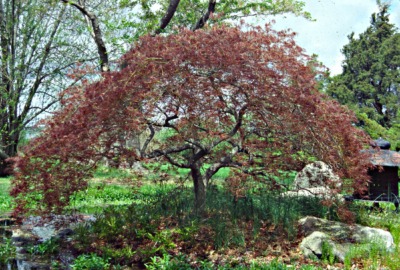
Japanese maple’s rarely need pruning

Butterfly bush is at its best pruned annually
2. No matter what the plant, cut all dead and diseased stems back to healthy wood. Look closely at the stems; you’ll know if they’re dead or diseased by their shriveling or if they’re dotted with fungal spores (but don’t confuse them with bark lenticels which are natural pores that allow for gas exchange between the atmosphere and internal tissues.) Also prune back broken stems, as well as those that are obviously out of place or rubbing against others.

Fungal blight on filbert stem
3. Tailor each cut to the response you want from the plant. I shorten a stem when I want to prompt buds remaining on it to grow. The result is increased branching. I lop a stem completely to its origin and, in contrast, there’s usually little or no regrowth near the cut. So I use these latter cuts thinning out crowded wood, and when I want to reduce the size of a plant.
Trees, Fruits, Bushes
4. Prune young TREES as little as possible. Any pruning weakens a plant and we want maximum stem and root growth from these plants; any stem pruning decreases total plant growth. I want trees that I plant to fill their allotted space a fast as possible.
5. On any TREE, cut away watersprouts and root sprouts. These vigorous, vertical shoots, the first originating along the branches and the second at the base of the tree, soak up the plant’s energy, look unattractive, and bear few or no flowers or fruits.

Watersprouts
6. Almost all FRUIT PLANTS need regular pruning. The amount depends on where a plant bears its fruits. For example: apple trees bear fruits on long-lived stubby growths growing off older stems, so need only moderate pruning.
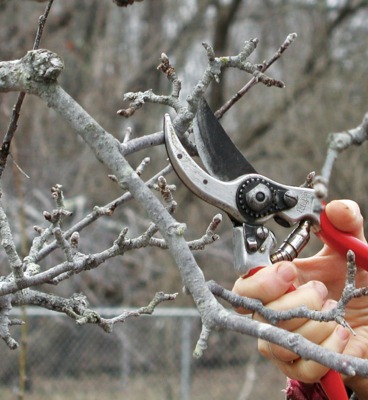
Pruning apple spurs growing on old wood
Peaches, in contrast, need relatively severe stem shortening to stimulate an annual supply of new shoots, which are the only ones that bear fruit the following year. Of course, it’s a balance; you want to leave some year-old stems intact on which to hang this year’s peaches.
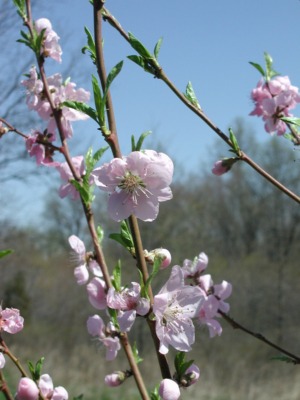
Pruning apple spurs
Each raspberry cane dies at the end of its second year, so the move here is to completely cut away all old canes. Also remove some young canes — which will bear this year — so that those that remain are no closer than 6 inches apart.
7. Avoid hedge shears on BUSHES, except for those trained to formal shapes.
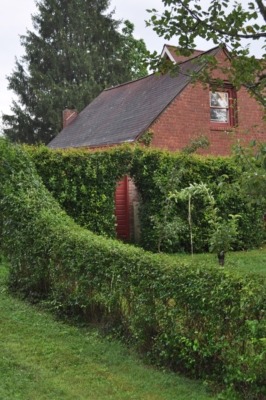
Hedges need repeated shearing with hedge shears each season
Prune most bushes by a renewal method, every year cutting some of the oldest stems to the ground to make way for young sprouts. In this way, the bush maintains a graceful fountain-like shape without ever accumulating any decrepit stems.
8. Tailor how much you prune any BUSH to its growth habit. Forsythia and lilac sucker abundantly, so don’t allow stems to grow very old before removing them to make way for new ones. Bushes that make few suckers — such as witchhazel and rhododendron — need their oldest stems cut back only infrequently, if at all.
9. Wait to prune SPRING FLOWERING BUSHES, such as spiraea and mock orange, until right after their blossoms fade or else you will be removing some of the flower buds soon to unfold. Last year is when spring flowering shrubs set up flower buds that will unfold this spring.

Forsythia, spring flowering, prune after flowering
Prune SUMMER FLOWERING BUSHES, such as rose-of-Sharon and potentilla, now or anytime before growth begins in spring. These summer flowering bushes set up and open flower buds on new shoots that grow this season.
The Right Tool For the Job
10. No matter what you are cutting, use a tool appropriate to the job. For stems a half-inch or less in diameter, use hand held pruning shears. Cut stems up to an inch-and-a-half across with a long handled lopper. For even thicker wood, use a pruning saw, which differs from a shop saw in having special teeth that do not become clogged by green wood. Use hedge shears for formal hedges, hand shears and loppers for informal hedges.
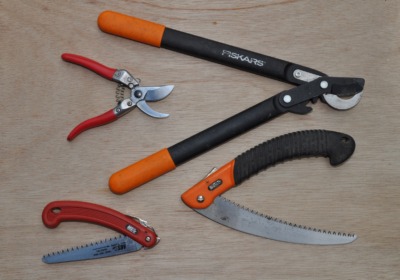
Various pruning tools
To avoid any frayed stems, I make sure that my pruning tools are sharp for clean cuts that heal quickest.



I have a Royal Raindrops crabapple that sends out MANY water sprouts each year that need to be pruned off to maintain its shape. Is it inevitable that this will become a garden chore every year or is there something we can do to minimize it? Thank you for your advice and newsletter.
I hate to say it but you’ll have to deal with it every year. With that said, if you rip off, by pulling quickly downward, any new water sprouts, there’s less chance of the resprouting.
“Don’t cut unless you have a clear reason” may be the most useful pruning rule of all.
Understanding where a particular plant produces its flowers or fruit is far better than cutting everything back simply because it is spring.
Agreed.
The advice about matching the pruning method to the plant is really useful. I also hadn’t realised how important it is to distinguish between spring and summer flowering bushes when deciding when to prune.