
JUMANGI!!!
The “True” Jimangi
Back in 1995, Robin Williams starred in a rather bizarre movie, Jumangi. The rhinoceroses charging through the living room and the crazed, great white hunter caused more terror than did the bizarre plant that kept threatening Robin Williams. After all, rhinoceroses and great white hunters, even crazy ones, are real enough, but that plant surely had to be no more than a moviemaker’s fantasy. Well, let me tell you, that odd looking plant bore an eerily strong resemblance to a real plant.
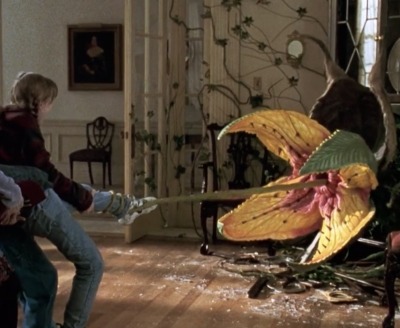
Jumanji
The moviemakers did not have to stray too far from botanical accuracy to make the real plant, called welwitschia, bizarre enough for the movie. Picture, if you will, a barren, coastal desert in western South Africa. Now every so often, drop a plant from the sky, a plant with a stubby, top-shaped trunk up to about three feet across off which grows two — and only two — strappy leaves. The fall from the sky frays the leaves, sprawling them out in an unkempt heap. Austrian botanist Friedrich Welwitsch, who found the plant in Angola in 1859 and is its namesake, wrote, “I could do nothing but kneel down […] and gaze at it, half in fear lest a touch should prove it a figment of the imagination.”
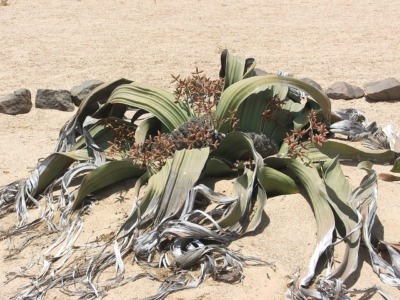
Welwitschia, Male
Weird in All Respects
A welwitschia plant doesn’t get to where it is, of course, by dropping out of the sky fully grown. It just looks that way. And its conical trunk, looking like a wrinkled, brown clam, isn’t perched on the soil, but buried with only a few inches protruding above its deep taproot. This helps the plant conserve watering and access.
The desert wind, not the fall, is what knocks the leaves about so that there appears to be many more than two growing from around the rim of the trunk. Most plants would continue to grow new leaves. Not welwitschia; it never grows any more leaves and, also in contrast to other plants, those two leaves just keep on growing. 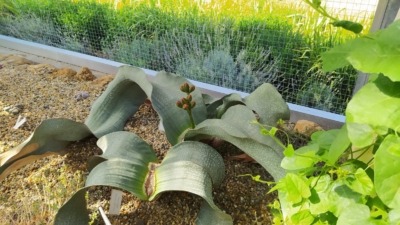 Besides the usual function of any plant’s leaves, welwitschia’s leaves also help quench this plant’s thirst, collecting morning dew, then dripping it onto the ground. This supplements water sucked up by the plant’s deep tap root.
Every once in a while, a welwitschia will flower, sending up short, branched stalks from atop the stem. In female plants, flowers are followed by seeds, which would be the way to propagate the plant.
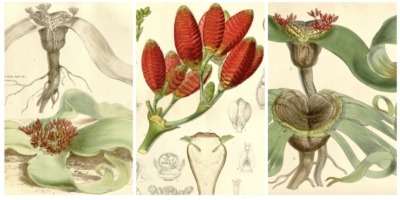
Welwitschia with male & female flowers. Thomas Baines, 1863, Curtis’ Botanical Magazine
I don’t recommend propagating welwitschia as a houseplant, though, unless you’re very patient. Seedlings grow very, very slowly. So slowly that the curator of the Royal Botanical Gardens at Kew was still bemoaning the slow growth in 1916, thirty-six years after the seeds had been sown. On the flip side of the coin, a welwitschia plant can live for thousands of years, sprawling out into a five foot high, twenty-five foot circle.
Okay, if you want to grow the plant, perfect soil drainage is a must. If you grow from seed, heat speeds germination, often to a mere one to four weeks. (Some seeds may take considerably longer, some never germinate.
You’re probably going to be growing the plant as a botanical curiosity rather than for its looks. Joseph Hooker, director of the Royal Botanic Gardens in the latter half of the 19th century, Kew, described welsitchia as “out of all question the most wonderful plant ever brought to this country – and the very ugliest.”
A Man Eater?
Now that I think of it, though, this slow growth would be preferable to having the plant grow as it did in the movie. Robin Williams had to run to keep the plant from grabbing onto his leg or arm.
The plant in the movie seemed ready to gobble up anyone that it held onto long enough, but real welwitschias are not supposed to be carnivorous. I say “not supposed to be” because periodically, over the centuries, there has been talk of “man-eating” trees, and some of them bear a resemblance to welwitschia. For instance, the Madagascar “Sacrifice Tree” reputedly has long tendrils, each about as thick as a man’s arm, that can capture a human in its viselike grip, then digest away all the flesh until only a skeleton remains.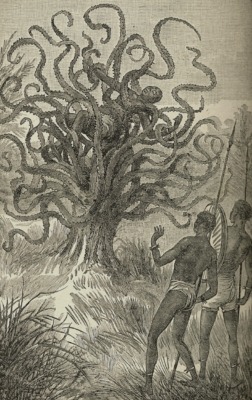
And take note: Madagascar is not that far from western South Africa, and the strappy leaves of welwitschia are as wide, if not as thick, as a man’s arm even after time and wind has repeatedly split them. What’s more, welwitschia did once go under the more ominous name of Tumboa.
It has been about 100 years since an expedition set out to search for and photograph the Madagascar “Sacrifice Tree.” No further reports on this, or any other man-eating plant have appeared.



Fantastic info….and fantastical plant!
That “Sacrifice Tree” , though, isn’t it about time someone sent a secondary expedition to find what happened to the members of the first?
That would take a very brave person. Since it hasn’t spread elsewhere, I say just leave it be.
Hi Lee,
Thanks for giving me one more reason to fear for the safety of mankind, as if reading the daily newspaper isn’t enough. For now, I’ll stick with my coleus plants!
Ha, ha!