
FAMILY MATTERS
The following is adapted from my book The Ever Curious Gardener: Using a Little Natural Science for a Much Better Garden:
No Idle Gossip
You often hear talk about various plants being related to each other. There’s the sunny-faced members of the Daisy Family, for example, and the Pea Family, all with pods. Cole crops, such as cabbage, broccoli, and kale, are close kin, all in the same genus and species. What characteristics link these groups of plants as relatives?
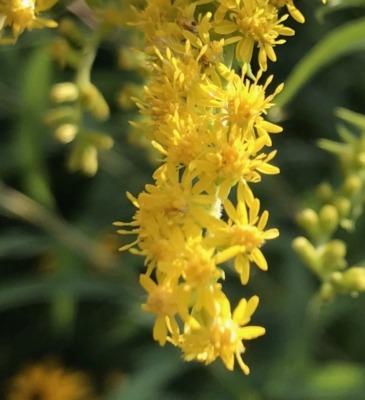
Yes, goldenrod is in the Daisy Family!
Before you blurt out that all daisies have petal-rimmed flowers typified by sunflower and aster, picture the flowers of goldenrod, also a member of this family. And although all cole crops have waxy, bluish green leaves, just look how the plants vary in form. We eat the stalk of kohlrabi, the leaves of cabbage, and the flower buds of broccoli.
Sex is Important
As with human families, plant kinship is based mostly on sexuality; and the seat of plant sexuality is in the flowers. A lack of understanding of plant sexuality prior to the 17th century was reflected in older systems of classification. For example, the third century B.C. Greek philosopher Theophrastus grouped plants as herbs, undershrubs, shrubs, or trees. In the 18th century, Pierre Magnol assigned plants to one of 76 families based on roots, stems, flowers, and leaves. Simple enough, but is a maple tree really related to a palm tree? Or a tomato to a marigold?
Also in the 18th century, Rudolf Camerarius started to shake up the plant world, and beyond, by establishing sexuality in plants. That is, plants have female parts, with ovaries, from which develop fruits and seeds. And male parts, whose pollen fertilizes the female flower and begins the development of the fruits and seeds.
Later in that same century, Swedish naturalist Carl von Linnaeus used the work of Camerarius to lay the groundwork for present day classification of plants, basing it on plant sexuality, their flower morphologies. The very recognition of sexuality in plants caused quite a kerfuffle at the time, made more so by his calling the stamen a “groom” and the pistil a “bride” who consummate the marriage when the flower blooms. “He wrote that ‘the flowers’ themselves contribute nothing to germination, but only do service as bridal beds which the great Creator has so gloriously arranged, adorned with such noble bed curtains, and perfumed with so many soft scents that the bridegroom with his bride might there celebrate their nuptials with so much the great solemnity.”
Back to cold science . . . Let broccoli or cabbage or mustard bear flowers, and you’ll see that all have four petals — an important characteristic of the Mustard Family. And daisies are linked more by the intricacies of the small florets that make up their heads than by the sunny heads themselves. If you look closely at goldenrod flowers, you’ll see why it also is part of the Daisy Family.
Linnaeus’s system included what he called “classes,” each determined by the number, proportion, and position of the stamens, the male flower parts. Classes were subdivided into “orders,” each based on the number, proportion, and position of the pistils, the female flower parts.
Although Linnaeus’s system was easy to use and gave all plants a convenient, binomial name, improvements were needed — and made. In the 18th century, Bernard Jussieu found shortcomings in Linnaeus’s system as he attempted to arrange in natural groupings plants at the Royal Gardens at Versailles. Why should male flower parts reflect a higher order of classification than female parts, anyway? So Bernard regrouped plants into more than a hundred orders which are now recognized as plant families.
All the older systems of classification were limited by their basis only on form and structure. As genetics and evolution became better understood in the 20th century, they were incorporated into the scheme of plant classification. Theories about plant relations continue to change with new knowledge about plant evolution and as new techniques, such as DNA fingerprinting, unravel the genetic makeup of plants.
Families Out in the Garden
All this family talk is not idle gossip. What’s the practical use of all this slicing and dicing to us gardeners?
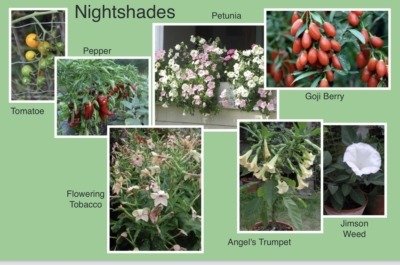
I like to know which plants are in the Nightshade Family because, aside from tomato, pepper, eggplant, and tomato, other kin poisonous plants like deadly nightshade, jimson weed, brugsmansia, and tobacco.
I like to know that my blueberries, lingonberries, mountain laurels, and rhododendrons are all in the Heath Family, a family most of whom demand very acidic soils.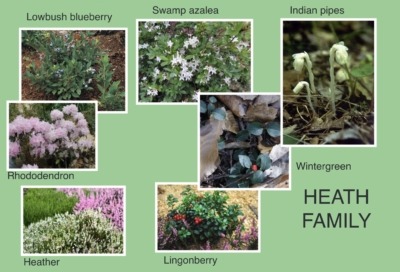 Also useful for me to know that legumes such as green beans, peas, and edamame are in the Pea Family, enriching the ground with nitrogen with the help of beneficial bacteria they harbor in their roots.
Plants in the same family are often attacked by the same pests. Club root fungi, for example, are as fond of cabbage as its kin, so the way to starve this pest out of the soil is to wait many years before again growing any of these plants where you last planted them. Late blight attacks tomato, potato, and, to a lesser degree, pepper, eggplant, and tomatillo. Celery worms feed on dill, parsley, carrot, and other members of the carrot family. And celery, of course.
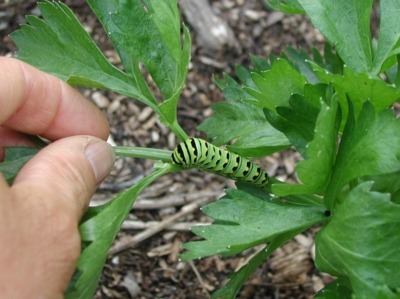
Celery worm
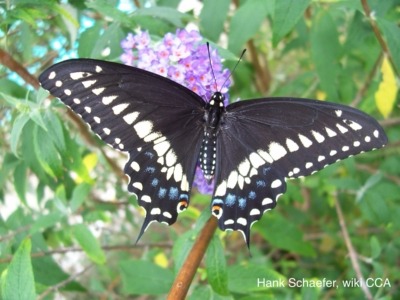
Eastern Black Swallowtail
These traits common to families are why I practice crop rotation. It is admittedly less effective with mobile pests. That celery worm is the larval phase of the eastern black swallowtail butterfly which can, of course, flutter by to another bed. Then again, I don’t mind this pest for the pleasure of seeing the beautiful butterfly. And the caterpillars themself ain’t so bad looking either. 
Knowing plant families coaxes me to peer more closely at flowers and marvel at their simplicity or intricacy.



Leave a Reply
Want to join the discussion?Feel free to contribute!