FIGS UP NORTH
Who Says I Can’t Grow Figs? A Mouse?
Crisp weather notwithstanding, almost every day I can reach up into the branches of my fig trees and walk away clutching a handful of soft, dead-ripe fruits. That’s because the trees, the ones bearing fruit, are in the greenhouse, where nights are chilly but daytime temperatures, especially on sunny days, are balmy or hot.
I’m not gloating. Those greenhouse figs take some work beyond normal routines of keeping heating, cooling, and watering systems chugging along harmoniously in the greenhouse. Earlier in the season I battled cottony cushion scale insects with toothbrush and soapy water, with oil sprays, and with sticky band traps (for ants, which “farm” scale insects) on trunks. Now I see the insects are staging a comeback at a time when the trees are too big to scrub with a toothbrush and too big, too laden with fruit, and surrounded too closely by lettuce, celery, and other winter edibles to spray oil. I’m hoping natural conditions keep scale insects in check until cold weather and lack of leaves or fruit finally puts them asleep for a few months.
A few weeks ago, some creature — a mouse is my guess — discovered the figs, and liked them. He, or she, chewed the bottoms of some fruits as they hung from branches and gathered others to cache in shallow tunnels. Traps, poison bait, and wide girths of sticky Tangle-Trap returned fruits to their rightful owner, me.
All this effort is worthwhile. Especially on sunny days, the figs are delectable, soft and sweet like dollops of jam hanging from the branches.
So Many Varieties, So Little Space

A bowl of figs, Rabbi Samuel, Millrock, San Piero, & Black Bethlehem
Growing a few varieties of figs makes fig-eating even more pleasurable. People wonder, on hearing that I grow figs, whether I grow “brown figs or white figs,” at which point I bring attention to the fact that there are hundreds of varieties of figs, with many of each color.
I keep trying to pare down my collection to the best. Instead, I seem to be adding varieties either deliberately or gifted. It’s hard, virtually impossible, to tell what variety you have until it fruits. Figs have been cultivated for thousands of years, along the way of which an older variety may have picked up many names. For instance, I have a variety I purchased as Verte (syn. Green Ischia); with brown fruit, I knew it was mislabeled. Its bearing habit and the appearance of the fruit nailed it down as San Piero, also known as Negro Largo, Douro Black, Aubique Noir, Large Blue, Lee’s Perpetual, and California Brown Turkey, among other names. The name California Brown Turkey distinguishes it from Eastern Brown Turkey, a totally different variety that I also grow and which itself is also known as English Brown Turkey, Everbearing, and Texas Everbearing,.
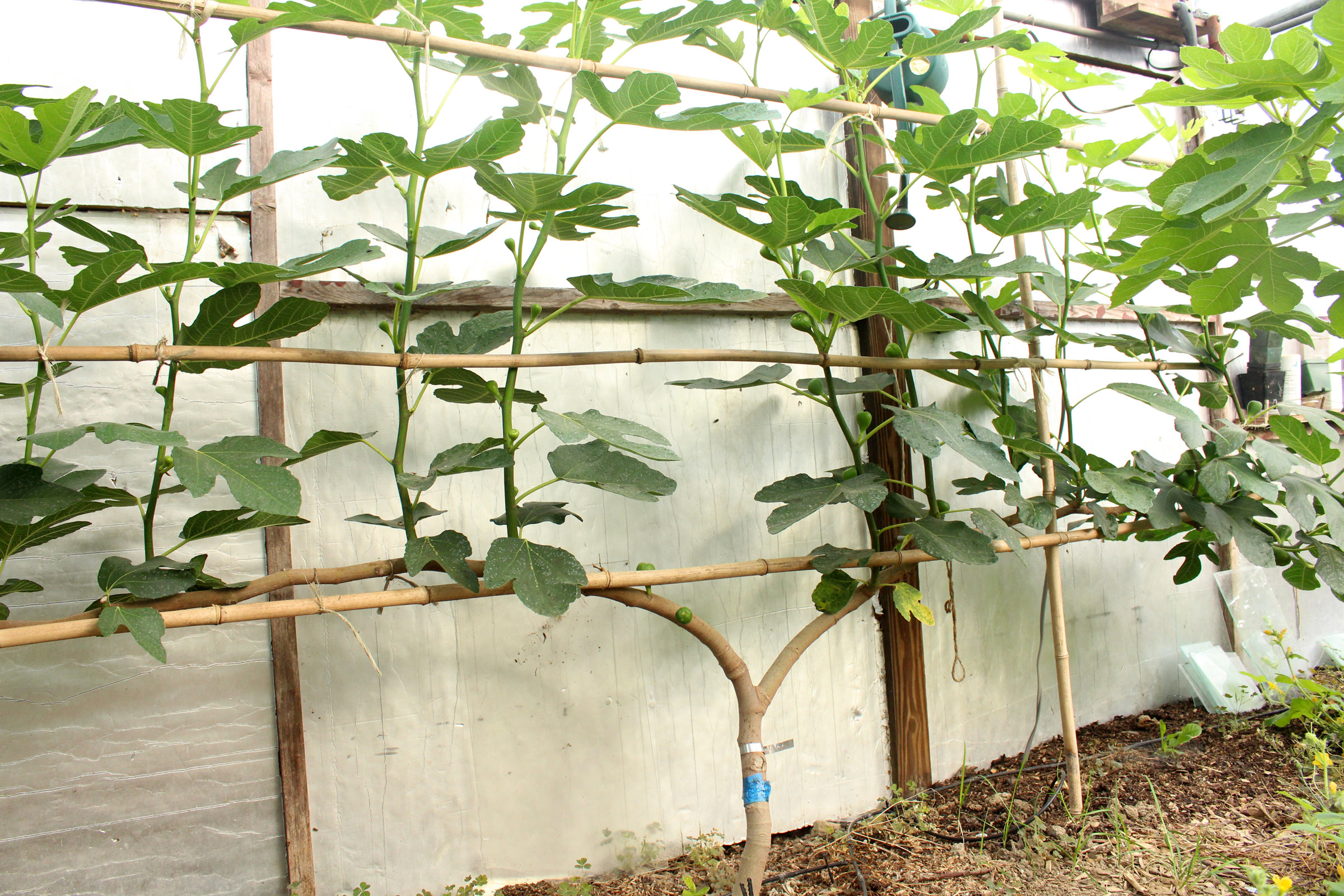
Espalier fig in greenhouse in July
A few years ago, a woman on Millrock Road here in town, offered me her potted fig tree; she was moving and didn’t want to take it with her. (Understandable: I also didn’t take all my 35 varieties of fig from my garden in Maryland when I moved up here to the Hudson Valley.) Still hers was an offer I could not refuse; perhaps that potted plant would bear the best fig ever. In a pot in the greenhouse this year, the tree finally bore fruit, greenish yellow and round, with the insides bursting to split the skin. It’s a keeper, and I’m adding to the nomenclature confusion by calling it Millrock fig until I learn otherwise.
Another fig, this one named by Jack Algiere, the farmer at Stone Barns farm, is bearing heavily and looks to keep doing so for weeks to come. I have espaliered this tree, Rabbi Samuel, against a greenhouse wall in the form of a permanent, low T. Fruiting shoots rise vertically about 6 inches apart from the upper side of each arm. This variety bears best on new shoots so my plan is to each winter cut all vertical stems down near the arms and then thin out new growth so vertical shoots are no closer that 6 inches apart. The Rabbi’s fruits are humongous, as big as small apples.
Subtropical, But Thankfully Adaptable
What makes figs so popular a fruit, even in climates far removed from the hot summers and mild winters it calls home? Perhaps a love for this ancient fruit, whose provenance is in one cradle of civilization, is coded into our DNA. And, of course, the flavor, sweet and juicy without being cloying.

Espalier fig in October, with ripe fruits
Although a subtropical plant, fig is accommodating to colder climates. You can hack back its roots — useful when providing new potting soil for pot-grown plants. It’s deciduous, so doesn’t need light in winter — useful in northern climates when looking for a cold, but not too cold, place to store the dormant plant. Most varieties do not need pollination to set fruit. And figs bear quickly and propagate easily.
Most important, in contrast to most temperate-zone fruits, fig plants can bear on new wood. Some varieties bear on one-year-old wood and some bear on both old and new wood. Bearing on new wood — as does Rabbi Samuel — makes it convenient to cut back a potted plant when maneuvering it indoors for winter. Or if winter cold kills part of the top of an outdoor plant. In either case, a plant that loses too much of its top requires a longer growing season before fruits start ripening.
Fruits keep ripening along new shoots, as they grow, until arrested by cold. Hence, my prediction for a few more weeks of fruit from Rabbi Samuel in the greenhouse. Those fruits hang in stark contrast to the scene outdoors, where leaves of tomato, pepper, and other tender plants have been blackened by the first killing frost here of 25°F, on October 19th.