
COOL COMPOST
Surprisingly Still Hot
I took the temperatures of my compost piles this morning, and all piles were healthy even though each gave a different reading. I like to see each pile have a passing “fever,” and one pile — the one I most recently built — developed a temperature that I was glad to see reaching almost 150 degrees F.. 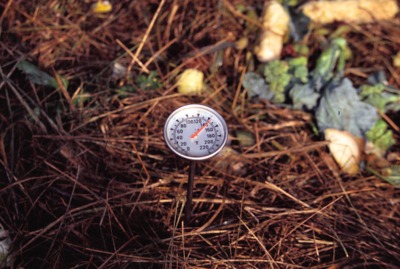 This temperature, which my compost piles often maintain for a few days, is enough to cook to death virtually all pathogens, insects, and weed seeds.
I was surprised at that high temperature because cooler days and colder nights this time of year typically keep temperatures from rising that high. That pile was built over the course of a couple of weeks and I tucked it in towards the end of last month. Piles built slowly and this late in the season don’t typically get that high or maintain the heat for this long.
Feed Your Compost “Pet”
An abundance of compost materials makes autumn a good time to assemble a large pile all at once, and such piles are the ones most likely to get steaming. Heat dissipates too easily from a small pile — one less than 3 feet on a side — and heat is lost as rapidly as it is produced from a pile built very slowly. This time of year autumn leaves and garden debris, in addition to the usual grass clippings and kitchen trimmings, quickly fill compost bins. My bins are 4 feet on a side and about 4 feet high. But still . . . the heat was surprising.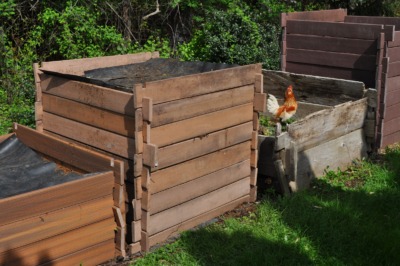
That steam billowing out my compost piles comes from the combined body heat of bacteria, earthworms, fungi, and other organisms working away at digesting raw materials. All are happiest, like any pet, if provided adequate food, water, and air. A wide variety of materials offers a smorgasbord of nutrients, and the different textures allow for good aeration. For instance, old corn stalks or straw fluff up materials, such as grass clippings or maple leaves, that used alone might pack down into a sodden mass.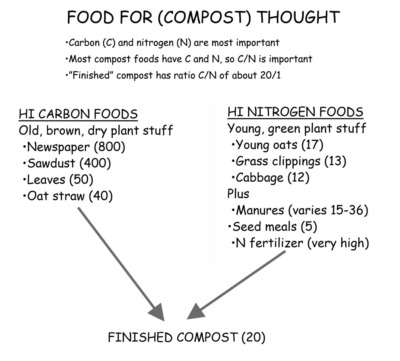
The most important thing you can do for your compost pile is to enclose it in some kind of bin. An enclosed pile is easier to build and, depending on the material, will also retain heat and moisture better than an open pile — which can too easily look like a pile of garbage.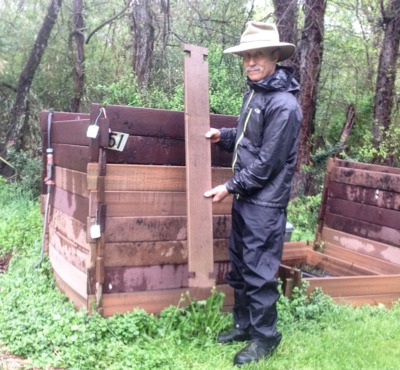
Once materials are assembled, composting organisms get right to work in a wonderfully orchestrated sequence of activity. First come those organisms that thrive at lower temperatures, the so-called psychrophiles, which work happiest from below freezing up to about 70 degrees. Once temperatures warm a bit, the next group, the mesophiles, get to work, and continue to do so up to about 100 degrees. As internal temperatures rise, the group of organisms called thermophiles start to multiply. They work above even 160 degrees.
I’ve read or heard claims that such high temperatures are detrimental because they kill everything off in the pile. Not so; these temperatures are more akin to pasteurization as opposed to sterilization. Pasteurization — of milk, for instance — is mean to kill off pathogens. The higher temperatures of sterilization are meant to kill off virtually everything.
After a few days at high temperatures, thermophiles have finished their food and are exhausted, so temperatures begin to drop. Mesophiles and psychrophiles waiting at the cooler edges of the pile multiply and move in, and they, along with earthworms and other creatures, finish the work. The temperature drop takes a few weeks in summer, but is hurried along in autumn’s coolness.
Not to be overlooked is that, besides gobbling up foodstuffs, most of the micro- and macroorganisms in the compost are friendly, for us. They are decidedly unfriendly to pests and pathogens within the compost, eating their food, treating them as food, and zapping them with antibiotics and other natural chemicals.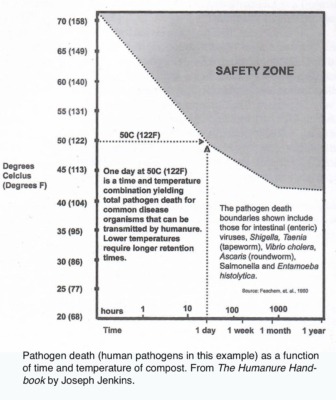
Don’t Fret Over Temperature
In contrast to monitoring our own temperature, no need to fret over the temperature of a compost pile. Sliding the long probe of a compost thermometer into the innards of a compost pile is just a way to see how the “herd” within is doing. Are they working fast, so decomposition will be well on its way before freezing weather temporarily arrests activity? If the herd is sluggish, perhaps the pile needs moisture or more nitrogen — supplied by manure or a sprinkling of fertilizer — to get cranking.
Whether the herd works quickly or slowly, though, any pile of organic materials eventually turns to compost. At lower temperatures, the process is merely slower. It is a combination of temperature and time that does in bad guys, such as diseased plants, within the pile. If an hour at 140 degrees kills a pathogen, that pathogen might still die at 120 degrees in 24 hours, even at a balmy 100 degrees in a week.
Whether you compost fast or slow, the material is ready to use once it is brown, with the original materials no longer recognizable, and has a nice woodsy smell. Once the feeding frenzy slows down, the pile also will have cooled to ambient temperatures.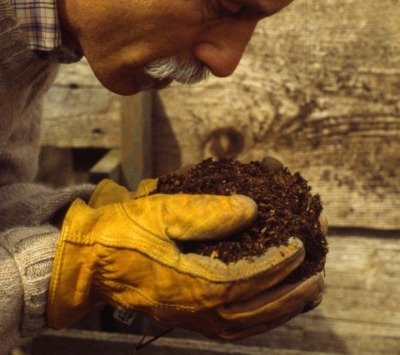


Leave a Reply
Want to join the discussion?Feel free to contribute!