
SMUT POPPING OUT OF YOUR EARS
Spongy Galls, Mmmm
Smut doesn’t sound like something that you would want in your corn patch — anywhere, in fact. The dictionary says that smut can be, among other things, obscene language or anything that blackens like soot. The smut I am referring to is a disease of grasses, and corn, being a botanical grass, can get smut.
You probably have at some time seen smut popping out of your ears. Spongy galls, looking like corn kernels that have been pumped up with steroids and painted silvery gray, ooze from between the husks. 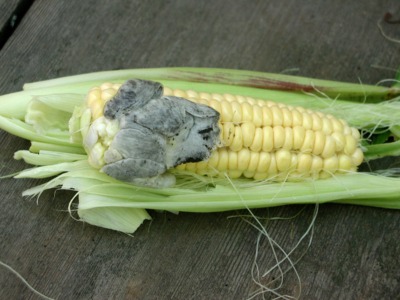 Within days, the galls darken, then burst open to release powdery, olive brown spores. Not a pretty sight to most corn growers.
But let’s look at those puffy masses in another light. They are the fruiting bodies of a fungus, which still sounds repulsive until you think of mushrooms, which also are fruiting bodies of a fungus. Corn smut, although the bane of corn growers, has long been considered a delicacy in Mexico. Huitlacoche, as it is called, is eaten boiled or fried, and its popularity has spread northward.
Take Your Pick, Disease or Delicacy
So we can look upon smut either way: as a corn disease to fend off, or as a delicacy to cultivate. As a disease, smut is interesting because although it typically infects 5 percent or less of the ears in most fields, infection rates may be as high as 100 percent in some patches of corn. Generally, though, it’s not a problem.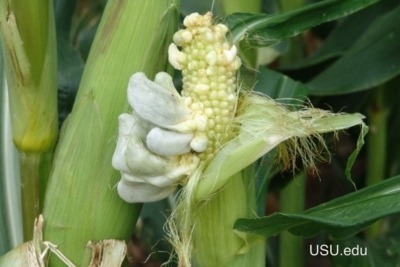
Insect or mechanical damage facilitates entry of spores, as can hail.
But weather conditions that influence the disease are not clearly defined. Hot, dry weather early in the season has seemed most conducive to infection, as has warm weather with moderate rain.
You can’t do anything about the weather, but you can take some action against smut if you are growing sweet corn to eat. Those powdery spores are what spread smut, so one step in controlling the disease is to pull off and discard infected ears. 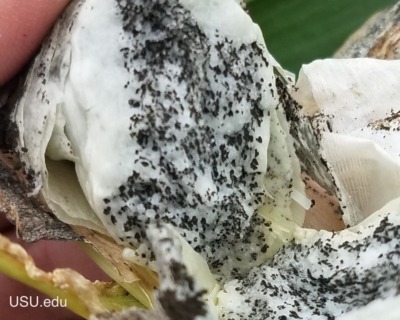 Tassels and stems can also get smutty, so remove them, too. The spores overwinter in the soil, from where they can be wafted up to plants by breezes or splashed up by rainwater, which is just one more reason to plant corn in a different location each year.
How you grow corn can influence infection. Lush growth is most susceptible, so avoid overfeeding with high nitrogen fertilizers. Attack by corn borers also makes plants more susceptible to smut, perhaps because infections spread most easily through injured tissue.
Cultivating Smut
Now let’s do a flip flop, and try to raise corn smut instead of sweet corn. Interest in eating smut has prompted agricultural scientists to study ways to actually cultivate the disease. Smut has been fickle, though, not readily amenable to deliberate infection and varying in its intensity with growth stage of the plant, perhaps the variety of corn, and other variables.

Merchant in Guanajuato selling corn husks, tomatillos, and huitlacoches
Again, we can’t do anything about the weather, but we can feed our plants plenty of fertilizer and plant corn where it grew recently. If I was serious about smut, I’d have to radically change my ways of gardening. No more thorough cleanup at season’s end, in the corn beds at least. No more laying down an annual mulch of compost, which would keep spores from wafting or splashing up. No more maintaining good fertility.
And if I was really serious about smut, I might want to try saving last years galls, then spraying a water suspension of spores from those galls onto this year’s silks. Timing is critical. For best results, spray the spores onto the silks just as they are emerging from the tip of an ear. Problem is that it’s been many growing seasons since I last saw smut on my ears. But I could, or you could, buy smut spores which are offered by many sources on the web. (The web being what it is, you’ll also be presented with other kinds of “smut.”)
If you inoculate your plants and you’re lucky, galls should be starting to form within two weeks of inoculation, and ready for harvest a few days later. Harvest the galls just as they erupt through the husk, which is about 2 weeks after silks appear. At harvest stage, they should be firm with just a little give to them, plump and silvery gray.
If you reap a bumper crop, you can freeze them — no blanching needed. Or refrigerate them unbagged — on the cob, with leaves, for up to about a week.
Obviously, you can’t expect to maximize harvest of both sweet corn and smut. I like my Golden Bantam sweet corn a lot more that I do huitlacoche. Perhaps you, like I, will content yourself with the occasional smut-infected ears that appear every year.
When you eat the galls, you probably will enjoy them more if you didn’t know the translation of the Aztec name huitlacoche: “raven excrement” or, simply, “black shit.” Think of them as their marketing names, Mexican truffles or maize mushrooms.
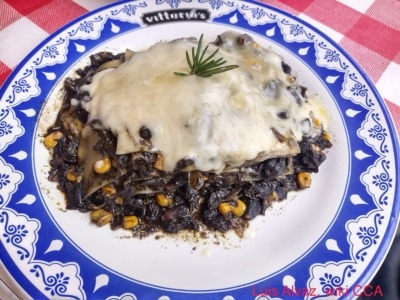
Huitlacoche lasagne



Wowie Zowie, Lee, such a night we are having. I just got back from a wee-hours journey to see the eclipse and meteors show. Not ready quite yet to return to dream-state, I opened up my email repository and saw that you had a new post. What you had to say was so intoxicating, I wonder if your creativity was also driven by the eclipse? Perhaps I should go put beans in my ears to push out the smut and get back to sleep?
WOW!
Whenever I encounter some huitlacoche I cook it. I find it delicious!