
THOSE “OTHER” RASPBERRIES
Two Eye-Catching Raspberries
Some raspberries are for eating; others are mostly for looking at — the plants, that is. Although you might not want to pluck fruits from these lookers, you might want to plant them in your flower garden. Two different kinds of good looking raspberry plants were recently staring out at me from the woods along a roadside.
The first of these, flowering raspberry (Rubus odoratus), also known as thimbleberry, could be mistaken for a wild rose.
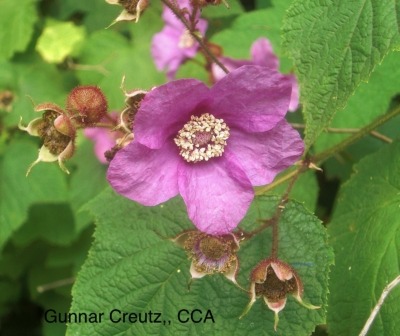
Flowering raspberry
Its large flowers, however, have broader petals than those of a wild rose, and while the rose’s petals are — well — rose colored, a purple tinge makes the petals of flowering raspberry downright lurid.
Pretty flowers and summer-long season of bloom are two qualities that recommend flowering raspberry as an ornamental shrub. Don’t let thorns make you afraid to plant this raspberry in your flower garden. This raspberry’s canes are unarmed. And no matter if your garden is not particularly sunny. Flowering raspberry is native to the somewhat shady edges of eastern American woodlands.
Another Beauty
I had to look more carefully last week to see the other pretty raspberry. This one, called wineberry, is native to Japan, Korea, and China. It was introduced into this country about 1890 as breeding stock for blackberries. Over the years, it has spread throughout much of the east to the point of being considered invasive and, in some states, prohibited.
It was not wineberry’s flowers that caught my eye. Wineberry finished flowering earlier in the season, and the flowers are, anyway, inconspicuous.
What wineberry shows off are its gracefully arching stems clothed from head to foot in bristly, rusty red hairs. Get out a magnifying glass and peer even more closely at the hairs, and you will see that each is capped by a cute little globular gland.
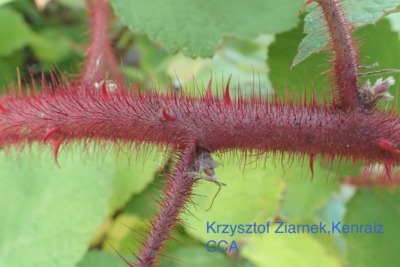
Wineberry stem close up
Occasionally you find flowering raspberry or wineberry for sale at a nursery, but the easiest way to get started with either of these raspberries is to propagate them from existing plants (with permission of the landowner). In early fall or spring, just dig up a clump and separate it into smaller plants for replanting in your garden. Wineberry stems form roots where the tips arch to the ground, so you also can peg the end of a stem to the ground, then cut off and dig up the rooted plant next spring.
Goes with Wine, in Name, Flavor, and Looks
Not that I’m suggested planting wineberry but if you did want to cultivate it, give it the same annual pruning as blackberries. The plants have perennial roots, with individual stems living only two years. Canes flower in their second year, then die, so each winter the stems that have flowered and fruited back in spring and summer can be cut back to the ground. You can recognize old stems by their cracking bark and flower remnants.
Flowering raspberry differs from other members of the Rubus genus in having perennial stems. So the only pruning they need is to have some of their oldest stems cut down to make room for younger, more vigorous and floriferous ones.
Flowering raspberry and wineberry do bear edible fruits. I’ve never tasted those of flowering raspberry, but from what I’ve read, they are rather tart and dry, with a flattened shape.
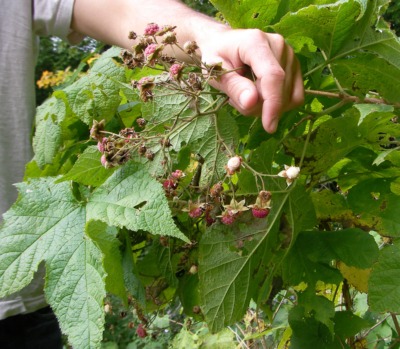
Flowering raspberry fruiting
Wineberry fruits remain tightly enveloped in a protective calyx until they are just about ripe. This calyx is particularly dense with those bristly hairs, which not only makes them look pretty but also contributes to their pest resistance.
As wineberry fruits ripen, the bristly calyxes spread open to reveal the berries within. When ripe, they are spectacular clusters of sparkling red globules.
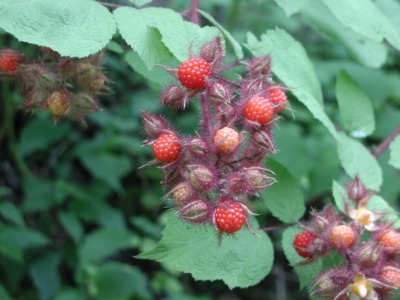
Wineberry fruiting
As I wrote, I’m not suggesting planting wineberry. I can and do enjoy the beauty of the arching stems and the fruits in the wild. Oh, and also their taste. I have read and have no doubt that they are also delicious and beautiful also dipped in chocolate or wine.



Years ago, on a bike ride on or near the Blue Ridge Parkway in Virginia, I ate wild Rubus odoratus and considered it delicious. Like a sweet, pleasantly tart, semi-dehydrated raspberry. Not sure if I found an especially good patch, or if the circumstances and now memory make it seem better than it actually was.
Dear Lee, always when I have a little time I make sure to read your blog posts, which -as a FT (vegetable) gardener- I enjoy, and sometimes have my interests peaked by when it’s about something I was not yet familiar with.
Today I just felt I had to reach out regarding your latest post about wineberry. Having seen first hand on some properties south of us (Greenwich, CT comes to mind) I cannot understate how incredibly invasive wineberry has become in ‘the wild’. Indeed, those arching canes set root so vigorously that they quickly can no longer be removed by pulling, and cutting the main plant back only allows it to regrow quickly. Even though the berries are edible I do not think it is a good idea to suggest anyone grow or propagate this plant! An entire previously restored (native) meadow has, within the time frame of several years, become consumed by wineberry. It honestly is considered an invasive, as it sure acts like that.
With the influence you have on people, through your writing and knowledge, I think it is not a good idea to praise this plant and suggest it for growing berries. The best one can do when finding one is to eradicate it. We’ve seen them starting to appear more and more in nature preserves and woodlands, and it is not a good thing.
Thank you, and with appreciation,
Tricia van Oers
and Robert Reimer
NB: I was intending a private reply but am not sure this is. Feel free to remove from your site if you wish. I just meant to reach out to you after reading the wineberry blogpost.
Hi Tricia, I appreciate your perspective which is, obviously, different from mine. I do think the nativism can be taken to extreme. Take, for instance, black locust trees, which are native but here in NY are considered to be “native invasive.” Why because although they have spread throughout eastern US, they originated in a specific locale in Georgia. “Native” depends on where you draw your boundaries. Black locust is one of my favorite trees: fragrant, pretty flowers; very rot resistant wood; excellent firewood; and easily coppiced or seed propagated.
Hi Lee,
Thx for sharing ur time and knowledge. I’m looking for recommendations on blackberries for eating. I’m in Maine, old zone 5b and now 6a. You were kind to share recommendations on raspberry a few years ago. I was able to purchase Fall Gold last year and delish for sure! Thx again for all u do for fellow plant lovers.
I haven’t tasted it but will be planting it myself: Triple Crown blackberry. The thorny ones have better flavor but are too viscious to deal with.
Yes, no thorns for me either! I’ll look out for Tripe Crown. Best to the rest of your growing season. Thx again for your newsletter and advice.
Thimbleberrys! They grow all over my place here on the hillside above Champlain Valley in Vermont. And the berries themselves are delicious!!! I didn’t know they were until one of my daughters, on a visit home, went around munching them. And, of course, the chipmunks and birds want their share too. I would need to be quite vigilant in picking them to beat out all the other critturs.