
WHAT GAVE SUSAN HER BLACK EYE?
It’s All Botanical
What gave Susan her black eye? Her central florets, that’s what. Black-eyed Susan flowers, blooming now and for the next few weeks, are actually made up of two kinds of florets, or small flowers. In the center of each flower are small, tubular flowers called disk florets. Those tubular petals are dark. Hence the black eye.
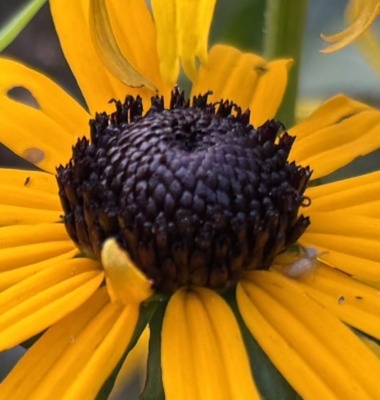
Black-eyed Susan disk flowers
Florets around the outside edge of the eye are called ray florets, and each one has one petal, large and orange-yellow. The petals point outward around the black eye, like a sunburst. The disk flowers and the ray flowers give black-eyed Susans the characteristic look of a daisy, “day’s eye,” which is the origin of the word.
(Not all flowers of the Daisy Family generally have a mix of ray and disk flowers. Dandelions, for example have all ray flowers resulting in a powderpuff of yellow petals. Tansy flowers represent the other extreme, all disk flowers.)
A Very Resilient Plant
You’ll find black-eyed Susans (Rudbeckia hirta) spreading open their petals in sunny fields from Maine to Georgia and west to Illinois. Here is a plant that thrives in summer’s searing heat, and is unfazed by periods of drought. Black-eyed Susan is also not finicky at all about soil. This flower will thrive almost anywhere, as evidenced by it’s having naturalized to the western states, as long as it has at least a half a day or more of sun.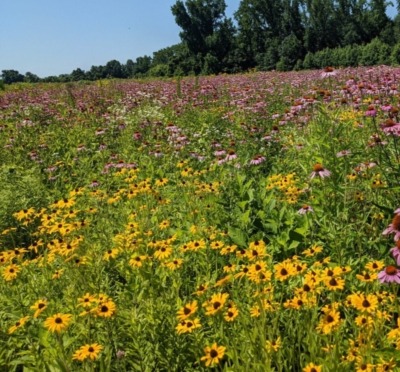
With such qualities, it is no wonder that black-eyed Susans have been moved into flower gardens. Black-eyed Susan is one of those short-lived perennials that is usually treated as an annual or biennial. Sow it in early spring, and enjoy its blossoms beginning the very first season. Sow it now, and enjoy its blossoms beginning next year.
Despite its sometime annual or biennial behavior, black-eyed Susan is not a plant that you have to grow from seed every year. Once you establish this flower in your garden, it will reseed itself naturally.
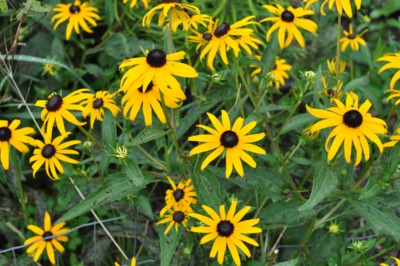
Self-seeded black-eyed Susan
To collect seeds from wild plants, cut off flower heads as they are fading but before the seeds disperse. Then let the heads finish ripening their seeds in an open paper bag in an airy, warm room. Whether you sow the seeds this summer or next spring, give them warm soil, at least 70 degrees, in which to germinate.
High-Bred Susans
Gloriosa daisies are a botanical form of black-eyed Susan often grown in gardens. With double the usual number of chromosomes, gloriosa daisies have large flower heads, six inches or more across, and sometimes extra rows of petals. It was created in the 1950s by doubling the chromosomes by treating seeds with colchicine (which occurs naturally in colchicum, also called autumn crocus even though it’s not a crocus).
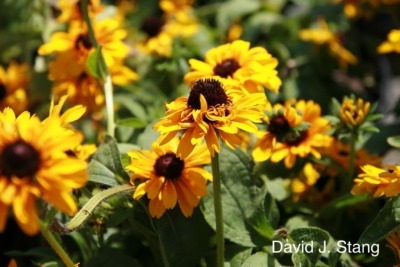
Goldilocks gloriosa daisy
If you like black-eyed Susans for cutting, Indian Summer is a variety particularly suited for this purpose. The flower heads are very large, up to eight inches across, but the best thing about Indian Summer is how long it lasts once cut. The flowers actually look better after a couple of days in the vase than when they are first cut, and will keep looking perky for about ten days.
Goldsturm is another popular garden variety of black-eyed Susan. It is actually a different species (R. sullivanti) from the roadside Susans, and a bit more demanding of water if it is to put on its best show. Give it good conditions, though, and the two foot high plants will be smothered in three to four inch deep yellow blossoms — with black eyes, of course.
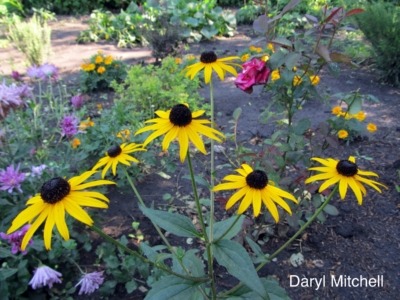
Rudbeckia Goldsturm
Yet another species, sweet black-eyed Susan, does tolerate drought very well, reliably putting on its show through August and September. A dramatic difference between sweet black-eyed Susan and the other Susans is the height of this plant: The flowers, with yellow petals around a brownish purple eye, perch prominently atop 5 foot stalks.
I just gotta’ mention one more black-eyed Susan, a meandering, tropical vine about 6 feet tall and totally unrelated to the previously mentioned Susans. Black-eyed Susan vine (Thunbergia alata) is a perennial, but because she cannot take temperatures much below freezing, treat her as an annual around here. The orange color and dark purple centers of the flowers, each an inch or so across, give rise to the plant’s common name. In contrast to our native black-eyed Susans, black-eyed Susan vine gets her black eye from the dark throat that results from the purple base of each flower’s five petals.
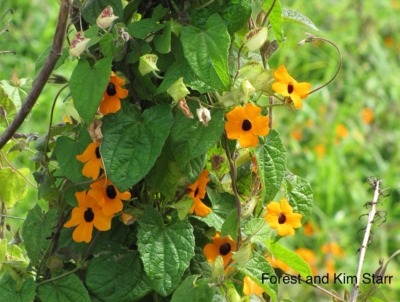
Black-eyed Susan vine



Leave a Reply
Want to join the discussion?Feel free to contribute!