
FRUITFUL PURSUITS
Tolerance and Rules
People tend to be too tolerant of their fruit trees, accepting them even if they bear poor or no fruit. Perhaps it’s the snowball of blossoms in spring that makes a lack of edible fruit later in the season acceptable. Of course, if a tree is young and not yet of flowering age, the barren plant can be forgiven. But pinpointing the reason why your tree is barren is the first step to reaping both visual and gustatory pleasures.
Lack of cross-pollination, that is, pollen from a different variety of the same kind of fruit, could be the problem.
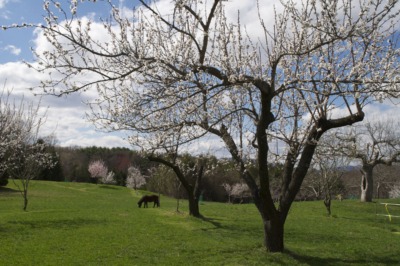
Apricot orchard in bloom
Most apples, pears, sweet cherries, Japanese plums, and hybrid plums need cross-pollination. No fruit will be borne on an isolated McIntosh apple tree or even two McIntosh apple trees planted near each other because all McIntosh apple trees are genetically identical (that is, clones of each other). What’s needed is pollen from another variety. A neighboring McIntosh and Golden Delicious apple trees both will produce fruit.
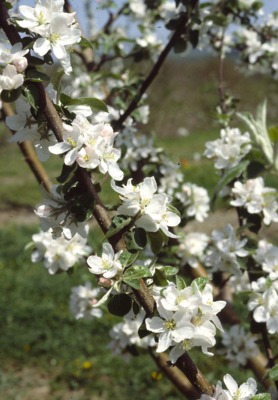
Apple blossoms
Of course, there are rule-breakers, even among fruits. A few varieties of sweet cherry — Stella, Lapins, and Sweetheart, for example — set fruit without pollination. And years ago in when I worked at the USDA facility in Beltsville, Maryland, I came came upon a seedless apple, Spencer Seedless. I’m assuming that, lacking seeds, it did not need pollination.
Most peaches, apricots, tart cherries, and European plums (dark-blue, oval plums) do not need cross-pollination, so even isolated trees should bear fruit
Some trees are fickle about their mates. Bartlett and Seckel pears, for example, won’t pollinate each other. Bing cherry just won’t accept the advances of pollen from Stella, in particular. But just about any other source of sweet cherry pollen — or even pollen from a tart cherry — suits Bing just fine.
And some apples, such as Winesap, Mutsu, and Jonagold, and Magness pear, can’t pollinate anything, so whenever one of these varieties is in the mix, you need three different varieties growing near each other for all to fruit.
Lending a Hand
Plants within about a hundred feet of each other generally will cross-pollinate. Not to worry, though, if a fruit tree needs cross-pollination but lacks a sufficiently nearby mate. Circumvent this deficiency by grafting a branch of another variety onto your tree, or beg or steal some flowering branches from another variety and put their bases in a bucket of water beneath your tree. Or, of course, plant another tree.
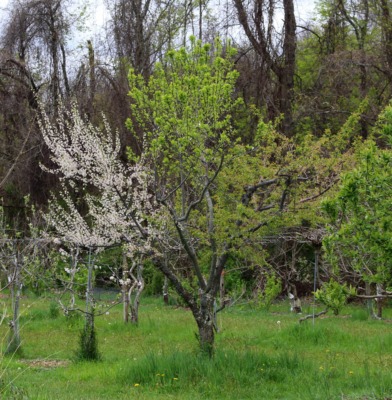
Plum tree grafted to two varieties
The right mix of plants does not always spell success in getting fruit. Pollination is done mostly by honeybees. They go on strike if the weather is too cold (below 50 degrees), too rainy, or too windy (more than 15 mph). Such conditions rarely prevail throughout the entire blossoming period so you usually get at least some fruit when bees are slacking off. You could take over the job yourself, hand pollinating the blossoms by dabbing back and forth between the varieties’ flowers with an artist’s brush.
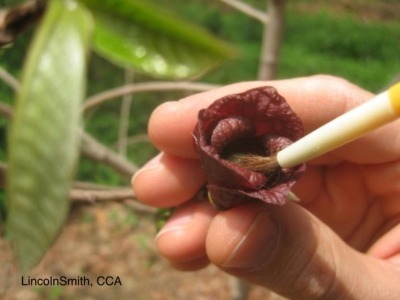
Hand pollinating pawpaw blossoms
Another workaround is to encourage native bees by planting food sources for them, leaving or providing them with them nesting sites, and avoiding toxic pesticides, especially during bloom.
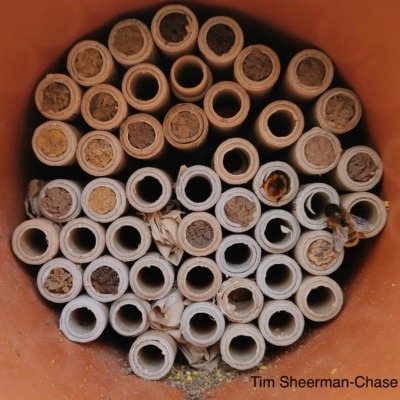
Nests for native mason bees
Things Beyond our Control
Variable production from year to year, with no fruit some years, also results when blossoms or developing fruitlets freeze. The critical temperature depends on the type of tree and the stage of bloom, but generally speaking, start to worry as the mercury drops to the high twenties. A sheet or a blanket thrown over a small tree might keep such flowers a few critical degrees warmer. You can tell if developing fruitlets have been damaged by cold by sacrificing one, slicing it in half, and looking for a blackened center.
Okay, so you have good pollination and the weather has been cooperative, but there still are no or insufficient fruits on your tree. Animals could be the culprits. Some insects cause small, developing fruits to drop. The plum curculio is one such insect whose tell-tale sign is a crescent-shaped scar on the fruit. Despite her name, she’s very cosmopolitan, willing to lay her eggs in apple, pear, peach, nectarine, apricot, and cherry fruits, in addition to plum fruits.
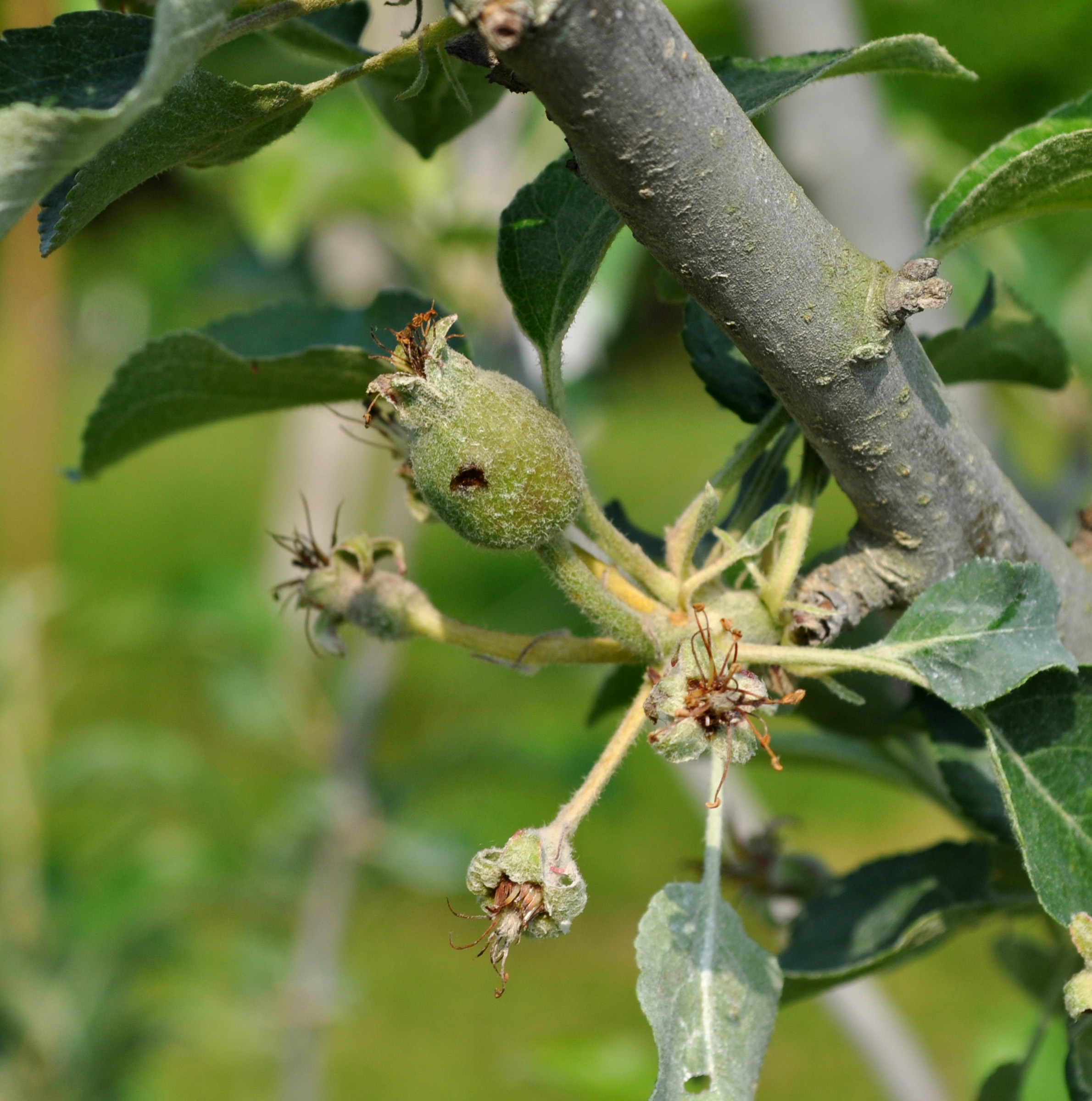
Curculio scar on apple fruitlet
As fruits enlarge, they appeal to furry and feathered animals. I once planted an apricot tree for my father. Every year, ironically around Father’s Day, the tree would be stripped clean of its unripe fruits by a squirrel hungry for the developing seeds. The evidence was on the ground, which was littered with split open, green apricots.
For all these potential problems, remember that fruit trees have had for eons the same goal that you have this year: to produce ripe fruit. In anticipation of all the potential hazards, these trees usually set much more fruit than they have the energy to ripen. Come June, the trees seem to breathe a sigh of relief as they shed excess fruits. Don’t let the falling fruits of “June drop” scare you; plenty of fruit — too many — often are still left on the tree.
But not this year: The temperature here plummeted to 20 degrees F this past April 21st essentially wiping out the chance of most fruit trees bearing fruit. All is not lost, fruitwise, because blueberries, black currants, and gooseberries are doing fine, as is Nanking bush cherry.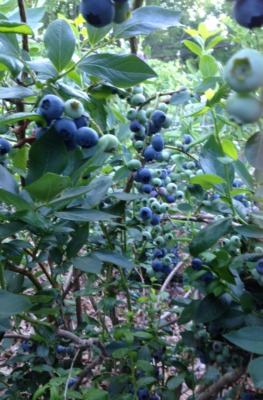



Here in my neighborhood in Pennsylvania the orchards lost a lot of their fruit. So did I, sad to say. I think I’ll get one peach. The pears made it through, though. Maybe this year I’ll learn how to harvest them, ha!
A lot lost here in the Hudson Valley also. Yesw, harvesting pears at the right time is an art.