
FEEDING FRENZY
Watch Your (Plants’) Diet
You wouldn’t eat as much pie as you would bread, would you? So don’t ever feed your plants without considering how rich their food — fertilizer — is. Urea, for example, is the plant food equivalent of a chocolate bar, a very rich food, rich enough so that a whole cup could kill a rose bush. Near the other extreme might be bone meal, the unbuttered popcorn of fertilizers, providing nourishment but nothing to get fat on.
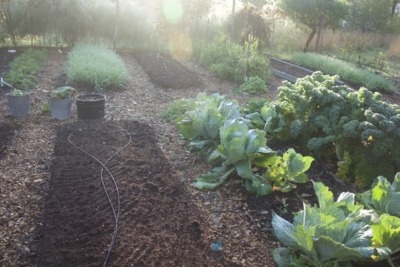
A well-nourished garden because . . .
Whether a fertilizer is organic or synthetic, the label on the bag or carton spells out clearly just how rich it is. Although plants require at least fifteen elements for health, three are needed in especially large amounts. They are nitrogen, phosphorous, and potassium.
Take a look at a fertilizer label and you will see three numbers on it, separated from each other by hyphens. Those numbers are the percentages of nitrogen, phosphorous, and potassium, in that order, “NPK” in gardening jargon. (Potassium is “K” because that is its chemical symbol, derived from its Latin name Kalium.)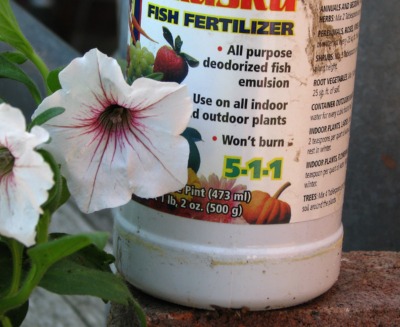
Actually, those three numbers are not the exact percentages of nitrogen, phosphorous, and potassium. Rather than being expressed in terms of the simple elements, the amounts of phosphorous and potassium are usually expressed in a traditional manner, as percentages of the oxides, commonly called “phosphorus pentoxide” and “potassium oxide,” respectively. Why the obfuscation? Because at one time the phosphorus and potassium contents in materials were determined by weight after samples were burned, which converted them to oxides. The weights of these oxides were then measured and recorded, even though phosphorus pentoxide is only 44 percent phosphorus and potassium oxide is only 83 percent potassium.
Efforts have been made to convince fertilizer manufacturers to list percentages on the simpler elemental basis, but traditions die hard. Especially when a 1-2-1 fertilizer, for example, would become 1-.9-.8, having people then believe that they were now getting less for their money.
Fortunately, the way the nutrient content of fertilizers is listed, although not strictly kosher, is, at least universal. Soil tests, like fertilizer bags, usually express phosphorous and potassium on the traditional oxide basis.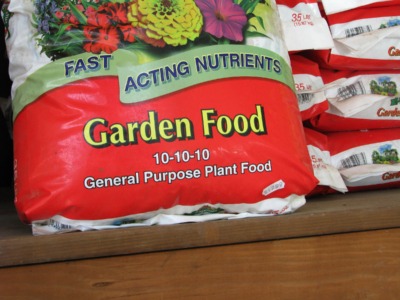
Watcha’ Got
Only when you know how much nitrogen, phosphorous, or potassium is in a particular fertilizer can you know how much of that fertilizer to use. Just divide the amount of actual nitrogen, phosphorous, or potassium needed by the percentage, expressed as a decimal, of nitrogen, phosphorous, or potassium in the fertilizer. 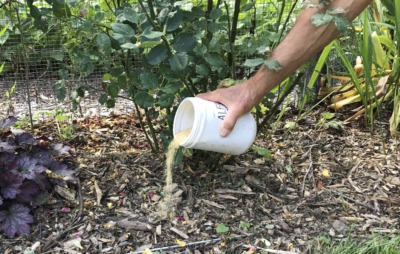 So if a soil test indicates that you need one-tenth of a pound per hundred square feet of actual potassium for your flower garden, you know to spread one pound of a fertilizer that is 10% potassium, 2 pounds of one that is 5% potassium, and so on.
If you continually enrich your soil with compost, manure, autumn leaves, and other organic materials, anyway an earmark of good gardening, your plants are generally getting well fed. In this case, barring a soil test, you could just replenish your soil with nitrogen each year.
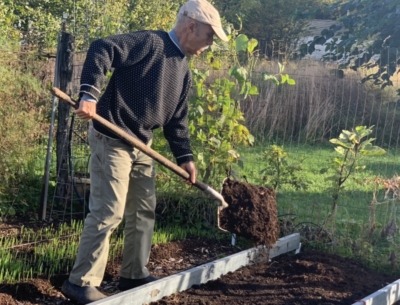
Spreading compost
Nitrogen is the element needed in greatest amounts, especially in the vegetable garden, and also is the most evanescent of plant foods. Besides what you take away with your harvests, nitrogen can waft out of the soil as a gas or be washed through it by rain. Most soils need about 0.2 pound of actual nitrogen per 100 square feet to replenish annual losses. I’ve used 3 pounds of soybean meal (7% nitrogen), but this same amount of actual nitrogen could also be supplied by, for example, 2 pounds of 10-10-10 or 0.5 pound of urea (46% nitrogen).
Ignore the Numbers If . . .
The reasons we can sometimes ignore phosphorous and potassium (as well as other essential nutrients) in computing fertilizer needs are twofold. Many soils contain great reserves of these elements, and if we annually enrich a soil with abundant organic matter, the organic matter helps release these minerals from the soil. What’s more, compost, manure, leaves, and other organic materials themselves contain phosphorous and potassium.
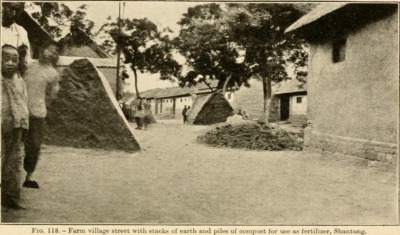
Piles of compost allowed the China of 100 years ago to sustain agricultural production for the previous 2000 years.
Just as the richest foods are not necessarily the best for us, they also are not necessarily the best for plants. One of the least concentrated plant foods — compost — is also the best. Years ago, with a nod to sustainability and economy, I stopped adding soybean meal or any other concentrated source of nitrogen to the soil in my vegetable garden. I computed that a mere one inch layer of compost supplies much, if not all, the food plants need for a year, in addition to supplying bulk and nurturing beneficial microorganisms and keep the ground well-supplied with air and water. My plants look very happy and healthy.
Fun fact: Compost is too low in nutrients and allegedly too variable to be legally called a “fertilizer.” Legalities aside, apply enough annually and your plants will be well-fed.
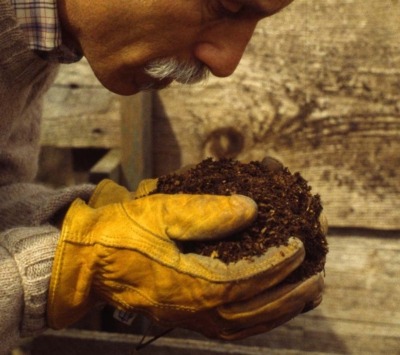
Mmmm. Ripe compost. No, I’m not about to eat it; just enjoying its woodsy aroma.



Leave a Reply
Want to join the discussion?Feel free to contribute!